When to Post on LinkedIn vs When to Write a Long-Form Article
LinkedIn posts vanish fast, but articles sit permanently and rank in Google search results.
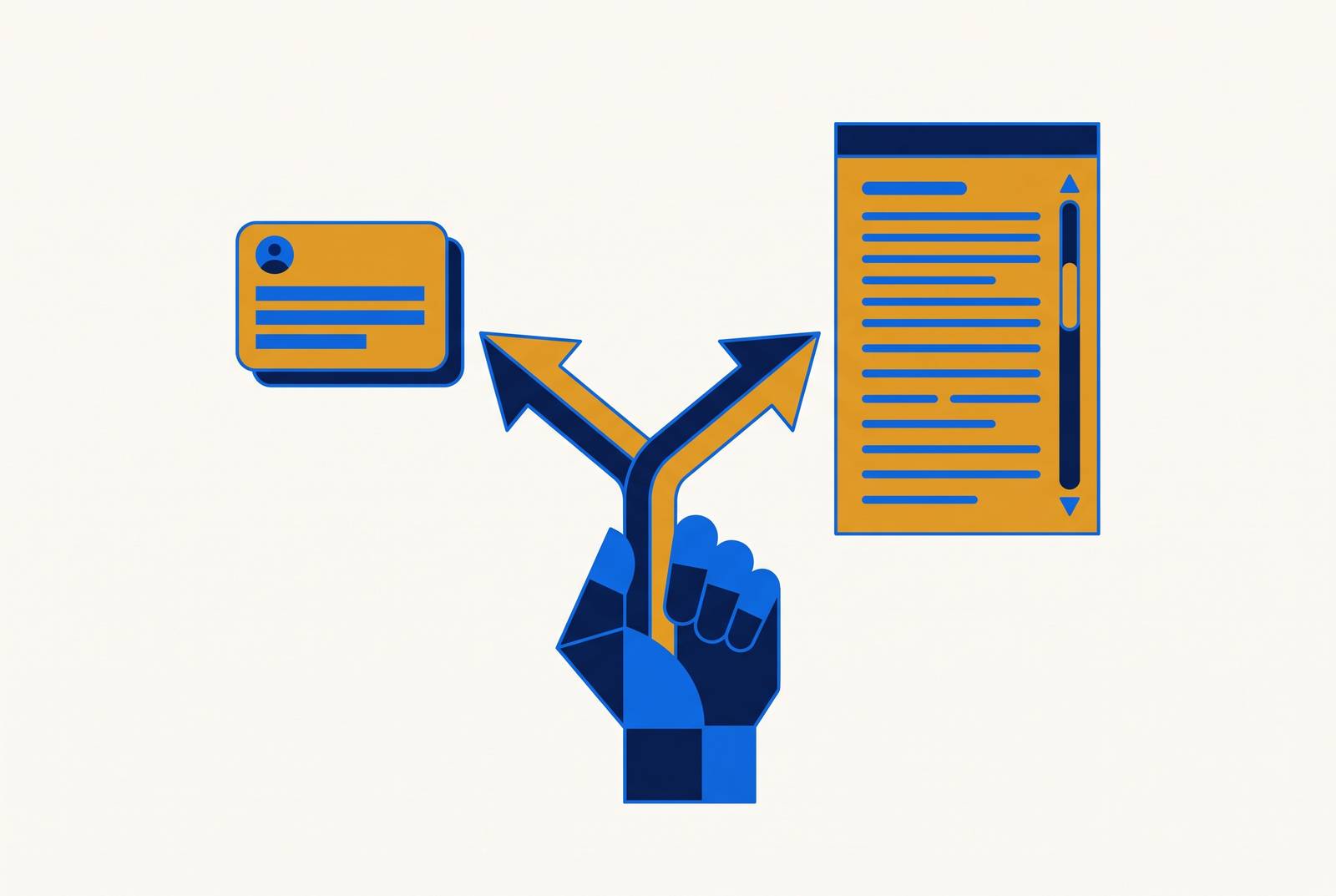
LinkedIn posts and long-form articles are not two flavors of the same content strategy. They're different tools built for different jobs, and most founders pick one based on habit, not on what the moment actually requires. The algorithm shift over 2025 and 2026 made that mistake more expensive: LinkedIn stopped rewarding volume and started rewarding depth (dwell time, real comments, a narrow set of consistent topics, whether the audience actually cares about the account posting). Posting daily about whatever crossed a founder's mind used to work fine. It doesn't anymore.
The founders getting the best engagement now post three or four times a week, on a narrow set of themes, with something specific to say. Everyone else is getting quietly punished by an algorithm that's gotten better at spotting filler. External links dropped into a post without context cost 20 to 35% of distribution. Content with the telltale rhythm of AI-generated writing loses about 47% of organic reach. Stack more than three to five hashtags on a post and reach falls by 68%. None of this is the platform being anti-AI, exactly. It's the platform being anti-lazy. LinkedIn's detection models are hunting for a human point of view, and if they can't find one, they turn the volume down.
Richard van der Blom's 2025 research on the platform found organic views down 50% year over year, but engagement per post up 12%. Fewer people are scrolling past. The ones who stop are paying more attention. That trade-off, smaller audience, sharper intent, is exactly why the format decision matters more than it used to. Post carelessly into a shrinking, higher-scrutiny feed and the cost of getting it wrong has gone up.
How B2B buyers now move through a purchase before sales ever gets involved
Here's the uncomfortable part for anyone still building a sales process around the first call: the buyer already decided most of what they think before that call happens. The 6sense B2B Buyer Experience Report found that a large majority of buyers mostly or fully define their purchase requirements before they ever speak to a salesperson. And a growing share of buyers now use LLMs somewhere in that research process. AI-assisted self-education isn't an edge case anymore. It's the default.
Sales cycles actually got shorter over the past couple of years, even as the research window before a rep gets involved expanded. Buyers are doing more homework, faster, entirely on their own.
Here's the number that should reframe how founders think about content: per the Edelman-LinkedIn 2025 B2B Thought Leadership Impact Report, 95% of business buyers aren't actively shopping at any given moment. They're not comparing vendors today. So the actual growth lever isn't converting today's shoppers, it's planting the preference that surfaces later, when they finally are.
Which means most of a founder's reputation gets built somewhere sales never sees: a scroll through the feed, a profile visit, a post someone saved six weeks ago and never mentioned. Dark social, basically. Invisible until the deal shows up already half-decided. That pre-sales fog is exactly where format choice stops being a style preference and starts being a strategic lever. Different buyer states need different formats.
What a LinkedIn post is structurally built to do
A LinkedIn post maxes out at a few thousand characters, and its engagement window is brutally short. Most of the action happens in the first 24 hours, then it falls off a cliff. That's not a bug. Posts are built for the feed, and the feed is built for now.
Their job: interrupt a scroll. Start an argument. Float a half-formed thesis and see who pushes back. Remind the network a founder still exists and still has opinions. Posts are relationship-maintenance tools. They are not filing cabinets.
One data point worth sitting with: personal profiles generate 561% more reach than company pages posting equivalent content, according to vendor benchmark data from social-hire.com. A founder's own profile pulls 5 to 15 times more reach than the same content posted from the company page. If the goal is reach, the company page is close to the wrong venue by default.
What posts do well:
- Hot takes and contrarian angles that bait a reply
- Fast data observations or market reads
- Founder stories, in-progress decisions, the messy middle
- Testing a thesis before committing real time to a longer piece
- Live commentary on industry news while it's still news
- Recruiting signals and culture snapshots
The catch: high reach, short shelf life. A post can go wide fast and still leave nothing behind. Someone finds the profile three weeks later, scrolls past it, and it might as well not exist.
What a long-form article is structurally built to do
LinkedIn Articles support substantially longer content than posts and, unlike posts, they don't disappear. They sit permanently under the profile's Activity tab, visible to anyone who wanders through later, whether that's a week or a year after publishing.
Here's the detail that changes the math: LinkedIn Articles get indexed by Google. Standard posts generally don't. That's a second distribution channel entirely, one built around search intent rather than feed momentum. Someone Googling a problem can land on an article they never would have scrolled past in a feed.
Articles are what answer the question a serious prospect is actually asking when they land on a profile: does this founder have real, developed thinking here, or just opinions? Per Edelman-LinkedIn's 2025 research, nearly three-quarters of executives trust thought leadership over other marketing and product material, and 75% say strong thought leadership convinced them to look into a product they weren't previously considering.
What articles do well:
- Full frameworks and step-by-step process breakdowns
- Detailed case studies, before-and-after comparisons
- Deep reactions to industry reports or market shifts
- Evergreen content on the company's own domain, built for search traffic and direct conversion, not just profile depth
That last one deserves its own line, because founders blur it constantly: a LinkedIn Article and a standalone blog post on the company's own domain are not the same asset. Publishing on the company domain builds SEO equity that compounds for years and can convert a reader directly. Publishing as a LinkedIn Article builds profile credibility, but the domain authority belongs to LinkedIn, not the company.
The trade-off here is the mirror of the post: lower feed reach, but the person who does show up is usually further along, closer to a real decision, not just scrolling for entertainment.
The decision isn't preference: it's what job needs doing right now
Before writing anything, the question that actually matters is simple: what does this piece need to accomplish, right now, in this specific buyer's head?
If the honest answer is stay visible, test an idea, react to something in the news, get a conversation going, that's a post. If the answer is establish real credibility, get found by someone actively researching, leave something permanent for a future profile visitor, reach people who aren't even in the network yet, that's an article.
There's a structural reason long-form matters more than founders assume. Edelman-LinkedIn's 2025 report found more than 40% of B2B deals stall because of internal misalignment inside the buying group, not because of anything sales did wrong. Thought leadership reaches the quiet stakeholders sales never talks to directly, the finance person, the technical reviewer, the person three levels removed who still has veto power. Posts reach the feed audience. Articles reach whoever's doing solo research on the company's behalf.
That same report found 75% of decision-makers and C-suite executives say a specific piece of thought leadership pushed them to research a product they hadn't previously considered. Worth noting: "thought leadership" in that finding means substantive, developed material, not a quick take posted between meetings.
Two fast tests settle most of the ambiguity. First, if the idea needs more than a strong opinion and a couple of supporting points to hold up, it's probably an article. If it still feels true and useful tomorrow without more development, it's a post. Second, if it's something a buyer would type into Google, it needs to live somewhere indexable, an article or a standalone blog post, since standard posts never surface there.
None of this makes the formats rivals. A post can point traffic at an article. An article can get carved into weeks of posts. The real decision isn't either/or, it's sequencing.
How the two formats work as a system across the buyer's pre-sales journey
Posts build the slow-drip familiarity that makes someone receptive by the time they land on the profile. Articles give that same person something real to evaluate once they're there. Neither one does the other's job.
Per Foundera's 2025 client data, founders who maintained a consistent LinkedIn presence with co-created content support saw a 30% reduction in sales cycle length. Prospects showed up already warm, because they'd been quietly following the founder's thinking for months before a sales conversation ever happened. Posts are what keeps that thread alive in the background.
There's a repurposing rhythm practitioners lean on, and it's less about saving time and more about squeezing more reach out of work already done:
- Day 0: publish the article, post an announcement with the link
- Day 2: pull one surprising stat or quote from the article and post it alone
- Day 5: turn three tactical tips from the article into a short list post
- Day 10: post a result or case study tied to the article's core argument
- Days 14 to 21: build a carousel distilling the framework (carousels pull the highest engagement rate, the highest of any format in 2025 benchmark data)
- Monthly: resurface the article from a new angle, or turn it into a reader Q&A
One piece, five formats. The article is the source of record. Everything else is distribution wearing a different outfit. Edelman-LinkedIn's 2025 findings back this up qualitatively: thought leadership consistently outperforms conventional marketing at demonstrating vendor value and moving buying decisions, and that effect compounds when posts keep the visibility going between article drops.
Storylane, a B2B SaaS company building demo software, offers a real-world scale check. Storylane's marketing leadership has pointed to LinkedIn as a meaningful and consistent driver of pipeline. That's not one lucky post. That's a system running.
Where founders go wrong when they default to one format only
Post-only founders build visibility with no floor under it. A prospect lands on the profile, sees plenty of activity, and finds zero evidence of actual depth. The credibility gap stays wide open exactly when it needed to close.
Article-only founders have the opposite problem. Deep, well-built pieces sitting on a profile nobody visits, because there's no feed presence pulling people there in the first place. Van der Blom's 2025 research found 81% of B2B campaigns fail to capture even basic attention or brand awareness, and a missing feed relationship ahead of the ask is a common reason why.
Then there's the founders publishing everything through the company page, thinking it's the more "official" venue. It isn't. Personal profiles pull 561% more reach and roughly 5 times the engagement for comparable content. The company page has its place, product announcements, hiring posts, but it's the wrong venue for thought leadership that needs to actually reach buyers.
The AI trap deserves its own mention, mostly because it's avoidable. Posts that read like standard AI output are reported to see meaningfully less organic reach. That's not a penalty on using AI as a tool, it's a penalty on skipping the human point of view, the specific data, the lived detail that makes a post worth reading in the first place. The platform can tell.
And the frequency trap: posting daily about anything wrecks the topic-consistency signal the algorithm now rewards. Three or four posts a week across three to five consistent themes beats daily noise, every time.
Last one, and it's the quiet killer: choosing the format based on what's easiest to knock out that week instead of what the content actually needs to do. Convenience isn't a strategy. It's just the absence of one.
Applying the format decision as a standing practice, not a one-time call
This isn't a decision made once and filed away. It's a habit, applied before every single piece: is this reach and relationship, or is this depth and discovery?
A quick standing test works well enough in practice:
- Would someone search this on Google? Article, or better, a standalone blog post on the company's own domain for the SEO equity.
- Is it timely, conversational, still half-formed? Post.
- Does the idea deserve a permanent home on the profile? Article.
- Testing whether the idea even resonates before investing real time? Post it first.
Content compounds in a way paid media simply doesn't. A well-built article on the company's own domain keeps pulling organic traffic for years after it's published. A post drives conversation for about a day, then goes quiet. Both have real value, just on wildly different clocks.
Worth factoring in given where CPCs are headed: U.S. LinkedIn ad costs now run well into the single digits per click for competitive B2B audiences. Every dollar that costs makes the organic authority built through consistent posts and solid articles look better by comparison, not worse.
Edelman-LinkedIn's 2025 data found 70% of decision-makers say they think more positively of an organization that consistently puts out high-quality thought leadership. Consistently is doing real work in that sentence, and it doesn't mean one format on repeat. It means both, running together, on purpose.
The founders who get this right aren't agonizing over posts versus articles every time they sit down to write. They're running a system: posts keep the lights on and the relationship warm, articles do the heavy lifting when it's finally time for a buyer to decide whether to say yes.