Go-To-Market Strategy Examples That Actually Show the Motion
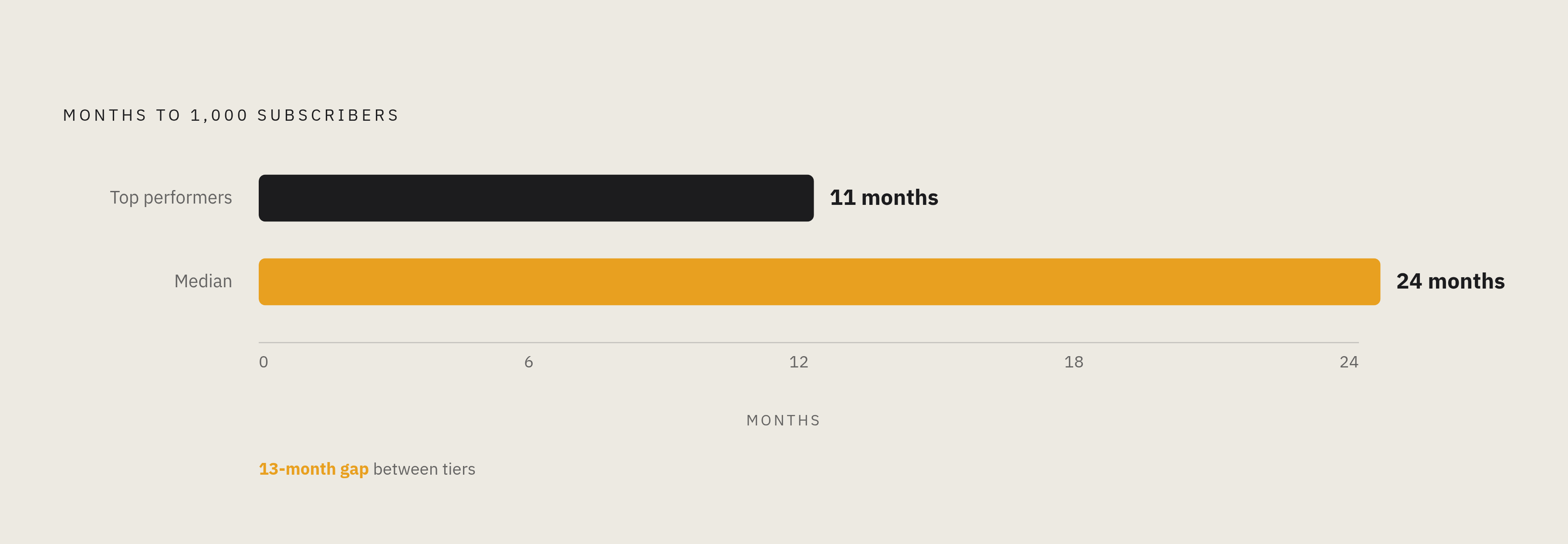
Top performers reach 1,000 subscribers in eleven months; median companies take twice as long.
Global SaaS crossed $340 billion in 2025 and is on track to clear $390 billion in 2026. More money is chasing the same buyers now, which sounds like good news until you look at who's actually catching it.
Median growth for private B2B SaaS companies dropped from 30% in 2023 to 25% in 2024, according to SaaS Capital, and about 7% of companies reported flat or negative growth last year. The pie got bigger. Fewer companies got a bigger slice of it. Growth is pooling at the top while everyone else scraps over what's left.
ChartMogul's 2025 GTM Report puts a number on the gap that actually matters: top performers hit 1,000 subscribers in 11 months. The median company takes two full years to hit the same mark. That's not a product quality gap, plenty of median companies build fine products, it's a motion gap. Winners run a specific sequence of channels and plays, in a deliberate order, with clear triggers for what happens next. Everyone else is winging it, hoping the market forgives them.
So picking a GTM motion isn't a marketing decision handed down after the real strategy work is done. It belongs in the same room as pricing and the product roadmap, at the same table, argued over with the same seriousness.
How B2B buyers actually make decisions before sales ever gets involved
Eighty percent of B2B deals go to the vendor the buyer already favored before anyone from sales picked up the phone, according to 6sense's 2025 Buyer Experience Report. Sales is mostly confirming a decision that already happened somewhere else, on someone else's screen, weeks earlier.
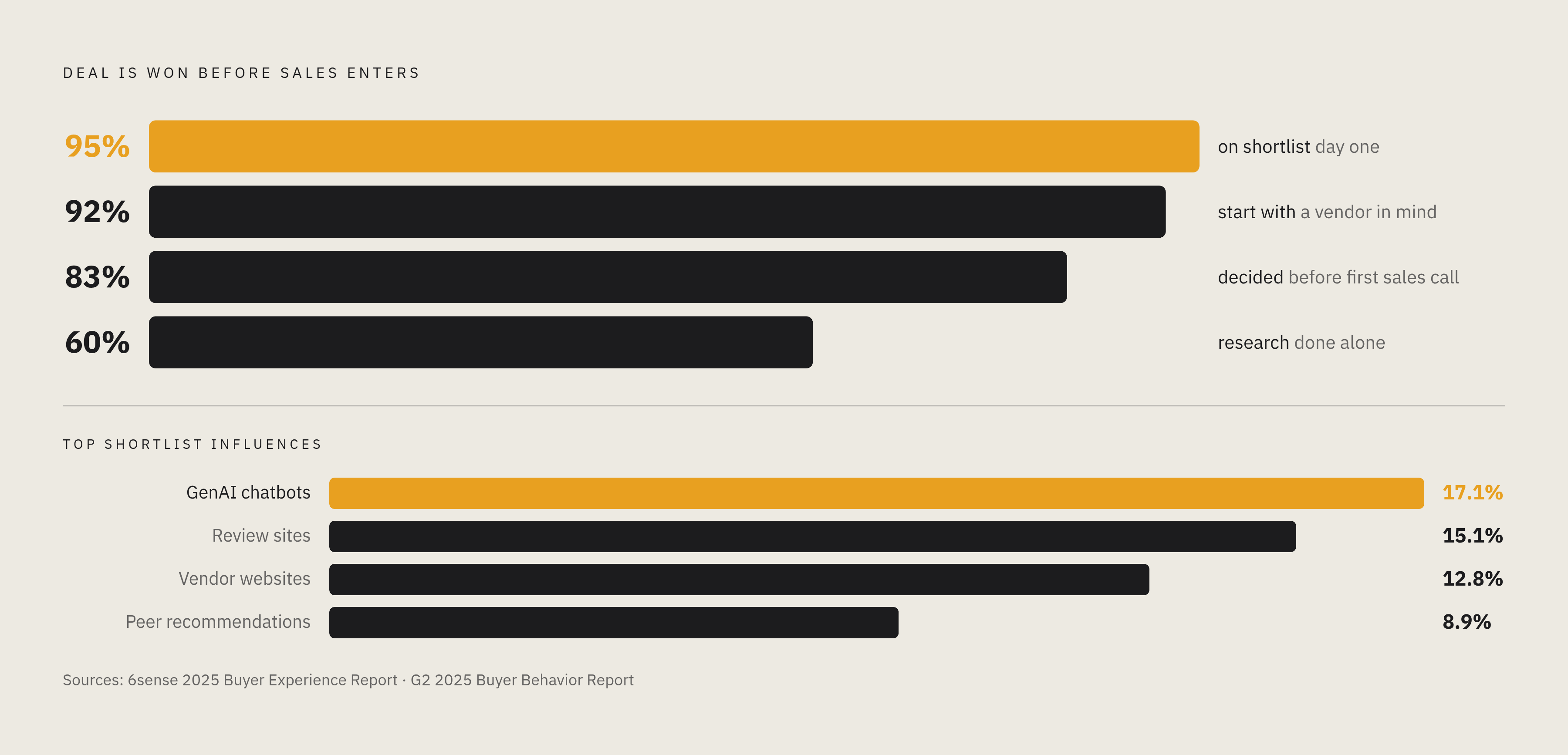
Ninety-two percent of buyers start their search with a vendor already in mind. Ninety-five percent of eventual winners were already on the buyer's shortlist on day one. Buyers do 60% of their research alone, and even when a rep gets to them early, 83% of buyers have already decided what they want to buy before that call happens. Sales isn't running the deal; it's catching up to it.
The buying committee has ballooned too: complex purchases now pull in 11 to 14 stakeholders on average, so a motion built to win over one champion is a motion built to lose to committee. Small mercy, the buying cycle shrank from 11.3 months in 2024 to 10.1 months in 2025. Yet a shorter cycle with more people in the room means less room to recover once you've fallen behind, not more.
Where's all this research happening? G2's 2025 Buyer Behavior Report found GenAI chatbots are now the top influence on vendor shortlisting at 17.1%, ahead of review sites (15.1%), vendor websites (12.8%), and peer recommendations (8.9%). Miss that AI-generated summary, miss that LinkedIn feed, and a brand fades out of consideration before the deal was ever a possibility. Nobody has to reject you; they just never see you.
The three GTM motions and what distinguishes them in practice
Three motions, three different bets on how the buyer wants to buy.
Product-led growth (PLG) hands the wheel to the product. Free trials, freemium tiers, in-product onboarding, all doing the work a salesperson used to do. Nobody picks up a phone; the product closes itself.
Sales-led growth (SLG) routes demand, inbound or outbound, into a sales team that owns the whole conversion process. That's the right call when the product needs explaining, needs customizing, or costs enough that the buyer wants a human walking them through it.
Hybrid runs both at once: self-serve for individuals or small teams, and a sales team that wakes up the moment usage data shows a bigger account hiding inside a free plan.
Here's where most companies get it backwards: they pick the motion that looks cheapest to run instead of the one that matches how their buyer wants to buy. Low price, high volume, product that explains itself? PLG. High price, big committee, long evaluation? SLG. Both buyer types at once, landing small and expanding later? Hybrid. Motion mismatch kills more companies than bad products ever do. Bolt PLG onto a product that needs hand-holding and you get confused users who churn quietly. Bolt heavy SLG onto a product buyers want to try before talking to anyone, and you get annoyed prospects who never book the call.
What a product-led motion actually looks like from zero to first traction
A free trial isn't a PLG strategy. Treating it as the whole plan is how companies confuse a feature for a system. Real PLG means shrinking the distance between signup and the moment a user actually gets value, then building the entire growth engine around that one moment.
The sequence goes something like this. Find the "aha moment," the single action inside the product that correlates with someone sticking around, and rebuild onboarding so new users hit that action in their very first session. Cut every signup step that doesn't serve that goal, because friction before value is the number one killer of conversion, full stop. Build in-product nudges that prompt an upgrade when someone hits a natural usage ceiling, instead of relying on an arbitrary 14-day trial clock. Then use usage data to spot power users, since those accounts become the outbound signal for enterprise conversations later.
The classic PLG case is a product that spreads bottom-up, one user at a time, as individuals bring it into work and usage moves sideways across departments. Enterprise sales shows up later, layered onto accounts where team usage has already proven the product's worth on its own. PLG builds the beachhead; sales expands the footprint after the fact.
The metric that matters early is activation rate, not signups. A massive free-user base that barely activates is a bucket with a hole in the bottom, not traction. And here's what founders miss constantly: PLG doesn't generate its own demand out of thin air. Something still has to drive strangers to the signup page. Usually that's content, community, or word of mouth; it doesn't happen just because the product happens to be self-serve.
What a sales-led motion looks like when it's working — and when it stalls
SLG earns its keep when the contract's big enough to justify paying a human to sell it, the product needs scoping, and the buying committee is large enough that someone needs to help the buyer navigate their own org chart.
Early SLG has a rhythm. The founder closes the first 10 to 20 customers personally, mainly because that's the fastest way to learn which pain point actually triggers a purchase and which objection kills the deal cold. That knowledge then gets turned into a repeatable pitch before the first sales hire, so the new rep isn't reinventing anything from scratch. Next comes hard qualification, since SLG stalls the second reps start burning time on accounts that were never going to close; tight ICP discipline is what keeps the whole engine efficient. And demand has to exist before headcount gets added, because outbound without inbound just burns cash calling people who've never heard of you.
Where does SLG actually break? Usually one of two places: the sales team scales before the pitch is repeatable, or the ICP is drawn so wide that win rates can't cover what it costs to land the customer.
Gong is worth studying here. Early traction came through disciplined founder-led sales into a tightly defined ICP before any sales team was added. A direct sales motion with strict qualification followed, paired with a content strategy that built category authority, so prospects arrived already oriented before the first call. With 11 to 14 stakeholders now sitting on the average complex deal, one champion isn't enough anymore. SLG has to multi-thread across that whole committee, or it loses the deal to a competitor the buying team never even mentioned out loud.
How the hybrid motion works in practice and why most companies arrive at it by default rather than by design
Most companies don't choose hybrid. They fall into it. PLG works a little, SLG works a little, neither gets shut down, and eventually the org chart looks hybrid without anyone deciding it should. Drift isn't strategy, even when it produces a strategy-shaped org chart.
Intentional hybrid design looks different. PLG handles cheap, low-friction acquisition for individuals and small teams; SLG activates only when usage data flags an enterprise account hiding inside a free tier. The decision that actually matters is the trigger. Usage-based triggers fire when a single account crosses a seat threshold, when a whole department starts using the product, or when someone creates an admin account, all classic tells of an enterprise deal waiting to be found. Firmographic triggers work differently: if a free user's email domain matches a target account, sales gets notified no matter how much or how little that person has used the product.
The clearest hybrid executions follow a consistent pattern: individuals sign up for free, usage spreads across whole teams, and enterprise sales steps in only once an organization has already proven, through its own usage data, that the product has real value inside it. The same script repeats across the most successful hybrid companies: bottom-up adoption first, enterprise contracts landed later, once the product was already embedded across departments before a single enterprise rep showed up.
The failure mode is treating hybrid as two separate motions run by two teams that never talk. Hybrid only works when PLG usage data flows straight into the SLG pipeline. Otherwise the two motions just coexist politely in the same building, ignoring each other like roommates who split rent and nothing else.
Why channel selection only makes sense after the motion is chosen
The common mistake: pick LinkedIn, SEO, outbound, and a couple of events, then force a motion to fit those channels after the fact. That's backwards, and it burns budget fast.
Channel choice should come from the motion, not the other way around. PLG-compatible channels drive signups directly: SEO, community, viral loops inside the product itself. SLG-compatible channels produce high-intent leads: thought leadership, targeted outbound, direct LinkedIn outreach, the kind of channels that carry a signal instead of raw volume.
Here's the uncomfortable part. Roughly 73% of the B2B buying journey happens anonymously, before a buyer ever contacts a vendor, according to research from 6sense and Green Hat. Most of what decides who makes the shortlist never shows up in any attribution model. A significant share of B2B SaaS companies are functionally invisible to AI-assisted buyers; they simply don't appear when someone asks an LLM to summarize the vendor landscape for them.
So channel strategy has to cover the spaces nobody can track: LinkedIn feeds, the training data behind AI tools, peer communities where nobody's logging a click. One of the few honest ways to measure any of it is embarrassingly low-tech: add an open text field to the demo booking form that just asks how someone heard about you. It catches the peer mentions and social influence that UTM parameters were never built to see.
Founder-led content as a GTM channel with measurable pipeline impact
Research into early-stage B2B SaaS companies that reached $5 million ARR points consistently to one pattern: founders who build a public presence on LinkedIn while the company is still small. That's not a coincidence sitting quietly next to a growth number. That's a mechanism, and it's one most GTM plans skip entirely.
Enterprise buyers look up founders on LinkedIn before they ever agree to a sales call. The founder's posts are part of the evaluation whether the founder realizes it or not. Edelman and LinkedIn's 2024 report on B2B thought leadership found that a large share of decision-makers say a piece of thought leadership led them to look into a product they hadn't previously considered, and many say strong thought leadership makes them willing to pay a premium to that supplier. That's not brand awareness. That's pricing power, earned before the first sales call ever happens.
There's a group that gets ignored constantly and shouldn't be: finance, legal, procurement, compliance. Research consistently finds these stakeholders consume thought leadership at nearly the same rate as the primary buyer. These are exactly the people who kill a deal after the champion already said yes. Ignore them, and watch a deal die in final approval for reasons nobody on the sales team ever saw coming.
The mechanism works the same way across categories: a consistent, opinionated content motion on LinkedIn built around a specific point of view about a problem buyers already recognize in their own work, steering clear of product features and company announcements.
The mechanism runs like this: someone posts a sharp, specific take on a problem in the category. That post reaches buyers deep in their anonymous research phase, months before they'd consider booking a call. By the time they do book it, they've already half-sold themselves. The sales cycle shortens, not because anyone moved faster, but because trust got built earlier, quietly, in the background, while nobody from sales was even in the room. 6sense's 2025 data backs this up from the other direction: 69% of the buyer journey was already complete before first contact with a vendor. Capturing intent isn't enough on its own; the content has to carry an actual point of view, or there's nothing there to build trust with.
What stage-appropriate GTM execution actually looks like at pre-product-market-fit, post-PMF, and scale
Pre-PMF, roughly pre-revenue to early ARR. The job here is learning, not scaling, and confusing the two is how companies burn their first eighteen months chasing a growth curve they haven't earned yet.
The founder closes every deal personally, because the founder needs to sit inside every objection and every trigger firsthand, in real time, with no layer of reporting standing between them and the truth. Channels at this stage are wherever the ICP actually spends time: direct outreach, the founder's own LinkedIn account, one specific community where the buyer's problem gets argued about out loud. The metric that matters is win rate, and how tightly the deals that close match the ICP on paper, not raw pipeline volume. For a PLG company at this stage, the equivalent discipline is activation rate and time-to-value, not signup counts; a spike in free signups with nobody reaching the aha moment is a vanity metric wearing a traction costume.
Post-PMF, roughly early ARR and climbing, is where the founder's personal playbook gets written down and handed off. The first real hires get made against a repeatable process instead of founder instinct, and channel investment starts scaling in whichever direction the pre-PMF data already pointed. That's the stage where the motion, whichever one fits, stops being an experiment and starts being an operating system. Scale is where hybrid becomes the default reality for a growing share of companies, and where the discipline of making that hybrid intentional, rather than accidental, is what separates the businesses compounding at 14% a year or more from the ones quietly flatlining inside a market that's still, on paper, growing just fine.