ICP Definition and Messaging Alignment in SaaS
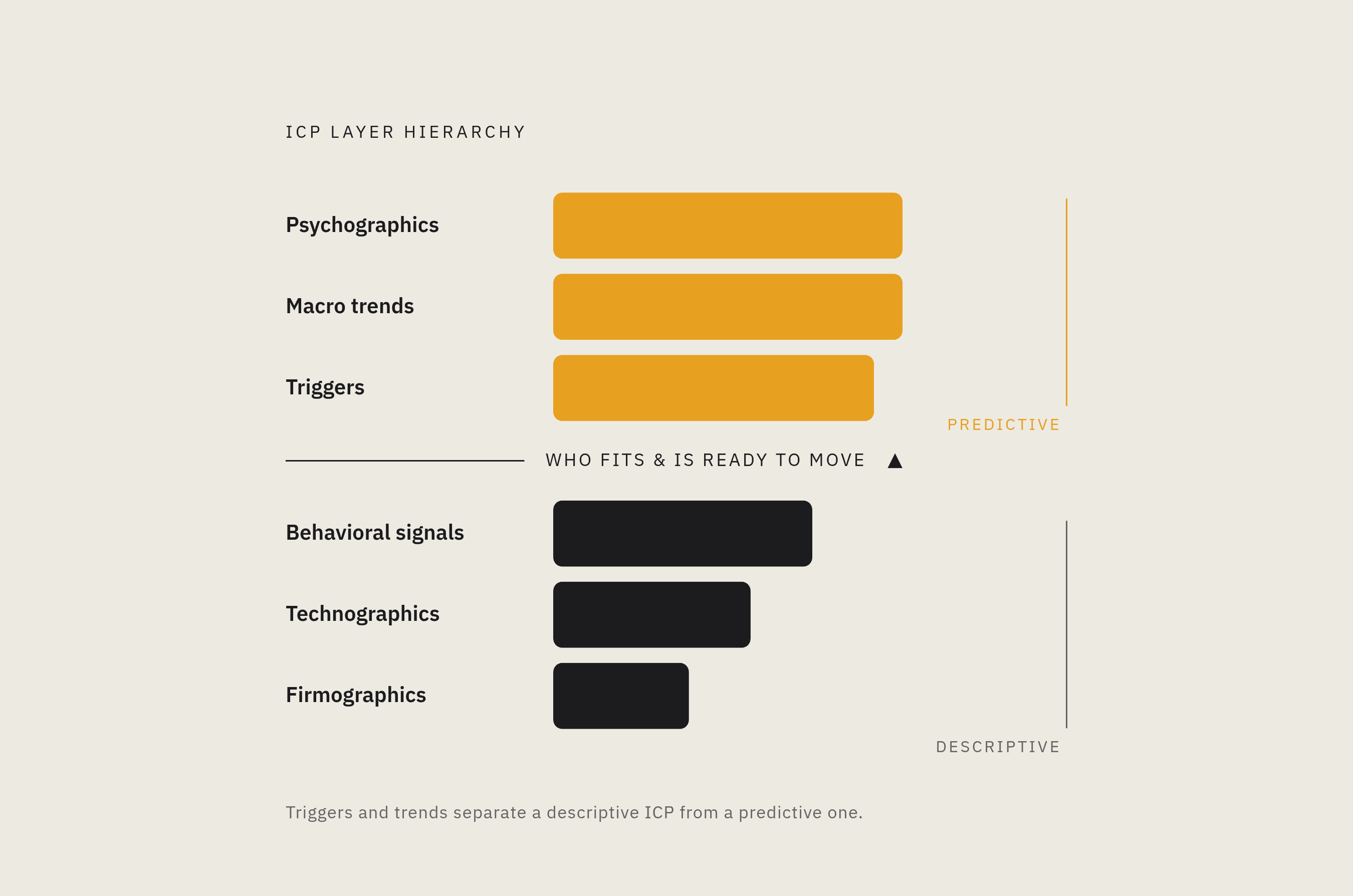
Triggers and macro trends separate a descriptive ICP from one that actually predicts deals.

Most teams build the first layer and call it done. That layer is firmographics. Industry, headcount, revenue band, geography. It's table stakes, and it's also nowhere near enough.
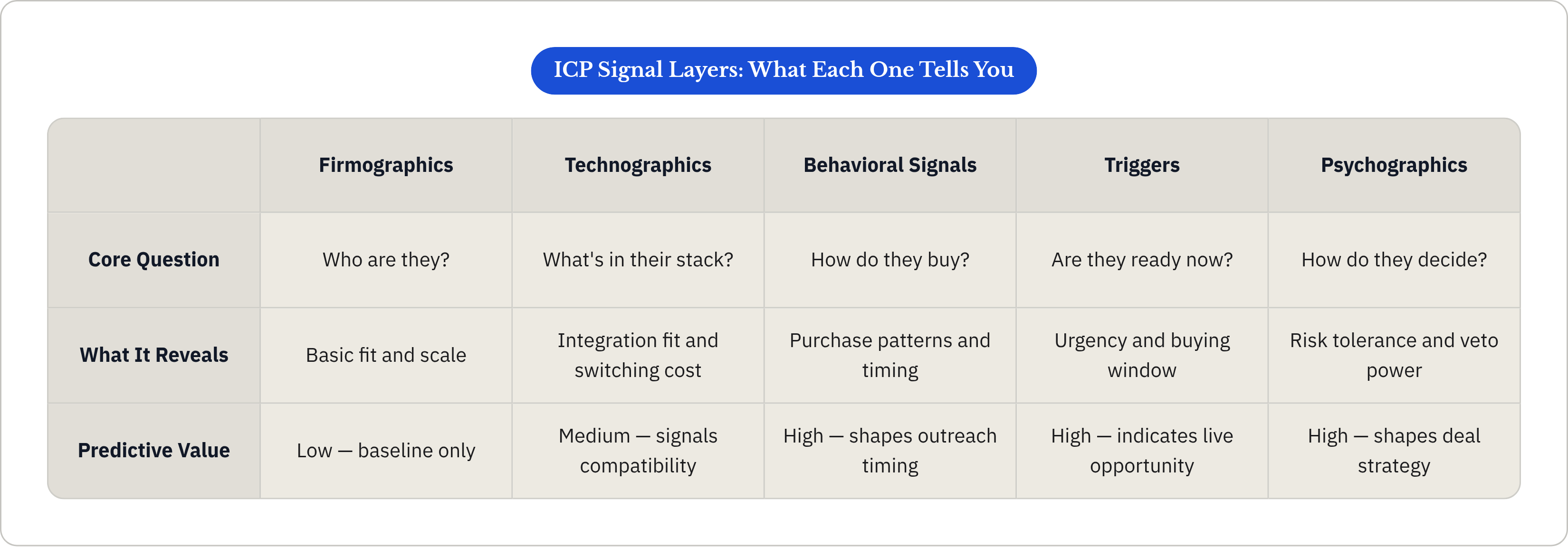
A real ICP stacks several signal layers on top of each other:
- Firmographics (the "who"): revenue band, headcount, geography, vertical
- Technographics: what's already in their stack. This tells you integration fit and switching cost before a single conversation happens.
- Behavioral signals: how this company actually buys. What triggers a search. Who gets pulled in, and when.
- Triggers (the "when"): proxy events that indicate urgency. A new VP of Sales just landed. They closed a Series B. They missed quarterly earnings.
- Macro trends (the "why now"): market shifts that make your solution feel inevitable rather than optional.
- Psychographics: how the buying committee actually makes decisions. Risk tolerance. Who holds veto power. How long consensus takes.
Triggers and trends are what separate a descriptive ICP from a predictive one. Descriptive tells you who fits. Predictive tells you who fits and is ready to move. Deals come from the second version.
What specificity actually looks like: not "mid-market SaaS companies." Instead: Series B SaaS companies, 150 to 400 employees, $15M to $50M ARR, selling into enterprise, running Salesforce and HubSpot, headquartered in North America, actively hiring for revenue operations roles. That version tells a rep exactly which companies to call. The vague version leaves them guessing and then blaming the market.
One more distinction worth getting clear, because it trips people up constantly. ICP lives at the account level. It answers "which companies do we target?" Buyer personas live at the individual level. They answer "how do we engage the people inside those companies?" Both matter. They operate at different altitudes, and mixing them up is how you end up writing messaging that tries to be everything and lands as nothing.
And your ICP is not your Total Addressable Market. TAM is everyone you could theoretically sell to. ICP is who you should actually be selling to right now. Conflating the two is how pipelines fill up with logos that look great in a slide deck and convert at a rate that makes your head hurt.
Why ICP Precision Has a Measurable Revenue Floor
Companies with a defined ICP see significantly higher win rates than those without one. Not because their reps are working harder or their managers are running tighter forecasts. Because the right accounts are entering the pipeline in the first place. A defined ICP changes deal selection. It doesn't just change what happens to deals after they're already in.
The retention side is where it compounds in a way that sneaks up on you. Right-fit customers renew. They expand. They refer. That LTV improvement isn't something you manufacture with a better onboarding sequence or a polished QBR deck. It starts at qualification and grows from there, quietly, in the background, while everyone's focused on new logo count.
The valuation math matters too, especially if you're building or have investors watching. A company with a focused ICP, strong LTV-to-CAC ratios, and low monthly churn can command a meaningfully higher multiple than a mixed-segment company sitting at the same revenue number with worse unit economics. Investors aren't just pricing current performance. They're pricing the predictability of future cohorts. ICP discipline is a signal that those cohorts will hold.
The benefit that gets overlooked most often is product roadmap efficiency. When you know exactly who you're building for, you stop building for everyone. Feature sprawl is expensive. So is the engineering time spent responding to requests from customers who probably shouldn't have been in the door.
How ICP Misfit Turns Into Churn, and How Fast It Compounds
Poor product-market fit is the primary driver of voluntary churn, and it doesn't announce itself on the day it happens. Sales prioritizes speed over fit, brings in accounts whose actual needs don't align with what the product does, and moves on to the next deal. The damage surfaces later. In CS. In renewal conversations. In an expansion pipeline that never materializes because nobody's talking to customers who actually want more.
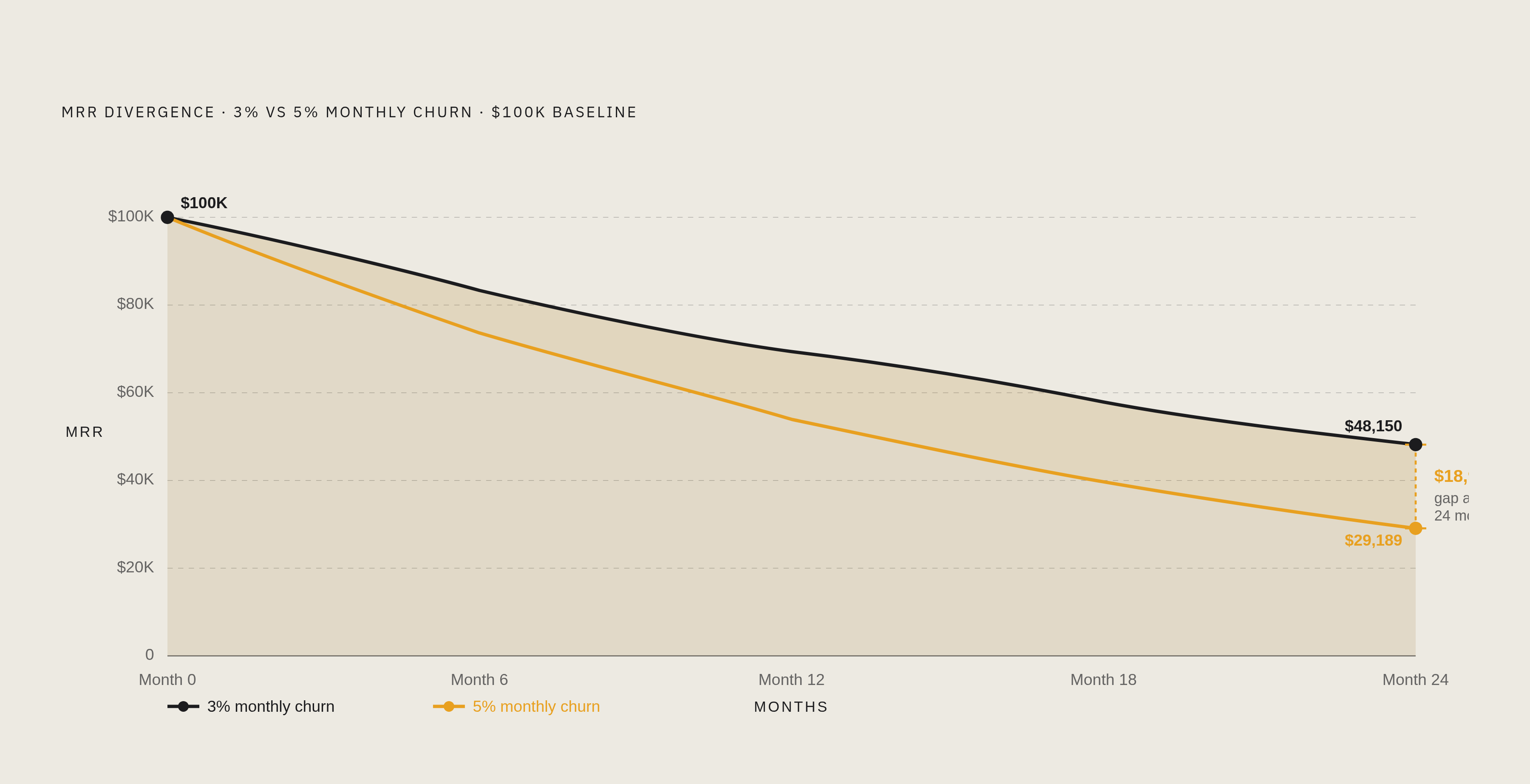
The math is where this gets uncomfortable. On $100K MRR, the difference between 3% and 5% monthly churn is a $2,000 monthly revenue gap. That sounds manageable until you run it out two years. At that point you're not looking at a gap anymore. You're looking at two different businesses, with two very different headcounts and two very different conversations happening in the board room.
Rough churn benchmarks by segment:
- SMB: 3 to 5% monthly
- Mid-market: 1.5 to 3% monthly
- Enterprise: 1 to 2% monthly
- Best-in-class: below 1% monthly
Where you land in those ranges almost always traces back to how disciplined qualification was when those accounts first entered the pipeline.
One tool that doesn't get nearly enough credit: the Anti-ICP. Write down explicitly who is not your customer. Share it with every SDR and AE. Treat it as a hard disqualification rule, not a gentle suggestion. The Anti-ICP stops the pipeline from filling with future churn before it becomes a retention problem you're trying to reverse-engineer six quarters later.
ICP drift is the quieter threat. Over time, marketing experiments expand targeting. Sales chases adjacent revenue because quota doesn't care about fit. Product responds to high-value edge-case requests from customers who are technically paying but structurally wrong. Nobody makes a bad individual decision. The accumulation of small, reasonable decisions creates a structural problem, and by the time it's visible, cohort performance has already degraded.
The diagnostic is simpler than people expect. If later cohorts churn faster than earlier ones, something is degrading. It's almost always sales volume pressure overriding fit discipline.
The Three Failure Modes That Make a Real ICP Rare
Failure Mode 1: Too broad to exclude anyone.
"Mid-market B2B SaaS" is a market segment label. It describes a category. It does not tell a rep which companies to call. An ICP that can't exclude anyone isn't functioning as an ICP. The whole point is to make the call on who's in and who's out before the first email goes out. If your ICP could theoretically describe half the companies in your CRM, start over.
Failure Mode 2: Lives in a slide deck instead of an operating system.
Slides get presented at QBRs and forgotten by Friday. A scoring model embedded in the CRM runs every day, on every account, whether anyone's thinking about it or not. The ICP needs to be operationalized: account scoring, lead routing, pipeline qualification criteria baked into the system. Not referenced in a Google Doc that nobody opens and everyone politely pretends to have read.
Failure Mode 3: Static when markets are not.
An ICP built 18 months ago and never revisited is running on assumptions that may no longer be true. Buyer behavior shifts. The competitive landscape changes. Your product evolves. The ICP has to track all of that, or it becomes a relic the team quietly ignores while quietly going their own directions.
The pattern underneath all three is the same: teams treat ICP as a one-time deliverable rather than a living input. The fix isn't more research. It's treating the ICP as infrastructure that requires maintenance, the same way you'd maintain any system your revenue depends on.
Positioning Is the Bridge Between ICP and Messaging, and Most Teams Never Cross It
April Dunford's framework makes a distinction that sounds obvious and consistently gets ignored: positioning is the strategy, messaging is the execution. Positioning defines who you're for, what category you compete in, and why you win. Messaging is the specific language used to communicate that position across channels and contexts.
Fixing the words without fixing the strategy underneath them doesn't work. The words will still be wrong. They'll just be more polished versions of the wrong words, and you'll have spent a lot of time on them.
Dunford's positioning process follows a specific order, and the order matters:
- Competitive alternatives: what would your best-fit customers use if you didn't exist?
- Unique attributes: what do you have that those alternatives don't?
- Value and proof: what do those attributes actually deliver?
- Target market characteristics: which ICP signals make a buyer care about those specific attributes?
- Market category: what context makes the value legible to someone who's never heard of you?
The process starts with best-fit customers as the input. Positioning built from internal assumptions rather than actual customer signals produces generic output that sounds right in the conference room and lands flat in the market. Every time.
One thing that surprises teams the first time through: in B2B SaaS, the real competition is usually the status quo. Buyers are already doing something. They're using manual processes, stitching together workarounds, making spreadsheets do things spreadsheets were genuinely not designed to do. Your positioning has to explain why switching is worth the disruption. Not just why your product beats another vendor.
On AI positioning specifically, because it comes up in every conversation right now: AI features are a baseline expectation, not a differentiator. Claiming "AI-powered" is roughly equivalent to claiming your product runs on the internet. If you want to differentiate, express capability as a concrete outcome improvement in a specific workflow. Not a feature claim.
A useful structure to pressure-test your value proposition: "[Product] helps [ICP] achieve [outcome] by [unique capability], unlike [alternative] which [limitation]." If you can't fill that in cleanly for your best-fit segment, the positioning isn't finished.
How ICP Signals Should Shape the Actual Words in Messaging
Messaging written for everyone reads like it's for no one. This isn't a copywriting observation. The more you try to speak to everyone simultaneously, the less force lands on any specific person. It's just how attention works, and buyers have gotten very good at skimming past language that doesn't feel like it's aimed at them specifically.
The ICP is the forcing function for specificity. Here's how to actually use it.
Start with the three problems your ICP is actively frustrated by, written in their words rather than yours. A support lead doesn't think in "unified ticketing architecture." They think: I have four tools open and I still miss tickets. Write the pain point first. The feature second. The outcome third.
For language, go directly to where your ICP already talks: support tickets, sales call recordings, G2 and Capterra reviews. If your ICP calls the problem "swivel-chairing between tools," use that phrase. Don't refine it into something tidier. Borrowed language reads as understanding. Polished paraphrase reads as marketing, and buyers recognize the difference faster than you'd hope.
If you serve multiple distinct ICPs, write a distinct messaging variant per segment. One blended paragraph trying to cover all of them converts for none of them.
For validation, put the draft in front of people who actually match the ICP profile. Not your VP of Marketing. Not your advisor. People who fit the profile. Ask them three questions without prompting:
- What does this product do?
- Why does it matter to me specifically?
- Why is it different from what I use now?
Failure on any one of those three points to a specific, diagnosable gap. Either the positioning is unclear, the ICP understanding is shallow, or both. At that stage it's not a copy problem anymore.
What Breaks When Sales and Marketing Don't Share the Same ICP
When sales works from one mental model of the ideal customer and marketing operates from a different one, everything built on top of that becomes unstable. Messaging, targeting, follow-up sequences, budget allocation. None of it reinforces the other because none of it is pointing at the same account.
Forrester's research on this found that a large majority of sales and marketing professionals report a lack of alignment, while most C-level executives believe their teams are already in sync. That gap between executive perception and frontline reality is genuinely telling. Leadership sees alignment because they set the strategy. The people executing it experience the fragmentation on every handoff.
The revenue impact is not subtle. Companies with strong sales-marketing alignment report higher win rates, better customer retention, and meaningfully more revenue attributed to marketing. Aberdeen Group documented a substantial year-over-year revenue gap between aligned and misaligned organizations, with aligned companies growing and misaligned ones declining. This has been documented broadly enough across sources that it's not really a question anymore.
When the ICP is a document rather than an operating system, alignment is structurally impossible. Sales optimizes for accounts they believe will close. Marketing optimizes for accounts they believe will engage. CS tries to retain whoever gets handed to them. Each function is working a different version of the customer, and the handoffs feel broken because they are broken. There's no single version of truth to coordinate around.
Gartner research adds pressure to this: most B2B buyers complete the majority of their research before speaking to a sales rep. That means the transition from marketing content to sales conversation is a critical seam. If marketing's messaging and sales's conversation are built on different assumptions about who the customer is, the buyer feels the discontinuity immediately, even if they can't name what's off.
The fix is a shared ICP that lives in the CRM as a scoring model, informs campaign targeting, and sets qualification criteria for sales. Not a slide deck in a shared drive. Something all three functions are optimizing against simultaneously, without having to coordinate on it every time a new campaign launches.
Building the ICP from the Customers Already Worth Keeping
The most reliable starting point isn't a hypothetical ideal customer or a market research report. It's your best current customers.
Identify the cohort with the lowest churn, the highest NPS, the shortest time-to-value, and the highest expansion revenue. These accounts are the empirical ICP. The task isn't to invent the ideal customer. It's to reverse-engineer what your best customers already have in common.
Pull signal from across every layer:
- CRM data: firmographics, deal velocity, where pipeline drops off by segment
- Product usage data: which features correlate with retention versus which get used once and abandoned
- Sales call recordings: what problems the best customers named before they bought, in their own words
The customers already worth keeping are telling you who else is worth pursuing. They've already proven the fit is real. The ICP is just the pattern underneath them, made explicit enough to act on.
Get that pattern specific enough to exclude someone. If every account in your current book could theoretically match it, it isn't working yet. A real ICP sharpens over time, lives in the systems your team uses every day, and keeps the pipeline full of accounts that actually belong there. That's the whole job.