Value Proposition Canvas for B2B SaaS Products
Map your product to each buyer's actual job, pain, and gain — not just features.
Every SaaS founder I know has the same drawer. It's the one where six months of positioning docs go to die, right next to the Trello board nobody updates anymore. The Value Proposition Canvas doesn't have to end up in that drawer, but it usually does, because most people fill it out once and treat it like a tax form rather than a tool they return to. This article is about using it the way it was meant to be used: to figure out whether what you built actually connects to what your buyer cares about, and to turn that connection into messaging that works before a salesperson ever picks up the phone.
That last part matters more than it used to. B2B buyers now do most of their homework alone, clicking through pricing pages and G2 reviews with nobody there to translate your feature list into something that matters to them. If your messaging doesn't land on its own, you don't get a second shot in a demo. You get ghosted.
What the Value Proposition Canvas is and what problem it was designed to solve
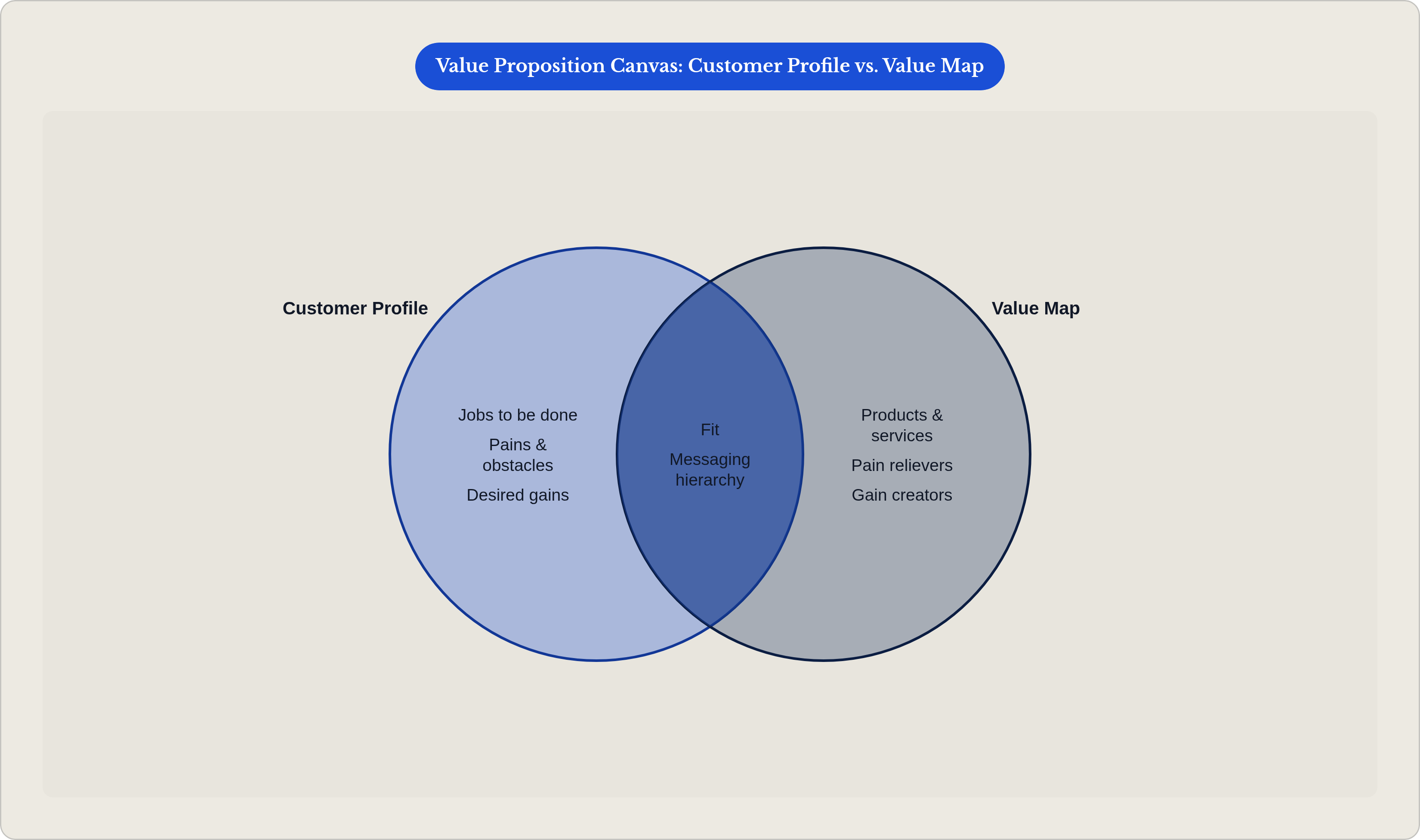
Alex Osterwalder built the canvas as a companion piece to the Business Model Canvas, meant to zoom into one specific relationship: what you offer versus what your customer actually needs. It's split into two halves, and the split is the whole point.
The right side is the Customer Profile. It maps three things about the person you're selling to: their jobs (what they're trying to get done, functionally, socially, emotionally), their pains (what's in the way), and their gains (what they're hoping happens beyond just the pain going away).
The left side is the Value Map. It mirrors the customer profile with your product's answer to it: the products and services you actually offer, the pain relievers that address specific frustrations, and the gain creators that deliver the outcomes people actually want.
"Fit" is the word Osterwalder uses for success here, and it's a good one. Fit happens when the left side answers the right side directly, not vaguely, not eventually. The canvas was built originally for product development, and it has since crept into positioning and messaging work because the mapping discipline is identical either way. For SaaS specifically, it does double duty: it's a product-market fit gut check and a blueprint for what your homepage should actually say.
Why the standard VPC needs adjustment before it works for B2B SaaS
Here's the catch. Osterwalder built this for a single customer, and B2B SaaS rarely offers one. It has a buying committee, and every member of that committee showed up with a different job to do.
The person using your dashboard every day has completely different pains than the VP who signs the check. And there's a whole cast of characters, procurement, legal, finance, security, who might never touch your product but can absolutely kill the deal. Fill out one canvas that tries to speak to all of them at once, and you'll end up with messaging so averaged-out that it resonates with exactly nobody. It's like writing a birthday card to five people who don't know each other. Technically addressed to everyone. Meaningfully addressed to no one.
There's a second wrinkle specific to SaaS: category gravity. Your buyer isn't evaluating your product in a vacuum. They're comparing it to the spreadsheet they've limped along with for three years, or the competitor they already have a login for. I once watched a founder pitch a scheduling tool to a prospect who'd built an entire empire out of color-coded spreadsheets and sheer stubbornness. The product was better in every measurable way. The prospect still walked, because the canvas never accounted for the fact that switching costs aren't just financial, they're emotional. Sometimes the job your buyer wants done doesn't fit neatly into the category you think you're selling in.
And pains and gains in SaaS run on two clocks at once. There's the immediate one (how bad is onboarding, how fast do I see value) and the strategic one (does this actually justify itself at renewal, does the ROI story hold up in front of the board). Miss either clock and you lose the deal for a different reason than you think.
The fix isn't complicated, even if it takes more work: run a separate canvas for each stakeholder. Then look at where they overlap. That overlap is your category-level message, the thing everyone agrees matters. Where they diverge is where your persona-specific messaging lives, and that's usually where deals actually get won or lost.
How to fill in the Customer Profile for a B2B SaaS buyer — the jobs, pains, and gains that actually matter
Start with jobs. There are three kinds, and most founders only bother with one.
Functional jobs are the operational task itself, something like "consolidate reporting across five data sources into one view." Social jobs are about how the buyer wants to be seen by their team or their boss because of this purchase, "be the person who modernized our stack" is a real motivator, even if nobody says it out loud in a demo call. Emotional jobs are about how the buyer wants to feel, usually something close to "confident I won't get blindsided in the board meeting."
Most SaaS teams map the functional job and stop, the equivalent of writing a dating profile that only lists your job title: technically true, emotionally empty. The social and emotional jobs are frequently what actually closes deals at the VP level, and they're the ones left blank on nearly every canvas I've seen.
Pains break into three buckets too: undesired outcomes (stuff that goes wrong), obstacles (stuff blocking them from even starting), and risk (what happens if they pick wrong). Risk gets underweighted constantly, and that's a mistake, because buyers fear a bad purchase more than they crave a good one. Nobody gets fired for sticking with the old tool. People do get fired for championing the new one that flopped. Why did the procurement manager cross the road? To avoid the vendor who couldn't answer a single security question.
Some SaaS-specific pains worth naming outright: implementation complexity, whether the team will actually adopt it, data migration headaches, compliance and security requirements, and how badly it'll clash with the five other tools already duct-taped into the stack. Rank these by intensity. Not every pain deserves the same size font on your canvas, or in your messaging.
Gains split into four tiers: required (table stakes), expected (what a decent solution should deliver), desired (hoped for, not assumed), and unexpected (the surprise that turns a customer into someone who tells their friends). Most SaaS messaging camps out in required and expected gains, which is exactly why so much of it sounds the same. Differentiation lives further out, in desired and unexpected territory. A project management tool buyer expects to save time. They desire a defensible ROI story for the CFO. They don't expect the tool to surface a capacity problem on their team they didn't even know existed, but when it does, that's the story they tell at dinner.
Where do you get all this? Win/loss interviews are the highest-signal source you have; they tell you what actually tipped the decision, not what you assume tipped it. Customer success calls help too, but only if you ask job-mapping questions ("walk me through what you were trying to do before you found us") instead of satisfaction surveys. Sales call recordings are gold if you listen for the words prospects use unprompted, not the words your own team trained them to repeat back. And G2 or Capterra reviews are basically free focus groups, written in the customer's own voice, pains and gains spelled out in plain text.
How to build the Value Map — connecting product features to the pains and gains that move buyers
Start with a full inventory: every feature, every integration, the support model, the onboarding flow, all of it. Just get it down on paper before you start matching anything.
Then, for every pain on the customer profile, write the specific product element that addresses it. Not vaguely. Specifically. This is about being honest about which pains you actually relieve and which you only sort of touch, since no product is painless. Founders who do this exercise honestly usually find a gap: a pain the customer clearly cares about that the product doesn't really solve. That's either a roadmap item or a sign you need to stop selling to that pain entirely.
Specificity is everything here. "Reduces reporting time" tells the buyer nothing. "Generates the board-ready revenue report in under two minutes from raw CRM data" tells them exactly what changes in their week.
Gain creators are a different animal from pain relievers, even though people mix them up constantly. A pain reliever removes a negative. A gain creator adds a positive the buyer actually wants. In SaaS, the best gain creators often live one step downstream from the product itself: "because you close the books three days faster, your CFO gets to make the investment call a week earlier than she used to." That domino effect is the kind of thing that makes a buyer look good in a meeting you'll never be in.
Now prioritize, ruthlessly. Not every feature earns a spot on the canvas, and trying to force all of them in is how you end up with a landing page that reads like an owner's manual. Highlight only the pain relievers and gain creators tied to your highest-intensity pains and most desired gains. That short list is your messaging hierarchy. Everything else gets a mention on a features page somewhere, not a headline.
One more thing: the canvas should look unfinished in places. If you don't have a strong answer to a pain yet, leave it blank. A canvas with no gaps is a canvas someone filled out to feel good, not to learn something.
Testing whether fit actually exists before writing a single line of copy
Fit isn't something you get to declare. You don't get a vote. The buyer does.
Run this check: for every high-intensity pain, is there a specific, credible pain reliever sitting across from it? For every desired or unexpected gain, is there a real mechanism that creates it, not just a hopeful claim? If a big pain has no reliever, you've found a gap, either in the product or in the message. And if you've got features on the left side with nothing corresponding on the right, that's dead weight, noise competing with the claims that matter.
A few ways to actually test this before you write a word of copy. Run the pairing in live sales calls, say the pain and the reliever out loud, and watch the prospect's face. Genuine recognition looks different from polite nodding, and you'll know the difference within about two sentences. Try landing page variants, one built around a specific pain-gain pair, one built around a generic capability claim, and see which one people actually stick around for.
LinkedIn deserves its own mention here, because it's the cheapest, fastest feedback loop most founders ignore. Post the actual tension your product resolves, written the way your buyer would say it, not the way your product deck says it. Watch what happens. Saves, shares, and DMs tell you which framing is landing and with whom, often within hours, and it costs nothing compared with waiting three months for a sales cycle to confirm you guessed wrong.
Turning canvas output into messaging that works across the B2B buying journey
The canvas doesn't hand you a tagline. It hands you an architecture, and different stages of the buying journey need a different room in that house.
At awareness, lead with the job and the sharpest pain, ahead of the product itself. The buyer needs to see themselves in the message before they care about your solution at all. Something like: "If your sales team is rebuilding the pipeline report in a spreadsheet every Monday, that's not a process problem, that's a data problem." Nobody's mentioned your product yet, and that's fine. Recognition comes first.
At consideration, bring in the gain creator, the actual change that happens once the pain's gone. This is where the ROI conversation lives, and it needs to speak the CFO's language: revenue impact, cost impact, risk reduction, rather than "streamlined workflows."
At decision, address the risks head-on: implementation, adoption, migration, security. Bake the objection handling into the message itself instead of leaving your sales rep to improvise it live, under pressure, with a prospect who's already nervous about signing.
And remember, you're writing for more than one reader. The end user wants relief from their daily grind plus a few pleasant surprises. The economic buyer wants a business outcome they can defend to their own boss, framed with the risk already handled. And the hidden stakeholders, finance, legal, compliance, care almost entirely about risk: certifications, contract terms, audit trails. Ignore them and you don't lose the deal loudly. You lose it quietly, in a meeting you were never invited to.
There's real evidence that this crowd matters more than founders assume. Research from Edelman and LinkedIn found these hidden buyers, the finance and legal and ops people who never touch the product but still shape the decision, consume about as much thought leadership as the primary buyers do, and strong content makes most of them noticeably more open to a sales conversation. So messaging built from your canvas, published as an actual piece of thinking rather than a pitch, reaches people your sales team may never sit across a table from.
How founders can use the canvas as a live positioning tool, not a one-time exercise
Most teams run this once, in a workshop, print it, frame it, and never touch it again. That's the exact moment the tool stops working.
Your customer profile isn't fixed. Early buyers tend to be technically sharp early adopters, and their jobs, pains, and gains look nothing like the mainstream buyers you'll be chasing in year two or three. A canvas built for the early crowd will actively repel the next wave if nobody updates it. Growing into a new segment means building a new canvas, the same way you can't stretch a toddler's raincoat onto a teenager and call it a fit.
A few signals should send you back to the whiteboard. You start losing deals you used to win, and nobody can quite say why. A new competitor shows up and starts winning on message alone, even though their product isn't better. You push into a new vertical or a new ideal customer profile. Or a stakeholder type you've never had to deal with starts surfacing in every deal cycle, asking questions your current messaging has no answer for.
Treat the canvas the way you'd treat your pricing page: something you revisit on purpose, on a schedule, rather than something you dust off only when a deal falls apart and you're scrambling for answers. The market moves. Your canvas should move with it, or it turns into expensive wallpaper.