Founder Narrative as a Positioning Asset
Founder narrative shapes how buyers categorize your company before they ever talk to sales.

Founder narrative isn't a personal branding project you bolt onto marketing once the product ships. It's the positioning strategy itself, the thing that tells buyers, investors, and future hires which mental drawer to file your company into before anyone books a call. By the time a prospect fills out a demo form, they've already decided who you are. Sales just gets to confirm it or fight it.
The Harvard Business Review's 2024 Digital Leadership Study found 78% of B2B buyers research company leadership before making a purchase decision, and 64% of hidden buyers trust thought leadership more than product sheets when judging whether a vendor can actually deliver. LinkedIn is where most of that research happens: over a billion members, roughly 65 million of them decision-makers, with something like four in five members shaping business purchases in some way. It's the front desk of B2B software now. Founders who treat their narrative as an afterthought are letting someone else write the sign above their door — and that sign has a way of advertising the wrong business entirely.
There's an old story about a startup founder who spent eighteen months perfecting the product and exactly zero minutes explaining why it existed. At his first investor meeting, he opened the deck, and the partner across the table stopped him after slide two and asked, "What do you actually believe is broken out there?" The founder blinked, flipped back to slide one, and read the tagline out loud. That was the whole meeting. He walked out having pitched a feature list to a person who wanted a worldview. Positioning, it turns out, is a lot like a load-bearing wall: you don't notice it's missing until the whole pitch collapses around slide three.
What "founder narrative as positioning" actually means — and what it isn't
April Dunford's version of positioning isn't a tagline. It's the decision about which competitive set a buyer uses to judge you, which features count as table stakes, and which category you actually live in. Call your product a "revenue intelligence platform" and it gets judged against one set of alternatives. Call the exact same product a "CRM" and it competes on a totally different scorecard, even though nothing in the code changed.
Founder narrative just moves that same logic into a human voice. What a founder says publicly, consistently, becomes the lens the market uses to sort the company before any pitch deck or positioning doc ever reaches a buyer's inbox.
Here's what it isn't:
- A personal branding hobby, chasing LinkedIn likes with no connection to what the company sells
- An origin story told once at a conference, then filed away and forgotten
- Generic thought leadership that name-checks the category without taking a side on anything
- Company-page content copy-pasted onto a personal profile, hoping nobody notices
Personal brand is about being recognized. Founder narrative as positioning is about being categorized correctly, so a buyer's brain files you as "the obvious choice" instead of "another option to compare." Most founders blow this by reaching for vague differentiators ("we're the easy AND powerful option," as if those two words haven't cancelled each other out since 2011), borrowing language nobody outside the company uses, or straight-up copying the narrative of whoever's already winning the category. That last one is like showing up to a costume party dressed as the guy who already won costume of the year. Technically flattering, tactically useless. As one investor is fond of saying, a founder who copies the market leader's story isn't a challenger, he's a tribute band.
How the SaaS market's saturation makes narrative the differentiator that survives commoditization
Building software got easy. Too easy, honestly. Features get cloned in a sprint, pricing gets matched within a quarter, integrations get replicated by anyone with an API key and a weekend. The product, on its own, rarely holds as a moat anymore at the category level.
So buyers staring down five nearly identical tools stop trying to evaluate features and start making a trust call instead. This trust gets built long before any formal evaluation starts. LinkedIn's 2025 B2B Institute research found 95% of hidden buyers say strong thought leadership makes them more receptive to sales outreach in the first place. The positioning fight happens in the quiet months before anyone opens a demo, not during it.
What can't be copied is a founder's actual point of view: why the category exists, what's broken about how everyone currently solves the problem, where things are headed. You can clone a pricing page overnight. Conviction is the one thing that resists copying.
The real moat here is mindshare, owning the mental model buyers reach for when they define the problem in the first place. Think of it like a lighthouse instead of a billboard: a billboard just interrupts you, but a lighthouse is what you orient toward when you're already lost at sea, looking for the one fixed point that tells you where the rocks are. That's stickier than any keyword or feature checklist, and the founder is usually the only person in the building who can carry that voice without sounding like a press release wearing a name tag.
The structural reason founder-driven content reaches buyers that company pages cannot
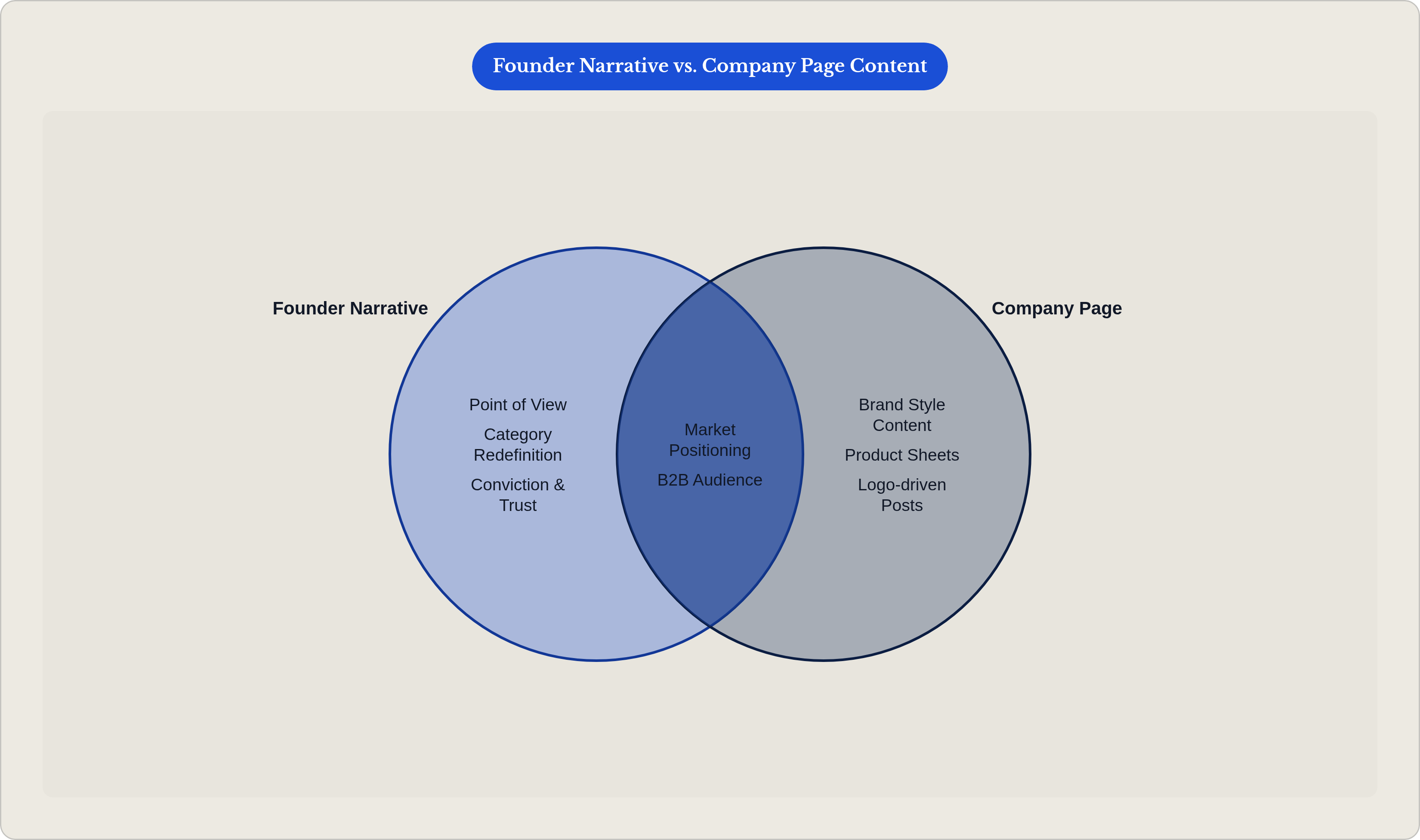
Data from DSMN8's feed analysis shows personal profiles make up roughly 62% of what shows up in a LinkedIn feed. Company pages get about 5%. This isn't a content quality gap — it's the platform's plumbing.
LinkedIn's algorithm favors people over logos because a personal post reads like a conversation, and a company page post reads like an ad nobody asked for. The platform's depth score, rolled out in late 2025, rewards posts that actually hold attention rather than ones that just get published a lot. Post like you're filling a quota and the algorithm notices. It's not subtle about it.
There are real penalties waiting for founders who post carelessly, and they stack:
- Posts with obvious AI-generated patterns reach a fraction of the audience they'd otherwise get
- Loading up on more than three to five hashtags tanks reach noticeably
- Dropping an external link with no context suppresses distribution almost every time
The algorithmic penalty is the smaller problem, honestly. The bigger one is credibility. Buyers can smell a corporate-sounding sentence from three scrolls away, and once they do, trust evaporates. It only takes one line that sounds like it came out of a brand style guide, and the whole post reads like a press release in a hoodie.
Thought Leader Ads work as a bridge from organic to paid, but only if there's something worth amplifying in the first place. Paid spend can't fix a story nobody wanted to read for free.
The hidden buyers most founders never try to reach — and why narrative is what reaches them
Hidden buyers are the people in finance, legal, compliance, or ops who never touch the product and never sign the contract, but who can quietly kill a deal from three rooms away. The 2025 Edelman-LinkedIn B2B Thought Leadership Impact Report ties hidden buyers to more than 40% of deals that stall out from internal disagreement. That's not a rounding error. That's almost half your pipeline dying of friendly fire.
The same report, drawn from close to 2,000 professionals globally, found:
- 63% of hidden buyers spend over an hour a week reading thought leadership, nearly matching primary buyers
- 81% say strong thought leadership surfaces challenges or opportunities they hadn't clocked yet
- 95% say it makes them more receptive to sales outreach
- 79% say they're more willing to advocate for a vendor during an RFP if that vendor consistently publishes strong content
- 51% say it helps them make the case internally to their own C-suite
Founders miss this constantly. Your public narrative is doing sales work inside a buyer's org, to people you'll never meet on a call and your sales team will never reach directly. Q: Why did the compliance officer kill the deal before sales ever heard about it? A: Because nobody sent him a single word explaining why the category existed in the first place. And 53% say strong content can outweigh brand recognition on its own, which is basically the great equalizer for any founder whose company doesn't have the name recognition of the category's 800-pound gorilla.
What makes thought leadership actually move buyers — and what gets ignored
Most founder content is safe. Safely generic, safely inoffensive, safely forgettable. It covers the category without saying a single thing a competitor couldn't also say, word for word. That's the content nobody remembers by Tuesday.
The Edelman-LinkedIn data found 73% of B2B decision-makers trust thought leadership more than marketing materials or product sheets when judging a company's actual capability, but that trust is conditional. Quality means data, real evidence the founder understands the buyer's problem, and concrete case studies. Opinion matters, sure, but opinion with no evidence underneath it is just noise wearing a confident font.
Separately, 71% of hidden buyers say thought leadership beats traditional marketing at showing a vendor's potential value, and 64% trust it more than product sheets specifically.
The content mix that tends to work for B2B SaaS breaks down roughly like this: 60% problem-focused (the pain, in the buyer's own words, not the vendor's), 25% solution or framework content (how to think about the problem), and 15% company and product content showing actual outcomes. Lead with the problem to build the audience. The solution content is what converts them once they're already listening.
Here's the part that should make every founder sit up: 75% of decision-makers say thought leadership prompted them to research a product they hadn't previously considered, and 70% of C-suite executives say it made them reconsider a vendor they were already using. Founder narrative doesn't just protect the awareness you already have. It goes and steals attention from the incumbent everyone assumed was untouchable. And with 54% of decision-makers spending over an hour a week reading this stuff, the audience isn't the problem. Whether your content is good enough to earn that hour is.
Constructing the narrative architecture: the choices that determine whether a story positions or merely informs
NFX's narrative templates, built originally for fundraising, hold up just as well for market positioning:
- Industry Story, the frame explaining how the category is shifting and where the company sits inside that shift
- Customer Story, a real person's journey through the problem and out the other side, which makes the abstract feel concrete
- Hero Founder, the credible case for why this specific person is positioned to solve this specific problem (not ego, evidence)
- Company Journey to Insights, the honest "we tried X, it didn't work, here's what we learned" arc that signals the founder isn't just guessing
Layered on top, five structures tend to actually create conviction instead of just information:
- Heroes vs. Villains, customer as protagonist, some force actively making their life worse as the antagonist
- David vs. Goliath, scrappy challenger against an incumbent whose size is exactly why it can't adapt
- Fundamental Shifts, the world changed, the old way is obsolete, your company is the inevitable next step
- Winners vs. Losers, those who adapt against those who get left behind, strongest when backed by real early-adopter results
Category-replacement framing is the highest-leverage move available. Build the argument around a structural flaw in how the existing paradigm works, not a product feature, and you stop competing in the category. You redefine it. The common mistake is building the product first and reverse-engineering a story to fit it. Flip that order. Start with a real point of view on what's broken, then locate your product as the answer to it.
Format matters here too, and not in a trivial way. Story-driven posts, built around a specific mistake or moment, consistently outperform generic advice posts because they're relatable and they carry an actual stance. Carousels uploaded as PDFs tend to post the highest average engagement of any LinkedIn format, no contest. And LinkedIn's own depth signal rewards two or three substantial posts a week over daily filler. Quality beats frequency here, decisively.
How the same narrative architecture works in a fundraising room
Investors spend an average of just under four minutes on a pitch deck, and a large share never get read to completion. The story has to do the heavy lifting before the spreadsheet even gets a chance.
Fundraising decisions start emotional, not analytical. Founders aren't pitching a revenue model. They're pitching a future the investor wants to be part of, and the narrative structure is what determines whether that pull actually lands.
Here's the real test: rounds close because someone inside the firm champions the deal in a room the founder isn't in. If your story needs you present to make sense, it's not a story yet, it's a pitch. The same Fundamental Shifts structure that works on buyers works here too, because it makes the investor feel like they're betting on something inevitable rather than something incremental.
Seed rounds now take noticeably longer to close than they did back in 2021, and founders are pitching more investors across a longer stretch of months than they used to. In that grind, a founder whose narrative is already circulating on LinkedIn walks into the first meeting with a head start nobody can buy on the spot. Their story arrived before they did, like a good opening act that's already warmed up the room. And recovery in early-stage funding has been selective, tilting toward founders building in categories like Consumer AI and Vertical SaaS, which makes credible category-framing even more important for anyone building outside those favored lanes.
The practical deployment: how to build narrative consistency that compounds into market positioning over time
Positioning doesn't get declared in a single LinkedIn post. It accumulates, slowly, from the pattern of what a founder keeps publishing, keeps arguing, keeps illuminating. One post is a data point. A year of posts is a reputation.
Most founders see some lift in visibility within a few months of posting consistently, but real authority, the kind where people quote you without checking your name, tends to take six to twelve months or longer. That's a long game in a market obsessed with short-term wins, which is exactly why it works as a moat. Nobody wants to put in a year of unglamorous effort. The founders who do it anyway end up with something competitors can't fast-follow their way into. Separately, 47% of business buyers say thought leadership led them to work with a company they hadn't previously considered, and that outcome only shows up after sustained presence, never after a single campaign.
The operating model, stripped down:
- Anchor everything in one coherent point of view on what's broken in the category and where things are headed. That's the actual positioning decision, not a content calendar decision.
- Carry that point of view consistently across formats: problem posts, customer stories, data-backed frameworks, clear stances on the debates happening in your category.
- Amplify whatever's already working organically with paid spend, rather than throwing money at brand content nobody engaged with for free in the first place.
Do this long enough, consistently enough, and the narrative stops being content. It becomes the frame the market uses to understand you, which is the whole point of positioning to begin with.