Repositioning an Existing B2B SaaS Product
Winning repositioning is a narrative fight fought in dark social, months before any sales call.

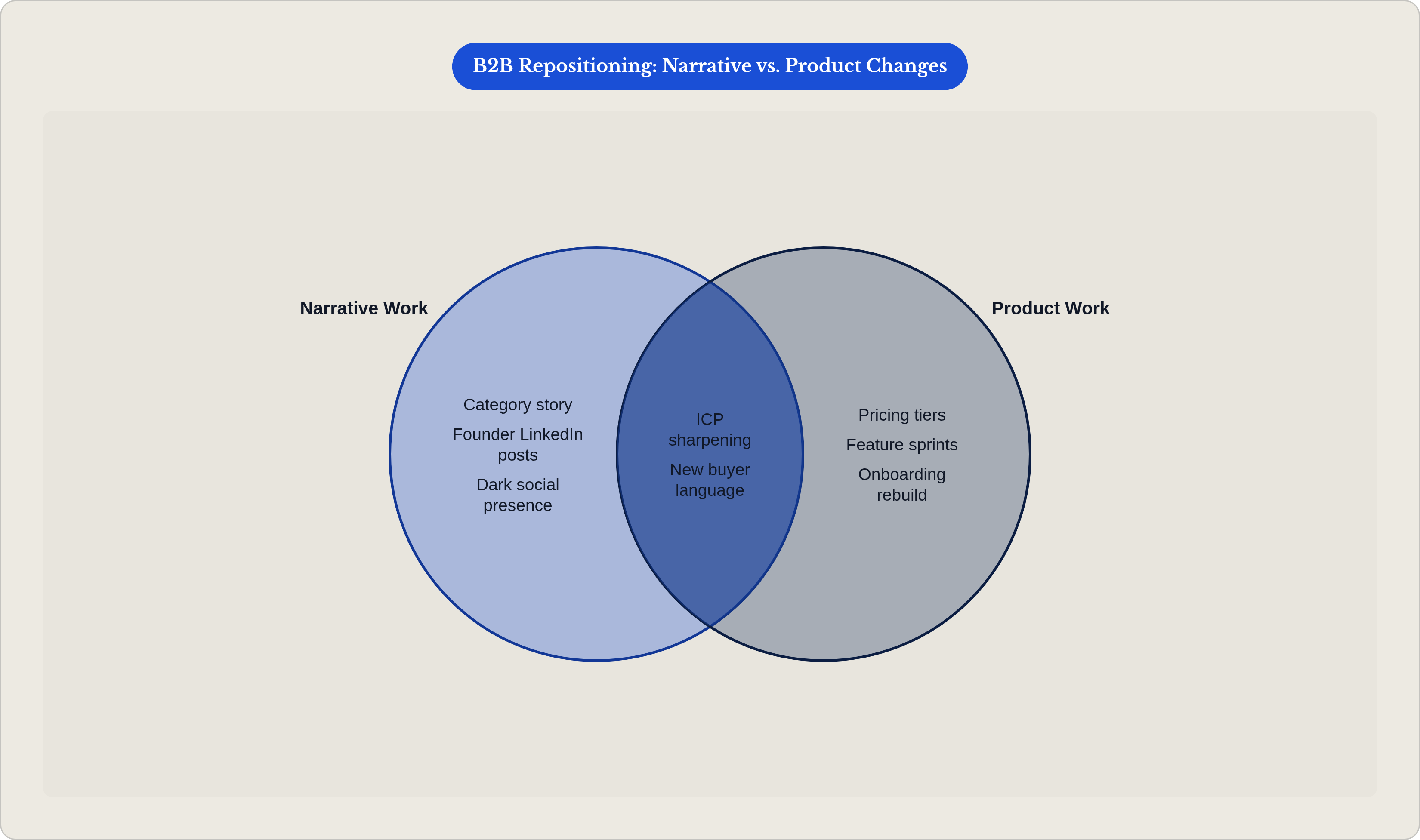
Repositioning a B2B SaaS product goes beyond a pricing exercise or a feature sprint. It is a narrative fight, and the founders who win it reframe how the market thinks about their category in public, months before a single sales call happens. Everything else, the new pricing tiers, the rebuilt onboarding flow, the shiny new homepage, is decoration on a house nobody's walked into yet.
Here's the instinct almost every founder follows when growth stalls: tweak the price, ship a feature, redo onboarding. Makes sense on paper, but none of it touches the actual problem. Buyers already filed your product into a mental folder, and that folder decides who evaluates you, what they compare you to, and whether you even make the list. Changing what the product does doesn't change what the market believes it does. Those are two different jobs, and only one of them is a narrative job.
So repositioning has three sequential problems to solve: sharpen the ICP, build a new category story, and run a deliberate campaign to replace the old mental model. All three happen in public. Let's walk through it.
How B2B buyers form their shortlist before a founder ever knows they exist
By the time a buyer emails you, the deal is mostly decided. A significant majority of B2B buyers have already picked a front-runner before they contact any vendor, and that front-runner wins the overwhelming share of deals that follow. Being first on the mental list beats being best in the bake-off, and nobody tells you this in sales training, but it's the whole game.
What that means for repositioning: stop trying to win the late-stage comparison. You're trying to be the name that pops into someone's head the moment they first articulate the problem to themselves.
And that name gets planted somewhere you can't see. Peer Slack communities, private LinkedIn DMs, a podcast recommendation someone mentions in passing, a gated forum thread. Dark social, basically, the layer of B2B research that never shows up in an attribution report. Somebody recommended your competitor in a DM last week and your CRM has no idea it happened.
If the old narrative about your product is still living in those private channels, no amount of website copy is going to dislodge it. And now there's a compounding wrinkle: a growing share of buyers run their research through AI tools before they ever talk to a human, and those tools surface whatever narrative shows up most consistently across public content. Feed the machine the wrong story for three years, and it'll keep telling that story back to buyers with total confidence.
A relaunch announcement won't fix this. What works is a sustained, founder-voiced narrative that actually travels through the channels where shortlists get built.
Why the existing mental model is stickier than founders expect
Mental models in B2B are peer-reinforced, which is a polite way of saying they're gossip with better production values. Once a category label sticks to your product, buyers repeat it to colleagues, and the label spreads on its own, no marketing required. You could shut down your entire content team tomorrow and the old story would keep circulating just fine without you.
Here's the compounding problem: your earliest customers, your earliest press hits, your earliest LinkedIn posts, all of it encoded the old frame. That content is still out there, still ranking, still shaping how new prospects interpret you. It's like a photo from your awkward middle school phase that keeps resurfacing at family gatherings. Technically accurate at the time, but deeply unhelpful now.
And when a founder stands up and says "we're not that anymore," buyers apply instant skepticism. Self-reported repositioning is the least trusted evidence available; nobody believes the company grading its own homework. What actually moves the needle is third-party endorsement: peers reframing the problem to other peers, credible voices outside your payroll using your new language because it's true, not because you asked them to.
That creates a strange paradox. The place you most need to change the story is a place you don't control, using voices you don't own, which means your personal credibility and reach, as a founder, become the lever. Consider two companies with the exact same repositioning ambition. One updates its homepage, fires off a press release, moves on. The other has a founder who spends six months publicly, relentlessly reframing the problem their category solves, one LinkedIn post at a time. The market responds to exactly one of those approaches. Guess which.
Sharpening the ICP as a prerequisite to any new story
The single most common mistake in repositioning: writing the new story before deciding whose problem it actually solves. Founders get excited about the narrative and skip the homework, then wonder why nobody bites.
ICP work for repositioning isn't the same exercise you did at launch. Back then the question was "who could use this." Now it's "whose language already echoes the frame I want to own." Different question, different answer.
Here's the practical method. Go interview the customers who found you through the new use case, the ones who arrived at the new frame before you'd even articulated it publicly. Ask them what words they used to describe the problem before they knew your product existed. Those words, not your words, not your marketing team's words, are the raw material for everything that follows.
This step also forces an uncomfortable decision: repositioning almost always means walking away from some existing buyers whose mental model is exactly the one you're trying to kill. Founders resist this because it feels like shrinking the market on purpose, which, fair, it kind of is. But a narrow, precise story reaches the right buyers with enough clarity to actually move them, while a story trying to please everyone moves no one.
The output here is specific: a buyer archetype with named fears, named aspirations, and the exact private language they use to describe their problem. That's the foundation. Skip it, and the category story you build next has nothing to stand on.
Constructing the new category story
A category story goes well beyond a tagline, a positioning statement, or a refreshed homepage hero section. It's an argument, coherent from front to back, about why the old way of solving a problem is broken and what a better frame looks like instead.
The structure looks something like this. Name the old frame explicitly, what has the market been calling this problem, and why does that framing fall short. Then articulate the cost of staying inside it, what buyers are losing or risking by clinging to the old category. Introduce the new frame, not as a feature bullet but as a genuinely different way of understanding what the problem actually is. And make it falsifiable. A category story needs sharp edges, argument and substance rather than the polish of ordinary marketing copy, and somebody needs to be able to disagree with it.
That last part matters more than founders think. The opinionated version of the story is the one that travels. Nobody screenshots a diplomatic, all-inclusive frame and shares it in their Slack community. People share the provocative claim, the one with an edge.
Take a company that repositioned from "project management tool" to "operational accountability platform." The old label put them in a crowded, commoditized evaluation full of feature checklists, competing against a dozen tools that all looked the same on paper. The new label got them into a different room entirely, conversations with operations leaders about accountability and outcomes, at a more senior level, against a completely different set of alternatives. Same underlying software, different conversation, different buyer, different price ceiling.
That story has to be founder-voiced from day one. You can't launch it from a company blog and expect it to carry personal weight. Research from Edelman and LinkedIn has found that a large share of B2B buyers trust thought leadership content more than a company's own marketing materials as a signal of real capability. The category story, delivered as a founder's point of view, carries a trust premium that product marketing simply can't buy.
Why the founder's LinkedIn presence is the primary distribution channel for a repositioning campaign
LinkedIn is where B2B categories actually get formed. It's the rare public channel where the dark social layer and the measurable, trackable layer overlap, which makes it uniquely valuable and uniquely underused by most founders who'd rather hide behind a company page.
Personal profiles get dramatically more organic reach than company pages. The platform's algorithm favors individuals over entities, because a person's post reads as conversation and a company's post reads as an ad, even when the words are nearly identical. That's not a conspiracy, it's just how the incentives shake out.
There's a trust asymmetry underneath all of this. A repositioning claim from a company page triggers marketing skepticism instantly. The same claim from a founder who's been posting consistently on the topic for months reads as conviction, because consistency is the tell, and you can't fake six months of posts.
There's also an AI layer now. Tools like ChatGPT, Perplexity, and Google's AI Overviews increasingly pull from LinkedIn profiles when answering professional questions, so a consistent founder narrative shapes how AI-assisted buyers encounter you long before they'd ever visit your site. And LinkedIn's user base skews heavily toward the seniority levels who actually control B2B SaaS budgets. This isn't a general audience you're broadcasting to. It's specifically the people whose minds you're trying to change.
The company page still has jobs to do: search legitimacy, ad targeting, official announcements. But the repositioning narrative itself needs to live on the founder's profile, because that's the only place it carries the personal credibility that makes anyone believe it.
What a deliberate repositioning content campaign actually looks like in practice
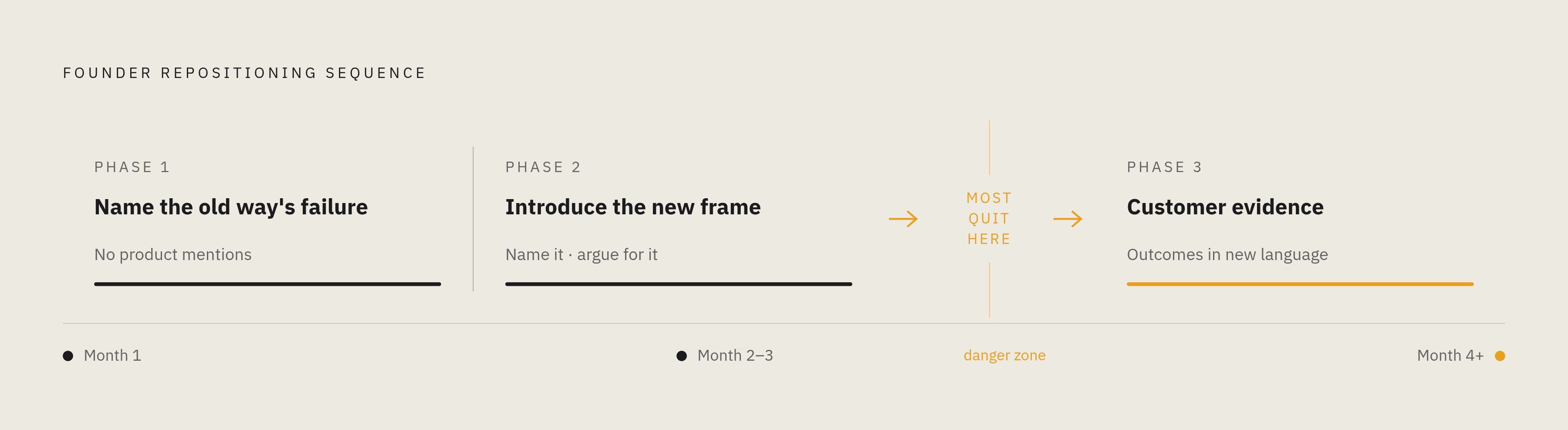
Repositioning through content unfolds as a sequence, built over months, not weeks, that slowly accumulates into a new mental model.
Phase one: establish the problem frame. Posts that name the old way of thinking and explain, plainly, why it's failing buyers. No product mentions, none. The only goal here is to make the audience feel the inadequacy of the frame they've been living in.
Phase two: introduce the new frame. Give the new category language a name and an argument. Opinionated, specific, willing to take a punch from someone who disagrees. This is where the founder's voice needs to be sharpest, because a mushy new frame is worse than no new frame at all.
Phase three: produce evidence. Customer stories, use cases, outcomes, all described in the new category's own language. Proof the story describes reality, not just ambition.
On format: text-only posts carry the most credibility for an argument like this, because they read as thinking out loud, not as a marketing push. Carousels work well for laying out old-frame-versus-new-frame side by side; they hold attention and the algorithm rewards that. Short founder video adds a human signal nothing else replicates. Keep production values low. Polish signals budget, while rawness signals conviction, and conviction is the entire point.
Cadence beats volume every time. Two or three substantive posts a week that build one thesis will beat daily posting that wanders across five topics. And the content needs to be sharp enough that it survives being copy-pasted into a private Slack channel; generic, safe content just doesn't travel, no matter how often you hit publish.
Expect this to take several months of consistent posting before you see compounding traction. Founders who expect a shortcut quit right before it starts working, which is the most avoidable failure in this entire process. Track progress without clean attribution by watching whether inbound prospects use the new language unprompted, whether sales conversations open at the right framing, and what people actually type when asked how they heard about you.
Amplifying the new narrative beyond the founder's own feed
The founder's feed alone can't replace a market-wide belief. It needs to leak out into channels you don't control, or it stays a nice LinkedIn habit instead of a repositioning.
Podcast appearances are some of the highest-leverage moves available here. A founder laying out the new frame on a show the ICP already trusts gets a credibility transfer from the host that no amount of paid promotion buys. Community presence matters too, showing up in the Slack groups and private forums where your buyers already hang out, not to pitch, but to use the new language naturally when problems come up in conversation.
Co-created content with adjacent credible voices, analysts, practitioners, respected operators who aren't on your payroll, does something a founder repeating themselves can't. When someone else restates your argument in their own words, it stops sounding like a pitch and starts sounding like consensus. And buyers who already believe the new frame are, quietly, your most powerful distribution channel; hand them sharp, shareable language, the kind of line they'd actually paste into a Slack message, and you've activated dark social on purpose instead of hoping it happens.
Most of this will never show up in your analytics dashboard. The signal that it's working isn't a click count. It's the quality of the inbound conversations you start getting.
The internal alignment repositioning requires before the public campaign begins
Here's where a lot of repositioning efforts quietly fall apart: the public narrative changes, but sales is still running the same discovery script from two years ago. A buyer who read three sharp LinkedIn posts about the new frame gets on a call and hears the old pitch. That's a trust rupture, and it happens fast.
The ICP sharpening work has to turn into actual sales qualification criteria. New frame, different buyer profile, different qualifying questions. Customer success and onboarding need the same update, because if old-frame language is baked into your onboarding deck, your newest customers will learn it and repeat it right back to their peers, undoing the work before it's even finished.
There's an underrated side effect here too. When a founder posts consistently in the new frame, it gives the whole team a shared vocabulary, a reference point everyone can point back to. Internal alignment doesn't have to fully precede the public campaign, in fact waiting for perfect internal consensus is a trap that kills momentum. The founder's public content often drags the internal alignment forward by creating outside accountability. Nothing focuses a sales team like a prospect quoting the CEO's LinkedIn post back to them on a discovery call.
How to know whether the repositioning is actually working
Wrong question to ask first: did MQL volume go up this quarter? That's far too blunt an instrument for something that compounds slowly and mostly outside your tracking tools.
Better signals. Are prospects and new customers using the new category language unprompted, in emails, in discovery calls, before your sales team has said a word of it? Are conversations starting at a different seniority level or a different point in the problem framing, evidence buyers are defining the problem differently before they ever reach you? Is your name showing up alongside the new frame in the peer recommendations that surface during win-loss interviews after a deal closes?
And don't skip the low-tech tool here: an open-ended, free-text "how did you hear about us?" field at the point of demo booking. It's clunky, it's not analytics-grade, but it's often the only place a specific post or podcast appearance shows up by name instead of getting swallowed into "direct traffic."
Before any of this shows up in revenue, you'll feel it first in the texture of your pipeline. Inbound conversations that open with the buyer already using your language. Sales cycles that skip the education phase entirely, because the buyer arrived pre-sold on the frame. Objections that argue with the new category instead of the old one. That shift, subtle, unglamorous, impossible to screenshot for a board deck, is what repositioning actually feels like while it's working, and revenue catches up later. It always does.