Messaging Consistency Across B2B Sales and Marketing
Contradictions between marketing and sales messaging kill deals before the first call even happens.

Let's start with the buyer, because that's where the actual damage lands. Not in your internal Slack threads, not in the QBR where marketing and sales argue about lead quality. The buyer is sitting on a call having already done their homework, and the rep is saying something that contradicts what the website said. That's the moment the deal starts to die.
Gartner surveyed 632 B2B buyers and found that 69% report inconsistencies between what they read on a vendor's website and what a sales rep tells them. By the time the rep gets on that call, the buyer has already formed an opinion from your content. Any contradiction between the pitch and what they absorbed before the meeting destroys trust at exactly the moment you need to build it. There's no reset. The story already started without you.
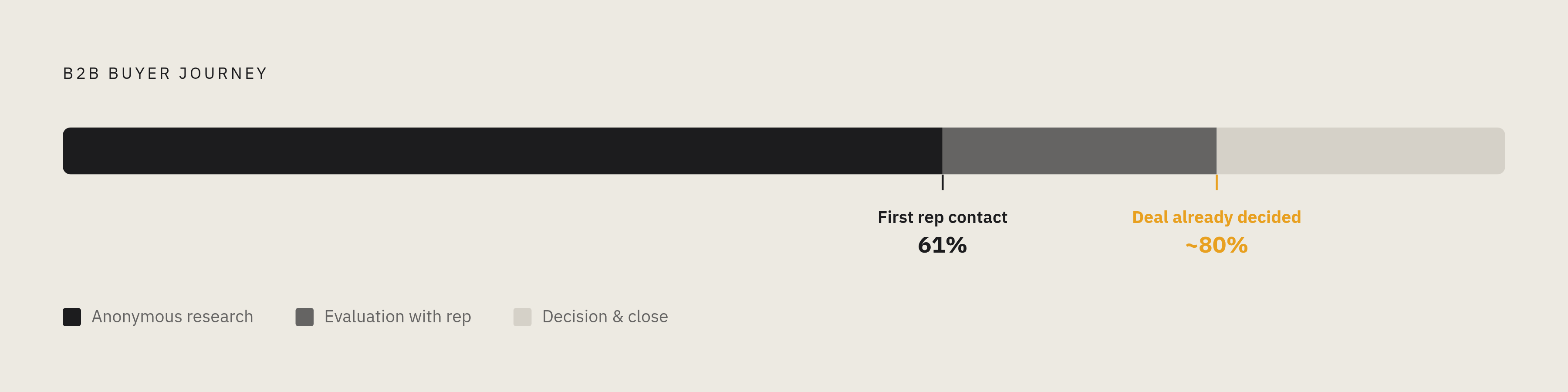
Here's where it gets more complicated. A 6sense study of nearly 4,000 B2B buyers found that buyers are reaching out to sellers earlier in the process than they used to. First contact now happens around 61% of the way through the journey, down from 69%. That sounds like progress. It's mostly not, because the anonymous research phase still owns the majority of the process, and whoever the buyer has mentally shortlisted going into that first call wins the deal roughly 80% of the time. Marketing tells the story when the buyer is invisible. Sales inherits whoever shows up. If those two stories don't match, no amount of rep charisma fixes it. The misalignment already happened before the calendar invite went out.
Then throw in buying groups. Forrester puts the average B2B buying group at 13 people. Each one encounters your messaging through different channels at different times. That's just more surface area for the story to crack.
And then there's AI, which has introduced a genuinely strange new wrinkle. Gartner found that 45% of buyers used AI during a recent purchase, but 69% of those same buyers still turned to a sales rep to validate what the AI found. The problem: AI pulls from indexed content, which often means it's surfacing your own published materials. If the rep contradicts what the AI already told the buyer, the buyer can trace that contradiction back to your own website. It's not rep-versus-homepage anymore. It's rep-versus-everything-you've-ever-published, which is a harder position to talk your way out of.
One more number worth sitting with: 73% of B2B buyers actively avoid suppliers who send irrelevant outreach. To a buyer, inconsistency and irrelevance feel basically the same. Both signal that you don't actually understand their problem.
How Content Created in Isolation Becomes the Default Sales Script
What actually happens when content and sales operate in separate silos is pretty predictable, and also kind of depressing.
Mediafly research puts the percentage of sales enablement content that goes unused at up to 70%. Months of work, skipped entirely. The reason isn't hard to find. 57% of sellers say they largely ignore marketing content because it feels generic and disconnected from the real objections they hear on calls. So reps write their own version. That version reflects their individual experience, their region, how long they've been at the company, and whatever happened to work last quarter. Not the company's intended story.
Meanwhile, 59% of marketers believe they know what sales teams need. Only 35% of sales reps agree. And 68% of marketers believe reps aren't using content to its full potential. There's a question buried in that gap that almost never gets asked directly: are reps failing to use the content, or is the content failing the reps?
Content built without sales input addresses the problems marketing assumes buyers have. These are rarely the objections buyers actually raise at the end of a deal, when things get real. The result is a library of assets that handles early-stage awareness reasonably well and leaves reps with nothing useful to pull from when the conversation turns to pricing, implementation timelines, or the competitor the buyer casually mentioned on slide two. Reps fill that vacuum with improvised talking points that vary by person and shift every six months. Think of it like a map that's detailed at the trailhead and completely blank by the time you reach the hard part.
Gartner's 2024 survey of 412 senior leaders found that marketing and sales collaborate on just 3 out of 15 key commercial activities. Content development is rarely one of the three.
The fix is structural and has to happen early. Sales input needs to come in at the brief stage, before anything is written. Once a draft exists, the gap between what's written and what's actually needed is already baked in. You're just negotiating around it from that point forward.
A Shared Messaging Framework as the Single Source of Truth
A messaging framework is not a brand guideline. Not a pitch deck. It's a structured document that captures the core value proposition, key messages, supporting proof points, and audience variants. The thing both teams draw from without needing to interpret or translate anything on the fly.
One practical model is the Message House, and the visual is intentional.
Roof: One overarching value statement. Broad enough to hold across audiences, specific enough to actually differentiate you.
Pillars (three to four): The distinct drivers of value that support the roof. Each reinforces the others. No overlap.
Foundation: The proof points, case studies, and data that validate each pillar.
A sales engineer and a demand gen manager can look at the same structure and immediately locate where their message sits. That shared orientation is the whole point. You stop having a version for marketing and a version for sales. You have one version, with context for who's using it and when.
The framework also has to flex without falling apart. A CIO cares about security and scalability. A marketing ops lead cares about usability and reporting. Same roof, different pillar emphasis. That's the framework doing its job. Same logic applies by journey stage: "why change" in awareness, "why us" in consideration, "why now" at decision. The emphasis shifts. The underlying story doesn't.
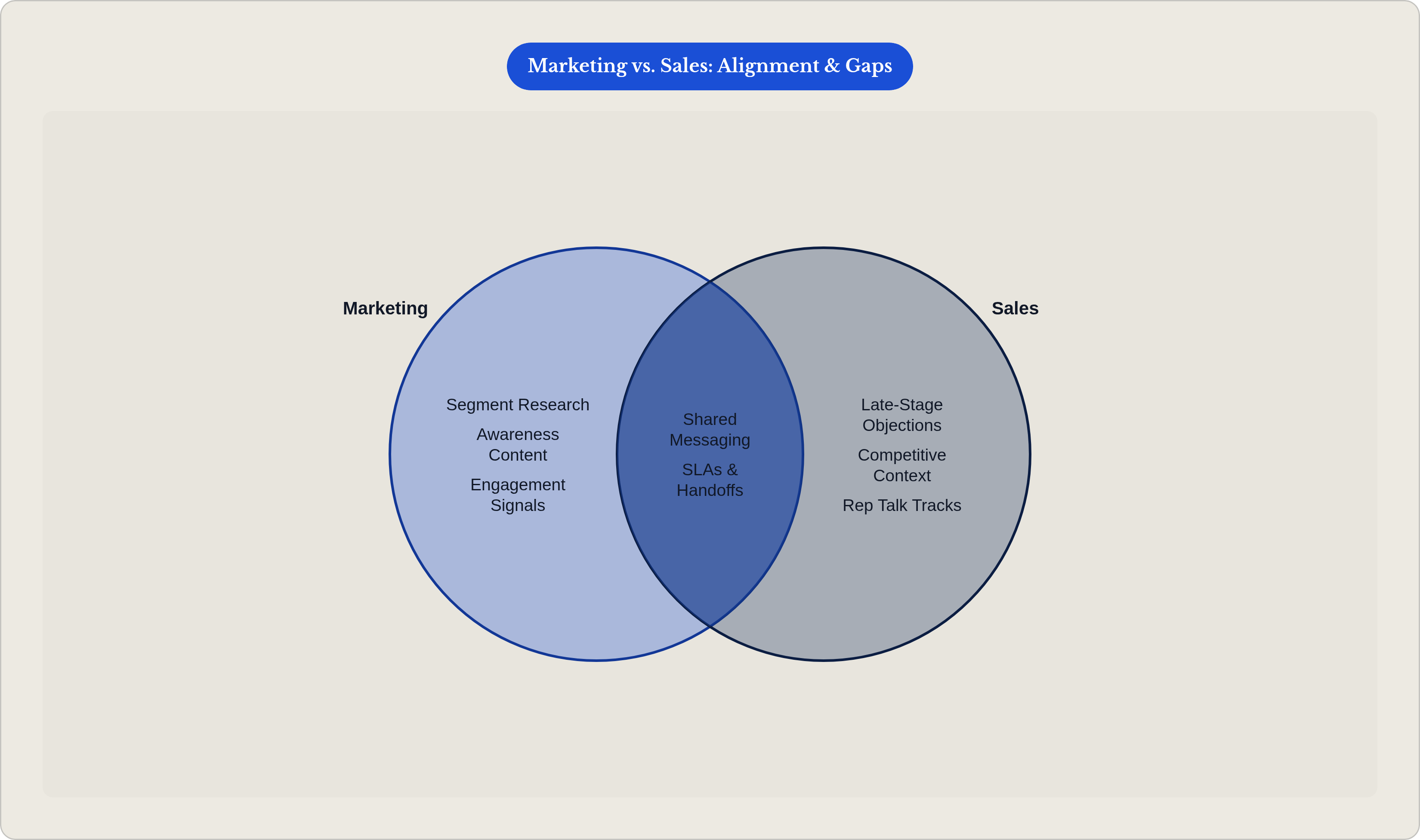
None of this works unless both teams actually build it together. Sales brings late-stage objections and competitive context. Marketing brings segment research and positioning. Joint authorship also produces something harder to manufacture: real buy-in. Reps who helped build the framework don't route around it. They built it. It's already theirs.
Nearly half of go-to-market leaders say sales messaging and positioning is a top priority in 2025, per Highspot's State of Sales Enablement Report. The appetite exists. What most teams are still missing is the structure to act on it.
Defining Shared Agreements on Leads, Handoffs, and What "Qualified" Means
A messaging framework without agreed handoff criteria just creates a different kind of inconsistency. Both teams tell a coherent product story and still disagree about who the story is for and when someone is ready to hear it. That disagreement shows up in the buyer conversation, usually as confusion that nobody on your team can quite explain afterward.
Start with a shared Ideal Customer Profile. Firmographics, pain profile, buying triggers, disqualifiers. If marketing is optimizing content for one audience while sales is pursuing a different one, your message can be internally consistent and still land with the wrong person every time. Consistent doesn't mean effective.
The MQL-to-SQL conversion rate is where the gap becomes visible fast. The median for B2B sits around 13%, per Salesforce's 2024 State of Marketing Report. Top-performing organizations convert at 25% or higher. The difference, more often than not, comes down to whether both teams genuinely co-own the MQL definition. When marketing and sales agree on what "ready" actually means (not in theory, but in practice, in writing) fewer leads disappear in the seam between departments.
Service Level Agreements make the handoff accountable rather than aspirational.
Marketing's SLA: Volume, quality, and stage-readiness of leads delivered.
Sales's SLA: Follow-up timing, quality feedback, and reporting on which messages landed.
SLAs convert the handoff from an informal gesture into a documented process. They also create a paper trail when something breaks. That's not about blame. It's just useful information you can actually act on. You can't fix what you can't see.
Without shared definitions and SLAs, a prospect can receive a perfectly crafted nurture email on Monday and hear a completely different story from a rep on Thursday. Both interactions are technically "on-brand." Neither one was coordinated.
Feedback Loops That Keep Messaging Current as Markets and Conversations Evolve
A framework built once and filed quietly becomes the thing it was designed to replace. Stale messaging nobody trusts enough to actually use.
The information problem runs in both directions, and that's the part most teams don't fully reckon with. Sales hears objections, competitive mentions, and new pain points on every call. That information almost never makes it back to the people writing content. Marketing tracks engagement signals and emerging search behavior. That intelligence almost never reaches the rep preparing for a call. Both teams are holding half the picture and making decisions accordingly.
The mechanisms that close this gap don't need to be complicated.
Win/loss debriefs: Structured questions about which messages moved the deal and which ones prompted pushback. Input goes directly into framework updates.
Call recording review: Marketing listens to how reps describe the product in late-stage conversations. It surfaces both drift and effective improvisation worth standardizing.
Shared CRM fields or channels for message flags: Reps log when a prospect reacts with confusion or cites a contradiction. Low friction, high signal.
Quarterly messaging reviews: Scheduled, not reactive. Both teams look at what's changed in the market, the competitive landscape, and buyer language, then update the framework accordingly.
Distribution matters just as much as the update itself. And this is where most teams drop the ball quietly. Content updates after a messaging change take at least three months to propagate through field assets for most organizations. That means reps are often delivering the old story well after marketing has moved on to the new one. The feedback loop has to include a mechanism for getting updates into the hands of reps, not just into a shared drive that nobody looks at unless they're searching for something specific.
When feedback flows in both directions consistently, alignment doesn't stall at the MQL handoff. Marketing starts to understand late-stage objections. Sales starts to understand early-stage engagement signals. The message holds across the whole funnel because both teams are looking at the same picture.
Governance: Who Owns the Framework and How Updates Actually Ship
Most messaging frameworks don't fail at the design stage. They fail in maintenance, and the failure is usually quiet. No one is clearly accountable for keeping things current, so the framework drifts until a rep says something on a call that contradicts the homepage and someone finally notices the story is broken. By then it's been broken for a while.
Every core GTM asset needs three things.
Owner: One named person accountable for the asset's accuracy. Not a team. A specific person.
Review date: A scheduled expiration that forces a check regardless of whether anything feels broken yet.
Trigger list: Predefined events that require an immediate review (competitive product launch, pricing change, new customer segment, a significant win/loss pattern). Trigger lists make the review call objective rather than political. It's not called because someone has a hunch. It's called because a defined condition was met.
Naming one owner from each team (a messaging lead in marketing and a sales enablement counterpart) creates a two-person check. Neither team can update the framework unilaterally. That's not bureaucracy. That's quality control. There's a difference.
Distribution still needs to be treated as its own step. A revised framework that lives in a shared drive but never surfaces in a rep's actual workflow is functionally nonexistent. Updates need to travel through the channels reps actually use: the enablement platform, the CRM, the pre-call brief. Short change notes covering what changed, why it changed, and what reps should say differently are what actually get read. Nobody opens a 40-slide update deck on a Tuesday morning. They read a three-bullet summary, maybe.
One distinction worth being clear about: a rep adjusting tone for a specific buyer or leaning into one pillar over another is the framework working as intended. Undocumented departures from the core story are drift. Governance exists to protect that line, not to eliminate judgment.
Embedding Consistent Messaging into How Reps Are Trained and Coached
A framework reps haven't practiced is not the same thing as a framework reps use. That gap shows up in the buyer conversation, usually at the moment it's hardest to recover from. Late in a deal, in front of multiple stakeholders, when the story needs to hold.
The sales playbook is how the framework travels from document to actual conversation. Playbooks translate the core story into practical tools: talk tracks, objection responses, discovery question banks, competitive positioning cards. All anchored to the same story. Without that translation layer, reps are left to interpret the framework on their own, and individual interpretation at scale is just another form of inconsistency (with a few extra steps).
Sending reps a PDF and calling it training is how organizations manufacture the illusion of readiness. What actually builds consistency is practice. Message certification programs where reps demonstrate they can deliver key messages accurately. Role-play scenarios built around real objections, not hypothetical ones. Recorded run-throughs that managers can review and coach against specifically. The reps who build the clearest, most consistent buyer stories aren't the ones who memorized the framework. They're the ones who practiced it enough that it became their own language, because you can't own a story you've only ever read about.
Training is a moment. Coaching is what keeps the moment from fading three weeks later.
Call reviews, pipeline conversations, and deal debriefs should all include a messaging dimension. Did the rep's story align with the framework? Where did they adapt well? Where did they drift in ways that probably cost them something? Managers who coach to messaging regularly make consistency a live standard rather than a launch event that happened eight months ago and lives on a slide somewhere.
The goal isn't robotic uniformity. It's a team where every rep can answer the same three questions the same way: what problem do we solve, who do we solve it for, and why us over the alternative. After that, the style can vary. The story shouldn't.