Brand Story Template for B2B SaaS Founders
Five narrative layers transform founder stories from timelines into credibility.

B2B SaaS founders write brand stories like changelogs: this happened, then this happened, then we raised money. Fine for a release note, useless for convincing anyone of anything. What actually moves someone from stranger to believer is five layers, built in order, each one doing a job the others physically cannot do.
Before we get to the layers, worth knowing what your buyer already did before you ever landed a meeting. The 6sense 2025 B2B Buyer Report puts it at 61% of the decision finished before a vendor conversation even starts. Eighty percent of deals go to whoever was already on the shortlist day one. Nobody earns that seat on a sales call. You earn it months earlier, with a story that made you memorable before anyone needed you.
Investors run the same background check, just with more zeros attached. DocSend found 78% of them look up a founder's writing or talks before taking the meeting. So while you're tightening the market-size slide, someone's already forming an opinion off a LinkedIn post you wrote three weeks ago and half forgot about. The deck confirms. The story convinces.
A brand story has to move three audiences (buyers, investors, recruits) from stranger to believer, with no sales rep in the room to translate. Chronology can't do that. Neither can a feature list. Both answer "what does this do," when the real question underneath all three audiences is "should I trust the person who built this." Skip a layer, or run them out of order, and the story just sits there. Flat. Doing nothing.
The three audiences one brand story must serve simultaneously
Buyers aren't grading your feature set. They're checking whether you understand their problem at a level that's hard to fake, which is why they research the founder before they ever open the pricing page. The 2024 Edelman-LinkedIn B2B Thought Leadership Impact Report surveyed close to 3,500 management-level professionals and found 75% said thought leadership content pushed them to look into a product they hadn't considered before. Call it whatever you want. It's the front door, not a bonus channel.
Investors ask something narrower: is this the person who should own this problem at scale? Everyone's slide says "large market, huge opportunity." They want lived experience instead. A financial model proves you can do arithmetic. A story proves you noticed something nobody else bothered to look at.
Recruits run their own quiet check too, usually while nodding along during the offer-letter walkthrough. Will this place matter in three years, and does the founder actually know why? Almost nobody asks that out loud in an interview, because it feels rude. A good story answers it before they have to.
Same judgment, three audiences: is this founder credible, clear, and convicted? That's why one well-built set of five layers can do the job for a buyer, an investor, and a recruit at the same time, and why a straight product pitch can't. It only ever talks to the buyer. The other two are left standing outside on the porch.
Layer one — the wound: naming the problem you lived before the product existed
The wound is the specific, lived moment that made the problem impossible to ignore, before you had any idea what the fix might look like. Not a market gap. Not a whitespace slide. A moment where something actually broke, and you were standing right there when it did.
This comes first because nobody believes your solution until they believe you lived the problem first. Investors want proof of real market insight, and the wound is the receipt. Anyone can claim insight. Only someone who was in the room can tell you what it smelled like.
Weak version: "I noticed a gap in the market." That's a market research finding wearing a trench coat. Strong version: a specific frustration with a specific cost, told with enough detail that someone can picture the desk, the spreadsheet, the 2 a.m. Slack message that started the whole thing. The gap between those two isn't polish, it's how much you're willing to actually say out loud.
Founders duck this layer constantly because it feels exposed. That exposure is exactly why it works. A polished pitch gets copied by a competitor by Friday. Nobody can copy a wound they didn't live.
Finding yours isn't complicated, just uncomfortable. When did you first feel the problem instead of reading about it somewhere? What did you try that failed outright, and what did that failure cost you, or someone you watched go through it? Sit with those answers before you write a word of copy.
Layer two — the villain: naming the broken system, not just the pain
The wound tells you what hurt. The villain explains why it kept hurting, on a loop, until someone finally named it and built against it. That's the structural flaw, the outdated assumption everyone tiptoes around without questioning.
Buyers trust founders who understand the system, not just the symptom. Investors back founders who can explain why the problem survived this long, and why it cracks now. Neither comes from describing pain well. Both come from diagnosing the cause.
One rule, no exceptions: the villain is never a competitor. Name a rival and your whole story shrinks into a rivalry, and rivalries bore everyone except the two companies fighting them. The villain is the broken status quo, the legacy habit nobody questions, the gap that's sat there so long people assume it's load-bearing.
Gainsight is a clean example. Their villain isn't a rival tool, it's companies running with zero real ownership over customer outcomes. That's an absence, not a competitor. April Dunford makes a similar point with a thought experiment: take the same product, frame it as a "revenue intelligence platform," and it fights bad forecasting. Frame it as a CRM, and it fights fragmented contact data. Same software. Two villains. Two categories.
That's the part most founders miss entirely. Naming the villain also names the category, which quietly decides who you get compared against. Get it right and you've picked your own battlefield. Get it wrong and you're fighting on someone else's terms, in someone else's stadium.
Layer three — the insight: the non-obvious belief that made you build differently
Founders botch this layer more than any other, and not from lack of insight. It's the opposite problem. You've sat with the idea so long it feels like common sense to you, and common sense doesn't sound like insight to anyone else. It's not obvious to the market, though, and closing that gap is the entire job here.
A real insight is something a smart, informed person in your space could reasonably argue with. If nobody could push back on it, it's a platitude wearing a nicer outfit.
Generic: "We believe customer success is important." Sure. So does every company, including the ones that are terrible at it. Sharper: "We believe most SaaS churn happens before onboarding even ends, which means what the industry calls 'customer success' is already too late." Someone can disagree with that sentence, and that disagreement is exactly how you know it's a real position instead of a platitude in disguise.
This layer also fuels your LinkedIn voice, stretched across enough posts to keep you on a buyer's shortlist long before they're ready to buy anything. For investors, it's evidence you see an angle nobody else does, which beats "we got here first" every time.
Simple to state, hard to do: the reader should walk away having learned something they can't unlearn. Once they see the frame, your product stops being one option among several. It starts looking like the only sane response to the problem you just laid out.
Layer four — the origin: why this founder, why now, why not stop
The origin answers what every investor is really circling, underneath all the polite questions about total addressable market: why you, out of everyone who could've built this?
Three questions do the work. Why you: what in your background makes you strangely well-positioned to see this clearly? Why now: what shifted, technically or economically, that makes this the moment, not five years ago, not five years out? Why not stop: what does it actually cost if the problem stays unsolved, and why can't you sit with that cost?
None of this is a résumé. A résumé lists jobs. The origin is the thread connecting them, the pattern that makes this company feel like the obvious next chapter instead of a random pivot after a layoff.
Under current fundraising conditions, "why is this team the one" has quietly become the main underwriting question, often ahead of market size, because market-size slides are cheap to fake and easy to inflate. A real origin story is much harder to counterfeit. That difficulty is exactly why it carries so much weight.
The first three layers built the case: lived experience, a diagnosed cause, a sharp point of view. Origin turns that case into trust, because it proves you're not walking away when things get boring or hard. Belief without staying power is just enthusiasm. Add the origin and it becomes conviction.
Layer five — the change on offer: what the world looks like when the villain loses
Everything up to this point lives in the past and present. This layer lives in the future, and it needs to be specific enough that someone can picture standing inside it, not just nodding along.
It's not a feature list either. Features describe what your software does on a random Tuesday afternoon. The change on offer describes what becomes true for a customer, or a whole category, once the villain actually loses.
Mission statements stay vague on purpose: "We help companies grow faster." Nobody can argue with it, and nobody remembers it by dinner. The change on offer trades that safety for a picture: "The SDR team never sends a cold email that wasn't already warm, because the founder's writing made the first introduction six weeks earlier." One of those sentences you can see happening. The other you forget by lunch.
There's a practical use here, not just a rhetorical one. Per the 2025 Edelman-LinkedIn report, a large share of B2B deals stall because the buying group can't get aligned internally. A specific change on offer hands your internal champion the exact words they need to sell the vision up to a decision-maker who never even joined your calls.
It matters for recruiting just as much, maybe more. Candidates join the change on offer before they join the salary or the equity grant. It answers "why does this company need to exist" in a way that pulls in people who actually want to work the problem, not just cash a check every two weeks.
How the five layers sequence into a single, deployable narrative
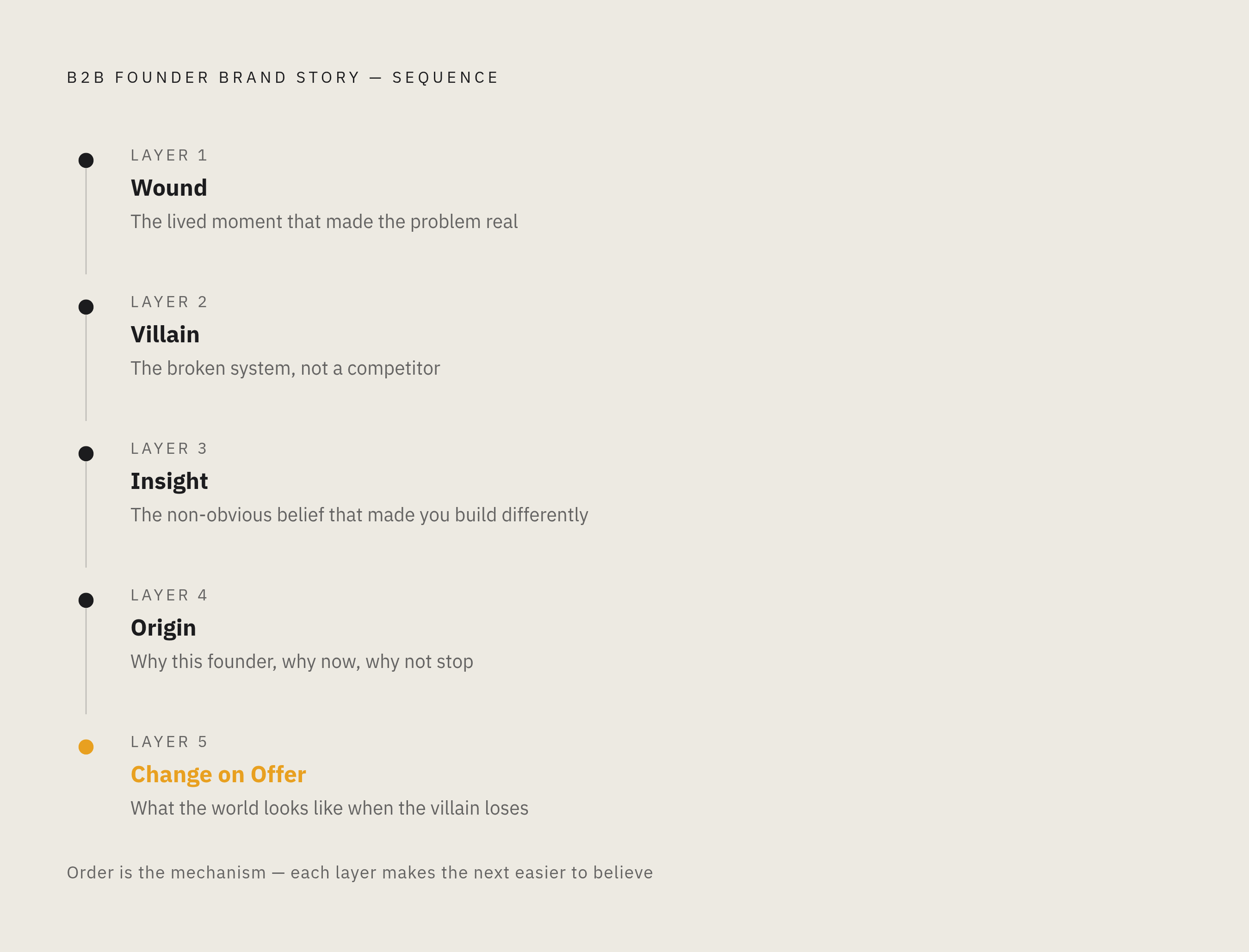
Wound, villain, insight, origin, change on offer, in that order. The order isn't decoration, it's the whole mechanism. Problem, cause, solution, protagonist, stakes: that's the shape of basically every story that's ever landed on a human being. Open with the change on offer, or worse, open with the product, and you're asking for belief you haven't earned yet. At that point it's a pitch, not a story, and pitches get politely ignored in a browser tab somewhere.
Quick gut check: does each layer make the next one easier to believe? The wound should make the villain land harder. The villain should make the insight feel necessary, not clever. The insight should make the origin feel inevitable. And the origin should make the change on offer feel like something you'll actually deliver, not something you're crossing your fingers about.
Format changes the length, not the sequence. In long form (an About page, an investor memo, a careers page) all five layers run across 400 to 600 words. Spoken out loud, in a pitch meeting or on a podcast, you compress wound, villain, and insight into roughly 90 seconds, then cover origin and change on offer in the next 60. On LinkedIn, you don't cram all five into one post; you rotate one layer per post, which is what keeps the whole thing modular instead of a wall of text nobody finishes reading.
There's a distribution reason this matters, and LinkedIn's own B2B Institute research backs it up: at any given moment, roughly 95% of your potential buyers aren't shopping. They're not opening your pricing page today, or this week, maybe not this quarter. The brand story's job is building familiarity with that 95%, so that when they finally cross into the 5% who are ready, you're not a cold email landing in their inbox. You're already the name they trust.
"Repeatable" just means you've got one canonical version of each layer sitting in a doc somewhere, ready to adapt for whatever channel comes next. Otherwise the story splits into five slightly different, slightly contradictory versions of itself, and nobody, including you, can keep track of which version is true.
Where each layer surfaces across channels — LinkedIn, pitch decks, and beyond
LinkedIn does most of the heavy lifting for a founder's personal brand, and the numbers explain why. Personal profiles pull roughly 62% of feed distribution, versus about 5% for company pages, per DSMN8's analysis. The same post gets roughly four times the engagement from a CEO's account as it does from the company page. Post only from the company account and you're shouting into an empty room, politely, to no one.
Different layers suit different formats. Wound and villain fit narrative posts and carousels, and carousels carry the highest engagement rate on the platform at 6.60%. The insight fuels opinionated text posts, the kind that get argued with in the comments, which is exactly the reaction you want. Origin does best on video, sitting at 5.60% engagement, third-highest on LinkedIn. The change on offer belongs in your profile's About section, quietly doing its job every time someone checks you out before a call they haven't scheduled yet.
Pitch decks skip a slide that would make everything after it land harder: wound, villain, and insight, compressed into three sentences, right before the market-size slide. Without it, that market-size number is just a number. With it, the same number feels urgent, because the audience already understands why the gap exists. Standard fundraising advice says to start building investor relationships two to three quarters before you need the check. A brand story, run consistently on LinkedIn during that window, does the relationship-building at scale, no cold outreach required.
On the careers page, the change on offer needs to be specific and visual, not a bulleted list of "values" that could belong to any company in the S&P 500. The origin belongs in the founder's bio, making the company feel like the logical result of a specific person's path instead of a random idea that happened to raise a seed round.
Owned channels (newsletters, podcast guest spots, keynote stages) work best when each appearance develops one layer in depth instead of cramming all five in every time. The wound makes a strong case study. The villain makes a strong category argument. The insight makes a genuinely good provocation on a panel. Pick one. Go deep. Stop there.
Worth watching: AI search tools like ChatGPT, Perplexity, and Google's AI Overviews increasingly pull from LinkedIn profiles when answering professional questions. A structured, consistent brand story on LinkedIn isn't just building trust with someone scrolling at midnight anymore. It's turning into raw material those tools cite when someone asks a question you already answered, five different ways, across five different posts, without ever expecting any of it to end up there.