LinkedIn B2B Lead Generation for Founders
Founder profiles generate eight times more LinkedIn engagement than company pages.
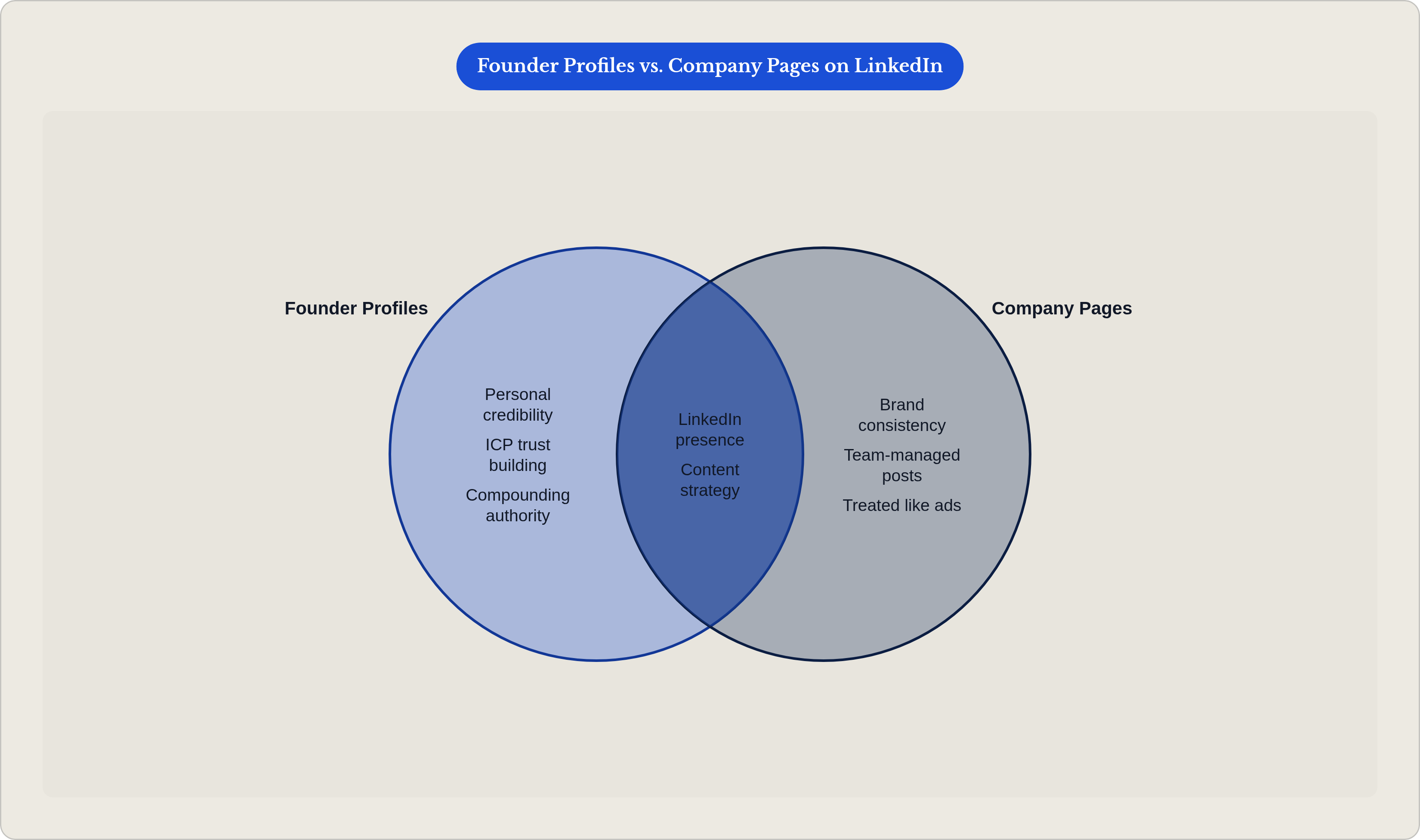
Personal profiles generate roughly eight times more engagement than company pages posting identical content. One feed analysis found that personal profiles account for around 62% of what users actually see. Company pages land at about 5%.
The algorithm logic isn't complicated. LinkedIn surfaces individual voices because they read like conversations. Company pages read like ads, so the algorithm treats them like ads and buries them.
But the trust gap runs deeper than the algorithm. Buyers already know a company page is marketing before they've read a single word. They discount it on sight. A founder writing from direct experience carries something no branded post can fake: the credibility of actually having been there, made the mistakes, and figured something out.
Consider the buying behavior: 78% of B2B buyers research company leadership before purchasing, and 64% are more likely to consider companies where that leadership is visibly active online. That's not a soft preference. That's a decision-making pattern showing up across industries.
This gap between founder profiles and company pages isn't going to correct itself. It reflects how B2B trust actually forms: through people, not logos. A marketing team posting on the company page cannot replicate what a founder showing up in their own voice, consistently, over time actually produces. The returns are different in kind, not just in degree.
What the Engagement Data Actually Tells Founders About Audience Quality
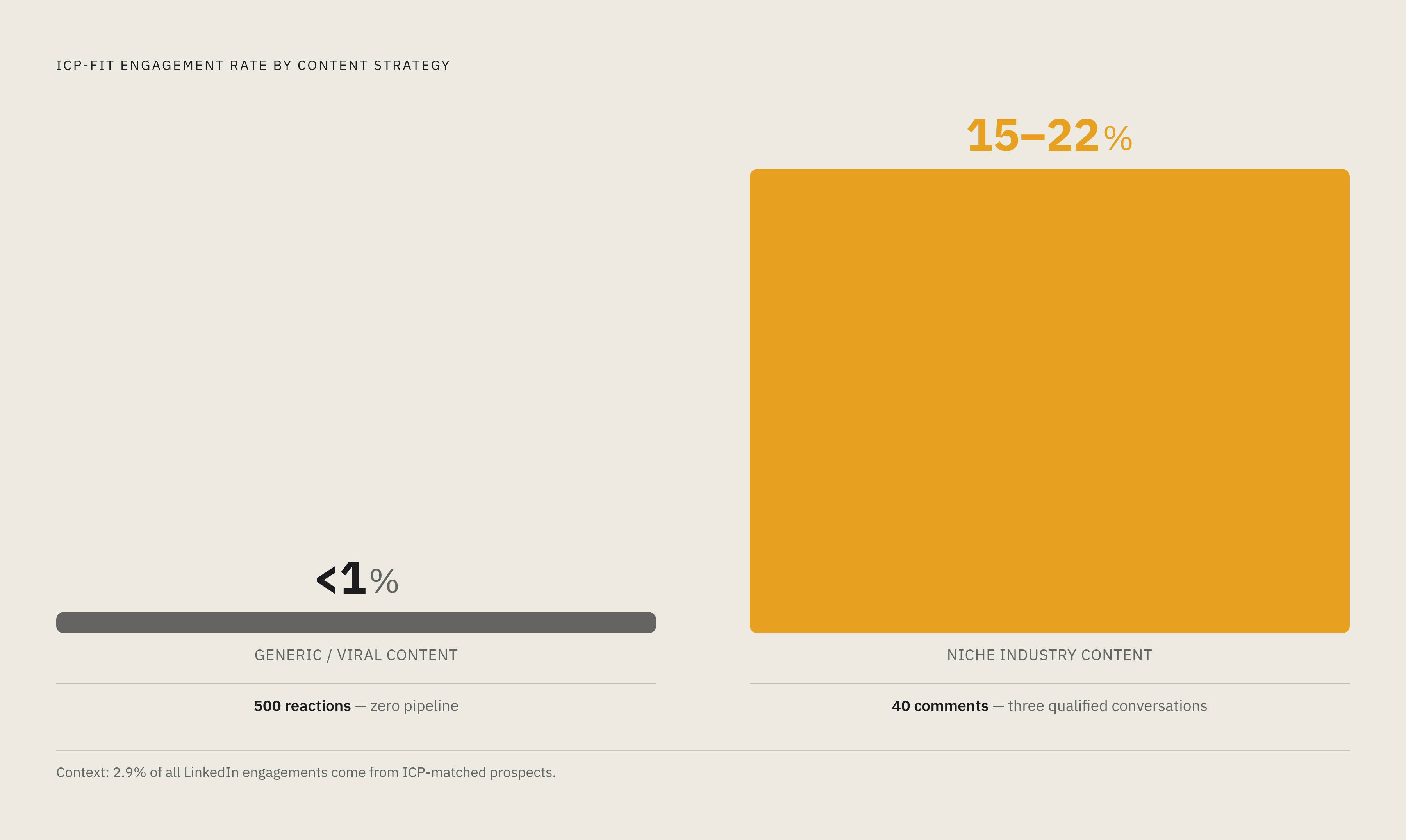
Here's the number that should kill vanity metric obsession: in a large-scale LinkedIn engagement analysis, only about 2.9% of engagements came from prospects matching the ideal customer profile. Roughly 97 out of every 100 engagements are not your buyers.
Look at your last post's likes with that in mind.
The contrast is stark. Niche industry content achieves a 15 to 22% ICP-fit engagement rate. Viral or generic content comes in under 1%. A post with 500 reactions from a broad audience can produce zero pipeline. A post with 40 comments from practitioners inside your ICP vertical can produce three qualified conversations.
Specificity isn't a liability. It's the selection mechanism. When you write for everyone, you reach no one who matters. When you write for a specific buyer about a specific problem they actually have, the people who engage are signaling something about themselves. They're raising their hands.
The goal isn't to maximize reach. The goal is to optimize for ICP resonance. Those are often opposites. Efficiently chasing the wrong one is a very good way to build an audience that never buys anything.
Your Profile Is Doing Conversion Work. Most Founders Haven't Set It Up That Way.
When someone encounters your post and clicks through to your profile, they decide in under ten seconds whether to follow, connect, or keep scrolling. That's the whole window. And most founder profiles are built like resumes, optimized for a job search that isn't happening rather than a sale that is.
Five elements actually drive that ten-second decision:
- Headline. The single highest-impact change most founders can make. It should describe the problem you solve for a specific buyer, not your job title. "CEO at [Company Name]" tells a visitor nothing useful and wastes the most visible real estate on your profile.
- Banner image. Visual space that most founders leave as the LinkedIn default gray gradient. It should reinforce your positioning. It's a billboard. Treat it accordingly.
- About section. Write in first person. Lead with the problem you solve and who you solve it for. Credentials can come later. Most prospects care about your problem-fit before they care about your background.
- Featured section. One strong proof point. A case study, a post that crystallizes your point of view, a lead magnet that gives something genuinely useful. One thing done well beats a cluttered collection of everything you've ever made.
- Recent activity. A profile with no recent posts signals inactivity before a visitor reads a single word about you. It quietly erodes credibility faster than most founders realize.
A founder with a sharp content strategy and a weak profile is sending qualified traffic to a dead end. The profile is the conversion layer. Build it like one.
How LinkedIn's Algorithm Actually Works Right Now
The algorithm shifted meaningfully in late 2025. LinkedIn moved away from weighting raw engagement (reactions, comments) toward what they're calling a "depth score." Time spent with content. Saves. Private DM shares. The signal they're after is whether content is actually worth someone's attention, not whether it triggered a quick tap.
Richard van der Blom's 2025 algorithm research found organic views are down about 50% year-over-year. But engagement per post is up 12%. Fewer people see content. Those who do, engage more deeply. If your content is genuinely good, that's a reasonable trade.
What this means practically:
- Contrarian hooks and engagement-bait questions now underperform. The algorithm identifies and suppresses them.
- Posts with recognizable AI-generated patterns get significantly less organic reach. The algorithm is trained to spot low-effort AI content.
- External links in the post body reduce reach by 20 to 35%. Put links in the first comment.
- Long-form posts with genuine substance outperform. The kind a reader forwards to a colleague rather than scrolls past.
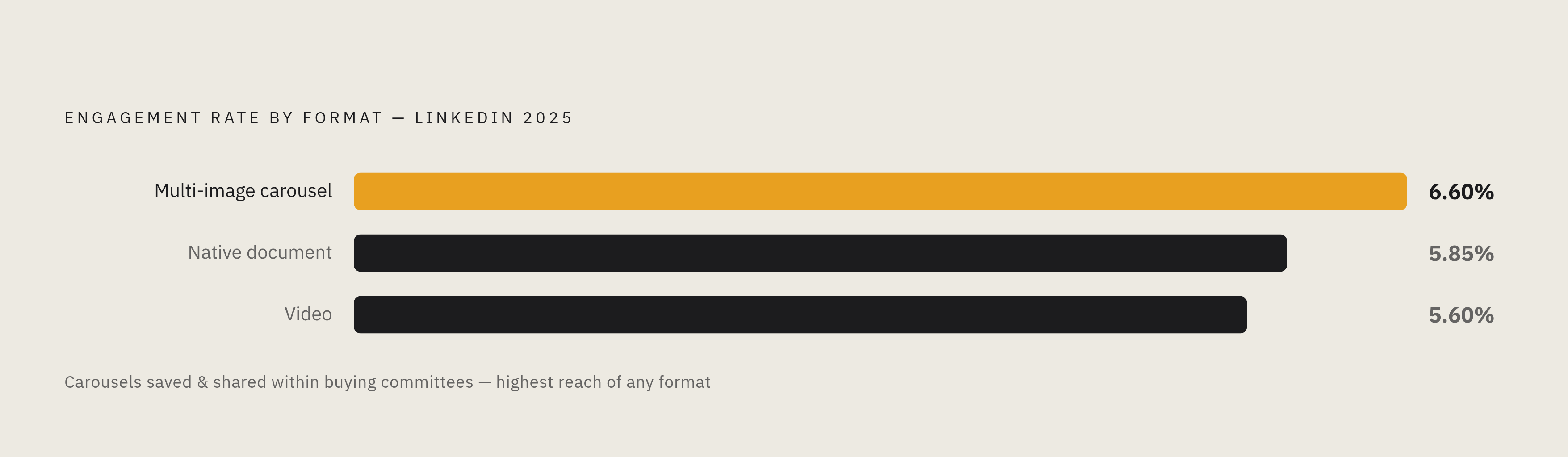
The format hierarchy by engagement rate: multi-image carousels lead at 6.60%, followed by native documents at 5.85%, then video at 5.60%. Carousels do something particularly useful for SaaS founders. They get saved and shared internally with buying committees, spreading through organizations in conversations you'll never see directly.
A Weekly Content Cadence That Won't Destroy Your Calendar
The time problem is real. Adam Robinson built 21 million views and $4M ARR from LinkedIn content. He also spent 65% of his working time on content to get there. Most founders cannot and should not operate at that ratio.
The good news: you don't have to. Here's a weekly structure that actually holds:
- One anchor post. A carousel or substantive long-form text post going deep on a niche topic. Highest-reach vehicle. Worth the most time. One per week is enough.
- Two to three shorter posts. Text-only or single-image. Twenty to thirty minutes each. These maintain feed presence without a major time drain.
- One engagement block. Twenty to thirty minutes of substantive comments on posts from ICP accounts. This is neither optional nor cosmetic. LinkedIn's algorithm counts thoughtful comments toward the commenter's own reach metrics. A specific, insightful comment on a post from a VP of Sales in your target vertical drives more relevant profile views than most paid campaigns will.
Businesses posting weekly get roughly twice the engagement of inconsistent posters. Founders posting five times per week see roughly eight times the pipeline impact compared to sporadic posting. But consistency matters more than volume. Two to three substantial posts per week outperforms daily superficial updates under LinkedIn's current algorithm priorities.
One principle worth keeping: match format to content type, not to whatever's trending this week. A framework works as a carousel. A hard-won lesson works as long-form text. A counterintuitive observation works as a short text post. Forcing the wrong content into the wrong format serves neither the content nor the reader.
The Content That Builds ICP Trust Versus the Content That Gets Ignored
95% of your market isn't shopping right now. That means content cannot read like a product pitch. It has to create demand before intent exists, which is a different job entirely.
What actually moves ICP prospects:
- Thought leadership that names a problem they hadn't yet articulated. Research from the Edelman-LinkedIn 2024 study found that 75% of B2B decision-makers said a single piece of compelling thought leadership prompted them to research a service they weren't previously considering. That's demand creation. That's what content does that ads fundamentally cannot.
- Opinionated takes that challenge weak or overused best practices. When a founder stakes a real position, the people who agree self-identify as potential buyers. The people who disagree leave. Both outcomes are useful.
- Lessons from direct experience. The kind of content only the person who actually built the thing can write. Nobody can copy this. It's the only true content moat a founder has.
What gets ignored: generic industry commentary, anything that hedges every point to avoid disagreement, rephrased news with no original perspective attached.
A useful content mix by funnel stage:
- Top of funnel: Industry trends and challenges. Builds discoverability with people who don't know you exist yet.
- Middle of funnel: Frameworks and case studies. Gives buyers something concrete to evaluate you against.
- Bottom of funnel: Customer outcomes and specific calls to action. But this only lands after trust has already been built. It cannot be assumed.
B2B decision-makers spend three times more time on thought leadership from company executives than on traditional brand content. And 73% say thought leadership is more trustworthy than marketing materials. Worth noting: 66% say they would avoid working with a provider whose thought leadership was poor. Your content is not just a marketing asset. It's a qualification signal working on your behalf whether you realize it or not.
How Outbound Activity on LinkedIn Shortens the Distance to Qualified Conversations
LinkedIn Sales Navigator users with a Social Selling Index above 70 have 45% more pipeline opportunities and are 51% more likely to hit quota than those below the benchmark. Outbound activity on the platform isn't a nice-to-have layer on top of content. It's what makes content work harder.
The comment strategy is the most underrated lever here. Commenting substantively on posts from ICP accounts puts your name in front of the right people in a context that reads as helpful, not salesy. You're demonstrating competence in a place the target buyer is already paying attention, rather than interrupting them somewhere else. That's a different entry point than a cold email, and it lands differently.
On connection requests: personalized requests that reference a specific post or shared context convert significantly better than generic ones. But the connection itself is not the goal. It's the beginning of a relationship that takes weeks or months to become an actual conversation. Treating it as anything faster usually burns it.
On DMs: the first message should give something. A relevant piece of content. A specific observation tied to something they've written. Skip the pitch. A warm DM, sent after a prospect has engaged with multiple posts over time, converts at a completely different rate than a cold message to a new connection. The content does the warming. The outreach closes the remaining gap.
One flag: engagement pods are now a liability. Artificial engagement clusters are detectable by the algorithm and suppress distribution rather than amplify it.
Thought Leadership Compounds. Paid Advertising Stops When You Stop Paying.
Paid ads stop the moment you stop paying. A founder's body of content on LinkedIn keeps surfacing in searches, getting shared, and generating profile visits indefinitely. That's the difference between renting attention and owning it.
The compounding works like this. Each post builds on the last. Your point of view becomes recognizable. Mindshare forms. Your audience grows without an additional cost per impression. After six to twelve months, a consistent content presence becomes a competitive asset a rival cannot replicate by buying ads. They'd have to start from scratch and wait.
Companies with active thought leaders see 2.7x more qualified leads than competitors without them, per HubSpot research. That gap widens over time, not closes.
There's also a direct effect on your sales team's day-to-day. Research from the Edelman-LinkedIn 2025 study found that 95% of hidden decision-makers say thought leadership makes them more receptive to outreach from a company's sales team. Prospects who have already encountered a founder's thinking are meaningfully easier to close than cold contacts. Your content is doing pre-sales work around the clock without needing to be managed.
And the compounding reaches pricing power. Research from the Edelman-LinkedIn 2024 study found that 60% of decision-makers say strong thought leadership makes them willing to pay a premium for that company's services. This isn't just about pipeline volume. It's about margin. That's a different and more interesting conversation.
The LinkedIn Newsletter Is the Asset That Survives Algorithm Shifts
Here's the structural vulnerability in any LinkedIn content strategy: the audience belongs to LinkedIn, not you. An algorithm change or a platform decline can erase years of built-up reach in a single quarter. It's happened on every platform that has ever mattered.
A LinkedIn newsletter list is different. Subscribers are an owned asset. They persist regardless of what LinkedIn does to its feed algorithm next quarter or the quarter after.
Over 184,000 newsletters are now published on LinkedIn. The format has become a standard channel for sustained industry engagement. Most founders start one too late, after the compounding would already have been working for them for months.
The newsletter does two distinct things worth separating:
- Retention. It keeps warm prospects in a regular relationship with your thinking between active purchase moments. The buyer who isn't ready today is still reading. When they're ready, you're the obvious call rather than a vague memory.
- Depth. It allows for longer-form content that builds substantive authority a feed post simply cannot. There's a real difference between having a memorable take and having a body of work. The newsletter is how the latter gets built.
Start before you feel ready. The compounding value of an early subscriber list follows the same logic as early content investment: the best time was months ago, and waiting another quarter doesn't improve the math.
How a Founder's LinkedIn Presence Affects Fundraising, Not Just Pipeline
This surprises founders who treat LinkedIn purely as a sales tool. Around 84% of investors research founders on social media before meetings, and 77% of VCs specifically pull up founder LinkedIn profiles before agreeing to take a meeting. Founders with active, authentic LinkedIn presence raise approximately 23% more in funding rounds.
The mechanism is the same one at work in the sales pipeline. Investors form a view of a founder's credibility, clarity of thinking, and category authority before the pitch deck is ever opened. Your LinkedIn presence is the first pitch. Most founders are unaware they're already giving it.
What investors are actually looking for when they pull up your profile:
- Evidence that you understand your market deeply. Content that demonstrates judgment, not just enthusiasm. Anyone can be enthusiastic about their own startup. Few can articulate why the market is wrong about something and back it up with specific reasoning.
- Consistency of point of view. A founder who has been articulating the same thesis for months or years, with the nuance that comes from doing the actual work, signals conviction. That matters enormously to investors who are betting on a person as much as a business model.
- Engagement with the category. Are smart people in the space engaging with your thinking? Do you engage back thoughtfully? These are social proof signals investors read quickly and weight heavily without always saying so explicitly.
The founder who has been building in public, sharing lessons and frameworks and hard-won opinions over time, walks into a pitch meeting with a credibility foundation the founder who just polished their deck cannot match on short notice. The pitch isn't where the investor makes up their mind. It's where they confirm what your LinkedIn presence already told them.