Social Selling Index and Measuring LinkedIn Sales Effectiveness
The score rewards activity volume, not sales results or relationship depth.

The LinkedIn Social Selling Index is not a revenue metric. It never was. It's a behavioral diagnostic built to tell you whether you're showing up on LinkedIn in ways that correlate with sales effectiveness. Use it like that and it's genuinely useful. Use it as a scoreboard to optimize for its own sake and you'll end up with a 78 SSI, a packed calendar of meetings that go nowhere, and a very confused pipeline.
Here's what the score actually measures, where it falls apart, and how to build a measurement system around it that actually connects to revenue.
How the Four Pillars Are Scored and What Behavior Each One Actually Rewards
The SSI runs from 0 to 100, updated daily, based on a rolling 90-day window of activity. The score benchmarks against your industry peers and your network, so it's always a relative number, not an absolute one. LinkedIn launched it in 2014 as a way to gamify B2B sales behavior and, let's be honest, to incentivize Sales Navigator adoption. Understanding that origin explains both what the score does well and where it quietly misleads you.
Four pillars. Each worth up to 25 points. Equally weighted.
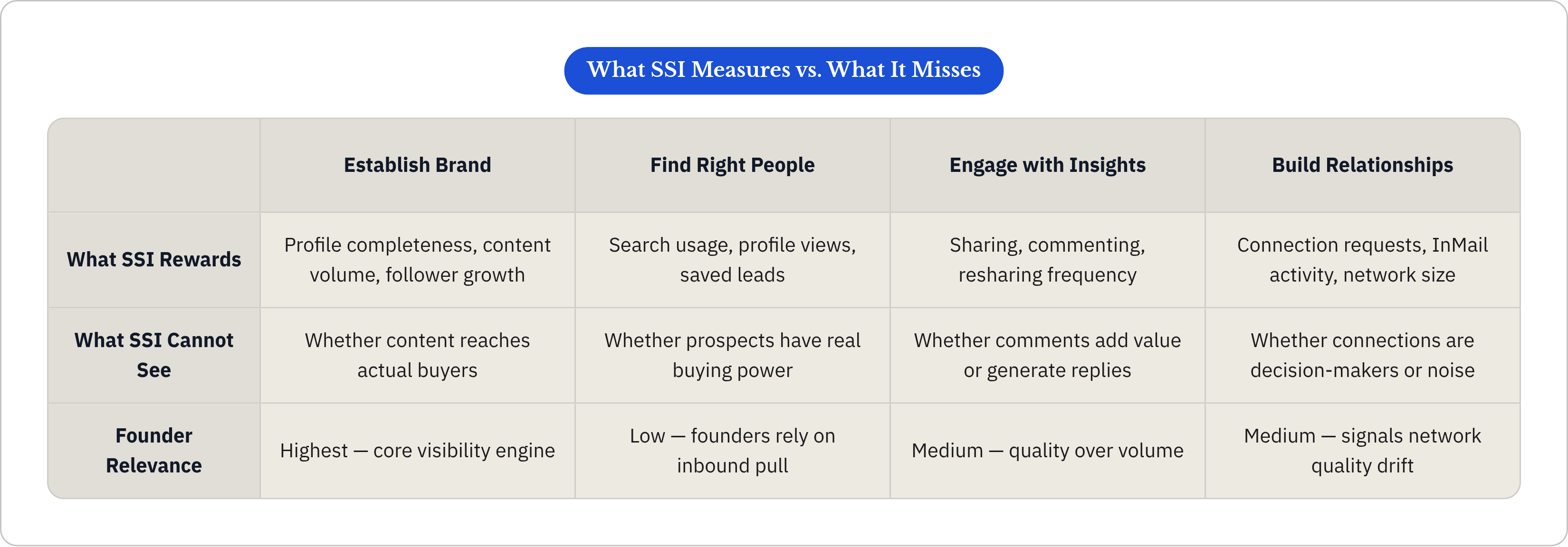
- Establish your professional brand. Profile completeness, content you publish, follower growth. Rewards visibility and perceived credibility on the platform.
- Find the right people. Search filter usage, profile views of prospects, saved leads. Rewards prospecting behavior, not prospecting quality.
- Engage with insights. Sharing content, commenting, resharing relevant posts. Rewards activity volume and consistency more than quality.
- Build relationships. Connection requests sent and accepted, engagement with decision-makers, InMail activity. Rewards network expansion, not relationship depth.
Notice a pattern. Every single pillar measures an action, not a judgment. LinkedIn can see that you viewed a profile. It cannot see whether that profile belonged to a real buyer or a random junior hire you found by accident. It can see that you sent a connection request. It cannot see whether your message was compelling or pure boilerplate.
Two reps can post the same volume of content, send the same number of connection requests, and score identically on SSI. One is booking qualified meetings weekly. The other is generating nothing but noise. The score cannot tell the difference — it's like a fitness tracker that counts your steps whether you're running a marathon or pacing the kitchen at 2 a.m.
A score above 70 puts you ahead of most peers. Above 75 is elite among active LinkedIn users globally, per LinkedIn's own benchmarks. Those are useful context points. Just don't confuse being in the top tier of a behavioral score with being in the top tier of revenue generation.
What LinkedIn's Own Performance Claims for High-SSI Users Say — and What They Leave Out
LinkedIn has published research on this. High-SSI reps create significantly more opportunities, are substantially more likely to hit quota, and receive promotions meaningfully faster than lower-scoring counterparts. These are real findings from a large sample of professionals, and they're worth taking seriously.
Here's the catch. These are correlation figures, not controlled evidence that SSI causes revenue. LinkedIn has a clear commercial interest in the perceived importance of this metric. That doesn't make the data wrong, but it does mean you should read it carefully.
The more honest interpretation is this: high SSI and high sales performance share a common cause. That cause is disciplined, consistent LinkedIn behavior. They don't cause each other.
A rep who already closes well will naturally generate SSI-rewarded behaviors as a byproduct of being good at their job. Prospects engage with their content. Connection requests get accepted because the targeting is sharp. Profile views spike because referrals are happening. SSI rises because they're effective, not the reverse.
This distinction matters enormously for how you act on the score. Chasing SSI for its own sake will not replicate the outcomes LinkedIn's data describes. You'd be reverse-engineering a side effect and expecting to generate the original cause. It doesn't work that way.
Where SSI Breaks Down as a Proxy for Pipeline Quality
Let's be specific about what SSI simply cannot see.
- Message quality. Whether your outbound copy is compelling or indistinguishable from a hundred other cold DMs.
- Discovery skill. Whether you're identifying real pain or just populating a pipeline stage.
- Buying power of connections. A broad network of peers scores just as well as a targeted network of economic decision-makers.
- Deal quality. A high-SSI rep can consistently book meetings with contacts who will never, ever buy.
- Urgency signals. No visibility into whether a prospect is actively in a buying cycle or just browsing LinkedIn on a Tuesday afternoon.
The concrete failure mode looks like this: a rep posts daily, comments on everything, and sends connection requests at volume. Mostly to junior titles. SSI climbs. Pipeline stays flat. No one can figure out why until they look at the quality of who the rep is actually reaching.
For founders specifically, there's a structural mismatch baked into the score. The "find the right people" pillar rewards outbound prospecting volume. But founder-led content works through inbound pull. When your post goes viral in your ICP and three warm leads appear in your DMs, SSI didn't register any of the work that made that happen. It will register if you then go search for more leads, but it missed the actual value-creation moment entirely.
There's also a timing problem. The score's 90-day window means a rep who goes quiet for a month while closing a significant deal will see SSI drop. Pipeline revenue peaks. SSI falls. Activity and outcomes move in opposite directions at exactly the moments that matter most.
The Signals That Fill the Measurement Gap SSI Leaves Open
SSI works best as one layer in a stack, not a standalone score. Here's what belongs in the rest of the stack.
Behavioral signals SSI doesn't surface:
- Connection acceptance rate. A quality signal on how well your outreach is targeted and personalized.
- Reply rate to InMail and DMs. A direct measure of message quality that SSI cannot see.
- Inbound profile views from target ICP accounts. An indicator that your content is reaching the right audience.
- Post engagement from decision-maker titles. Not total likes. Who is engaging.
Pipeline signals that close the loop:
- Meetings booked from LinkedIn-sourced outreach.
- Stage-1 to qualified conversion rate for LinkedIn-sourced contacts.
- Qualified pipeline created and attributed to LinkedIn activity.
Then there's the hardest gap of all. B2B buyers increasingly move through private channels before any traceable engagement occurs. Slack groups, forwarded posts, screenshotted content, direct messages. LinkedIn has no SSI component for influence that never generates a visible interaction.
Self-reported attribution helps here. Asking prospects where they first heard about you remains one of the few ways to surface that kind of influence. It's imperfect. It's also irreplaceable.
The 2024 Edelman-LinkedIn B2B Thought Leadership Impact Report found that only 26% of marketers can measure the link between thought leadership and business outcomes. So if your attribution is messy, you're not failing. You're in the majority. The measurement gap is an industry-wide problem, not a personal one.
How Founders Should Read Their SSI Differently Than Sales Reps Do
Founders are not running an outbound sales motion. They're building inbound authority. The SSI pillars weight toward behaviors that matter more for rep activity than for thought leadership. Which means founders have to translate the score differently.
The "establish your professional brand" pillar is the highest-leverage one for founders. Profile completeness, consistent content publishing, follower growth. These directly reflect the visibility engine that drives inbound pipeline. This is where founder energy should concentrate.
Personal profiles generate significantly more engagement than company pages. A founder's SSI on their personal profile is the right place to measure. Full stop.
The "build relationships" pillar is worth reading as a signal of network quality drift. If it's falling, the founder has probably stopped engaging meaningfully with senior contacts. That will show up in pipeline. Just not for several months. By the time you feel it in revenue, the gap opened long ago.
The "find the right people" pillar is the least relevant for most founders. Not useless. But don't stress about it the way a sales rep should.
Practical framing: treat SSI as a weekly hygiene check, not a monthly KPI you'd present to a board. Its value is catching behavioral gaps early. Not proving marketing ROI.
How to Improve Each Pillar Without Gaming the Score Into Uselessness
The failure mode to actively avoid is optimizing for the score instead of the behavior it proxies. An SSI shaped by hollow activity is worse than a lower, honest SSI. It gives you false confidence and corrupts the signal.
Establish your professional brand.
Write your headline and about section in ICP language, not resume language. The question your profile should answer isn't "what have you done?" It's "what problem do you solve for people like me?" Publish two to three substantive posts per week. Carousels (uploaded as PDFs) carry the highest average engagement rate of any format, per Richard van der Blom's 2025 LinkedIn research. Text-only posts with a strong opening line consistently outperform produced graphics. Most founders underuse this format because it feels too simple. It isn't.
Find the right people.
Use search filters to build saved lead lists of actual ICP titles and company sizes. The score goes up, but more importantly, prospecting becomes intentional. For founders specifically, viewing profiles of target accounts before engaging in their comments or DMs creates a warm signal trail that benefits both SSI and actual relationship-building.
Engage with insights.
Leave substantive comments on posts by target accounts and relevant peers. Not generic reactions. LinkedIn's algorithm now tracks something like a depth score in which dwell time and comment quality carry more weight than simple reaction volume. Also worth knowing: AI-generated comments receive dramatically fewer replies from authors and far less engagement from other users, per van der Blom's 2025 research. Authenticity is both an SSI imperative and an algorithm imperative at the same time.
Build relationships.
Personalized connection requests to decision-makers at target accounts. Your connection acceptance rate is a better signal than your send volume. Follow up after connecting. SSI rewards ongoing interaction, not just the initial add.
What a Functional SSI-Plus-Pipeline Measurement System Looks Like in Practice
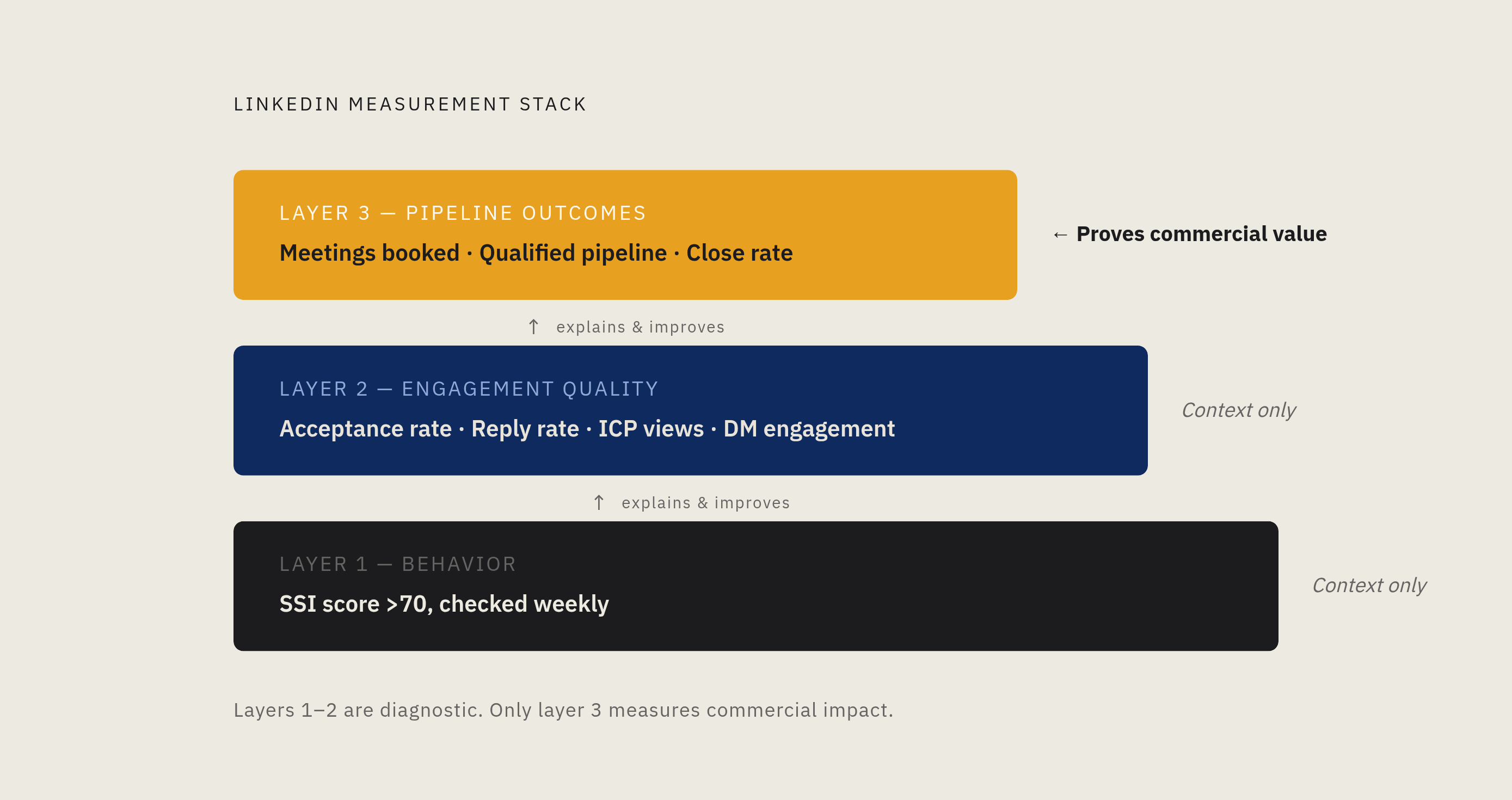
Three layers. Each one tells you something the others can't.
Layer 1 — Behavior (SSI). Check weekly. Look at whether each pillar is trending in the right direction. Flag drops before they compound. Target above 70 as a floor, not a ceiling.
Layer 2 — Engagement quality. Connection acceptance rate, reply rate, inbound profile views from ICP titles, engagement by decision-maker seniority. These are signals SSI cannot see. They tell you whether the right people are noticing you, not just how active you've been.
Layer 3 — Pipeline outcomes. Meetings booked from LinkedIn, qualified pipeline created, close rate on LinkedIn-sourced contacts. This is the only layer that proves commercial value. The other two layers exist to explain and improve these numbers.
One more reality check on timelines. Meaningful pipeline impact from thought leadership takes six to twelve months. Founders who expect quick ROI from SSI optimization will abandon the channel before the flywheel starts. The 2024 Edelman-LinkedIn report found that a strong majority of B2B decision-makers find thought leadership more trustworthy than marketing materials, and a significant portion say it makes them more willing to pay a premium. No SSI pillar directly measures either of those outcomes. But SSI-driven behavior, done with quality and done consistently, can eventually produce them.
The real utility of SSI is as an early-warning system for behavioral drift. The moment a founder or rep stops showing up on LinkedIn, the score will signal it. Usually weeks before pipeline shows the damage. By then you're playing catch-up. The point is to never need to.