What Mindshare Actually Means and Why Awareness Is Not Enough
Most B2B SaaS companies measure pipeline after buyers have already chosen their vendor.

Awareness means a buyer knows a brand exists. Mindshare means that brand is the one that pops into their head when the decision actually gets made. In crowded B2B SaaS markets, that second thing is worth more than almost anything a marketing budget can buy, and most companies are chasing the first one instead.
Mindshare is a mix of recall, preference, emotional pull, and whether a buyer trusts you're credible on the specific problem they have. A brand with real mindshare gets linked to an outcome, not just a logo. There's a line that captures this better than any slide deck could: you can't win market share if you're not winning mindshare first. Awareness works like a light switch, simply on or off, while mindshare is a ranking, and where you land on that mental leaderboard is what determines whether you get a phone call. This gap matters more in B2B SaaS than it does for, say, a soda brand, because the sales cycle is long, the decision involves a committee, and switching vendors later is expensive and painful. The shortlist forms in the buyer's head long before anyone from sales says hello.
How far into the buying journey decisions are actually made before sales gets involved
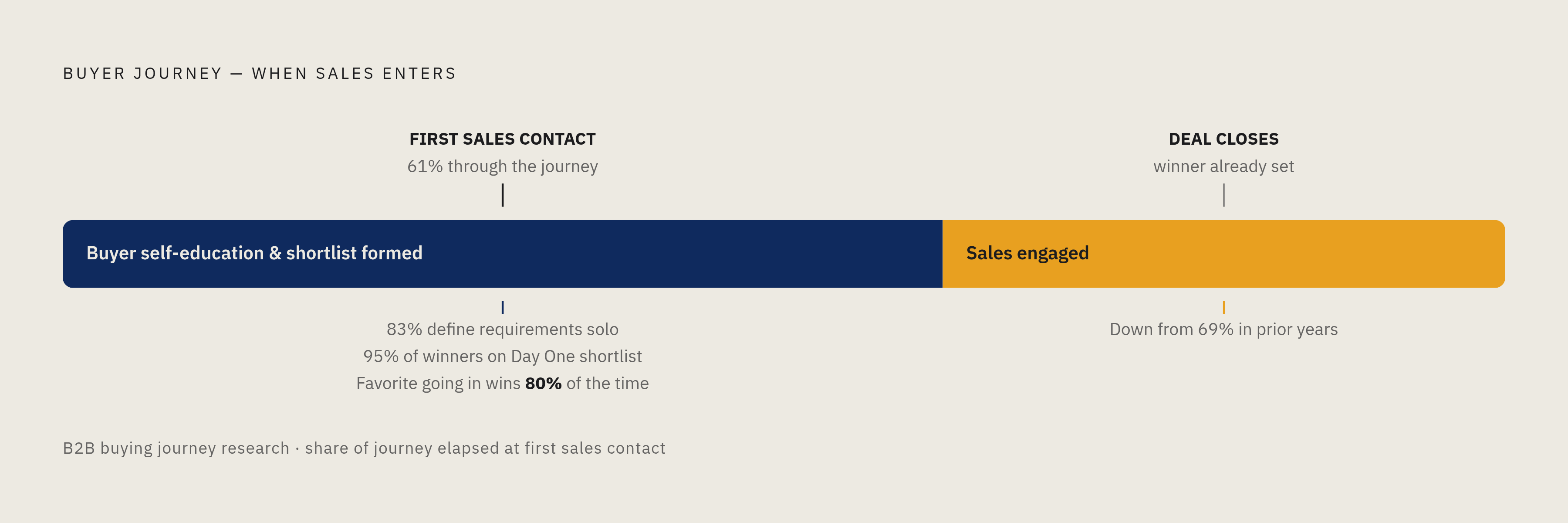
Here's the uncomfortable part for anyone running a sales team: 6sense's 2025 Buyer Experience Report found that 95% of the time, the winning vendor was already sitting on the buyer's Day One shortlist. The favorite going in wins the deal about 80% of the time. Sales is closing a decision that got made earlier, somewhere sales couldn't see.
Research from the LinkedIn B2B Institute, Bain, and NewtonX lines up almost eerily well. 81% said the product they eventually bought was already known by everyone in the buying group on Day One. Only 4% ended up buying something that just a couple people in the room had heard of. Being known is closer to a cover charge, since no recognition tends to mean no entry.
And the self-education happens before anyone picks up the phone. 6sense's 2025 data shows buyers define their own purchase requirements, mostly or completely on their own, 83% of the time before ever talking to a sales rep. Which raises an awkward question for anyone building attribution models: if the race is basically over before first contact, why does the dashboard still treat first contact as the starting line? Pipeline reports built around that first touch are measuring a race after the runners already crossed the tape. For a SaaS founder, that means the ads, the SDR sequences, and the nurture emails aimed at someone who's never heard of you are, frankly, playing from behind before the game even starts.
The invisible research phase that analytics tools don't capture
A lot of the decision-shaping conversation happens somewhere no tracking pixel can reach. Dark social is the term for it: sharing and discussion that happens in private, in Slack groups, closed LinkedIn messages, forwarded emails, the stuff that never shows up in Google Analytics no matter how many UTM parameters get slapped on a link.
The Starr Conspiracy's 2025 research found that 64% of B2B buyers name peer recommendations from these private channels as their most trusted research source, ahead of analyst reports, ahead of anything a vendor writes about itself. Meanwhile, 6sense's 2025 numbers show the point of first contact has drifted from 69% down to 61% of the total buying journey, meaning even more of the influential early stage is happening off the record.
Picture a buying committee where someone shares a founder's LinkedIn post inside their company Slack. Nobody clicks a tracked link, and no CRM field lights up, yet that post just shaped how five people in that channel think about the vendor, and it happened entirely outside anyone's reporting dashboard. Sopro research adds another layer: 77% of buyers read user reviews and 54% talk directly to current customers before they buy anything. None of that traffic belongs to the vendor.
So a company that looks quiet in its own analytics might actually be building serious mindshare in rooms it simply can't see into. The reverse is just as true, and arguably scarier: a company pouring money into trackable channels, the paid ads, the gated whitepapers, might be totally absent from the conversations that are actually deciding the deal. Dark social is a signal about where trust actually gets built, and the only real question is whether a brand has a seat at that table at all.
How most B2B SaaS companies are measuring the wrong things and missing the gap entirely
Wynter research turned up a number that should make marketing leaders a little uneasy: 50% of B2B SaaS companies don't track brand health at all, full stop.
Only 26% measure it with any regularity. Another 20% say they plan to start within the next year, but only 4% have even a pilot running, a roughly fivefold gap between what people say they'll do and what they're actually doing. Meanwhile the metrics everyone actually watches, MQLs, pipeline velocity, CAC, demo requests, all sit downstream of mindshare. They tell you what happened after someone already decided you were worth talking to. None of them tell you whether you made the Day One shortlist in the first place.
It's a strange paradox: more dashboards, more tracking software, more attribution models than at any point before, and yet the one variable that most determines whether a deal was winnable before it started goes completely unmeasured. Companies obsess over lead quality while the actual hull of the ship, the brand's position in the buyer's head, quietly takes on water. Real brand health tracking looks different: share of search, aided versus unaided recall, category association surveys, sentiment inside the dark social communities where buyers actually talk. None of that is standard reporting in B2B SaaS. Most of it isn't reporting at all.
What it takes for a brand to earn a position on the mental shortlist
Mindshare comes from saying the same specific thing, consistently, until a buyer's brain files you under a category without having to think about it.
Consider the timing problem: Edelman's 2024 research found that at any given moment, 95% of business buyers aren't actively shopping for anything. They're not in-market, just living their lives, dealing with whatever's on fire that week. Mindshare is the thing that makes a brand retrievable the second that 5% window cracks open. Miss that window and the buyer defaults to whoever they already had in mind, which, again, is usually decided long before they started looking.
Thought leadership, done right, actually moves that needle. The 2024 Edelman-LinkedIn Report found 75% of decision-makers said a genuinely compelling piece of thought leadership pushed them to research a product they weren't even considering before. Of that group, about 23% ended up doing business with the company that wrote it. That's a pipeline mechanism hiding in plain sight. And 60% of decision-makers in the same report said strong thought leadership makes them willing to pay more, meaning mindshare doesn't just win the deal, it protects the margin on it.
Specificity beats volume here. A brand tied clearly to one problem sticks in a buyer's memory far better than a brand that's published something about everything under the sun. And the audience isn't just one person anymore: The Starr Conspiracy's 2025 research puts the average B2B buying committee at 11 stakeholders. Mindshare has to exist across that whole group, not just with the one champion who happens to answer emails fastest.
Why the hidden stakeholders in buying groups are a neglected mindshare audience
Somewhere in every deal, there's a finance person, a legal reviewer, a procurement lead, someone in operations, none of whom will ever touch the product, all of whom can kill the deal with one comment in a Slack thread. Call them hidden buyers, a group most content strategies pretend doesn't exist.
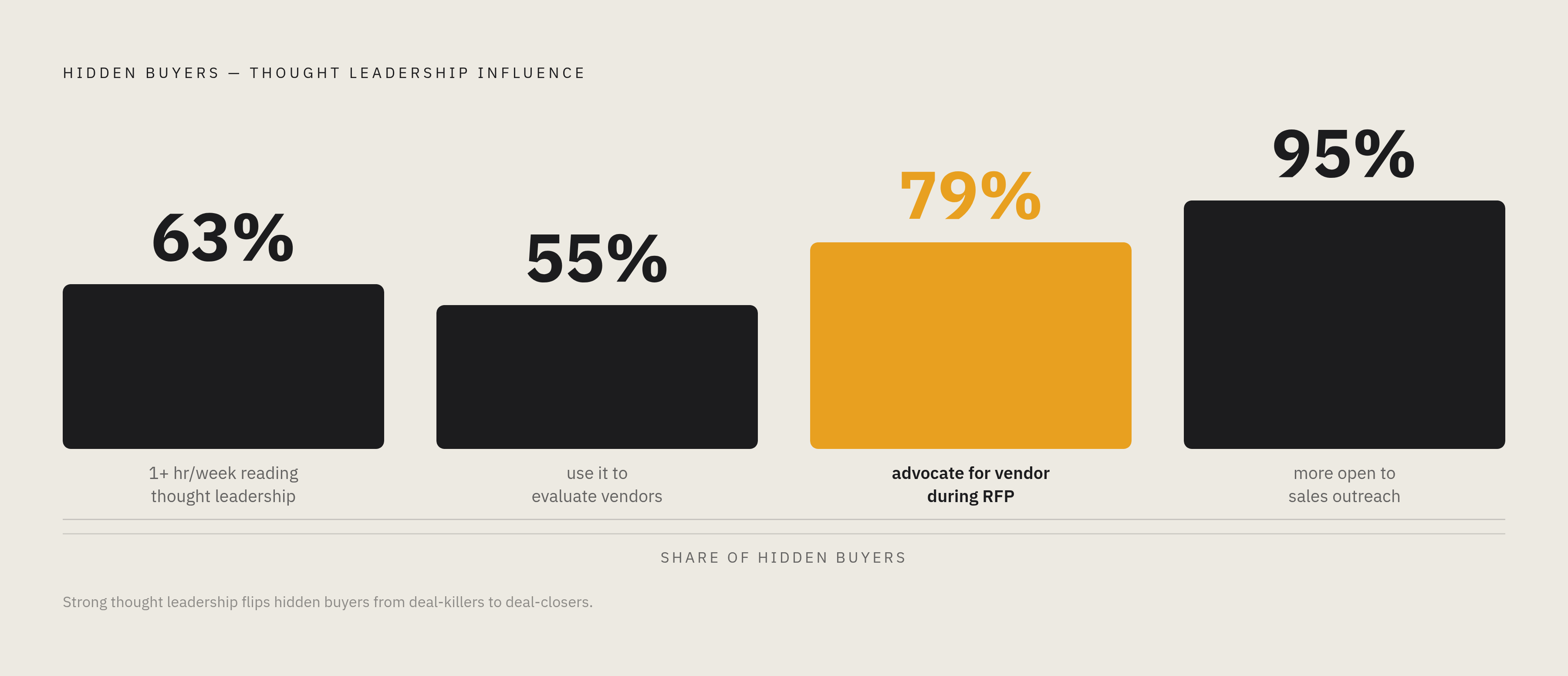
That's a mistake, based on the numbers. The 2025 Edelman-LinkedIn B2B Thought Leadership Impact Report found 63% of hidden buyers spend more than an hour a week reading thought leadership content. 55% of them use that content to evaluate vendors, which is nearly identical to the 56% figure for the primary target buyer. These are not passive bystanders quietly nodding along in the back of the room.
The report goes further: 79% of hidden decision-makers say they're more likely to advocate for a vendor's proposal during an RFP if that vendor has consistently produced strong thought leadership. And 95% say strong thought leadership makes them more open to hearing from sales and marketing in the first place. So the content is doing double duty, building recall with the visible champion while quietly earning trust with the people in legal and procurement who can stall a deal for months over one clause. Most B2B content strategies write exclusively for the primary buyer persona and ignore this audience entirely, which is a strange gap given how many deals actually die in review, not in the pitch.
Why most thought leadership fails to build any mindshare at all
Here's the catch: most thought leadership doesn't do any of this, because most of it isn't very good. The 2024 Edelman-LinkedIn B2B Thought Leadership Impact Report found 71% of decision-makers say less than half of the thought leadership they read gives them anything valuable. And 87% of B2B marketers use content specifically to build brand awareness, according to the same body of research, meaning everyone's aiming at the same target with wildly different accuracy.
Generic content burns attention without leaving a mark, eroding trust while building precisely zero recall. The failure has a recognizable shape: broad hot takes that offend nobody, safe opinions everyone's already heard, a point of view carefully sanded down until there's nothing left to disagree with, and therefore nothing left to remember. Buyers aren't short on content; they're short on content that says something.
Volume doesn't fix this. The research is consistent on that point: depth and specificity build durable mental association, while frequency alone does not, and mindshare rewards patience over spectacle. Analysis of the 2024 B2B Marketing Awards found a large share of winning thought leadership campaigns ran as "living" platforms, sustained efforts built over time rather than a single campaign burst. Mindshare accumulates the way sediment builds a riverbed, slowly, and rarely because someone ran a good campaign for six weeks.
Why the founder's voice builds mindshare faster than the company's content program
Here's a fact worth sitting with: LinkedIn has become the dominant professional content platform for the exact audience mindshare needs to reach. People buy from other people, which is exactly why a corporate page can talk all day and still generate less trust than one honest post from an actual human.
The platform's own mechanics back this up. Personal LinkedIn profiles consistently get more reach and engagement than company pages posting comparable content, a pattern visible enough that it shapes how most practitioners approach distribution. The pattern is consistent across platforms: executive posts tend to meaningfully outperform company page posts on impressions and engagement. Founder voice beats brand voice, reliably, at the distribution level, not just anecdotally.
The revenue correlation is hard to ignore too. The revenue correlation is hard to ignore: B2B SaaS companies that scale fastest tend to have founders who are visibly active on LinkedIn. Correlation isn't causation, sure, but that's a big number to wave off as coincidence. Enterprise buyers are already researching the founder on LinkedIn before they ever agree to a sales call; that founder's posts function as due diligence material.
The platform dynamics heading into 2025 and 2026 make this even sharper, as distribution increasingly favors depth and genuine engagement over raw posting volume. Founders who stick to three to five clear themes outperform the ones scattering opinions across a dozen topics a week. A founder who keeps naming the same specific problem and the same specific solution, over and over, plants the category association that becomes mindshare, and does it in the exact channel where buyers are already educating themselves long before a vendor ever enters the picture.
What owning a mental category position actually requires over time
Mindshare is what's left over after months, sometimes years, of showing up with the same specific point of view; nobody "achieves" mindshare in Q3.
Owning how an entire category thinks is more durable than owning a keyword or a quarter's pipeline number. It compounds the same way trust compounds: slowly, then all at once, when the right buyer happens to be in-market. And the timing works against anyone looking for a quick payback. Edelman's 2024 finding that 95% of buyers are out-of-market at any given moment means the mindshare built today mostly pays off later, on a timeline that makes it painfully easy to deprioritize in favor of whatever metric closes this quarter's board deck.
Think of it as a competitive moat built from something other than a better feature set or a lower price. In SaaS markets where product differences keep narrowing and buying cycles keep tightening, the company or founder that owns the mental shortlist wins the deal before the competition even realizes there was a race. That takes a consistent point of view, a narrow set of things you're willing to be known for, and the discipline to keep showing up in the exact channels where buyers self-educate, long before any of them raise a hand.
The founders who treat their own voice and their own narrative as a strategic asset end up building the one advantage a competitor can't copy off a product roadmap. Everything else can be matched, but a specific, consistent voice that's been in a buyer's head for two years cannot.