Why Opinionated Content Closes More B2B Deals Than Helpful Content
Strong opinions get forwarded privately; generic advice gets ignored.
B2B buyers make up their minds before sales ever gets a call on the calendar, and the content that shapes that decision is the opinionated stuff, not the merely helpful stuff. Generic how-to guides build awareness, sure. But awareness isn't what closes deals; conviction is. This piece breaks down why a sharp point of view beats a helpful one, and what that means for anyone still cranking out listicles because "content marketing said so."
Start with the numbers, because they're almost comically bad. According to the 2025 Adobe B2B Digital Trends report, 69% of B2B practitioners feel pressure to rapidly increase the volume and variety of digital assets they produce. More blog posts, more templates, more "ultimate guides." The assumption baked into that pressure is simple: more content equals more trust. That assumption doesn't hold up. More content usually just means more noise, and buyers can tell the difference between noise and signal within about four seconds of scrolling.
Here's the kicker: quality hasn't kept pace with volume. The 2024 Edelman-LinkedIn B2B Thought Leadership Impact Study found only 15% of decision-makers rated the thought leadership they consume as very good. Fewer than half rated it merely good. So the bar is sitting on the floor, which sounds bleak, but it's actually good news for anyone willing to say something specific. Standing out doesn't take genius. It takes a spine.
Generic helpful content delivers exactly one thing: awareness. It answers a question and moves on. Templates, listicles, "5 ways to optimize your funnel," none of it gives a buyer anything to actually agree or disagree with. And awareness without conviction just parks the buyer in research mode indefinitely, like a browser tab that never gets closed. The content that gets bookmarked, quoted, and sent to a colleague is the content that plants a flag. That's the whole game.
Where the real buying decision gets made — before any sales contact
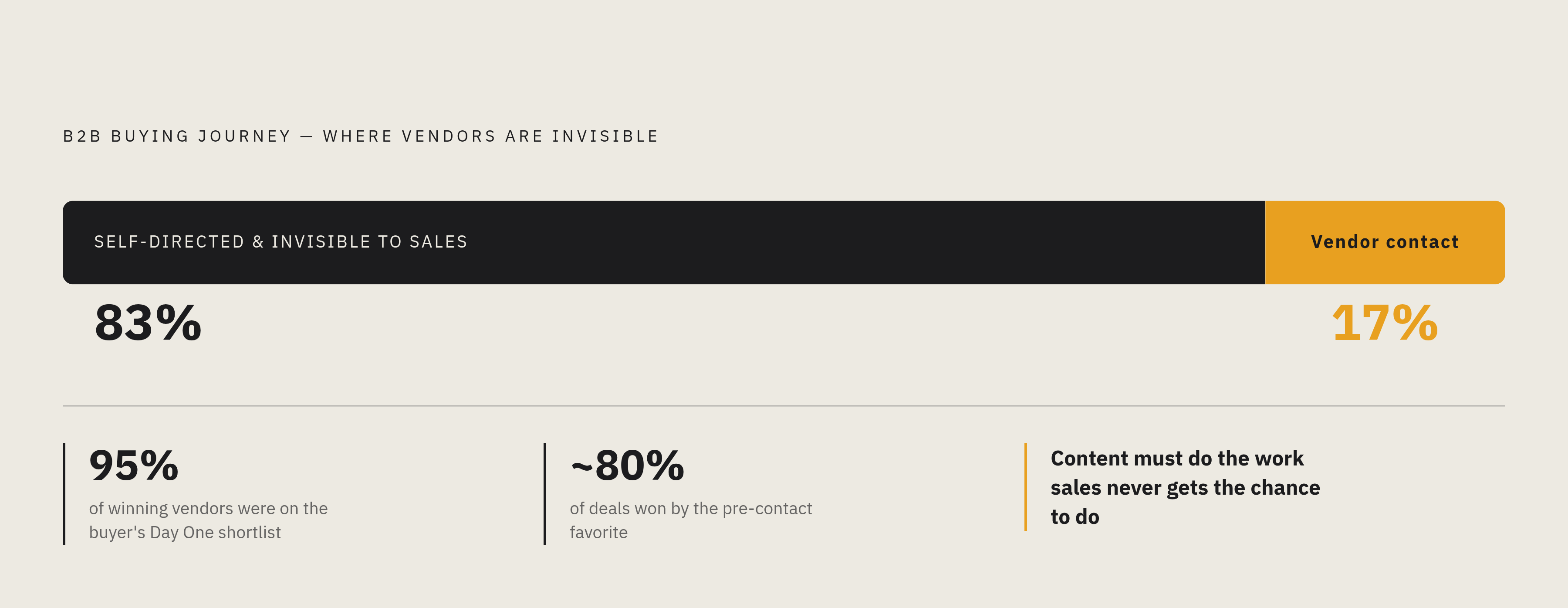
Gartner's 2024 research put a number on something most sales teams already suspected: buyers spend only 17% of their total buying journey in direct contact with vendors. That leaves roughly 80% of the process happening entirely off the vendor's radar, self-directed, invisible. This is a structural shift in how purchasing works now, not a blip caused by remote work or a stubborn cohort of Gen Z buyers who hate phone calls.
And the shortlist forms fast. The 6sense 2025 Buyer Experience Report found that 95% of the time, the vendor that eventually wins was already on the buyer's Day One shortlist. The pre-contact favorite wins about 80% of deals. Translation: the deal is mostly decided before a single sales email lands in an inbox. Content that isn't shaping that early, invisible stage isn't part of the decision at all; it's just decoration.
Buyers also define their own purchase requirements before talking to sales, 83% of the time according to that same 6sense report. That's not a minor detail, that's the whole spec sheet getting written without vendor input. Whoever shaped the buyer's idea of "what good looks like" wins the RFP before it's even drafted. Helpful content responds to requirements that already exist. Opinionated content writes them.
There's a longer game here too. At any given moment, roughly 95% of potential buyers aren't actively shopping. A buyer who reads a founder's sharp take today isn't going to act on it this week; they're filing it away, mentally, for the day they actually need a vendor. Generic advice is forgettable by design (it has to be, since it's trying not to offend anyone). A clear opinion sticks around, retrievable months later, the way a good one-liner outlives the meeting it was told in.
How dark social carries opinionated content into the rooms you can't see
Dark social is the unglamorous term for sharing that leaves no trail: Slack forwards, private LinkedIn DMs, email chains, WhatsApp groups full of people who really should be working. When someone on a buying committee screenshots a founder's post and drops it into an internal channel with "look at this," that action never shows up in any dashboard, ever. No UTM parameter survives a Slack forward.
And dark social isn't some fringe channel for the paranoid. The Starr Conspiracy's 2025 research found that 64% of B2B buyers cite peer recommendations from private, dark social channels as their most trusted research source, ahead of analyst reports and ahead of anything the vendor published itself. Peer trust beats brand trust. It's not close.
So what actually gets forwarded? Opinionated content, almost exclusively. Nobody sends a colleague a how-to guide with "you NEED to see this," because a how-to guide is homework, not a conversation starter. A post that stakes out a real position, one specific enough to agree or argue with, triggers the kind of reaction that makes someone hit share. Recognition or disagreement, both work. Bland information never does.
AI research tools are pouring gasoline on this fire. Per The Starr Conspiracy's 2025 findings, 71% of B2B tech buyers used generative AI during vendor evaluation, and buyers using AI tools are 2.3 times more likely to finalize their shortlist before contacting a single vendor. Founders whose opinions get cited and quoted across the web are starting to surface inside AI-generated shortlists, which is a new and largely unmeasured layer of dark social amplification. Meanwhile, per 6sense's 2025 data, buyers now wait until 61% of the way through their journey to contact sales, down from 69%. The influential early window keeps sliding further out of anyone's line of sight.
Nobody's tracking dark social well, and chasing that is a fool's errand. The real question worth asking is what content earns a share in the dark in the first place. Opinionated content does. Helpful content, generally, does not.
What makes a point of view the actual purchase trigger
There's a trust gap that helpful content simply can't close. Per the 2024 Edelman-LinkedIn study, 73% of B2B decision-makers say thought leadership is a more trustworthy gauge of a firm's competence than its own marketing materials. Fair enough, except trust requires specificity. A piece that could've been written by literally any vendor in the category signals nothing about that vendor's actual judgment, and judgment, not information, is what buying committees are quietly grading the whole time.
B2B buying is expensive, cognitively speaking. Deals in 2024 averaged 11 stakeholders, and each additional stakeholder shaved off roughly 10 percentage points of purchase probability. Committees are hard to herd; more cats, slower stampede. A founder who states a clear, specific conviction about the problem hands the internal champion something they desperately need: a script, language they can repeat verbatim in the next stakeholder meeting rather than another pile of information to digest.
That matters more than it sounds like it should. More than 40% of B2B deals stall because the buying group can't get aligned internally, not because the product is wrong. Content that gives the champion a tight, repeatable narrative shortcuts that stall. It's the difference between handing someone a pile of research and handing them a one-sentence pitch they can say with a straight face.
Call it the alignment trigger. When a buyer reads something and thinks "this person gets the problem exactly the way I do," the vendor stops being one of five interchangeable options on a spreadsheet. They become the vendor who gets it. That shift, from researching to deciding, is the actual mechanism. Generic content, built to avoid alienating anyone, avoids agreement just as thoroughly. Neutral by design; persuasive by accident, if ever.
This runs deeper into the org chart than most vendors assume. Edelman-LinkedIn's 2025 research on hidden buyers, finance, legal, compliance, procurement, found 63% spend more than an hour a week on thought leadership, and 55% use it to actively evaluate vendors. These are the people who never take a sales call and still hold veto power. Content with a real point of view gives them something to grab onto and, eventually, defend in a room the vendor was never invited into.
The measurable pipeline impact of high-conviction thought leadership
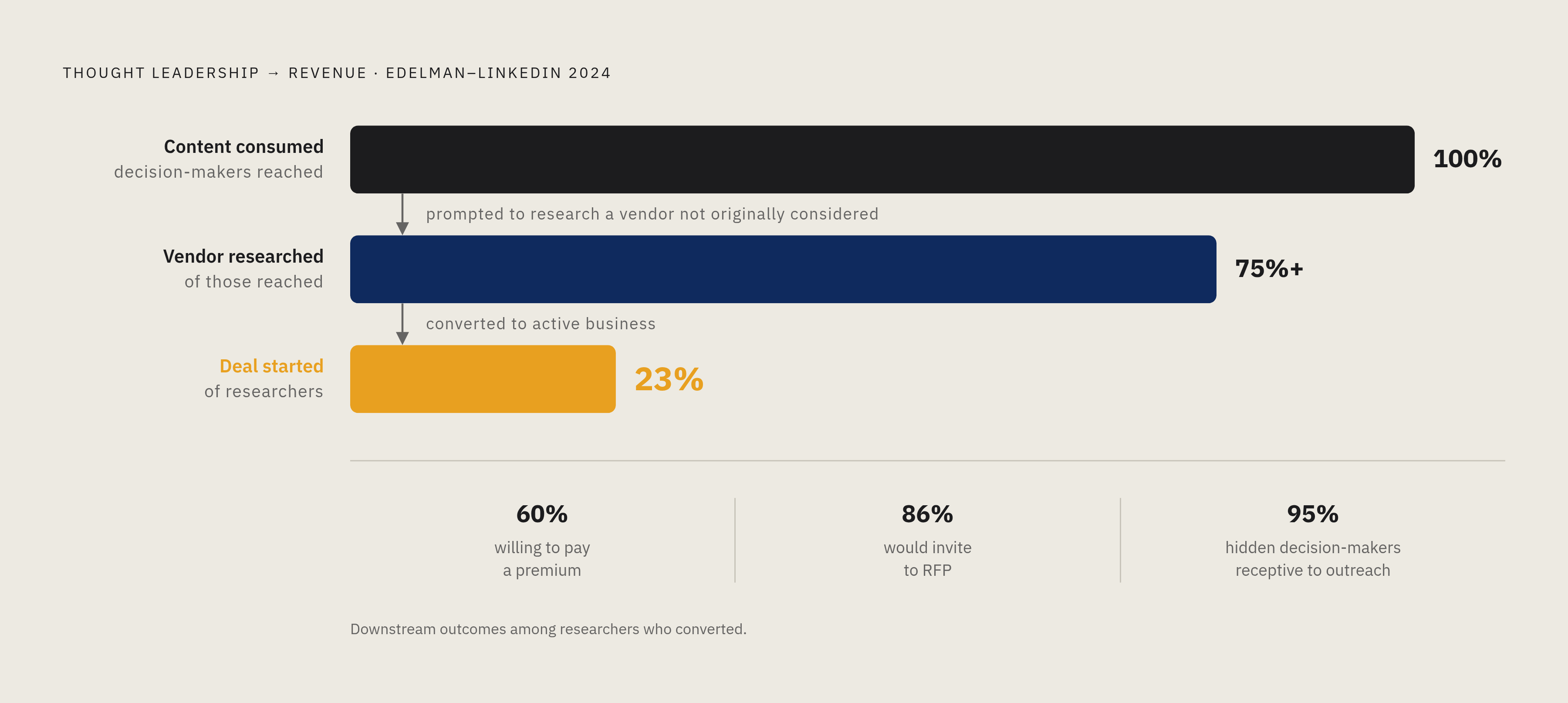
The chain from content to revenue isn't theoretical; Edelman-LinkedIn's 2024 study traced it. More than 75% of decision-makers said a strong thought leadership piece prompted them to research a product they weren't originally considering. Of those who went ahead and researched a new vendor because of a piece of content, about 23% ended up doing business with that company. That's a real conversion rate off a single touchpoint, which is more than most cold outreach sequences can claim with a straight face.
Two downstream effects make the case even harder to argue with. First, 60% of decision-makers say strong thought leadership makes them willing to pay a premium for a vendor, per the same 2024 study. Second, 86% said they'd be moderately or very likely to invite an organization with consistently strong thought leadership to participate in an RFP. That second one is pipeline, plain and simple, showing up in the form of an actual invitation to bid. On the hidden-buyer side, Edelman-LinkedIn's 2025 data found 79% of those decision-makers said they're more likely to champion a vendor with strong, consistent thought leadership during the RFP process itself.
There's also a straightforward outreach multiplier. That same 2025 study found 95% of hidden decision-makers say thought leadership makes them more receptive to sales outreach, and 53% of decision-makers said strong thought leadership matters more to them than a brand's name recognition. That last stat is worth sitting with. It means content can partially offset the advantage of a bigger, more established competitor, which is the clearest lever a smaller SaaS company has when the enterprise incumbent has ten times the marketing budget and none of the personality.
So why isn't everyone doing this well already? Execution, not ambition, is the gap. Per CMI/MarketingProfs 2024 research, 96% of B2B marketers say their organization produces thought leadership, yet at 37% of those organizations, fewer than 5% of employees with real subject expertise actually contribute to it. Everyone's claiming the title. Almost nobody's doing the work that earns it. That gap is the opportunity, sitting right there, mostly unclaimed.
Why founder voices carry more conviction than brand content
There's a structural reason personal LinkedIn profiles outperform company pages, and it's not mysterious, it's the algorithm. Personal profiles generate roughly seven times more impressions and four times more engagement than company pages for similar content. The platform's design clearly favors the kind of content people actually want to read, and brand pages have been losing that bet for a while, which is the same gap Mindshare Lab, a LinkedIn ghostwriting agency for B2B SaaS founders, was built around.
The logic underneath is simple: buyers trust people, not logos, especially when that person shows specific, hard-won judgment rather than polished talking points. A founder who describes the problem space with real precision signals that the product behind them was built by someone who actually understands the terrain, not someone reciting a positioning doc written by committee. That confidence travels through a buying group the way a warm reference does. It's very hard to fake conviction at length; eventually the cracks show, and buyers are good at spotting them.
The real-world proof isn't subtle. Adam Robinson built a significant following by building in public, radically transparent, no corporate filter. Peep Laja made his own content the primary engine behind the CXL brand's reputation. Chris Walker built Refine Labs into a recognized voice in demand generation through consistent LinkedIn posts and a podcast, not through a bigger ad budget. In every one of these cases, the founder's voice was the growth engine, the driving force behind the outcome, well ahead of the company blog nobody read or the SEO strategy targeting "best CRM software 2024."
These aren't three lucky outliers cherry-picked to make a point (okay, they kind of are, but the mechanism generalizes). They prove that a founder committing to a point of view, consistently, over time, compounds into something a paid media budget can't buy: mindshare that exists before the buyer even knows they'll need a vendor. Someone who's read a founder's takes for six months shows up to the eventual sales call already agreeing with the worldview. At that point the product demo is closer to a formality than a pitch.
What separates an opinion that converts from one that just provokes
Not every hot take moves a deal forward. Provocation without expertise is just noise wearing a leather jacket; conviction rooted in real domain experience is signal. Buyers respond to content that names a problem they recognize but haven't quite put into words themselves, not content that's chasing a reaction for its own sake. The test is simple: does the piece give the reader a framework they'll actually use in a meeting, or does it just make them nod once and keep scrolling?
Opinions that move deals tend to share a few traits. They're specific, naming the exact failure mode or buyer persona rather than gesturing at "the industry" in general. They're consequential, implying a real choice; if the reader agrees, they're quietly being asked to reevaluate whatever they're currently doing. They're repeatable, compressible into one sentence a buyer can say out loud to a colleague without sounding like they're reading off a slide. And they're rooted in something the founder actually built, shipped, broke, or learned the hard way, not stitched together from three other people's research reports.
Consistency is what turns a single good post into an actual category position. One sharp piece of content is a flare. A sustained, coherent point of view repeated across months is a claim on how the whole market thinks about the problem. That claim has teeth: per the 2024 Edelman-LinkedIn study, 55% of decision-makers have stopped engaging with brands that publish generic content altogether. Inconsistency doesn't just cap the upside. It actively drives the audience away, one unremarkable post at a time.
The most common way founders sabotage their own point of view is hedging every claim into oblivion. "It depends," "in some cases," "your mileage may vary," slapped onto every sentence until the actual opinion disappears entirely. That instinct feels safe, but a hedged opinion converts nobody; it just adds one more forgettable voice to a market that's already drowning in forgettable voices. Pick the position. State it plainly. Let the market argue back if it wants to. That argument, if it happens, is the sound of a deal starting to move.