Authentic Founder Voice Development
Distinctive founder voice drives trust and revenue when authenticity replaces AI-generated averages.

Everyone is publishing more, and audiences trust it less.
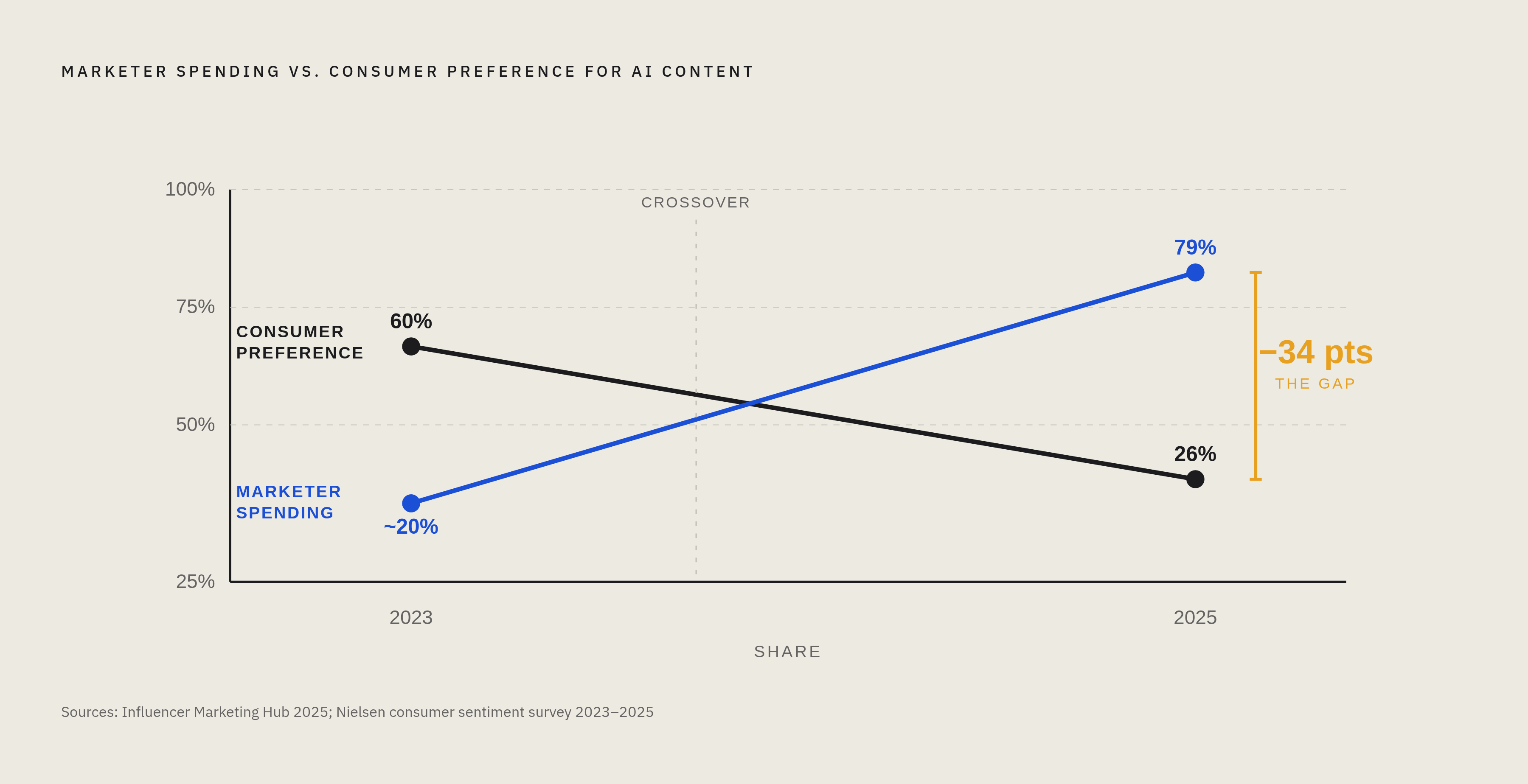
Marketers poured more money into AI-generated content over the past year. 79% increased spending, according to Billion Dollar Boy's 2025 Muse Report. But consumer preference for AI-generated content collapsed from 60% to 26% in just two years. That's a 34-point drop running directly against the investment trend. Nobody planned for that gap. It just opened up.
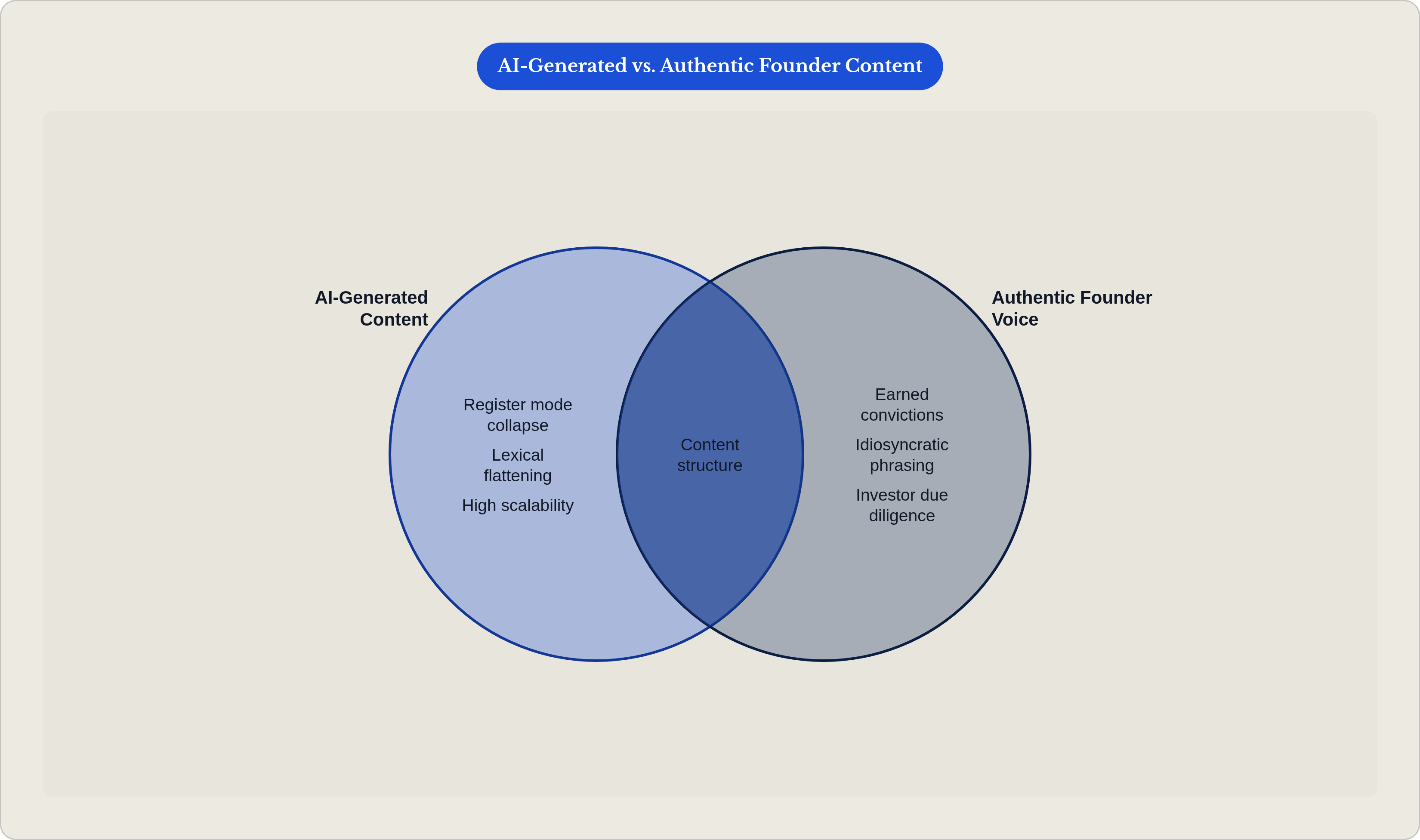
Stanford HAI has a name for the mechanism: "register mode collapse." Large language models train on broad datasets and converge toward the statistical center of what's already been written. Ask one for "authentic founder voice" and you get the flattened average of every founder who's ever published anything. Which is, by definition, not your voice.
A 2025 SSRN study made this concrete in a way I find genuinely hard to shake. When restaurants temporarily lost access to ChatGPT during a Milan ban, their content became 15% more lexically diverse and 12% more syntactically varied. The absence of the tool made them more distinctive. Not because AI is bad, exactly. Because AI, by default, sands things down. It rewards sounding reasonable over sounding real.
What gets sanded first:
- Your idiosyncratic phrasing
- The things you keep returning to because they actually matter to you
- The words you'd actually use, swapped out for high-frequency synonyms
After enough passes through the filter, you're not writing anymore. You're translating. And then the translation gets translated. Each generation a little flatter, a little further from the original signal, which is content decay in its most structural form. Eventually something essential is just gone. Think of it like a photocopy of a photocopy of a photocopy — by the tenth generation, you can barely read what the original said.
This is the opening. Companies with distinctive brand personalities see meaningfully higher customer retention. Content with genuine voice generates substantially more engagement than standardized messaging. And 52% of consumers actively reduce engagement when they suspect content is AI-generated. The audience is already sorting for real. The question is whether you're on the right side of that sort.
What decision-makers are actually looking for from founders
Not marketing. Something they can actually trust.
73% of B2B decision-makers say thought leadership is a more trustworthy basis for assessing a company than its traditional marketing materials, according to the 2024 Edelman-LinkedIn B2B Thought Leadership Impact Report. That number was roughly 59% in 2019. The shift has been directional and consistent.
What that trust actually converts to:
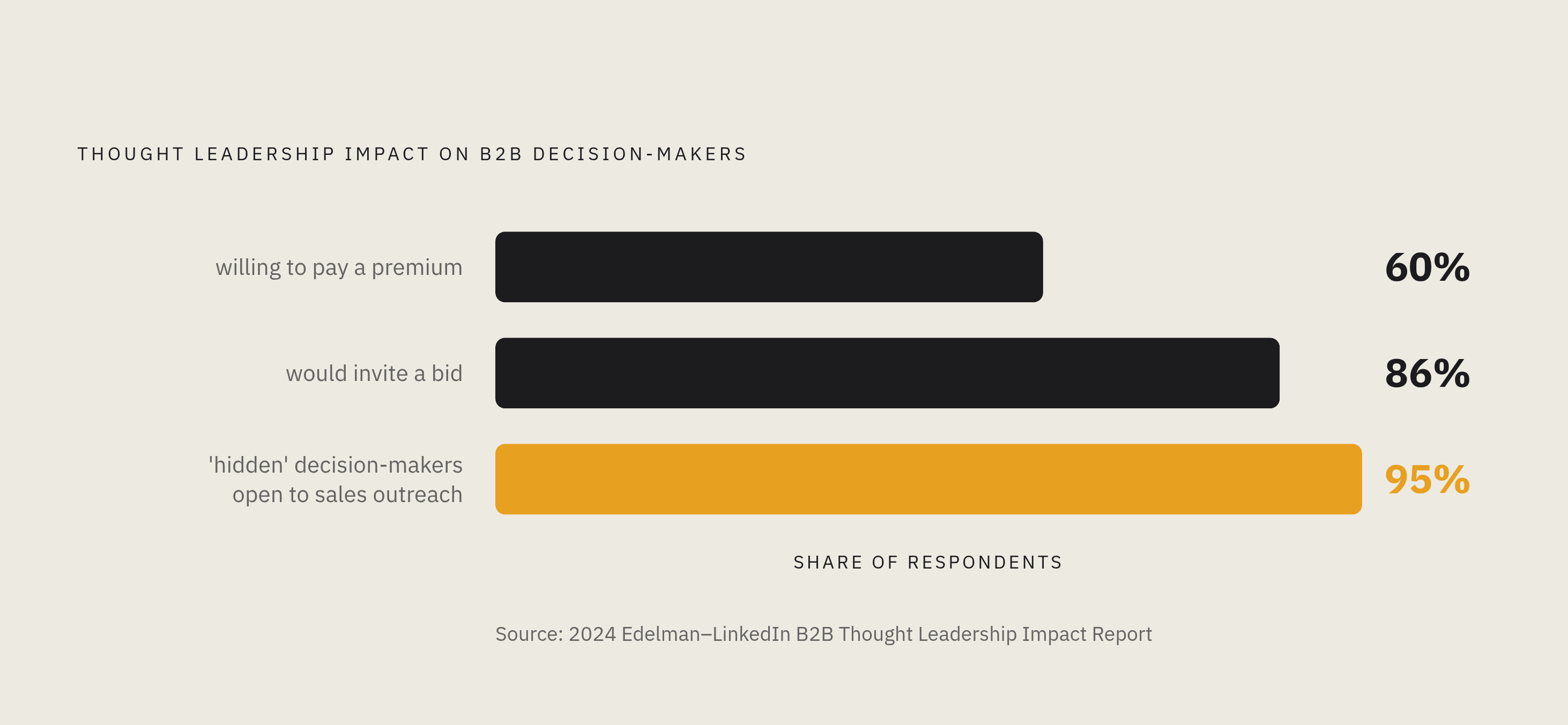
- 60% of decision-makers are willing to pay a premium to work with companies demonstrating strong thought leadership
- 86% would invite a company to bid on a project if it consistently produces high-quality thought leadership
- 95% of "hidden" decision-makers say thought leadership makes them more open to sales outreach
That last one is the one worth sitting with. The founder's published perspective reaches people who aren't in the room yet, often at the earliest stages of the B2B buyer journey. The reader who forwards your article to their procurement team before anyone schedules a call. The partner who circulates your LinkedIn post ahead of a board meeting. You're not just talking to the person in front of you. You're talking to a room you'll never see.
For founders specifically, 84% of investors research founders on social media before meetings. Your visible thinking is functioning as pre-meeting due diligence on your character and clarity, whether you intended it to or not. Weber Shandwick puts a number on this: executives estimate that 44% of their company's market value is directly attributable to CEO reputation. Founder voice is not a personal brand exercise in the conventional sense. It's a financial variable.
Here's the other side of that data, though. The same Edelman-LinkedIn report found that 71% of B2B decision-makers say less than half of the thought leadership they consume provides valuable insights. Everyone is publishing. The deficit isn't volume. It's perspective worth encountering, from someone who actually believes what they're saying. Most thought leadership has a thought problem — there isn't much thinking in it.
Why perspective has to come before voice
Most founders skip ahead. They start thinking about tone. Formal or casual? Warm or authoritative? Contractions or no contractions?
Those questions aren't wrong. They're just premature. They're also probably the wrong questions entirely, because tone takes care of itself once you actually know what you're trying to say.
Perspective, or point of view, is the specific set of observations your particular work, in your particular context, has produced. Not general opinions about your industry. Earned convictions. The things you believe because you've been inside a problem long enough to see what people outside it can't see yet, or at least can't see clearly.
There's a useful frame here: the "Why-You Factor." Not why the company exists in the abstract, but what you specifically saw that others weren't seeing. The asymmetric insight that preceded the decision to build. When you can articulate that with some precision, something interesting happens. Word choice follows. Rhythm follows. The voice problem largely dissolves, because there's something real to say and a fairly specific way you'd say it.
The contrast case is recognizable the moment you encounter it. A founder who hasn't done this work produces content that sounds like the marketing team's perspective, restated. That's not an insult to anyone. It's just that without excavated perspective, the marketing materials are the only available raw material. So that's what gets echoed, slightly reworded, in a LinkedIn post.
This also matters structurally. People trust content shared by individuals more than content coming directly from brands. Individual posts get significantly more engagement than corporate posts on the same topic. But only when the individual voice is genuinely distinct from the corporate one. An individual who sounds like a press release doesn't unlock that advantage. They just add another distribution channel for a message nobody was that engaged with to begin with.
How to excavate the perspective you already have
Here's the thing. The perspective isn't missing. You already have it. The work is surfacing it, not inventing it.
Start with questions that create a little discomfort:
- What do you believe about your industry that most practitioners in it would push back on?
- What did you have to unlearn to build what you built?
- What failure, yours or someone else's, made the problem you're solving visible to you?
- What do you see in customer behavior or competitive positioning that isn't in the trade press yet?
These questions are trying to get under the pitch deck. They're not asking what you built. They're asking what you had to see first, and what it cost you to see it clearly.
The origin story is useful raw material here, but not the sanitized version. The "we identified a gap in the market" version leaves everything important out. The actual moment the specific problem became undeniable. The customer call that ended badly. The pattern you noticed across 40 conversations that nobody was naming. The thing that made you think: this is genuinely broken, and I cannot stop thinking about it.
Two real examples worth looking at. Heyday Canning Co. co-founder Kat Kavner started with values and purpose, not aesthetics. By her own account, the team spent weeks in uncomfortable conversations about what they truly believed before a single product label was designed. Voice emerged from that groundwork. It wasn't decided in a brand workshop. It grew out of something they actually worked through. Omsom co-founder Vanessa Pham centered a specific, underserved audience (first- and second-generation Asian Americans) at a time when competitors were overlooking them entirely. That specificity of perspective drove both product and voice at the same time. She wasn't trying to sound a certain way. She was building toward a conviction she already held.
A useful reality check is the voice audit. Pull examples from every channel you publish to and read them as a set. Ask which ones sound like a person and which ones sound like a company. Trace what's different about the ones that work. Usually it's something small. A specific claim, a concrete story, a position stated without a hedge at the end to soften it. Collect those moments.
What you're building toward is a short list, the raw material for content pillars. Two or three genuine convictions you can speak to with specificity and evidence. These become the load-bearing material in everything that follows.
Translating excavated conviction into content that holds its shape
Once you know what you actually believe, the production question becomes: how do you keep it from getting smoothed out?
The most useful filter is the read-aloud test. Does this sound like you? Does it have your rhythm? Do you recognize your own contrarian positions, your vocabulary, your way of thinking through a problem? If fewer than 70% of sentences pass that test, another pass is needed. That threshold isn't a stylistic preference. It's a practical quality gate, and it's worth treating it like one.
On the question of AI: it has a clear role and a clear limit. The split that actually works looks like this. AI handles research, structure, and first-pass drafting. The founder handles voice, specific stories, and conviction. The part only you can contribute gets your full attention rather than being delegated. This is not an argument against using AI. It's an argument for knowing which part of the work is actually irreplaceable.
One concrete recommendation from practitioners who've thought hard about this: write 50 posts without AI assistance before bringing it in as an amplifier. The exercise builds an empirical record of what your actual voice looks like when nobody is smoothing it out. Then, when you do bring AI in, you have something to constrain it toward. You're not starting from scratch with every prompt. You're giving it a sample set and telling it to stay inside that range.
It's also worth calibrating explicitly. Most founders land somewhere between conversational and formal (not sloppy), with personality but not performance, and with high directness. Startups that hedge sound uncertain. Rating these dimensions and writing them down creates a calibration reference for every piece of content, whether you're writing it yourself, using AI, or working with a ghostwriter through a structured ghostwriting process.
That brings you to what some practitioners call a Voice Charter. Five to seven rules no content may violate. Short enough to actually memorize. Strict enough to automatically disqualify content that doesn't belong. It captures the specific phrases you use and avoid, the contrarian positions that are non-negotiable, and the topics where your take genuinely differs from the industry consensus. Every prompt template starts with this as a system instruction. It doesn't guarantee good content, but it prevents you from inadvertently publishing something that sounds like your industry association's newsletter.
The underlying reason this matters: human-crafted content retains readers 2.7 times longer than AI-generated alternatives. The driver isn't production quality in the traditional sense. It's distinctiveness. Readers feel the difference between someone who means it and a reasonable simulation of someone who means it. That feeling is what keeps them reading.
What happens to voice as the company scales
The timeline goes like this:
- Months 1 to 3: the founder writes everything; voice is natural but completely undocumented
- Months 4 to 8: a marketer and a freelancer join with nothing to work from
- Months 9 to 12: AI enters, outputs become competent but generic
- Month 13 and beyond: the content sounds like it came from three different companies
The problem isn't that the team got bigger. The problem is that what got scaled was a style, not a perspective. Style without documented perspective is unanchorable for anyone who didn't write the original content. There's nothing to hand off because nobody ever wrote down what the founder actually believes, why they believe it, and where that belief came from.
There's also a time problem worth being honest about. The founder is running strategy, hiring, fundraising, operations, and customer relationships simultaneously. A content strategy that depends entirely on one person's consistent output will eventually break. The founder's commitment may be genuine, but the structural demand on their attention is real, and it compounds.
The governance model that survives this has two elements. Keep the founder visible in high-impact formats: keynote articles, industry commentary, milestone announcements. Not everything. The important things. And make sure every contributor understands the company's core narrative, not just its brand voice guidelines. Those are not the same thing, and the distinction matters more than most teams realize until it's too late.
A useful framing: executive voices should live inside the brand voice framework, not replace it. The founder's perspective informs the brand, but the brand is not exclusively a vehicle for founder expression. This creates room for the team to carry the perspective forward without the founder becoming a bottleneck on every piece of content that goes out.
On ghostwriting specifically, the difference between what works and what doesn't come down to sourcing. Ghostwriting rooted in the founder's actual convictions, specific observations, and documented positions reads as authentic. Ghostwriting that synthesizes generic industry content in the founder's name reads as exactly what it is. People notice. Not always consciously, but they notice.
What persists at scale isn't writing style. Style can't be transferred. What persists is excavated perspective documented in a Voice Charter and a set of content pillars. Convictions and positions that can be internalized and expressed by others without losing the signal. That's what's worth building. Worth building before you need it, specifically, because by the time you need it, you're already behind.
One last number: only 1% of LinkedIn users post content weekly, yet that group generates 9 billion impressions per week. The competitive opening for a founder with a genuinely documented perspective is still largely uncrowded. The bar isn't frequency. It's whether you actually have something to say.