Ghostwriting and Content Delegation for Founders
Thought leadership drives real pipeline, but only when it sounds like the founder actually wrote it.

The trust numbers are hard to ignore. According to LinkedIn and Edelman's 2024 B2B Thought Leadership Impact Report, 73% of B2B decision-makers say thought leadership is a more trustworthy signal of a company's capabilities than traditional marketing. Seventy percent think more positively about brands that publish high-quality thought leadership consistently.
That trust converts. Three-quarters of decision-makers in the same study said a piece of thought leadership led them to research a product or service they hadn't previously considered. That's not brand awareness. That's demand generation.
Jay Singh, CEO of Casper Studios, drives 90% of his inbound leads organically through LinkedIn. Jessica Schultz, founder and CEO of Amplify Group, does zero cold outbound. Her pipeline runs entirely through referrals and inbound from LinkedIn thought leadership and a weekly newsletter. What those two have in common: neither of them are just broadcasting. They have an identifiable point of view, and people can feel the difference between that and content that was clearly written by someone who has never met the founder.
LinkedIn's own 2024 data adds something worth knowing. Sixty-seven percent of buyers prefer thought leadership featuring the perspective of an identifiable author. A founder's profile generates more trust and more pipeline than a company page because people follow people, not logos. Generic company content can't do the same job. It doesn't have the right shape for it, a content-market fit problem no amount of production polish can fix — a company page trying to build trust is like a mannequin trying to shake your hand.
The business case for consistent founder content is real. But it depends entirely on content that actually reads like the founder wrote it. That's precisely what makes delegation so hard to pull off.
How widespread ghostwriting already is among founders and executives
The practice is more common than most people admit out loud. More than 60% of B2B executives who publish regular thought leadership rely on ghostwriters, content agencies, or AI tools to produce it, according to the Content Marketing Institute. Among funded founders working with one agency, roughly one in five use some form of ghostwriting support, and that number keeps climbing as LinkedIn becomes a primary go-to-market (GTM) channel.
The market has responded accordingly. Global ghostwriting services sit somewhere in the multi-billion dollar range. LinkedIn-specific ghostwriting was reportedly the fastest-growing service category within that market in 2023, and the trajectory hasn't reversed.
But market size isn't the point. The point is that the practice is completely normal. Executives have always used speechwriters. PR teams draft statements under a CEO's name. Communications staff write op-eds that get published under the founder's byline. Ghostwriting content is the same model applied to social and digital. It's not a shortcut. It's a production model.
What market size tells you nothing about is quality. And most ghostwritten content is forgettable. That's the actual problem worth solving.
Why most ghostwriting arrangements fail to produce content worth reading
Here's something the ghostwriting industry doesn't advertise loudly enough: the writing itself is 20% of the work. The other 80% is extraction. Getting the actual insight out of the founder's head, as the subject matter expert, and onto the page in a form that couldn't have come from anyone else. When that process fails, the content fails with it.
A skilled ghostwriter can absolutely reproduce a founder's sentence structure, their vocabulary, their general tone. What they can't manufacture is operational insight. The specific, hard-won perspective that comes from actually building something. The result is content that sounds right but says nothing only this founder could say. Most ghostwritten content lives in that gap. It passes the surface-level test but has nothing behind the walls.
AI made this worse and raised the stakes simultaneously. ChatGPT flooded LinkedIn with generic content through 2023 and 2024. The volume of forgettable posts went way up. The side effect is that voice-matched, genuinely specific content became more visible by contrast. Agencies using AI for first drafts and then lightly editing are reportedly seeing engagement rates 40 to 50% lower than those using human-first writing processes.
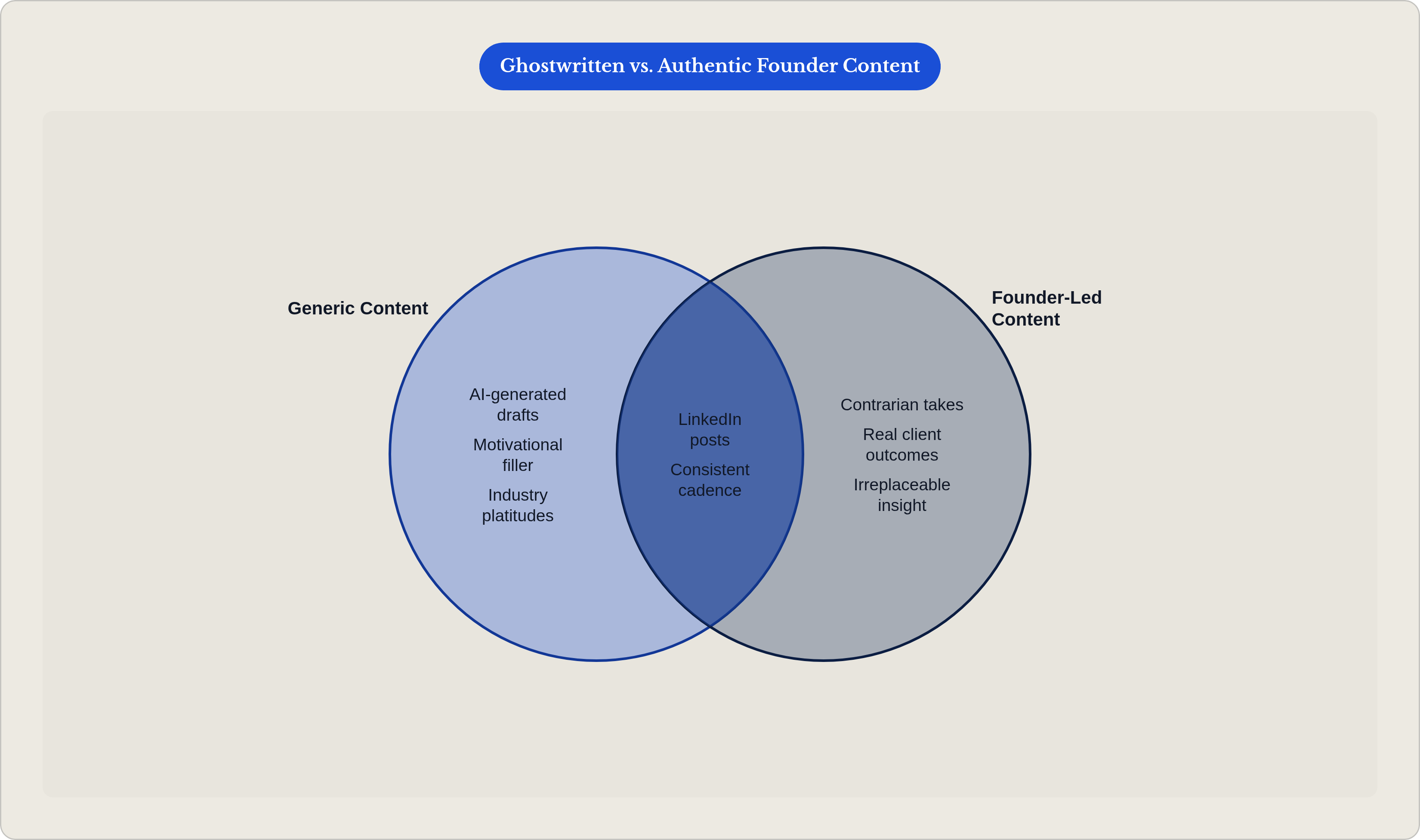
What generic content looks like in practice: motivational filler, repackaged conventional wisdom, industry platitudes that could have been written by anyone about any company in any sector. What actually performs: personal stories with specific numbers, real client outcomes, contrarian takes with some friction behind them. Content only this founder could have written.
If the process isn't designed to extract what's irreplaceable about the founder's perspective, the whole thing is a waste of money. Generic content is like a key cut for every lock — it fits nothing.
Capturing voice before any writing starts
Onboarding typically runs one to two weeks. The ghostwriter spends that time studying the founder's existing content, running a substantive interview about worldview and experience, and building a voice guide. That document captures vocabulary preferences, structural tendencies, and the topics or framings the founder will decline to publish under their name.
The voice capture session itself usually runs 60 to 90 minutes. The questions aren't "what topics do you want to cover." They go deeper. What do you believe that most people in your industry would push back on? What advice are you tired of seeing repeated? What did you get badly wrong in year one that you'd never repeat? One good session like that often generates raw material for six to eight pieces. Sometimes more.
What a voice guide actually contains:
- Vocabulary. Words the founder uses naturally versus words that would never come out of their mouth. Some founders say "leverage." Others would rather delete the whole post.
- Sentence rhythm. Long, analytical builds versus punchy fragments versus storytelling cadence. Some founders write like they're presenting a board deck. Others write like they're texting a colleague.
- Structural tendencies. Does the founder lead with the conclusion and work backward? Or build the tension first and reveal the point at the end?
- Core positions. The three or four things they have a genuine, defensible view on. Not the safe takes. The ones with some friction in them.
- Hard edges. Subjects, framings, or tones they will decline to publish. These matter as much as everything else on this list.
The test for whether extraction actually worked: could someone else in the industry have said this? If yes, keep digging. The real insight hasn't surfaced yet.
A voice guide isn't a one-time document. It should be updated as the founder's thinking evolves, as the business changes, and as the relationship between founder and writer deepens. The ones that don't get updated are the ones that quietly turn into a liability.
Mapping content to what the business actually needs right now
A content calendar built around what's interesting to write will drift. An editorial calendar built around what the business needs the market to believe in the next 90 days stays useful.
Content strategy should shift with business stage. Hiring mode calls for content about culture and leadership philosophy. Fundraising calls for industry insights and signals that the founder has a genuine read on what's changing. Pipeline development calls for case studies, contrarian takes, and how-to content that positions the founder as the clearest thinker in the room.
A few things on format and frequency that hold up consistently:
- Consistency beats volume. Three posts per week every week beats seven posts for two weeks and then silence. The algorithm rewards regularity. So do readers.
- Text posts convert pipeline. Video builds reach and awareness. Which one you prioritize depends on what you actually need right now.
- "How I…" posts generate meaningfully more saves than listicles. Personal stories and real lessons outperform promotional content.
The best founders also repurpose, treating content repurposing as a distribution strategy rather than an afterthought. A LinkedIn post becomes a newsletter section. A long-form piece gets broken into a thread. A case study becomes a short-form video. Agencies are increasingly building repurposing into their service packages because the incremental cost is low and the reach multiplier is real.
There's a failure mode worth naming here. It shows up more often than it should: a ghostwriting engagement that produces polished, on-voice content completely disconnected from any commercial purpose. Pretty words. No pipeline. It happens when strategy gets treated as a one-time setup task rather than something that gets revisited as the business moves.
How the weekly working rhythm actually runs
Once onboarding is done, the weekly rhythm is simple. The ghostwriter delivers three to five LinkedIn posts, or a mix of posts and longer content. The founder reviews, gives feedback, approves. Total founder time: 30 to 60 minutes per week.
What that 30 to 60 minutes should actually be spent on:
- Voice check. Does this sound like me, or does it sound like a competent approximation of me? There's a difference, and founders usually feel it immediately.
- Insight check. Is there a claim, a story, or a number in here that only I could make? If not, flag it before it goes out.
- Specific feedback. Not "make it more me." Something like: "I would never frame it as a failure. I'd call it a pivot and here's why."
The feedback loop is where voice accuracy actually improves. The first month is calibration. By month three, a founder working with a good ghostwriter should be spending less time on corrections and more time on minor tuning. That compression is the sign things are working.
The division of labor is worth being explicit about. The founder owns the raw insight, the opinion, the story, and the final sign-off. The ghostwriter owns structure, drafting, headline writing, and formatting for the platform. When those lanes blur, things get messy fast.
There's a subtle failure mode to watch for. The founder starts rubber-stamping posts without reading carefully. The content drifts toward generic. Engagement drops. The founder assumes LinkedIn stopped working. It didn't. The founder just stopped showing up inside the content.
One more thing. Engagement isn't fully delegatable. A ghostwriter can draft reply templates for common comment types. But when a conversation goes deep, when someone pushes back on an idea or shares a real story in the comments, the founder needs to respond. That's where the actual relationship gets built. No template covers it.
Where AI fits into a delegation setup — and where it doesn't
A 2025 study by Josh Bernoff and Gotham Ghostwriters found that 61% of writers use AI for support. The most common use cases: research, title generation, and brainstorming. Only 7% use it to generate the actual content. That breakdown tells you something real about where AI helps and where it falls flat.
The market ran this experiment for everyone. Ghostwriting demand dipped in 2024 as clients experimented with pure AI output. It recovered through 2025 as they realized what they were getting: plausible, generic, forgettable. Turns out speed without substance is just a faster way to be ignored.
The configuration that actually works: AI plus strong voice infrastructure for routine volume output. Standard LinkedIn posts, repurposing, first drafts that a human then substantially rewrites. Senior human writing for the highest-stakes pieces. Signature articles, fundraising narratives, keynote content. Those get the full human treatment, because the cost of getting them wrong is real.
AI productivity gains are real. Among writing professionals using AI tools, many report meaningful increases in output speed. But a faster bad draft is still a bad draft. Productivity and quality are not the same lever.
There's also an ethical dimension worth knowing. Using AI to generate client content without disclosing it is considered unethical by the professional ghostwriting community. AI-generated content also cannot receive copyright protection. Both of those things have practical consequences, and neither of them gets mentioned often enough in sales conversations.
The simplest test for whether AI is being used well or poorly: if the tool can generate the post without any input from the founder, the post contained no irreplaceable founder insight to begin with. That's the real problem. Not the tool.
What to look for when choosing a ghostwriter or agency
Pricing first, because it's usually the first question:
- Solo ghostwriters run roughly $1,000 to $5,000 per month depending on experience and scope.
- Full-service agencies covering content, strategy, engagement, and distribution typically run $2,000 to $5,000 and up per month.
- For most funded founders, the practical midpoint is somewhere around $2,000 to $3,500 per month for a mid-to-full-service package.
Questions worth asking in the first conversation:
- How do you capture voice? The answer should describe a specific extraction process. A questionnaire is not the same as a voice interview. If they can't describe the process clearly, they probably don't have one.
- What does the first 30 days look like? There should be a defined calibration period. Skipping straight to publishing is a flag.
- Can I see examples of clients whose voices are clearly different from each other? The worst ghostwriters sound identical across all their clients. Ask to see the range.
- What metrics and key performance indicators (KPIs) do you report on? The answer should include pipeline signals, not just impressions and follower growth.
Red flags worth taking seriously:
- They offer content without any voice capture process upfront.
- Their portfolio reads like one person wrote everything.
- There's no process for incorporating feedback into a living voice guide.
- They lead with follower counts and viral posts as the primary success metric.
Ask directly about AI. Ask whether it's used in drafting, how, and at what stage. A credible writer will have a clear answer. Evasiveness on that question is worth taking seriously.
The market is splitting. Some ghostwriters are moving toward AI-assisted work at lower price points. Others are moving upmarket toward full human writing and charging significantly more for it. Knowing which one you're actually hiring matters a lot more than most people realize until it's too late.
How founders know the arrangement is working — and when to recalibrate
The leading indicators show up before the lagging ones.
Inbound attribution starts shifting. Prospects mention a specific post in their first message. Someone says "I've been following you on LinkedIn." A warm intro references something the founder wrote. These signals appear weeks before pipeline numbers change, which is why founders who ignore them until the numbers move are already behind.
Review time shrinks. In month one, the founder is rewriting sentences and flagging voice misses every week. By month three, they're doing minor tune-ups. That compression means the voice guide is doing its job.
The founder recognizes their own thinking. This one is harder to quantify but easy to feel. Reading a draft and thinking "yes, that's exactly what I would have said" is genuinely different from thinking "this is close enough." Close enough sounds fine at first. Over six months, it compounds into drift.
When to recalibrate:
- Engagement drops across multiple posts while format and topic have stayed consistent. Usually means voice drift. Go back to the voice guide and figure out when it stopped getting updated.
- The content is getting attention but not the right kind. Lots of likes from other founders, no inbound from buyers. Time to revisit whether the content calendar is still aligned with commercial goals.
- The founder dreads the weekly review. Sometimes this means the relationship is broken. Sometimes it means the founder's thinking has evolved and the ghostwriter hasn't caught up. Either way, it needs addressing rather than tolerating.
- The arrangement hits six months without a strategic check-in. Business goals change. Hiring priorities shift. A fundraise starts. The content strategy should move with all of that, not keep running on autopilot while the company pivots underneath it.
The arrangement is working when the founder can look at a published post and honestly say two things: that sounds like me, and only I could have said that. When both are true, the delegation is working. When either one is missing, something in the process needs adjusting. Usually sooner than feels comfortable to admit.