Personal Brand Building Before Product Launch
Founders should build personal credibility before launching products to accelerate early growth.

People connect with people before they connect with products. That gap matters most when your company has nothing to show yet.
Think about the early-stage reality. No Fortune 500 clients. No analyst coverage. No decade of case studies. The founder's voice is the only credibility on the table. And here's the thing. It's filling that vacuum whether you're being intentional about it or not. Before a prospect agrees to a call, they've already looked you up. Your personal brand is already part of the sales process. The only question is whether you built it on purpose.
The reach numbers alone should settle this. Content shared by individuals gets roughly five to six times more reach than the same content posted from a company page. That's not a marginal edge. That's a categorically different outcome from the same words, same message, different source.
There's also a compounding effect most founders ignore until it's almost too late to build anything. A meaningful chunk of a company's market value, in some studies close to half, traces back to the founder or CEO's reputation specifically. Not the product. Not the brand assets. The person.
One thing I want to name directly, because I've watched founders resist this work for genuinely bad reasons. Building a personal brand is not self-promotion. It's thought leadership: making your problem-solving approach legible to the people you want to serve. The founders who push back are usually picturing the cringe version. Talking-head LinkedIn videos. Humble brags dressed up as lessons learned. The version that actually builds something useful looks nothing like that, and the difference is obvious once you've seen both.
Choosing What to Stand For Before You Have a Product to Point To
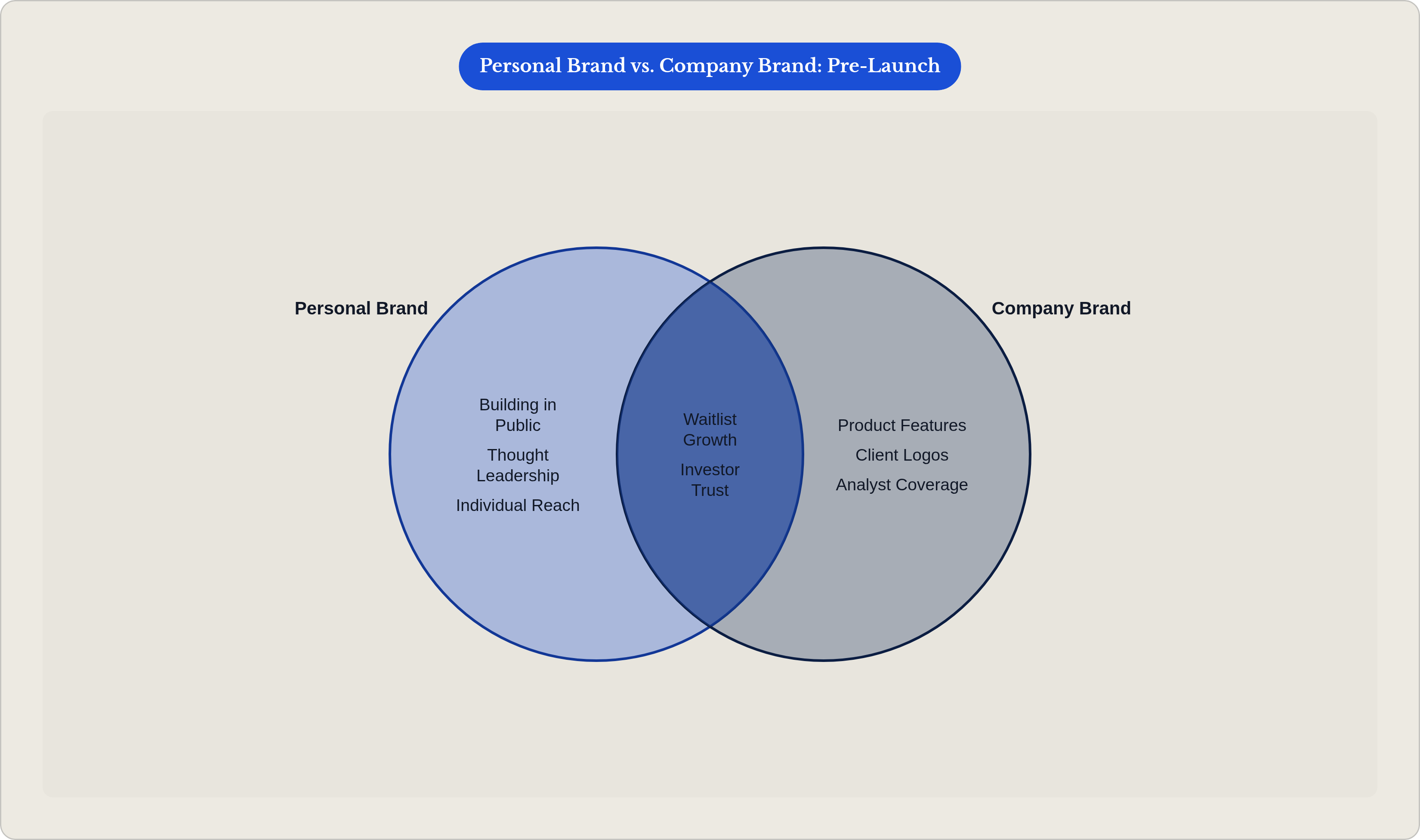
Here's the positioning problem that's unique to pre-launch: you can't lead with product features because there's no product yet. So you lead with perspective instead.
The move is to share how you think about the problem your product will eventually solve. Patterns you've noticed. Lessons that cost you something. Ways the existing solutions keep failing the people you're building for. The audience forms around a point of view before they ever know what you're building, which sounds backwards until you realize it's the only thing that actually works.
I watched a founder grow to 5,000 followers before shipping a single thing. The approach was almost boring in how simple it was. Weekly breakdowns of where competitors' products fell short. No product announcements. No hype. Just consistent, honest analysis that the target audience found genuinely useful. When the product launched, those 5,000 people already trusted the builder. The launch wasn't a cold introduction. It was a follow-up to a conversation that had been running for months.
Finding your lane means looking for overlap between three things:
- What you actually know well
- The problem your product solves
- What your target audience is actively trying to learn
That constraint is doing more work than it looks like. Founders who can't find the overlap usually haven't sharpened their positioning or defined their ideal customer profile yet, and the content exercise surfaces that faster than almost any strategic workshop I've ever seen.
Platform choice follows the same logic, and it's really a question of content-market fit. Go where your audience already pays attention, not where you're most comfortable.
- B2B founders belong on LinkedIn. The majority of B2B decision-makers are there, and long-form posts plus comment engagement reach the people who can actually buy.
- Consumer-facing founders often do better on Twitter/X for fast dialogue, or Instagram and TikTok if your product is inherently visual.
The goal at this stage is narrow. Become a recognizable voice in the problem space before anyone knows what you're building.
Building in Public as a Pre-Launch Trust Accelerant
Building in public means sharing the actual development process. Progress, setbacks, real metrics, decisions you almost made differently and kind of wish you had. Not a highlight reel. A process that anyone following you can watch unfold in real time.
Why it works isn't complicated. People invest in what they've watched being built. The audience becomes a participant in the story rather than a spectator at a product announcement. And participation creates loyalty that polished marketing content almost never produces. I've never seen a slick brand video do what a founder posting "we almost shut this down last week, here's why we didn't" does to an audience.
Share the messy drafts. Share the hard calls. Share the thing you almost launched but pulled back at the last minute because something felt off. That transparency isn't weakness. It's the mechanism.
Research from Edelman and LinkedIn found that more than three-quarters of C-suite executives said a piece of thought leadership led them to research a product they hadn't previously considered. You don't need a massive audience for this to matter. You need the right people paying attention.
The examples here are not subtle.
Pieter Levels started building in public years before Photo AI launched. By the time the product was live, he had a massive, engaged following. Photo AI generated roughly $5,400 in its first week. A comparable product launched cold, with no audience, might realistically do a fraction of that. The difference wasn't the product.
37signals had a blog with tens of thousands of regular readers before Basecamp ever launched. The community existed before the product did. The launch was a conversion event, not an awareness campaign. They didn't have to convince anyone the problem was real because they'd spent years writing about it.
Base44 grew to 400,000 users without paid marketing through a LinkedIn building-in-public strategy and exited for $80M.
In all three cases, the audience wasn't acquired at launch. It was accumulated during the build. That's the whole mechanism, and it only works if you start early enough for it to compound.
Converting Audience Attention Into a Waitlist Before the Product Ships
Social media audiences are useful. They are not owned. Algorithms shift, reach drops, and a platform can change its rules on a random Tuesday for reasons that have nothing to do with you. Much of that reach is also dark social, shared through private channels where you have no visibility at all. The email list is what you actually control, and in media terms it is the only owned channel in the mix.
The conversion gap between email and other sources is significant. Email traffic converts at a rate roughly four times better than most other channels. And visitors who arrive from a founder's personal social presence convert to waitlist signups at a notably higher rate than visitors from cold discovery channels like Product Hunt. That gap is entirely explained by prior trust. People who've been reading your posts for three months are not strangers.
Superhuman is the clearest example of what a deliberately managed waitlist can produce. They created real scarcity through limited beta access, used public waitlist counts and early user testimonials as social proof, and kept anticipation alive through development updates. The result was hundreds of thousands of signups that converted to serious early revenue within the first year of general availability. The waitlist did work that no launch campaign could have done after the fact.
A waitlist does more than collect email addresses. It signals market demand. It gives you a testing ground for messaging before you're committed to anything. It gives you zero-party data and a concrete data point for investor conversations. And it makes launch day a warm conversion event rather than a cold introduction to people who've never heard of you.
The timeline depends on what you're building. A simple product with an existing audience might need a few weeks of email teasing. A high-consideration B2B product might need several months of community-building before the list gets activated. The mistake isn't moving too fast or too slow. It's treating list-building as a launch-week task, which almost guarantees you're starting from zero when it matters most.
How Pre-Launch Brand-Building Affects Investor Conversations
Investors are fundamentally assessing execution risk. A visible, growing audience is evidence of distribution capability, and for many investors it reads as an early distribution moat. Most early-stage founders can only demonstrate product capability. Those are different things, and the gap matters more than most founders realize until they're in the room.
The institutional credibility that makes investors comfortable. Client logos. Analyst coverage. Years of track record. That's exactly what early-stage founders don't have yet. A strong personal brand fills some of that gap. Not perfectly. But enough to change the conversation.
Tyler Denk, founder of Beehiiv, raised a $12.5M Series A in six days. He's been direct about attributing that to the audience he built through building in public. His words: "I receive a dozen emails every day from funds who want to invest in Beehiiv." The audience didn't just help with customers. It collapsed the fundraising timeline from months to days, which is not a small thing when you're burning runway.
There's a more targeted version of this worth knowing. A founder who deliberately shaped their brand messaging to appeal to a specific investor persona raised $1.7M in seed funding. Same playbook as audience-building for customers. Just pointed at a different person.
Pre-launch brand-building is not a demand generation activity that competes with fundraising prep. It is evidence that supports the fundraising conversation. Once you frame it that way, the prioritization question answers itself.
The Practical Sequence for the Months Before Launch
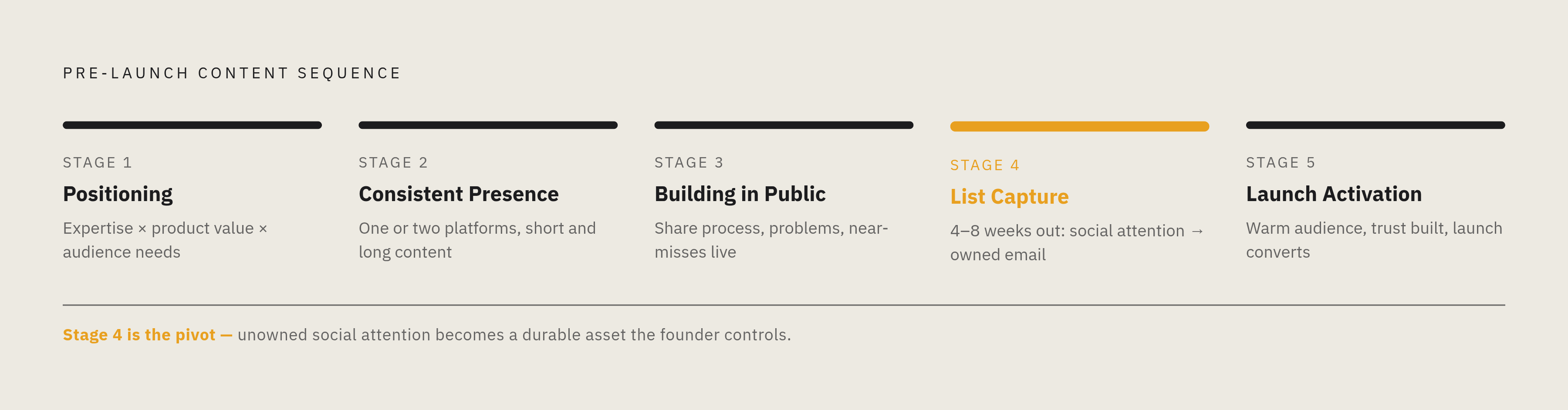
Five stages. Sequential. Skipping steps is how you end up starting from zero on launch day, which I've seen happen enough times that it stopped surprising me.
Stage 1. Positioning. Before you publish anything, define your topic lanes at the intersection of your expertise, your product's value, and what your audience wants to learn. Establish the perspective before anyone knows a product exists. If you can't articulate what you stand for in the problem space, you're not ready to build an audience around it yet.
Stage 2. Consistent presence. Show up on one or two platforms where your target audience pays professional attention. Mix shorter content for reach with longer content for depth. Consistency matters more than volume. Become a recognizable voice, not a prolific poster nobody reads.
Stage 3. Building in public. Start this as soon as there's something real to share. The process, the problems, the near-misses, the decision you made on a Thursday afternoon that you're still not sure was right. Invite the audience into the journey rather than saving everything for a launch announcement. When people follow the journey, they show up for the destination.
Stage 4. List capture. Typically four to eight weeks before launch. Convert social attention into owned email through a waitlist or early-access offer. This is the asset you control regardless of what any platform decides to do next week.
Stage 5. Launch activation. The audience is warm. The list exists. The trust is already there. Launch day becomes a conversion event for people who've been watching the whole time.
The mindset shift underneath all five stages is the same. The product launch is not the beginning of the story. It's the payoff of a story the audience has already been following. Start that story early enough, and you stop dreading launch day entirely. It becomes the easy part.