Founder Storytelling Frameworks for B2B Audiences
Emotional connection matters more in B2B sales than most founders realize.

B2B brands achieve over 50% emotional connection with enterprise buyers. B2C brands land somewhere between 10% and 40%. So the buyers reviewing TCO models and 47-slide vendor decks are more emotionally connected to the brands they buy from than the average person buying a pair of sneakers.
That's not a fluke. It's what happens when the stakes are high and the consequences are personal. Neuroscience has been pretty clear on this for a while. Emotional processing and memory formation are activated by narrative, not data tables. Stories are remembered up to 22 times better than isolated facts. Around 63% of people recall a story they were told. Only about 5% remember a statistic.
Leading with data isn't wrong. It's just incomplete. Data gives buyers the justification to say yes to something they've already decided they want. Story creates the trust that makes the data credible in the first place.
So the question isn't whether to tell stories. It's how to structure them so they actually do something.
The environment you're selling into in 2025 is genuinely weird. The average buying group for a complex B2B solution now sits at 8.2 stakeholders. Millennials and Gen Z make up 71% of those buyers. They did most of their research before you knew they existed, in what demand gen teams now call the dark funnel. Ninety-five percent of winning vendors are already on a buyer's shortlist before a single conversation happens. About 60% of the buying journey happens without you in the room at all.
When you do get access? Sixty percent of buyers say a sales-heavy approach actively turns them off.
What moves committee decisions is proof. Case studies and success stories, the most durable form of social proof in B2B, are the most influential content type for 42% of B2B buyers. Seventy-three percent of B2B decision-makers say case studies significantly influence their purchasing process. That's a lot of weight on one format that most companies produce badly.
The harder structural problem is this: one story has to reach a champion who's carrying the project internally, an economic buyer who controls the budget, and a technical evaluator who needs to validate the implementation. Three different jobs for a buying committee with three very different fears. The champion is worried about whether staking their reputation on your product will end well for them. The economic buyer wants to know what happens if nothing changes. The technical evaluator needs to see that you've done this before without making a mess. One story, three jobs.
That's the actual problem frameworks solve, not unlike what jobs-to-be-done theory maps at the product level. Not creativity. Architecture.
How StoryBrand's SB7 Gives a Founding Narrative Committee-Ready Structure
Donald Miller published Building a StoryBrand in 2017. Over a million copies. He updated it in January 2025. The core idea didn't change, because it didn't need to.
Customers don't buy the best product. They buy the one they understand fastest.
SB7 strips your message to seven elements: character, problem, guide, plan, call to action, and the stakes on either side of the decision. The one rule most founders break immediately: the customer is the hero. You are the guide. Think Yoda, not Luke. Your origin story, your funding round, your award from a trade publication nobody outside your industry has heard of. None of that is the hero. The customer is.
The seven elements aren't arbitrary. They map almost cleanly onto the buying committee.
- Champions need language about the internal problem. They're selling your solution up the chain. They need to explain the pain in terms their executive cares about.
- Economic buyers need the failure and success stakes, the ones that activate loss ave, which is the question status quo bias makes every committee avoid asking out loudrsion. What happens if nothing changes. What the upside looks like if it does.
- Technical evaluators need the plan and signals that you've done this before.
The BrandScript, the one-page document SB7 generates, becomes the source of record. Homepage headline, email sequences, sales scripts, customer success messaging. Everyone pulling from the same place.
The most underused element in the whole framework is the internal problem. SB7 separates the business pain (external) from how the buyer feels about that pain (internal). Most B2B messaging stops at external. But the person inside a large organization isn't just worried about whether your product works. They're worried about whether championing it makes them look like the person who saw something others missed, or the person who wasted a quarter's budget on a vendor that flaked. That fear is real, and naming it in your messaging builds trust faster than almost anything else you could say.
One honest note: SB7 governs message clarity and positioning, not the full sales motion. It's not a substitute for TCO modeling or technical documentation. In a heavily technical sale, you pair it with those things.
The Pixar Story Spine for Founder Origin Stories
The Story Spine was created by Kenn Adams. It became associated with Pixar's development process, which is probably why everyone calls it the Pixar Story Spine now. Six sentence starters:
- Once upon a time...
- Every day...
- Until one day...
- Because of that...
- Until finally...
- And ever since then...
Founder origin stories have the same problems. Too long, too product-focused, or accidentally self-congratulatory in a way that makes the audience feel like they're watching a highlight reel. The Spine fixes this by forcing you to sequence events rather than describe them. You can't explain everything when you're filling in six sentence starters. The template also does something subtle: it puts the founder in the protagonist role through the disruption beat, then lets them hand hero status to the customer at the resolution.
Here's the difference in practice.
Without the Spine: "We built this platform after spending years in enterprise procurement and realizing existing tools were fragmented, overpriced, and not built for modern teams."
With the Spine: "Once upon a time, every procurement team ran on spreadsheets and gut instinct. Every day, they were drowning in vendor emails and missed renewals. Until one day, I lost a six-figure contract renewal because no one on the team knew when it was due. Because of that, I spent two years talking to 200 procurement leads about what a better system would look like. Until finally, we built the first platform designed around how procurement teams actually work. And ever since then, our customers haven't lost a renewal to bad timing."
Same facts. Different feeling. The second one makes a buyer lean forward. The first one sounds like every other About page, which is to say, it sounds like nothing.
Adapting the Hero's Journey and BAB for B2B Case Studies
Seventy-three percent of B2B decision-makers say case studies significantly influence their purchases. Only about 34% of companies use them effectively. That gap is almost entirely structural.
Most B2B case studies are feature summaries wearing a trench coat. "Company X had Problem Y. They implemented Solution Z. Results followed." That's not a story. That's a press release with a logo.
The Hero's Journey maps a protagonist through a challenge, a transformation, and a new world. In a case study, the customer is the protagonist. Your product is the tool that enables the transformation. The structure:
- The customer's world before the problem appeared
- The disruption that made the status quo unsustainable
- What they tried first that didn't fully work
- The turning point
- The new world after
Step three is almost always missing, and it's the most trust-building part of the story. When you acknowledge that the customer tried other things before finding you, and those things didn't fully solve it, you're doing something most vendors are too nervous to do. You're being honest. That honesty does more for credibility than any ROI figure, partly because it's so rare.
The Hero's Journey is a scaffold, not a script. A generic story with no specific detail is a waste of everyone's time. The framework creates the shape. The customer's actual situation is what makes it matter.
BAB (Before-After-Bridge) is the leaner version for shorter formats.
- Before: Specific, vivid description of the problem. Make the reader feel the friction.
- After: The outcome. Be as measurable as you can.
- Bridge: How the solution created the transition.
BAB works in one-pagers, short emails, LinkedIn posts, and any content marketing touchpoint where a full case study would feel like overkill. Where a full case study would feel like overkill, BAB gets the job done. Use the Hero's Journey for long-form, relationship-building content. Use BAB for conversion-oriented proof points. The format should drive the choice, not which one you find easier to write.
Using the Three-Act Structure and Sparkline for Sales Presentations
Most sales presentations start with the company overview. Nobody has ever closed a deal because of a company overview slide. Not once. The three-act structure fixes this by starting where the audience already lives.
- Act 1 (Setup): The status quo. Their world, not yours. What life actually looks like right now for the people in that room.
- Act 2 (Confrontation): The problem. The cost of inaction. What makes the status quo unsustainable. The goal here is to make them feel the gap.
- Act 3 (Resolution): Your solution. The transformed future state. The ask arrives here and it doesn't feel like a sales move because they've been on the journey.
Audiences are conditioned by narrative structure from childhood. The arc creates forward momentum. The question isn't whether it works. It works.
Nancy Duarte's Sparkline adds another layer. It alternates between "what is" and "what could be" throughout the presentation, creating waves of contrast. The gap between those two states produces desire for change, not because you told them to want something different, but because they felt the contrast themselves. This is particularly useful with skeptical buyers who have sat through dozens of vendor decks and have developed a kind of pitch immunity. The contrast structure sidesteps the pitch dynamic. You're not telling them your product is better. You're showing them what better would feel like, repeatedly, until they start asking how to get there.
The practical combination: three-act structure as the macro architecture, Sparkline contrast layered most heavily at the transition from Act 2 to Act 3. That's the moment right before the ask, which is exactly when you want emotional engagement to be highest.
CAR and the C.O.R.E. Story for Short-Form B2B Content and Conversations
Most B2B selling doesn't happen in a formal presentation. It happens in LinkedIn comments, prospecting emails, quick anecdotes on a discovery call, fifteen seconds in an elevator. These moments need lighter frameworks.
CAR (Context, Action, Results) has three moves:
- Context: Set the scene. Create empathy before anything else.
- Action: What was done.
- Results: Specific outcome. Quantify where you can.
CAR is a natural fit for LinkedIn posts, short emails, verbal anecdotes in live conversations. Its brevity is the feature, not a limitation. It forces you to pick the one proof point that matters most rather than cataloguing everything you've ever accomplished.
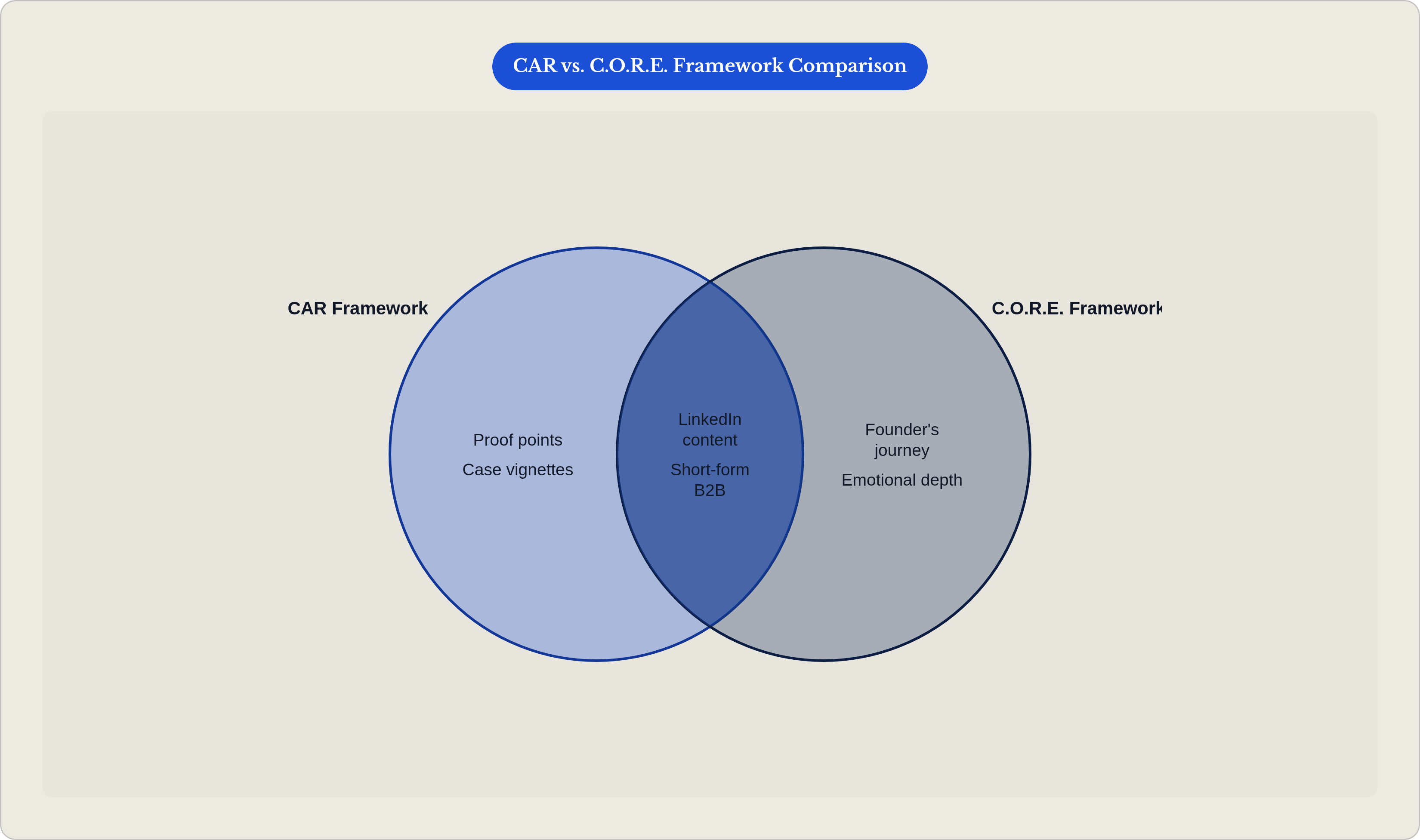
C.O.R.E. (Conflict, Overcoming, Results, Experience) was developed for founders, coaches, and consultants who are themselves the credibility signal.
It starts with conflict, the challenge the founder or customer faced, which anchors the story in emotion before any solution enters the picture. Then Overcoming: the turning point or key decision. Then Results. Then Experience: what was learned, what it felt like to come out the other side.
C.O.R.E. is for when your own journey is the content. When the founder's personal experience is what gives the message weight. It turns biography into business relevance without turning into a TED Talk or a LinkedIn brag post, which is harder than it sounds.
CAR is faster and results-forward. Use it for proof points and case vignettes. C.O.R.E. is more emotionally developed. Use it when the founder's story is the story.
Both are built for LinkedIn, which concentrates B2B decision-makers in a context where short narrative posts consistently outperform promotional ones. Worth naming directly, because a lot of founders treat LinkedIn like a press release distribution channel and then wonder why nothing happens.
Choosing and Combining Frameworks for Different B2B Contexts
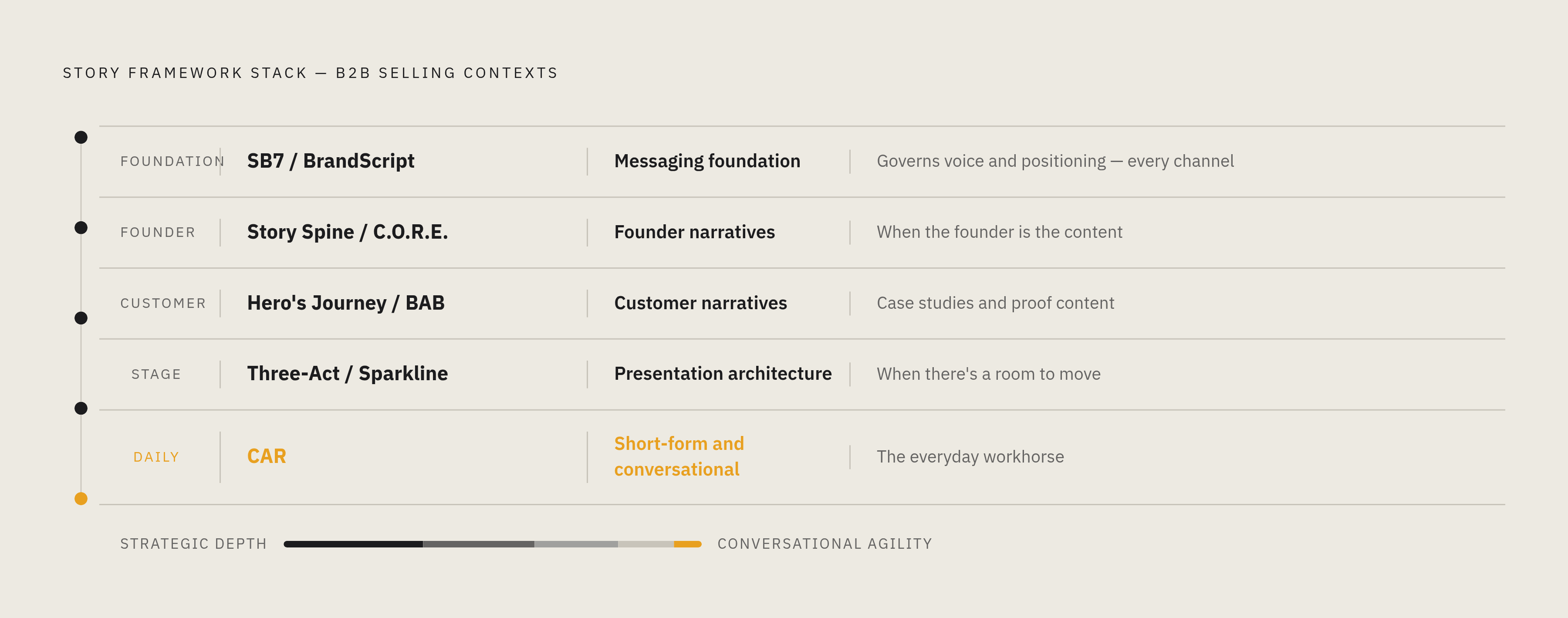
These frameworks aren't competing. They operate at different levels and they layer.
- SB7 / BrandScript: Messaging foundation. Set this first. Use it to govern voice and positioning across every channel.
- Story Spine / C.O.R.E.: Founder-level narratives. Use when the founder is the content.
- Hero's Journey / BAB: Customer-level narratives. Case studies and proof content.
- Three-Act / Sparkline: Presentation architecture. Use when there's a room to move.
- CAR: Short-form and conversational. The everyday workhorse.
A single deal will require CAR in prospecting, Story Spine on the About page, BAB in a one-pager for the champion, and Sparkline in the executive presentation. All of them are saying the same essential thing. The BrandScript is what keeps the voice consistent across all of it, so each piece sounds like it came from the same company with the same point of view, even when the formats are completely different.
One principle runs through every framework: the customer is the hero, the founder is the guide, and the product is the means. That holds whether the format is a LinkedIn comment or a forty-minute keynote.
Get the architecture right and the data lands differently. The room responds differently. The committee remembers you when they're sitting in a conference room six weeks later making a final call, and most of them can't fully explain why one vendor stuck and the others didn't. They just know one of them told them a story that felt true. That's the one that wins.