Personal Brand ROI Measurement for Founders
Most founder brand programs fail because they measure vanity metrics instead of revenue impact.

78% of executive branding programs track only engagement metrics. Just 12% establish any direct connection to revenue outcomes, according to an analysis of more than 250 programs.
A 2024 CMO survey found that 67% of marketing leaders discontinued executive branding initiatives within 12 months. Not because the programs weren't working. Because nobody could prove they were.
Joe Kingsbury at Edelman has a name for what happens next. No ROI story means no budget. No budget means no senior engagement. No senior engagement means weaker content. Weaker content makes ROI even harder to prove. The program eats itself — like a snake that swallowed its own tail and called it a growth strategy.
Two traps keep founders stuck in this cycle.
The first is the vanity metric trap. Followers and impressions show up in dashboards. They go up and to the right. They feel like proof. But they don't connect to pipeline, hiring, or valuation. You're essentially counting how many doors you knocked on without checking whether anyone answered.
The second is the timing trap. Founders expect results in eight weeks. Real brand authority compounds over six to eighteen months. When those two timelines are that far apart, programs get cut right before the payoff would have shown up.
Better content won't fix this. A better measurement architecture, built around a clear attribution model, will. And it has to be built before the content calendar even starts.
How Decision-Makers Actually Use Thought Leadership Before They Buy
The 2024 Edelman-LinkedIn B2B Thought Leadership Impact Report surveyed roughly 3,500 management-level professionals across seven countries. Some of what they found should change how you think about what brand content is actually doing.
Seventy-three percent of B2B decision-makers say thought leadership is more trustworthy for assessing a company's capabilities than marketing materials or product sheets. Ninety percent say they'd be more receptive to sales outreach from a company that consistently produces high-quality thought leadership. Seventy-five percent say it has prompted them to research something they weren't previously considering.
This content is doing pre-sales work in what practitioners call the dark funnel. Quietly. Before a lead ever shows up in your CRM.
The engagement levels back this up. Fifty-two percent of decision-makers and 54% of C-suite spend an hour or more per week consuming thought leadership. These aren't passive scrollers. They're actively using this content to make buying decisions, sometimes to reconsider vendors they're already using.
And there's an opening here: less than half of decision-makers rate the thought leadership they consume as good. Only 15% describe it as very good. The bar for standing out is genuinely low.
The measurement implication follows directly from all of this. Because brand content does its most important work before a lead is ever created, your tracking infrastructure has to capture influence that precedes the lead form. If your attribution only starts when someone fills something out, you're missing most of the picture.
The Leading and Lagging Indicator Framework Founders Should Actually Use
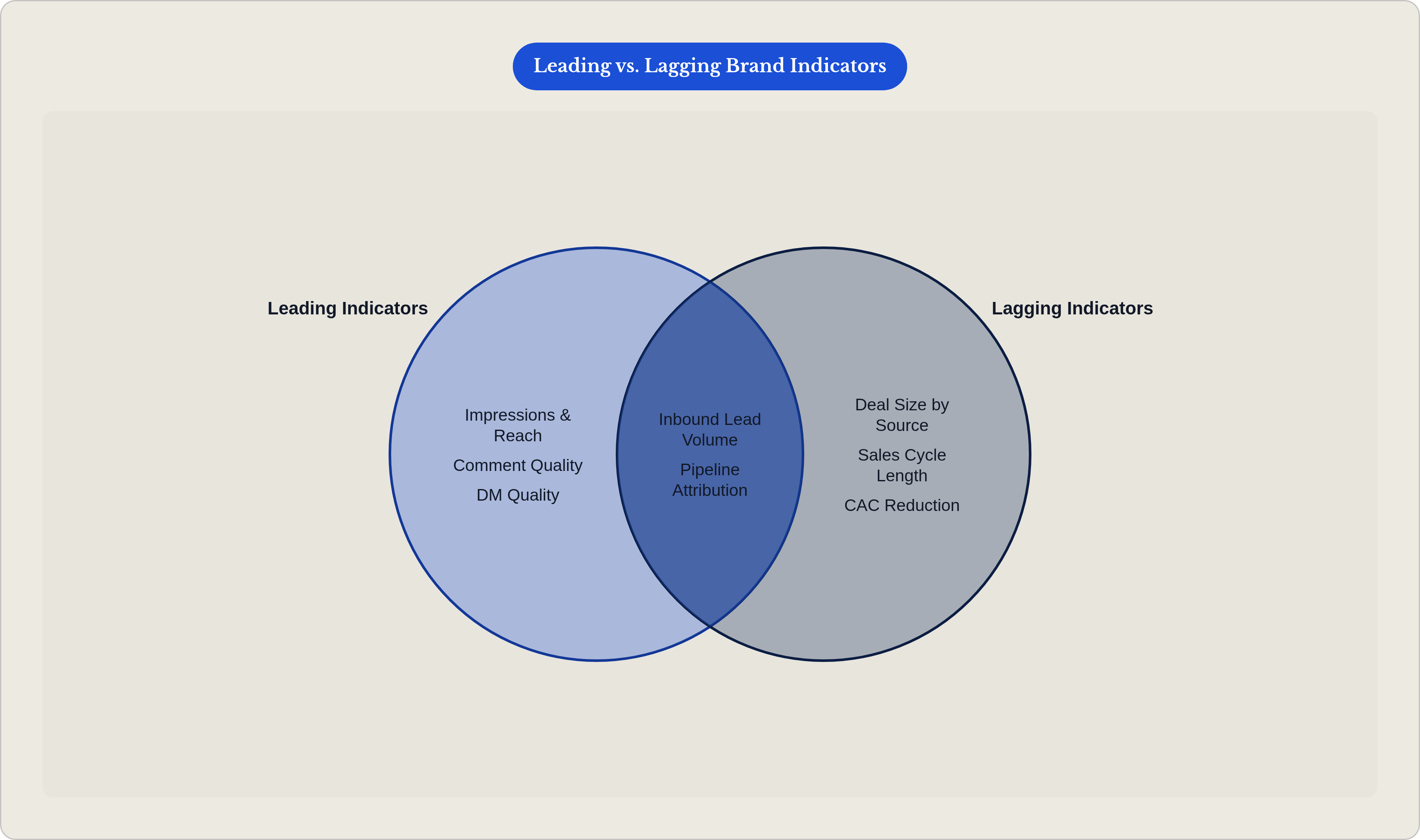
The core distinction is simple. Leading indicators are early signals, usually visible within two to six weeks. Lagging indicators are pipeline and revenue outcomes, which take six to eighteen months to fully show up. You need both. Neither one tells you much without the other, and agencies like Mindshare Lab, a done-for-you LinkedIn ghostwriting service for B2B SaaS founders that structures content programs around exactly this kind of leading-to-lagging progression, build the measurement layer in before the first post goes live.
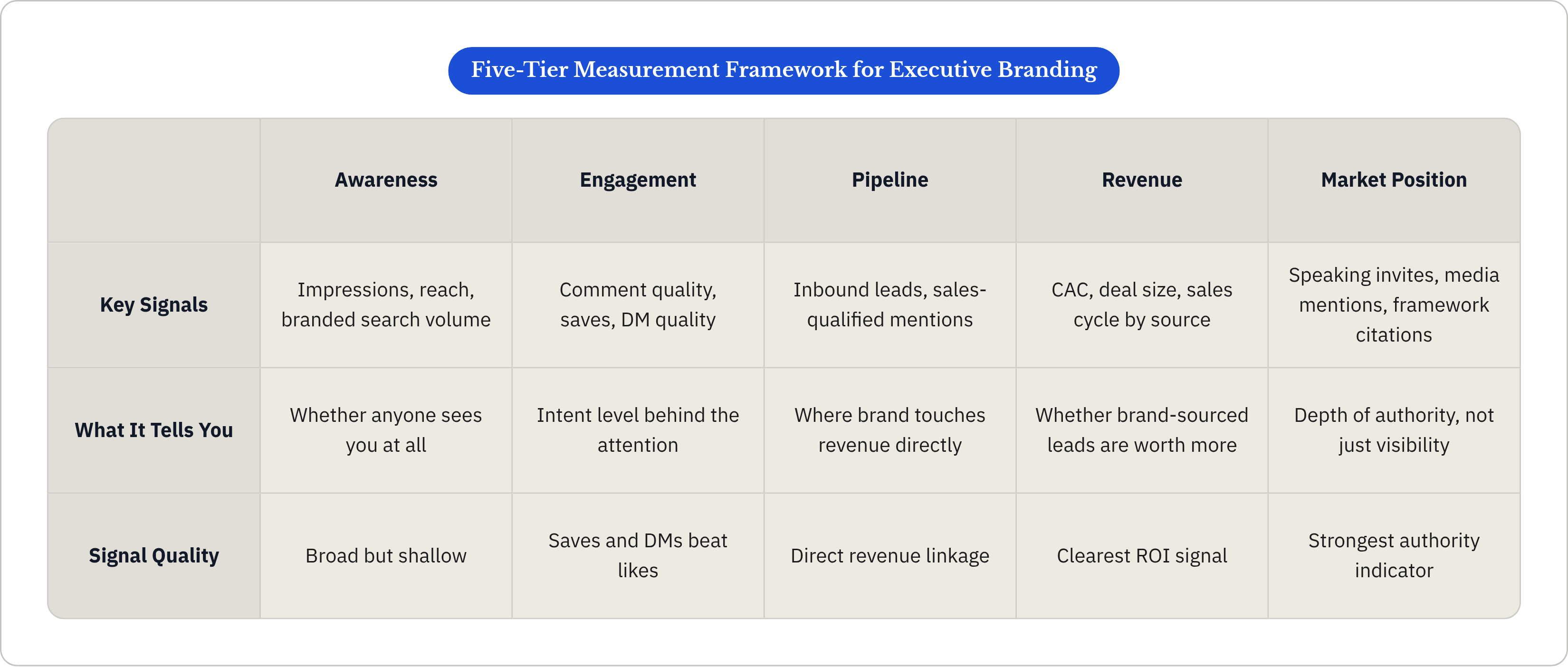
Metta Startup Studio (2025) lays out a five-tier structure that maps this well.
- Awareness. Impressions, reach, share of voice, branded search volume. This tells you whether anyone is seeing you at all.
- Engagement. Comment quality, saves, DM quality, content shares. Saves and DMs signal intent far more reliably than likes. A like is a reflex. A save is a decision someone made.
- Pipeline. Inbound leads sourced from personal brand touchpoints. Sales-qualified leads who mention the founder's content during conversations. This is where brand starts touching revenue directly.
- Revenue. Customer acquisition cost for brand-sourced leads versus cold outreach. Deal size by lead source. Sales cycle length by lead source. These numbers tell you whether brand-sourced leads are actually worth more, and by how much.
- Market position. Speaking invitations, media mentions, how often other people cite your frameworks and ideas. That last one is a real signal of authority, not just visibility.
One discipline that matters here: limit your initial tracking to three to six metrics. Only track what will actually change a decision. A metric without an attached action is just noise, and tracking fifteen things is functionally the same as tracking nothing.
There's also an authenticity signal worth folding into this. Posts with a personal story or lesson generate roughly 38% more engagement than promotional posts, and tend to improve share of voice faster than consistent promotional content does. "How I..." posts generate about three times more saves than listicles. That's not just craft advice. It's a leading indicator of downstream performance. Authentic content produces stronger early signals, which means it shows up sooner in your pipeline metrics.
And before any of this matters, establish a baseline. Measure your current brand position against your chosen metrics before the program starts. Every ROI claim you make later depends on having a real starting point to measure against.
Connecting Content Activity to Pipeline: The Attribution Infrastructure
The infrastructure has three layers.
GA4 tells you what happened on your site. Your CRM tells you who became a lead and what happened to them in revenue terms. UTM parameters are the connective tissue linking content to both, which is what makes closed-loop attribution possible.
For LinkedIn specifically: add UTM parameters to any links you share, and review LinkedIn Analytics weekly as a leading indicator. Impressions, profile views, and search appearances aren't vanity when you're tracking them against a baseline and watching for directional change over time.
On the CRM side, HubSpot captures UTMs natively. Salesforce requires custom fields. For teams that need closed-loop revenue attribution, Ruler Analytics is worth looking at.
None of those tools catch everything, though. Some of the best attribution comes from simply asking. A "How did you hear about us?" field on your intake form, or a verbal question during a discovery call, surfaces information that no analytics platform will ever capture on its own. This is especially true for podcast appearances, event talks, and word-of-mouth that originated from content.
There's also what people call "dark social" to account for. Log it when prospects mention in a sales conversation that they've been following your content. Track time-to-close for inbound versus outbound leads. Compare win rates where prospects engaged with founder content first against leads that came in cold. The pattern usually shows up pretty quickly.
For early-stage founders who don't have a full CRM stack yet: a spreadsheet noting how each new inquiry found you is a legitimate floor. It captures the qualitative "why" before you have the infrastructure to capture anything else.
One non-negotiable: the attribution system has to exist before content publishing begins. You cannot retrofit tracking onto content that predates it. That data is gone.
What Benchmark Outcomes Look Like When the System Is Working
These are calibration standards, not guarantees. Use them to interrogate your own results, not as automatic expectations.
Prospects who engage with executive content before sales conversations move through pipeline 35 to 40% faster. Lead qualification rates increase 45 to 55% when prospects have already consumed thought leadership before the first call. They show up warmer. The education phase is shorter or already done.
On customer acquisition costs: companies running systematic executive branding programs see CAC decrease 25 to 30% compared to traditional marketing channels.
The compounding effect is real and worth understanding before you discount it. One B2B SaaS company found that year-two results were 2.3 times better than year one as the content library and executive authority grew. After 18 months, the program delivered 329% personal branding ROI compared to traditional marketing channels. That's not a typical outcome, but it's also not a fluke.
On LinkedIn specifically, only 1% of its billion-plus users post content weekly. That 1% generates 9 billion impressions per week. Consistency is a structural advantage, not a best practice someone invented.
Talent and partnership effects also show up in the data. Companies with visible executive thought leaders receive 2.5 times more qualified job applicants and reduce recruiting costs by up to 40%. Strategic partnership proposals arrive at roughly three times the rate compared to companies without visible leadership.
When your system is working, these levers move. Not all at once, and not immediately. But the directional signals are consistent.
Time Horizons: What the Data Says About When Different Returns Appear
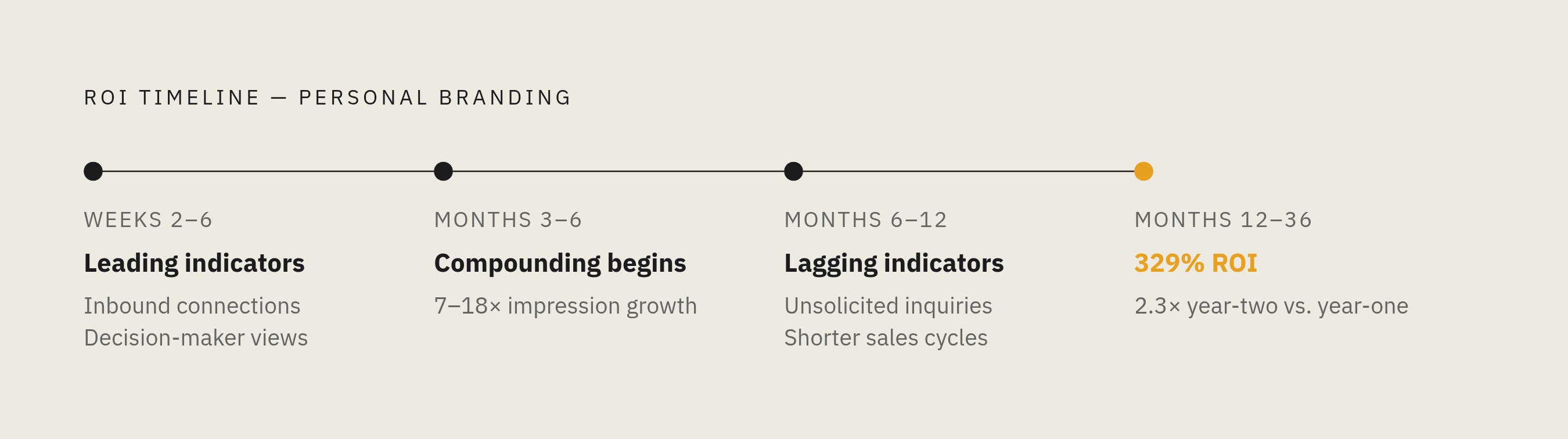
Weeks two through six bring the first leading indicators. More relevant inbound connection requests. Profile views from decision-makers rather than just peers. A noticeable shift in the quality of DMs, from generic pitches to real questions from people who read something you wrote.
Months three through six are when compounding begins. The content library starts functioning as a trust-building asset through content compounding, working on its own schedule. Inbound inquiry volume increases. B2B founders in structured programs consistently see seven to eighteen times growth in LinkedIn impressions within 90 days.
Months six through twelve are when lagging indicators start appearing. Unsolicited client inquiries. Shorter sales cycles for brand-sourced leads. A measurable difference in close rates between inbound and outbound leads.
Months twelve through thirty-six are when the full ROI picture emerges. Metta Startup Studio and others recommend a minimum of 12 months of baseline data, with continuous measurement over 24 to 36 months to capture what sustainable returns actually look like.
The consistency risk is real. A personal brand that posts for three weeks and then goes quiet doesn't build the compounding effect. The time lost to inconsistency can't be recovered by doubling output later. You're not just losing impressions. You're resetting the clock.
One additional context worth knowing for founders thinking about a raise: 90% of VC deals today are outbound, meaning investors are actively scanning for founders they already recognize. Brand presence has to be established well before a raise is underway. The pipeline for investor relationships is longer than most founders expect, and you can't sprint your way into it.
The Founder Dependency Risk and How Measurement Contains It
Here's the quiet risk inside every founder brand program. If 44% of company market value is attributable to CEO reputation, then the founder's departure, controversy, or reduced visibility is a material business risk. Not a PR problem. A valuation problem.
The trap isn't visibility itself. The trap is visibility that only works when the founder is physically present. When the brand lives entirely in the person rather than in documented ideas, frameworks, and points of view, it doesn't scale. And it doesn't survive a transition. Think of it like a sun and its solar system: if the star burns out, every planet that depended on it goes dark.
Measurement is what contains this. When you track which frameworks generate pipeline, which ideas get cited, which content earns speaking invitations, you're identifying intellectual property worth institutionalizing. Those ideas start out attributable to the founder. Over time, they get embedded in company culture and positioning. They transfer in a way that charisma doesn't.
The content categories that score highest on market position metrics (citation frequency, framework adoption, speaking invitations) are exactly the ones that translate most cleanly into team culture and company positioning. That's not a coincidence. It's because those ideas have been tested against a real audience and found useful by people beyond the founder.
There's also a focusing function here that's easy to miss. When you're tracking which ideas generate pipeline versus which ones only generate likes, you naturally concentrate your attention on the IP that compounds. That's the asset worth protecting and scaling beyond any one person.
The Three Measurement Pitfalls That Derail Otherwise Sound Programs
The first one is treating vanity metrics as success signals. Tracking follower counts and impressions without connecting them to any tier of the pipeline stack feels like progress. It masks stagnation. The worst version is when a program gets renewed based on follower growth while pipeline contribution is never measured at all. That's how programs quietly become very expensive ways to feel productive.
The second is inconsistency. Posting actively for three or four weeks, then going dark. This does two things at once: it destroys the compounding timeline, and it makes attribution nearly impossible, because your baseline and active periods blur together. You can't measure the lift from a program that keeps stopping and starting. You end up with data that doesn't tell you anything.
The third is using the wrong benchmarks. Using B2C influencer benchmarks for a B2B founder brand, or measuring success against engagement rates from categories with very different audience sizes and buying cycles, produces a distorted picture. A B2B founder with a thousand highly engaged decision-maker followers is running a fundamentally different operation than a lifestyle brand with a hundred thousand passive ones. The numbers aren't comparable, and treating them as if they are leads to bad decisions.
Two additional pitfalls come up often enough to name.
Attribution over-credit: assuming that all inbound leads during an active brand period came from the brand program. Other marketing, seasonal factors, and sales activity all contribute. You have to control for them, or your ROI math is fiction.
Incomplete cost accounting: measuring brand-sourced revenue without accounting for the full cost of content production, distribution, and the founder's time. The return looks better than it is. That catches up with you eventually.
The fix is not more metrics. It's fewer, more deliberate ones. Three to six KPIs, selected because they're actionable. Baselined before the program starts. Reviewed on a cadence that matches the relevant time horizon: weekly for leading indicators, monthly for pipeline, quarterly for revenue.
Measurement isn't the unsexy part of brand building. It's what makes the whole thing defensible, scalable, and worth doing again.