Founder-Led Social Selling vs Traditional B2B Sales Outreach
Founder presence on social media reaches buyers during research, not after they've already decided.

The most important moments in the B2B buying journey are almost entirely invisible to your GTM team. Not slightly hard to track. Invisible.
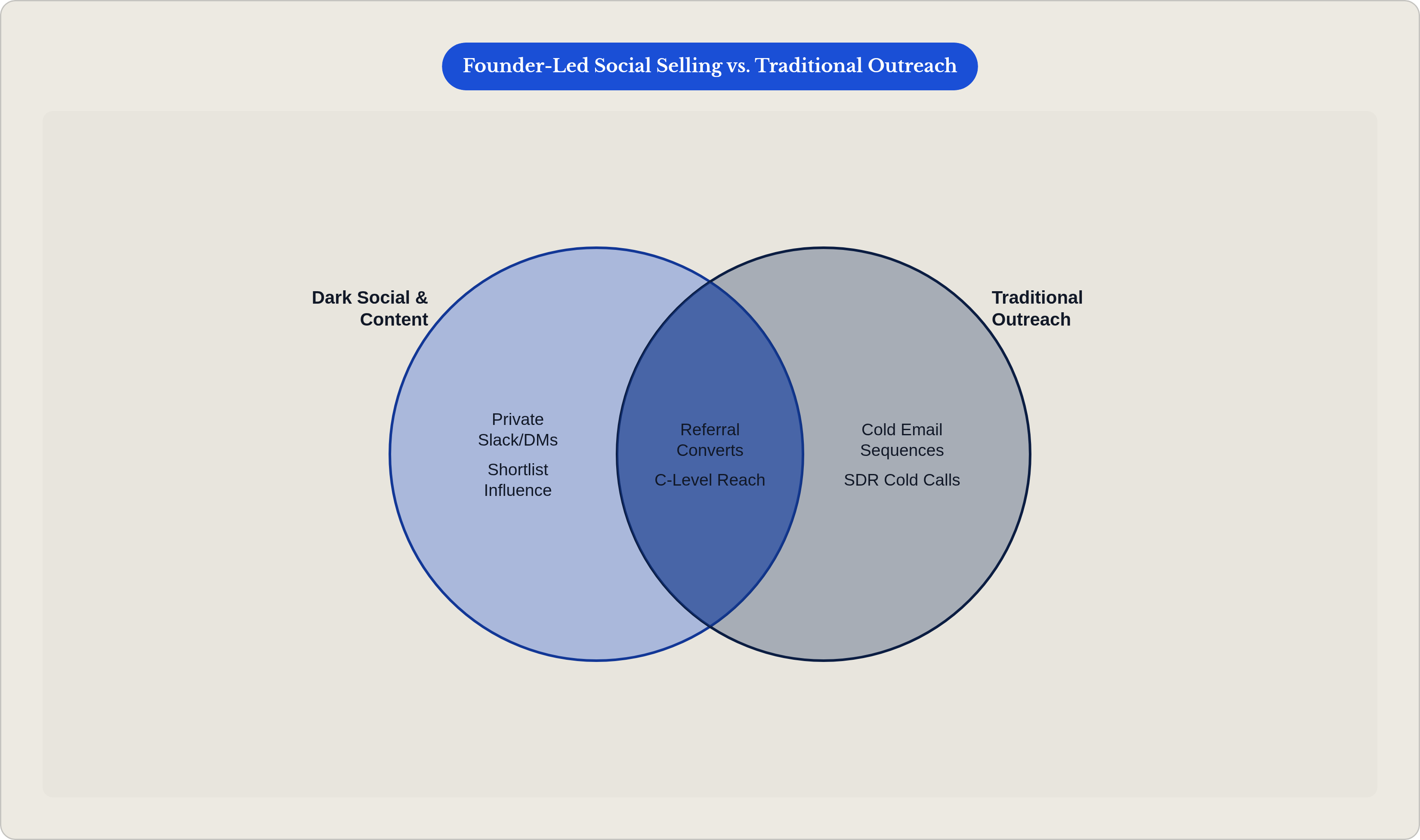
This is what people mean by dark social. The definition is simpler than the name sounds. It's digital sharing and engagement that leaves no trackable trail. Private LinkedIn DMs. Internal Slack channels. WhatsApp threads. Emails forwarded between three people on a buying committee. Podcast recommendations dropped in a gated forum at 11pm. None of it touches a UTM parameter.
When a buying committee finds a founder's LinkedIn post genuinely useful and drops it into their internal Slack, that high-intent action never shows up in your analytics. It looks like nothing happened. So budgets flow toward things that are measurable rather than things that are effective. The dashboard shows the tip of the iceberg. The iceberg is where decisions are actually forming.
Peer recommendations from private channels consistently rank as the most trusted source B2B buyers consult during evaluation. Ahead of analyst reports. Ahead of vendor content. Ahead of search results. The most trusted part of the buying process is also the part you can't see, which is either amusing or maddening depending on how much you've spent on attribution tooling.
AI has added another layer on top of this. A growing share of buyers now use LLMs at some point during research, and a meaningful number of SaaS companies get misrepresented or summarized inaccurately when buyers run their names through ChatGPT. A founder who has been actively shaping their narrative across public digital surfaces is simply harder to get wrong. And because buyers increasingly encounter AI-generated summaries before they ever visit a website, public thought leadership feeds those surfaces too.
If you're not creating content that travels through these channels, you're absent from the most trusted part of your buyer's decision-making process. Not underrepresented. Absent.
Why Traditional Outreach Arrives Too Late and Performs Too Poorly to Compensate
The volume playbook is familiar. Hire SDRs, load a sequencer, send a lot of emails to a lot of people. It worked well enough for long enough that entire GTM motions got built around it. That window has largely closed.
Cold email reply rates have dropped significantly over the past several years. Decision-makers receive over 100 sales emails per week. The channel is structurally saturated, and most buyers have developed a reflexive skepticism toward it. Run the cold call math and the picture gets clearer. Roughly 1,000 dials produce around 166 actual connections. Of those, maybe 50 to 80 hear any part of the pitch. Four or five book a meeting. You get two real opportunities. You close about one deal.
That math was never efficient. It's getting worse.
The problem isn't that SDRs are bad at their jobs. The structural problem is timing. Buyers spend only about 17% of their total buying time actually talking to potential vendors. The rep who shows up cold is competing for a tiny, late slice of attention from someone who has already done most of their thinking. Better personalization helps at the margins. It doesn't fix the underlying trust deficit, because the trust deficit was built long before the email landed.
Outreach does still work in specific conditions:
- Referrals convert at roughly 26%, which is dramatically higher than cold contact rates
- C-level executives respond when outreach reflects real, specific account knowledge rather than templated pain-point language
- Coordinated multichannel sequences genuinely outperform single-channel approaches
What those conditions share is prior familiarity. Some reason for the prospect to believe the message is worth 30 seconds of their attention. Outreach works as a follow-through tool for buyers who already have a signal about you. As a first-contact strategy for buyers who have never heard of you, the unit economics are moving in the wrong direction and have been for a while.
What Founder-Led Social Selling Actually Does Differently in the Pre-Sale Window
The core difference is timing. Not tactics. Not messaging framework. Timing.
Founder content reaches buyers while they are forming opinions, building shortlists, and dropping links in Slack channels. Not after all of that has already happened. Prospects who have engaged with a founder's content before receiving any outreach respond at meaningfully higher rates than cold contacts. Warm leads generated through content engagement move to sales conversations faster. The content handles trust-building before the sales conversation ever starts, which changes the nature of the conversation entirely.
Why does the founder's voice carry weight that a company page can't replicate?
A few reasons, none of them complicated.
Buyers know company-page content is marketing. They read it with a filter on. A founder's perspective carries the implicit authority of someone who built something and has actual stakes in it. That reads differently, and buyers can feel the difference even when they can't articulate it.
LinkedIn's algorithm also structurally favors individual accounts over brand pages. Personal posts get better organic reach because the platform reads them as conversational rather than promotional. The system itself is set up to help the founder more than the brand account.
And the content founders naturally produce is exactly the content that travels through dark social. The Edelman-LinkedIn B2B Thought Leadership Impact Report, which surveys thousands of management-level professionals across multiple markets and has done so across several consecutive years, consistently finds that decision-makers consider thought leadership a more trustworthy way to assess a company's capabilities than marketing materials or product sheets. The same research finds that decision-makers who aren't visibly involved in procurement cycles are more receptive to outreach after encountering genuine thought leadership. Hidden buyers, in other words, are getting influenced by content before they ever raise their hand.
Here's the shortlist dynamic. The winning vendor is already on the buyer's shortlist the vast majority of the time before any sales contact happens. Those shortlists are built through peer channels and self-directed research. Consistent founder presence on LinkedIn is one of the few levers that actually influences shortlist composition before the formal sales process starts.
You're not selling. You're getting on the list.
The Performance Gap Between Social Selling and Traditional Prospecting in Practice
The performance difference between social selling and cold outreach isn't a slight edge. It represents a structural shift in how buyers enter the sales conversation, which changes nearly every downstream metric.
LinkedIn InMail messages average response rates substantially higher than cold email. Companies with strong social selling adoption consistently achieve higher revenue attainment than those with low adoption. But the raw response rate isn't even the most interesting number. Deal quality and sales cycle length change too.
B2B companies that implement social selling systematically see average deal sizes increase and sales cycles shorten. Prospects enter conversations already familiar with the seller's thinking, which compresses the discovery phase significantly. A buyer who discovered a founder through content, followed their posts for several months, and then received an outreach message is a fundamentally different kind of conversation than a cold contact who has never heard of the company. The "sales call" in the first scenario is closer to a confirmation than a pitch. That's a different kind of selling. Easier, faster, and cheaper to run.
Among B2B SaaS companies that have grown meaningfully in recent years, the pattern shows up repeatedly: founders who post actively on LinkedIn generate a disproportionate share of qualified enterprise leads compared to those who don't. It's not a coincidence. It's what happens when you're present during the research phase instead of showing up after it's over.
How a Founder Builds a Distribution Moat on LinkedIn (and What the Flywheel Actually Looks Like)
Let's be precise about what we're building here, because people often treat this like a campaign. It's not a campaign. It's an asset.
A distribution moat is a proprietary audience that trusts you, listens to you, and buys from you without paid advertising or cold outreach as the primary engine. Unlike a cold email sequence, an audience built on LinkedIn compounds. Future buyers are getting warmed up right now by posts you haven't written yet. That's a strange thing to sit with, but it's accurate.
It requires patience. Founder-led content needs a minimum four to six month commitment before meaningful momentum develops. That's not a flaw in the strategy. That's just how trust actually works, online or anywhere else.
What the LinkedIn Algorithm Actually Rewards Right Now
Organic reach on LinkedIn has dropped broadly. Engagement per post, though, is up. The audience is smaller but more attentive, which is a better situation than a large, disengaged one.
What the algorithm is actually measuring is dwell time. A user who spends 45 seconds reading a post without liking it is more valuable to the algorithm than someone who likes it within two seconds and keeps scrolling. Genuine attention is the signal. Not surface engagement, not click volume.
Practical implications:
- Two to three substantial, genuinely useful posts per week outperforms daily lightweight updates
- Strong first lines matter more than almost anything else, because they determine whether someone expands the post or keeps moving
- The algorithm rewards content that makes people stop, not content that prompts a quick reaction and disappears
Format Choices That Actually Move the Needle
Carousels uploaded as PDFs consistently achieve the highest average engagement rate of any format on the platform. That's worth knowing before spending a week on a video series.
The most underused high-performing format is the text-only post. A well-written 200-word post with a strong opening line and a specific, genuine observation routinely outperforms polished graphics, produced video, and posts with external links. Production quality is not the variable that matters. The sharpness of the thinking is.
What founders should resist: spending money on design before they've developed an actual point of view. The algorithm responds to the latter. So does the audience.
The Content Posture That Builds Authority vs. the One That Gets Ignored
Opinionated, specific, experience-grounded content earns trust. Generic tips content does not.
Buyers follow founders who have a point of view, not founders who soften every observation into brand-safe neutrality. If you're not willing to say something someone might disagree with, you're probably not saying anything worth remembering. Being carefully inoffensive on LinkedIn is technically presence and completely forgettable at the same time. Those two things can coexist, and for a lot of founders they do.
LinkedIn is the single most concentrated surface for reaching the people who will eventually sit on buying committees. The ROI of having a distinct voice there isn't abstract. It's the shortlist.
Where Traditional Outreach Still Fits (and How to Position It Relative to Founder Content)
This is not an argument for eliminating outbound. It's an argument for sequencing it correctly.
Referrals convert at roughly 26%. Founder visibility on LinkedIn generates the reputation that produces warm referrals at scale, which means the content work and the outreach work aren't competing with each other. They're connected. A C-level executive responds when outreach reflects genuine account knowledge. A founder whose content is already visible gives the SDR real material to reference authentically, not a generic pain-point sentence assembled from a persona template.
Outreach works best as an amplifier of existing trust. Not a generator of trust from zero.
The prospect who has seen the founder's content, engaged with a post, or heard the founder mentioned in a peer channel is a categorically different outreach target than a cold name from a list. The "cold" email is already warmer. Cognism's approach illustrates this clearly. By ungating content, creating demand through dark social channels, and then following up with targeted outreach, they produced a 4x higher conversion rate, a 26% higher win rate, and a 36% shorter sales cycle. The outbound worked because the awareness work came first. The sequencing was the strategy.
What this means practically:
- The question is not whether to run outbound
- The question is whether to run it into an audience that has never heard of you, or into one the founder has been building trust with for months
- As acquisition costs rise, the cost of the former compounds; the efficiency of the latter improves over time
The founders who figure this out aren't doing less selling. They're doing it in the right order. They show up during the research phase. They get on the shortlist. Then they close. Everyone else is showing up after the decision was mostly already made and wondering why the conversion rates are so rough.