Dark Social and B2B Buyer Research Blind Spots
Buyers decide which vendors to buy from in secret channels your analytics can't see.
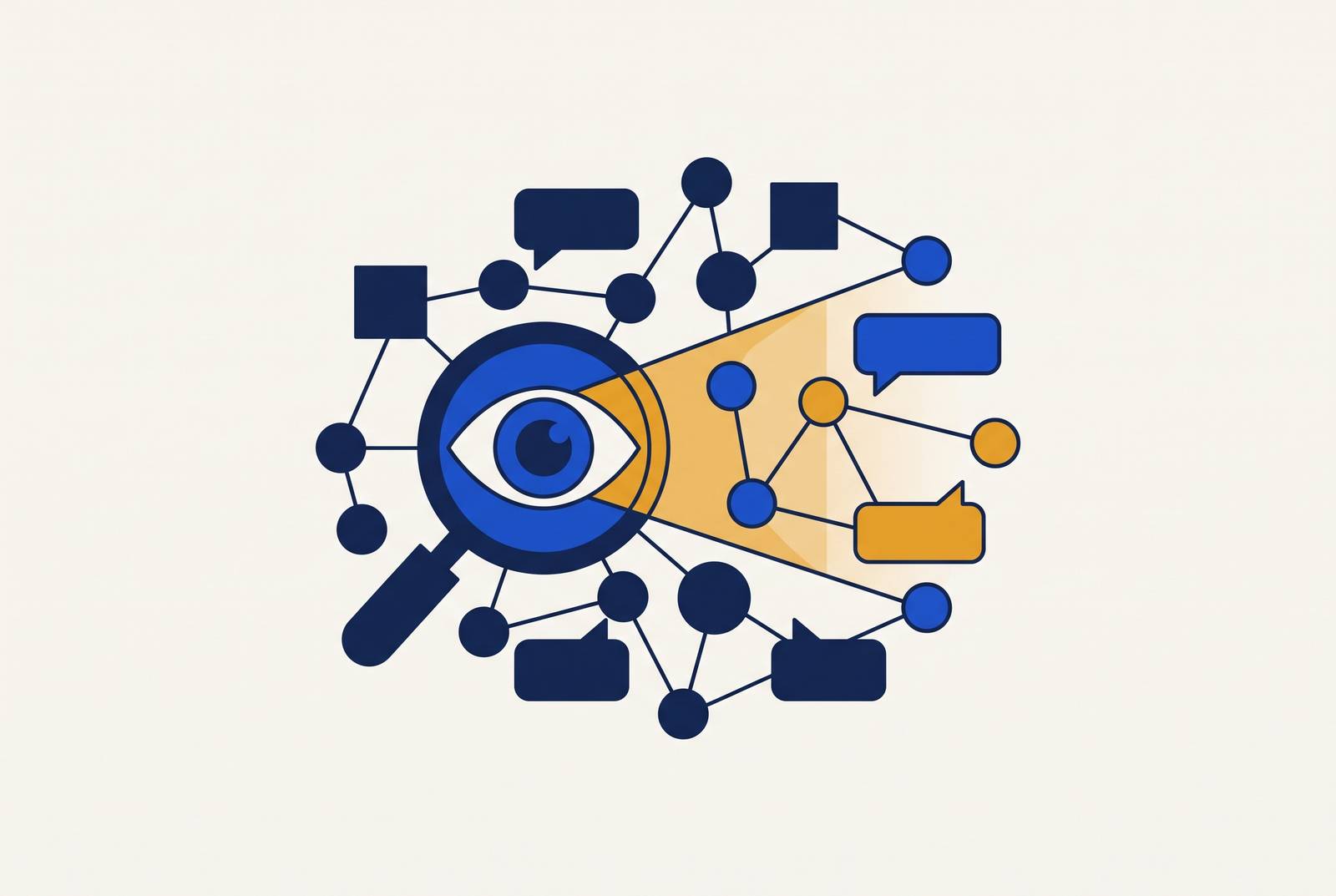
Roughly 70% of the B2B buying process happens before a prospect ever fills out a form, books a demo, or replies to a cold email. Marketing dashboards only see the last 30%, and most teams are making budget decisions based on that sliver. This measurement gap isn't slowly closing as tools get better — it's widening, and encrypted messaging, private communities, and AI research tools are the reasons why.
Dark social has a specific meaning, and it's worth being precise about it. The term describes content and conversation moving through channels analytics literally cannot read: Slack DMs, WhatsApp threads, closed Discord servers, email forwards, LinkedIn messages — a step beyond a vague "word of mouth exists" observation. Alexis Madrigal coined the term in The Atlantic back in 2012, describing traffic that showed up as "direct" in analytics tools because there was no referral data attached to it. That problem has only gotten more severe since, as encrypted platforms became the default way professionals talk to each other, and something like 84% of B2B content sharing now happens in these private channels. So the majority of how your content spreads is, by design, invisible to you.
Where the invisible 70% actually happens
Nothing about dark social is exotic. It's the ordinary plumbing of how professionals get things done: a Slack community where someone asks "anyone used this vendor," a WhatsApp thread with a former colleague, a LinkedIn DM asking "is this tool actually good or is the marketing lying to me." Peer recommendations from these private channels are the most trusted source B2B buyers cite during evaluation, ahead of analyst reports, ahead of vendor content, ahead of search results (Qualtrics XM Institute, 2024). That signal sits above the trackable marketing funnel rather than beside it. For most buyers, most of the time, it is the funnel.
Here's the part that should reorder how marketing teams think about their own funnel: 78% of buyers had already heard of the product they ended up choosing before they started formally researching it (TrustRadius, 2024). The shortlist gets built before a single trackable action occurs, and by the time someone fills out a form or requests a demo, they're closer to the finish line than the start, just checking a box on the way to a decision they'd already leaned toward.
What actually moves through these channels? Personal recommendations, cautionary tales about a bad vendor experience, comparisons based on someone's lived experience with a product rather than its feature sheet. None of that is running through a pixel. Ask yourself the last time you posted "anyone have a good recommendation for X software" in a Slack group, then quietly ignored the three vendor emails that showed up in your inbox that same week. That's the whole mechanism, right there.
How 6sense's shortlist data reframes what "pipeline" actually means
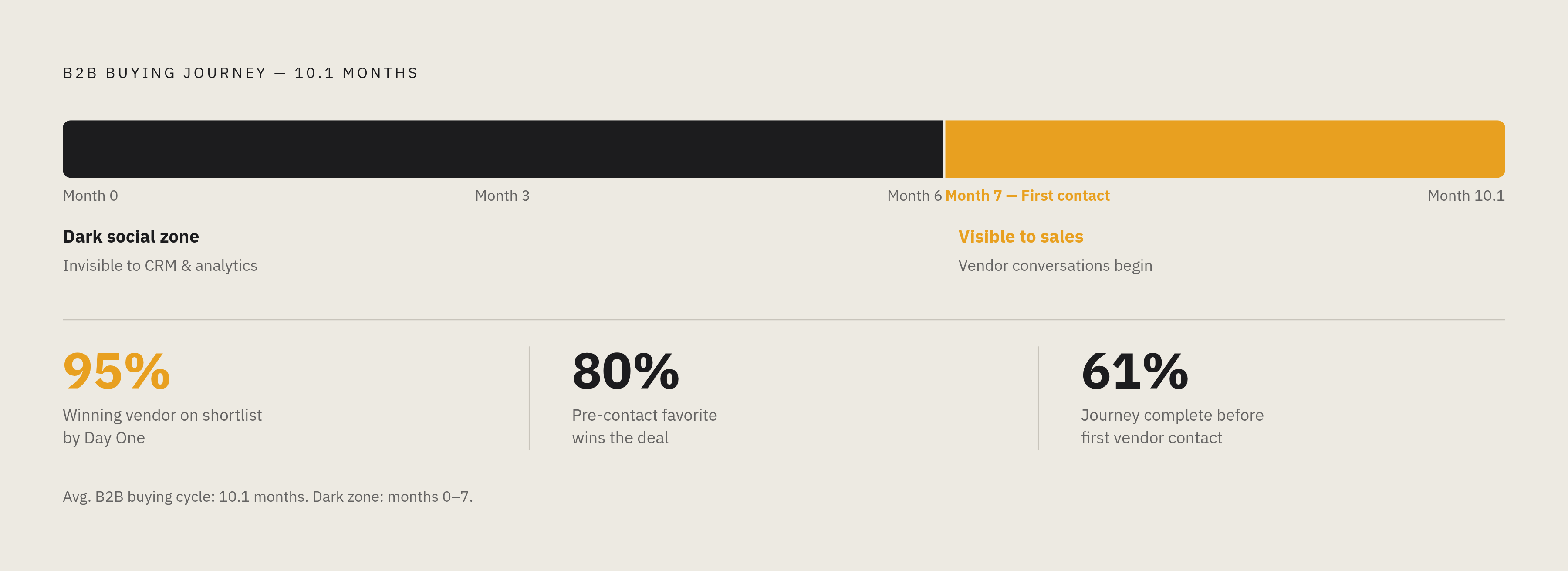
6sense's 2025 Buyer Experience Report puts a number on something a lot of sales teams have suspected quietly for years: 95% of the time, the vendor that wins the deal was already on the buyer's shortlist on Day One, and the pre-contact favorite closes roughly 80% of deals. Read that again, because it's not a small stat to shrug past. It means the outcome of most deals is set before sales ever says hello.
Buyers are also waiting longer to reach out. Contact with a seller now happens at around 61% of the buying journey, down from 69% in earlier 6sense research. The window where a sales rep can actually change the outcome keeps shrinking.
So what does "pipeline," as most revenue teams track it, actually measure? Contacts, MQLs, demo requests — all tail-end events. A sales team closing 80% of its pipeline might feel like it's crushing quota through sheer selling skill, when really it's riding on thought leadership and peer trust it never sees and can't take credit for on a dashboard. If that upstream trust erodes, the pipeline numbers won't flinch, right up until they collapse.
The full buying journey now averages 10.1 months, with first vendor contact landing around month seven or eight. Do the math: that leaves roughly six months where the buyer is forming opinions entirely in the dark, and that stretch is the longest, most consequential part of the whole process — the one no CRM was built to see.
How AI research tools are deepening the dark funnel
If dark social was already a blind spot, AI research tools have started bricking up the window. ChatGPT, Gemini, Perplexity, and Claude.ai together pulled in over 7.6 billion visits a month as of late 2025, and Perplexity's monthly visits grew roughly 7x between January 2024 and December 2025. These tools have moved well past novelty status. They're where a growing share of buyers do their first pass of vendor comparison, well before a company website enters the picture.
94% of B2B buyers now use large language models somewhere in their purchase process, and none of it shows up in attribution. A buyer types a messy paragraph describing their requirements into an LLM, gets back a shortlist of three or four vendors, and moves on. No cookie fires, no referral source logs — the website that would've captured that visit twenty years ago never gets the chance.
There's tracked evidence of the shift too, even if it's a partial picture. ChatGPT already sends 3.37% of Forrester's traffic and 2.97% of Gartner's, and that's just the visits that convert into a click. The consultative back-and-forth that ends without a click-through, where the LLM just answers the question directly, leaves no trace at all.
HubSpot's own organic traffic dropped from 13.5 million visits in November 2024 to under 7 million by December, an 80% year-over-year fall, despite staying highly visible in search and getting cited inside LLM answers constantly. Visibility stopped translating into visits. BrightEdge found something similar industry-wide after AI Overviews launched: impressions climbed almost 50% year-over-year while click-through rates fell nearly 30%. Being seen and being clicked have quietly become two different things.
The bigger structural shift runs deeper than adding another dark channel to the pile. AI compresses the entire research phase into a single conversation with a model, one that never touches your site, your forms, or your tracking pixels. And if a brand isn't part of the model's training data or its live web knowledge, it never makes the shortlist to begin with. Cut before the audition started.
The buying committee complexity that attribution models were never built to handle
Attribution models were largely built around the idea of one buyer clicking through a handful of touchpoints, and that buyer doesn't exist anymore, not in B2B. The average enterprise buying group now sits at 11 stakeholders, and complex purchases can involve 20 (Gartner, 2024), up 57% from the 7-person committees Gartner documented back in 2017. Each additional stakeholder shaves off roughly 10 percentage points of purchase probability. More cooks, slower kitchen, colder meal.
Sales reps, meanwhile, get less and less of the buyer's actual time. Only 17% of the total buying journey is now spent with a vendor's sales team (Gartner, 2025), and 61% of buyers say they'd prefer a rep-free experience if they could have one. Which raises an obvious question: who's actually influencing the other 83% of the journey?
Some of it's the hidden buyers: finance, legal, compliance, procurement, operations — people who will likely never open the product but hold veto power over whether it gets bought at all. More than 40% of B2B deals stall because of internal misalignment driven by exactly this group, and they're not passive bystanders waiting to be looped in. 63% of hidden buyers spend more than an hour a week consuming thought leadership, nearly matching the primary target buyer's engagement, and 95% of them say strong thought leadership makes them more receptive to being contacted by sales in the first place.
None of that shows up in a CRM. The IT director raising quiet objections in an internal Slack channel, the CFO who read a founder's LinkedIn post three months back and filed it away, the compliance lead who heard a podcast mention your competitor by name — add in that Chrome phased out third-party cookies in 2024, the technical scaffolding attribution used to lean on is being dismantled at the exact moment the buying committee got more complicated. Bad timing, or maybe just timing.
What marketers actually get wrong when they try to optimize around the blind spot
Here's the trap, plainly: channels shaped by dark social (social content, podcast guest spots, community presence, founder posts) look like garbage in a dashboard because they don't generate a trackable conversion event. Meanwhile, branded search and retargeting sail in at the end of the journey and take full credit for a decision that was made weeks or months earlier, somewhere the dashboard never looked.
Marketing teams respond, reasonably but wrongly, by pouring more budget into whatever's measurable and starving whatever isn't. It's a bit like judging a chef entirely on plating and ignoring the fact that the meal took six hours to prepare.
That's expensive, because the buyer's alternative to switching vendors is often just... not switching. Between 40% and 60% of enterprise software evaluations end in "no decision" (G2 research), with buyers sticking with the tool they've already got rather than taking a risk on something new. So the trust built during the dark social phase carries the real weight of the decision, rather than serving as a bonus signal. It's the entire reason a company makes the shortlist instead of getting filtered out before the buyer even opens a browser tab.
Then there's the direct traffic problem. A buyer reads a founder's LinkedIn post, closes the tab, and six weeks later types the company's URL straight into their browser. Analytics logs that as "direct," a category that basically means "we have no idea," and the social influence that actually drove the visit disappears from the record entirely.
Optimizing around MQLs makes all of this worse, not better. Chasing form fills and email opens selects for buyers who were already most of the way to a decision. It tells you nothing about the 70% still forming opinions in channels you can't see, and it quietly trains marketing teams to ignore the exact phase where deals actually get won or lost. A pipeline built entirely on late-stage signal can look perfectly healthy right up until the influence upstream of it dries up, and by then, it's too late to backfill trust that took months to build.
Why thought leadership is the primary lever for the part of the funnel you can't track
Edelman and LinkedIn ran the most rigorous look at this available, surveying close to 3,500 management-level professionals across seven countries in 2024, and the numbers are hard to argue with. 73% of B2B buyers say thought leadership is a more trustworthy way to judge a company's competence than traditional marketing materials, and buyers are actively distrusting the brochure in favor of the opinion piece.
75% of decision-makers say thought leadership pushed them to research a product or service they hadn't previously considered. That's dark social influence, made visible for once, because someone happened to report it in a survey — the mechanism doesn't change whether it's tracked or not, and a sharp piece of writing shifts someone's shortlist either way.
60% of decision-makers say strong thought leadership makes them willing to pay more, beyond simply liking the brand more. 86% said they'd be moderately or very likely to invite a company producing consistent thought leadership to participate in an RFP, which makes thought leadership less of a branding exercise and more of a shortlist-entry ticket. 70% of C-suite executives said thought leadership actually made them reconsider a vendor relationship they already had, meaning it reaches people who weren't even shopping.
And the hidden buyers, the finance and legal and procurement crowd holding veto power? The people attribution can't see are the same people actively reading and being moved by the content marketing teams write off as unmeasurable.
Here's why it travels: a sharp, opinionated piece is worth forwarding. Someone reads it, thinks "my team needs to see this," and drops it in a Slack channel. A generic vendor blog post about "five ways to boost productivity" does not get forwarded anywhere, because nobody wants to be the person who shared that.
Why the founder's voice reaches where company content cannot
LinkedIn is where dark social becomes visible, or at least visible-ish, in B2B. Nowhere else concentrates management-level and executive attention at that scale. It functions closer to the professional world's group chat than a conventional marketing channel.
The distribution math on the platform tells its own story. Company pages get roughly 5% of feed allocation, while personal profiles pull in the large majority. That gap reflects a structural fact about where attention actually sits now, not a passing algorithm quirk, and individuals draw measurably more trust than the same content from a brand account.
There's an opening buried in that stat too: a remarkably small share of LinkedIn's active users post content regularly, and that sliver generates the overwhelming majority of impressions on the platform. The bar for standing out is lower than most founders assume, mostly because so few of them are even trying.
Why the founder specifically, and not the company page? Because trust is the currency of dark social, and trust travels between people, not logos. A buyer forwarding a founder's post to a colleague and saying "this guy gets it" is the exact mechanism dark social describes, while a company page post rarely triggers that behavior; it reads as marketing, because it is marketing. Over time, a founder posting consistently builds the kind of background familiarity that explains why 78% of buyers already knew the vendor they picked before formal research even started. That familiarity has to come from somewhere, and increasingly, it's coming from a person's face and opinions in someone's feed, not a logo in a banner ad.
Organizations that consistently produce thought leadership see 54% of buyers say it prompted them to go research the company's offering (Edelman-LinkedIn, 2024). The pattern holds: content that's specific and opinionated is what spreads through private channels and earns trust, while safe, generic content just sits there, politely ignored.
What B2B marketers and founders should actually do differently
Start by accepting that full attribution isn't coming back. Cookies are going away, AI research is structurally untrackable by design, and private-channel sharing was never measurable in the first place, not even in the golden age of third-party cookies. Chasing a perfect attribution model at this point is a bit like chasing a bus that already left the station and also doesn't exist anymore.
Shift measurement toward leading indicators instead: direct traffic trends, branded search volume, how fast inbound deals move once they surface, and how often prospects mention specific pieces of content unprompted on sales calls. None of these are perfect proxies, but all of them beat pretending the dashboard shows the whole picture.
Use self-reported attribution, and use it relentlessly. Ask every new contact "how did you first hear about us?" The answers will consistently surface channels the dashboard says are worth zero, because the dashboard was never built to see them.
Put budget behind content built to be shared peer-to-peer, not content built to generate a trackable click. The 6sense numbers make the case on their own: if 80% of deals go to whoever was already on the Day One shortlist, the actual game is winning that pre-contact position, months before a form fill exists to take credit for it.
For founders specifically, LinkedIn thought leadership is the single most direct lever available for the part of the journey nobody can see. It builds the prior familiarity that shortlist decisions run on, it reaches hidden buyers who are already reading and receptive, and it travels through the exact private-channel sharing that dark social is describing in the first place.
And the content itself matters more than the schedule. Opinionated, specific, category-reframing writing gets forwarded, while safe brand content does not — what gets said is, in a very real sense, the distribution strategy. Treat the dark social phase as the highest-leverage window in the entire buying journey, not a black box to shrug at. It's where shortlists get built, where trust gets earned or quietly withheld, and where most deals are already decided long before anyone on the sales team knows the buyer's name.