Ideal Customer Profile Research Process for B2B SaaS
Data reveals which customers actually stay, grow, and refer—not which ones look good on paper.
Most B2B SaaS founders build an ICP once, on a slide, and never touch it again. Pick an industry, a headcount range, a job title, call it done, ship it to sales. A profile built on guesses breaks every downstream decision it touches: messaging goes soft, sales chases the wrong logos, content lands with nobody.
Gartner frames ICP around three dimensions: firmographic, environmental, and behavioral attributes. The framework covers "who" and "under what conditions," though ICP describes the account, not the person signing the contract. Persona work comes after, stacked on top of the account-level profile.
Every real ICP needs three layers, and most companies stop at one. Firmographics (size, geography, tech stack) tell you what the account looks like on paper. Buying triggers tell you what makes urgency appear out of nowhere, while macro trends explain why this problem got sharp now instead of two years ago. Skip either of the last two and the profile is just a firmographic guess wearing a nicer outfit, the business equivalent of judging a book by its LinkedIn headline.
The cost of getting this wrong compounds quietly. Poor-fit customers churn faster, eat more support hours, and refer almost nobody, which means the sales team keeps re-filling a bucket with a hole in the bottom. SiriusDecisions found companies with a defined ICP see a 68% higher win rate. That's the floor of what structured research produces, and most companies never get there because they mistake a guess for a profile.
Starting with your existing customer base before looking outward
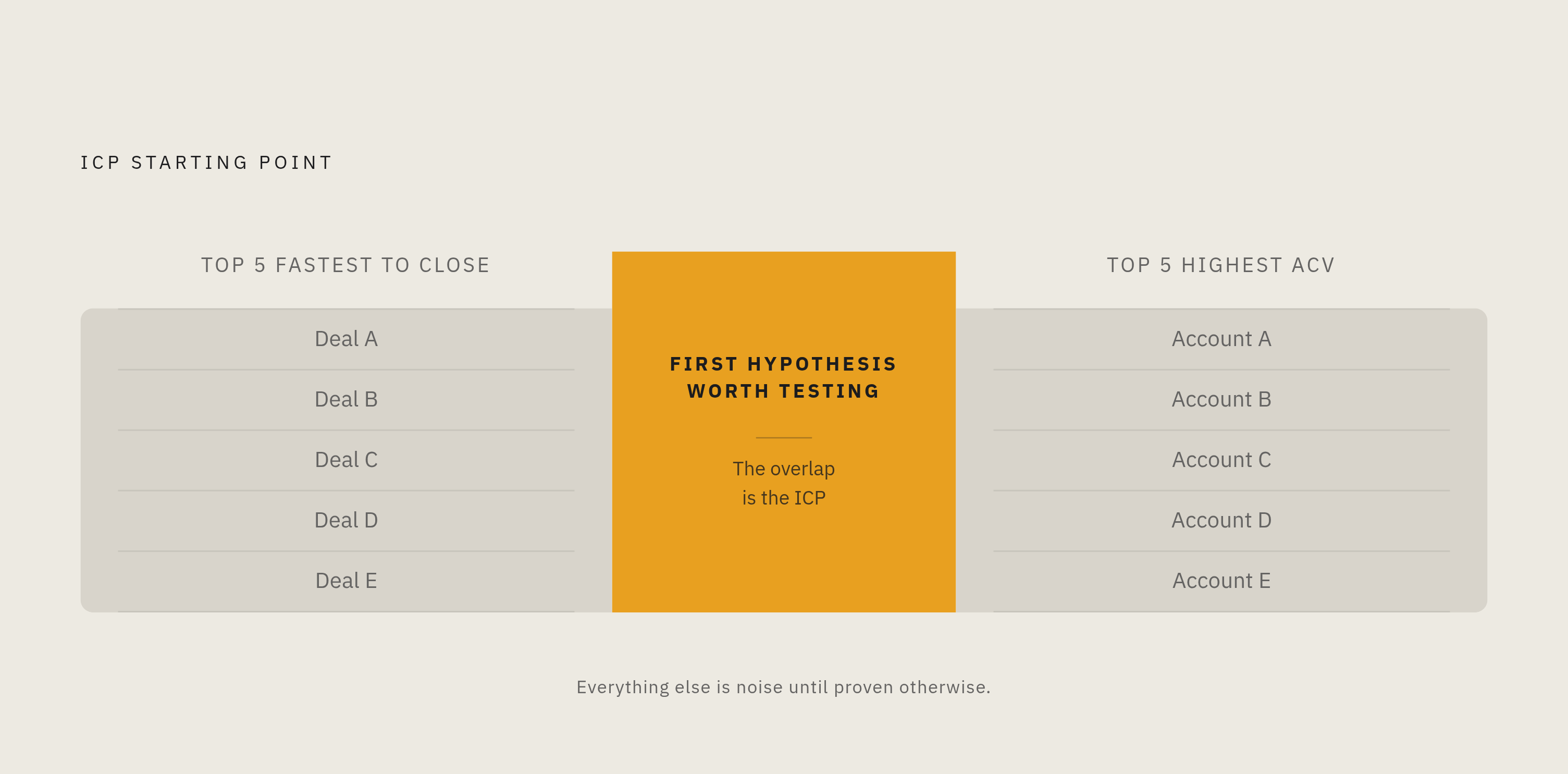
The strongest ICP signal available to any company is already sitting in its own CRM, unread: the top 20% of accounts by revenue retention, adoption depth, and how fast the deal closed. Nobody needs a market research firm for this part; they need to open the CRM and actually look.
Pull two lists: the five fastest-to-close deals, and the five highest-ACV accounts. Where those two lists overlap, that's the first hypothesis worth testing, and everything else is noise until proven otherwise.
From there, capture the firmographic variables that actually move the needle. Revenue and ARR band matter, though headcount matters less than people think; funding stage predicts budget availability more reliably than headcount alone, because a 40-person Series B company with fresh capital buys differently than a 40-person bootstrapped one. Geography and go-to-market motion matter too. Tech stack matters most of all for specificity: "B2B SaaS companies with mid-range ARR running on Salesforce" tells a sales team something to act on Monday morning, while "Mid-market SaaS" tells them nothing, and they'll fill that vacuum with whatever logo looks good in a case study.
Firmographics only get you halfway. The behavioral layer is where the real pattern hides: which of these accounts were hammering the pricing page before they ever booked a demo? Who downloaded three pieces of content in a week, went quiet for a month, then reappeared ready to buy?
This step produces three to five segmentation hypotheses, not a finished ICP. Treat them as suspects, not verdicts, and let the next step serve as the interrogation room.
Testing segmentation hypotheses with data before committing to them
Here's where most ICP work quietly falls apart: founders spot a pattern, feel good about it, and never measure it against anything. A hunch that survives one gut-check gets treated like a fact for the next three years.
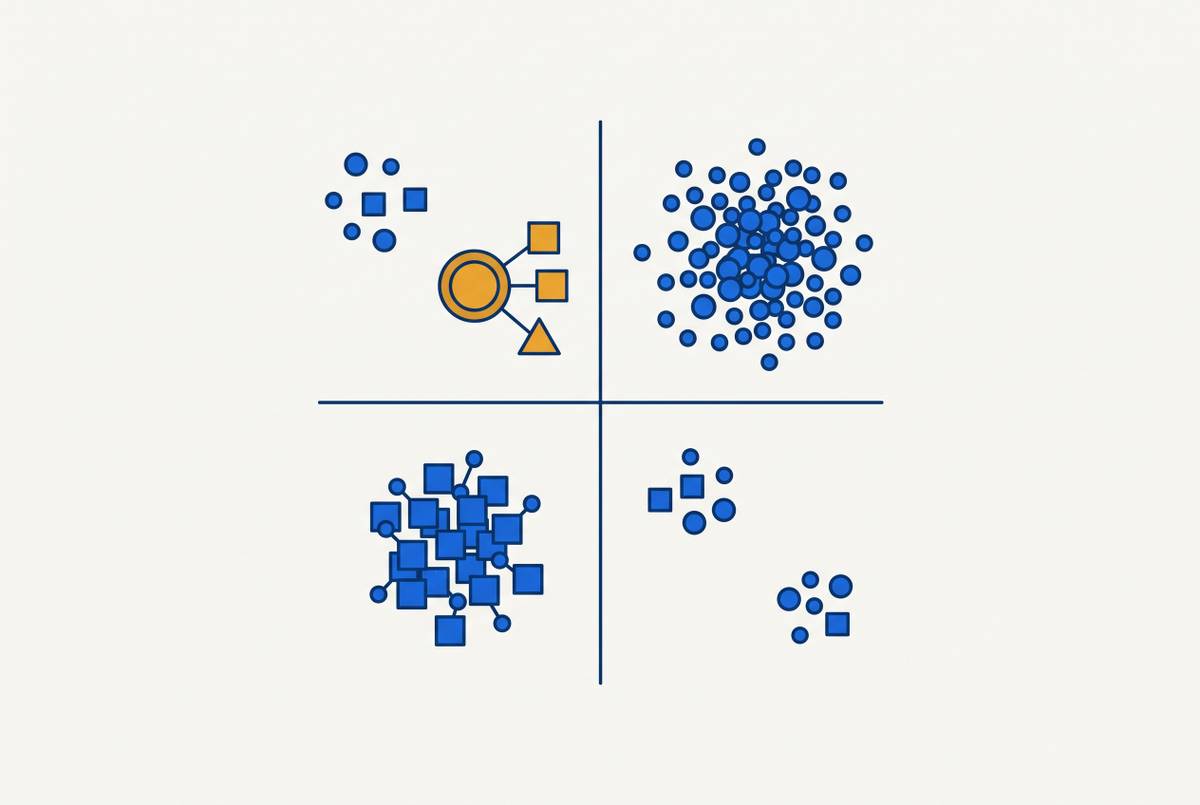
Two analyses fix that. First, share-of-business: what portion of revenue and deal volume comes from each candidate segment, in real numbers, not vibes. Second, break out LTV/CAC ratio, churn rate, and gross margin by segment, not blended across the whole customer base, since blended numbers hide exactly the thing you're trying to find, the way averaging the temperature of a freezer and an oven gives you a perfectly reasonable-sounding room.
Consider one instructive failure. At a B2B software company, the founder was convinced "innovators," early adopters willing to bet on something new, were the ideal customer, but the data disagreed, sharply. The variable that actually predicted retention was how long a customer had been operating in their industry: newer entrants churned hard, established players stuck around for years. The founder's self-image as a disruptor had leaked straight into the ICP, and the data was the only thing that caught it.
Founders tend to build ICPs that look like themselves, which is why data has to be the correction mechanism for a founder's gut feeling about who's "cool enough" to be a customer.
A validated hypothesis has a specific shape: shorter sales cycles, higher net revenue retention, lower support burden, measurably, compared to the rest of the base. When no segment clearly wins any of those categories, that means the customer base is still too mixed to answer the question, and acquisition needs sharpening before ICP research can go any deeper.
What customer interviews reveal that no CRM data can
CRM data is a record of what happened, with no opinion on why it happened. It can't tell anyone what it felt like to be the buyer sweating a decision in a Tuesday afternoon meeting, staring at a pricing page, wondering if this is the tool that finally gets used or the one that quietly dies in a Slack channel by March.
Here's the fatal gap almost every company has: how a company sees its own value rarely matches how the customer experienced it. That mismatch corrupts messaging for months, sometimes years, until someone finally sits down and asks a customer directly, in plain language, without a survey tool in between.
The order matters here. Interview the best customers first, the ones flagged in step one, then recent churned accounts, then lost deals, the ones who never signed at all. Each group answers a different question, and running them out of order means building conviction on the wrong evidence first.
For the best customers, four questions do most of the work. What were you trying to solve before you found us? What triggered you to start looking? What made you choose us over the alternatives? What would make you leave?
Start with rapport, not the hard questions. Ask how they stay informed, what they read, where they spend their attention online, before moving into decision-making territory. That warmup surfaces the exact channels the ICP will later target, and it also means the buyer isn't answering the hard questions cold.
Interviews catch what data structurally cannot: the emotional trigger behind the purchase, the internal champion's political tightrope, the competitor that was one signature away from winning the deal instead. According to available research, B2B marketers who conduct customer research are 466% more successful than those who skip it, and that gap comes from knowing things a dashboard has no field for.
Keep going until saturation, the point where the same triggers and objections keep repeating and nothing new shows up. When writing it up, resist the urge to summarize. Tag verbatim quotes by theme instead, because the customer's exact words become next quarter's ad copy, and a paraphrase never lands the same way in an email subject line.
Win-loss analysis as the sharpest ICP correction tool
Win-loss analysis works best as a pacemaker: a continuous check on whether the ICP still has a pulse, not a one-time report filed after the deal's already cold.
The CRM problem here is specific. The reason a buyer actually walked away almost never matches what the salesperson typed into the deal notes ("went with a competitor" is doing a lot of quiet, lazy work in most CRMs). That gap, between what the rep believed and what the buyer felt, is exactly where ICP assumptions come apart.
A simple coding framework makes this usable instead of anecdotal. Tag every interview finding against consistent categories: product fit, sales execution, competitive positioning, commercial terms, implementation confidence, stakeholder dynamics. Track frequency and co-occurrence across the whole interview set, not just whichever complaint was loudest or most recent. Watch for patterns like this: "implementation confidence" shows up in 40% of losses but only 10% of wins. That's a systemic signal the segment might be right, but the sales motion or onboarding story is scaring people off before they ever get to feel the product work.
Bring the sales team into this directly, and let them walk through their own lived experience of where deals actually stall, since they'll remember the objection that never made it into Salesforce.
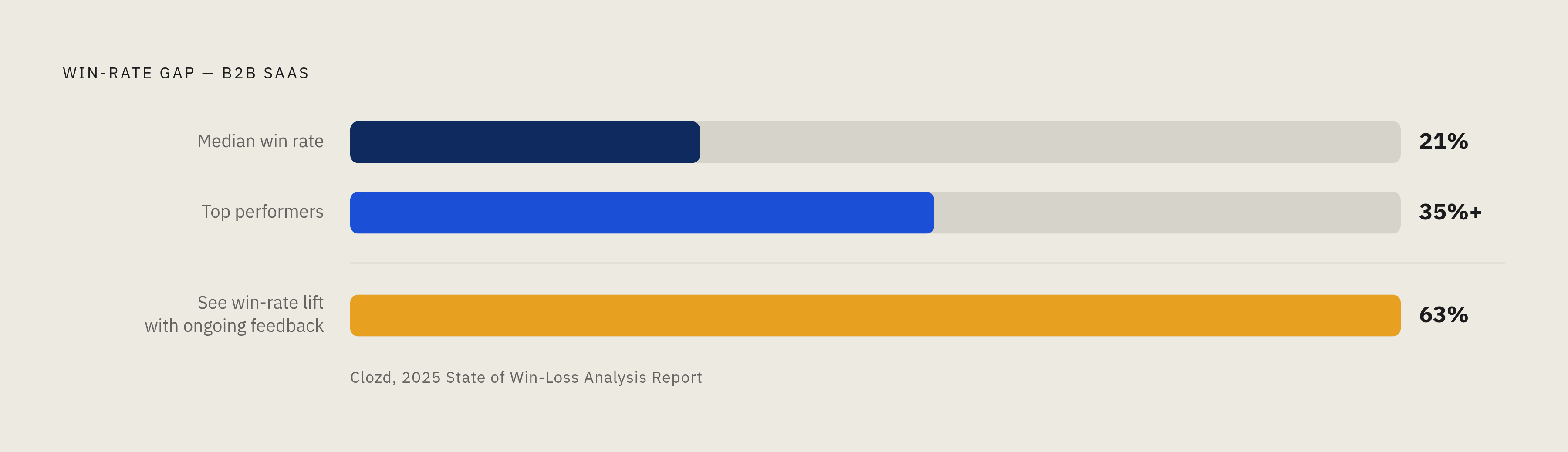
The numbers back this up. Per the 2025 State of Win-Loss Analysis Report, 63% of Clozd clients see a direct increase in win rate from ongoing feedback programs. The median B2B SaaS win rate sits around 21%, while top performers push past 35%, and win-loss analysis is one of the few concrete levers that closes that gap.
What this step ultimately produces is the edge of the ICP, along with the center: which account types close fast and stay for years, and which ones consistently stall or churn no matter what. Knowing the boundary is just as valuable as knowing the bullseye, and most companies only ever chase the bullseye.
Translating research findings into a structured ICP document
An ICP document works as a filter and a decision tool. Every go-to-market choice should run through it and come out the other side clearer, not muddier.
A complete document contains six things. Firmographic profile: revenue band, headcount range, funding stage, geography, tech stack. Buying triggers: fundraising round, leadership change, compliance deadline, new competitive pressure. Macro context: the market forces making this problem acute right now, not five years ago. Behavioral signals: job postings, G2 research activity, content engagement patterns that flag an account as in-market. Anti-ICP signals: the traits that predict churn, endless sales cycles, or low ACV, and arguably more important than the positive profile, since knowing who to avoid saves more time than knowing who to chase. Customer language: the exact phrases from interviews describing the problem in the buyer's own words, not the internal team's.
That document should plug straight into go-to-market work. Firmographic filters define TAM/SAM/SOM sizing, and customer language replaces internal jargon in messaging. The channels surfaced in interview warmups tell the team where content actually needs to show up. One campaign targeting RevOps leaders swapped "growth acceleration" for "forecast accuracy," a phrase pulled straight from ICP interviews, and saw 3.1x higher engagement, according to M1-Project case data. That's the entire value of the document in one swap: a phrase a real buyer said, replacing a phrase a marketing team invented.
The ICP works best as a compass, not a locked gate. Accounts outside the profile occasionally turn into great customers anyway. Flag those as exceptions worth watching, not reasons to throw the whole document out.
Keeping the ICP current as the market and product evolve
An ICP built on last year's customers describes last year's product, last year's market, and a competitive landscape that's already shifted underneath it. Markets don't hold still just because a slide deck says they should, and neither does the product roadmap.
A handful of triggers should force a review, immediately, not at the next quarterly planning meeting. A new feature or pricing tier changes who gets the most value from the product, win rates in a previously strong segment start sliding, a new competitor shows up and starts winning a specific type of buyer, or a funding round resets the scale of company the business can credibly serve.
At minimum, review ICP assumptions against fresh win-loss data every quarter, and run new customer interviews every six months, or immediately after any major product change. Anything looser than that, and the document goes stale without anyone noticing, right up until a board meeting where nobody can explain why win rates dropped.
"Living document" is an operational requirement here, a shared document with version history and dated assumptions, a named owner (usually the founder or head of growth) responsible for actually triggering the update instead of waiting for someone else to notice the drift, and sales and customer success feeding new signal into the document constantly, not reading it once during onboarding and never opening it again.
Companies that keep investing in customer research grow two to three times faster than the ones that treat it as a one-time project, according to available research. That gap widens over time, because an accurate ICP touches every go-to-market decision that follows it, and a stale one quietly taxes every single one of those decisions.
Founders have a role here that goes beyond signing off on updates. A founder visible in the market, on LinkedIn, in DMs, in comment sections arguing about the exact problem the product solves, picks up ICP signal no scheduled interview will ever catch. Every reply, every unsolicited DM from a stranger who says "wait, this is literally my problem," is free research. A founder publishing sharp, opinionated takes about a specific pain point builds a personal brand and runs a live, unpaid focus group at the same time, twenty-four hours a day, whether they realize it or not.