Win-Loss Analysis Process for B2B SaaS Sales Teams
Structuring win-loss interviews reveals why deals slip away and where to fix your sales process.

79% of B2B sales teams grew revenue last year. At the same time, up to 70% of individual reps missed quota in 2024, with average attainment sitting around 43%, according to Hyperbound's 2025 benchmark report. That's a math problem, and win-loss analysis is how you find where the math is breaking.
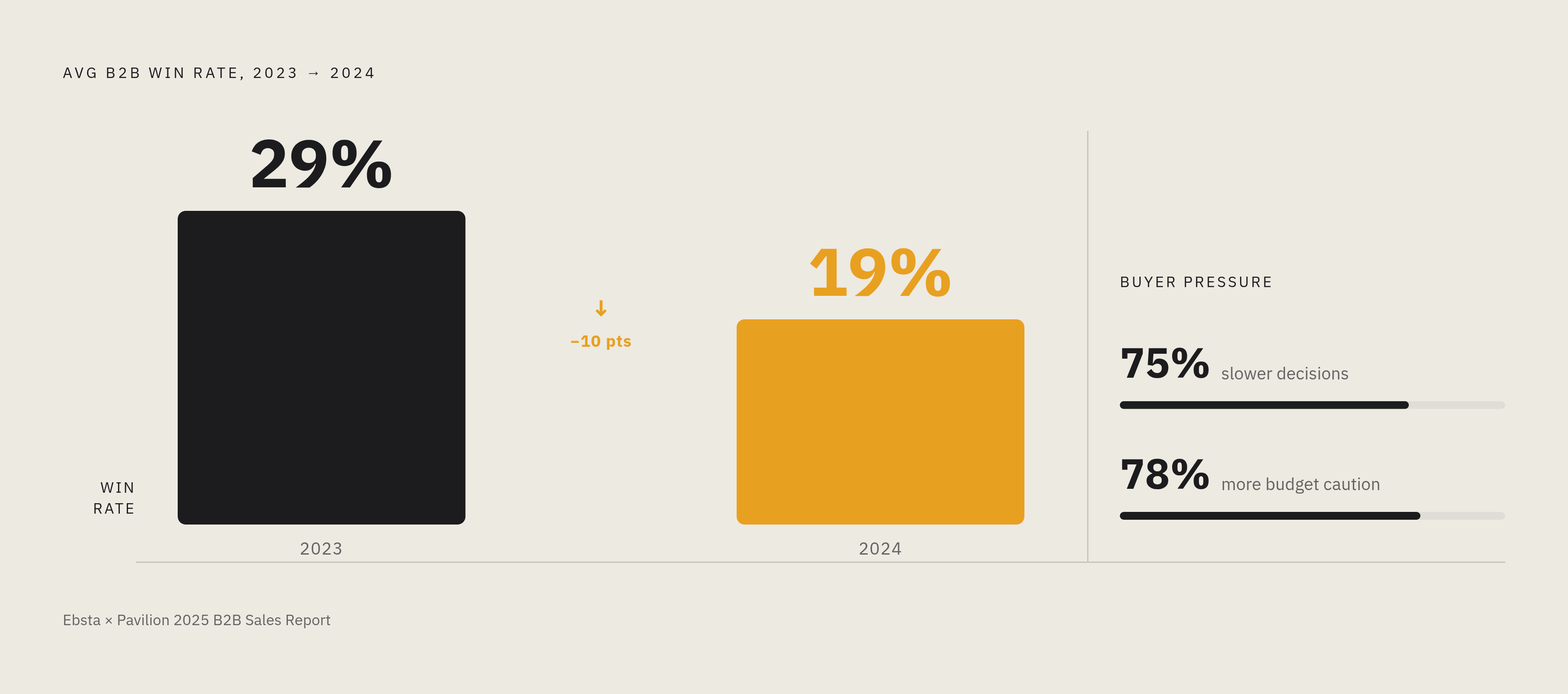
Win rates are shrinking industry-wide, and the drop is steep. The Ebsta x Pavilion 2025 report puts the average win rate at 19%, down from 29% the year before. That's the whole floor sinking, not one company losing its touch. Buyers are taking longer to decide (75% say so, per Salesforce's State of Sales 2024), more of them are being cautious with budget (78%), and enterprise deals in 2026 average 13 decision-makers, with each new stakeholder cutting purchase odds by about 10 points. Add in that buyers are arriving at conversations later in their evaluation than ever, and you've got sales teams showing up to a play that's already in Act Three.
The room changed shape, and the teams pulling ahead right now have better information: a structured way of knowing exactly where deals are slipping and why. That's what win-loss analysis is for. Let's get into how to actually run one.
What win-loss analysis actually is — and what it isn't
Win-loss analysis is a structured conversation with a buyer, shortly after they made a decision, asking them to explain that decision in their own words. Not the rep's words, and not the CRM's dropdown menu. The buyer's.
That distinction matters more than it sounds like it should. CRM close-reason fields capture what the rep believes happened, filtered through whatever story is easiest to tell a sales manager. Research into B2B buyer decisions has found that decision-makers frequently rate competing products as roughly equal on features. When the product is a wash, the decision comes down to sales experience, trust, support quality, and how painful implementation looked. None of that shows up in a CRM field labeled "Lost - Price."
It's worth being clear about what this isn't, too. Customer satisfaction surveys happen after onboarding; this happens right at the decision point, while the reasoning is still fresh. A debrief with the rep who worked the deal carries different value, since self-reported loss reasons are reliably biased (price gets blamed constantly, mostly because it's the least embarrassing thing to admit). And the real payoff comes from treating this as a loop you keep running, rather than a one-off audit you frame on the wall.
Done right, it hands you competitive positioning nobody else has, product gaps that actually cost you deals versus gaps that just get mentioned in passing, the exact language buyers use to describe your category, and the friction points in your own sales process that your team can't see because they're standing inside it.
How to calculate your baseline win rate correctly before you start
Before you interview a single buyer, get your number right. Win rate is wins divided by total decisions, times 100, and the trap is in what counts as a "decision."
No-decision outcomes and stalled deals don't belong in that denominator, and they definitely don't belong in the numerator. Leave them in, and your win rate quietly deflates, making you think you're losing to competitors when you're actually just losing to indecision. Those are different diseases with different cures.
Once you've got the math right, break it apart. SMB deals typically close somewhere in the 28 to 35% range; enterprise deals close at 12 to 18%. Blend those into one company-wide number and you've built a metric that describes nothing accurately. Same goes for channel: inbound leads convert at roughly double the rate of outbound leads, so mixing them produces a number neither the inbound team nor the outbound team can actually use.
And don't set it once and forget it. The Ebsta x Pavilion dataset showed meaningful swings in win rate across 2023 to 2024, even among strong performers. Recalculate quarterly, not annually. You want three numbers walking out of this step: overall win rate, win rate by segment, and win rate by inbound versus outbound. Those three become your scoreboard.
Building the interview sample — who to talk to, in what ratio
Once your baseline's set, you need bodies to interview, and the mix matters as much as the volume. A workable split, per User Intuition's B2B best-practices framework, runs about 40% won deals, 45% lost deals, and 15% no-decision.
That's loss-heavy on purpose. Wins tell you what to reinforce; losses tell you what's fixable, which is exactly why they're the interviews everyone wants to skip. No-decision deals are their own category entirely, surfacing timing issues and process friction that neither a win nor a loss interview will catch, since nobody actually chose anything.
Within each deal, you want three possible voices: the economic buyer who signed or declined to sign, a champion if one existed (their honesty after the fact is often sharper than the official buyer line), and a blocker if you can identify one, especially in enterprise losses where a single skeptical stakeholder can sink a whole committee's momentum.
Timing is not optional here. Interview as soon after the decision as possible, because waiting lets memory soften into whatever story is easiest to tell yourself. And don't wait for a mountain of data before you act: a usable pattern tends to emerge once you've built a consistent set of interviews within a given segment. Filter out deals that are clear outliers from your typical deal profile. Outliers make for interesting anecdotes and terrible strategy.
Whether to run interviews internally or use a third party
Here's the uncomfortable part. Buyers are trying to preserve a relationship, even one they just ended. That means when your own rep, or someone from your own company, calls to ask what went wrong, the buyer softens the truth. Nobody wants to be the reason someone loses their commission or their job, so the criticism gets rounded down and the compliments get rounded up.
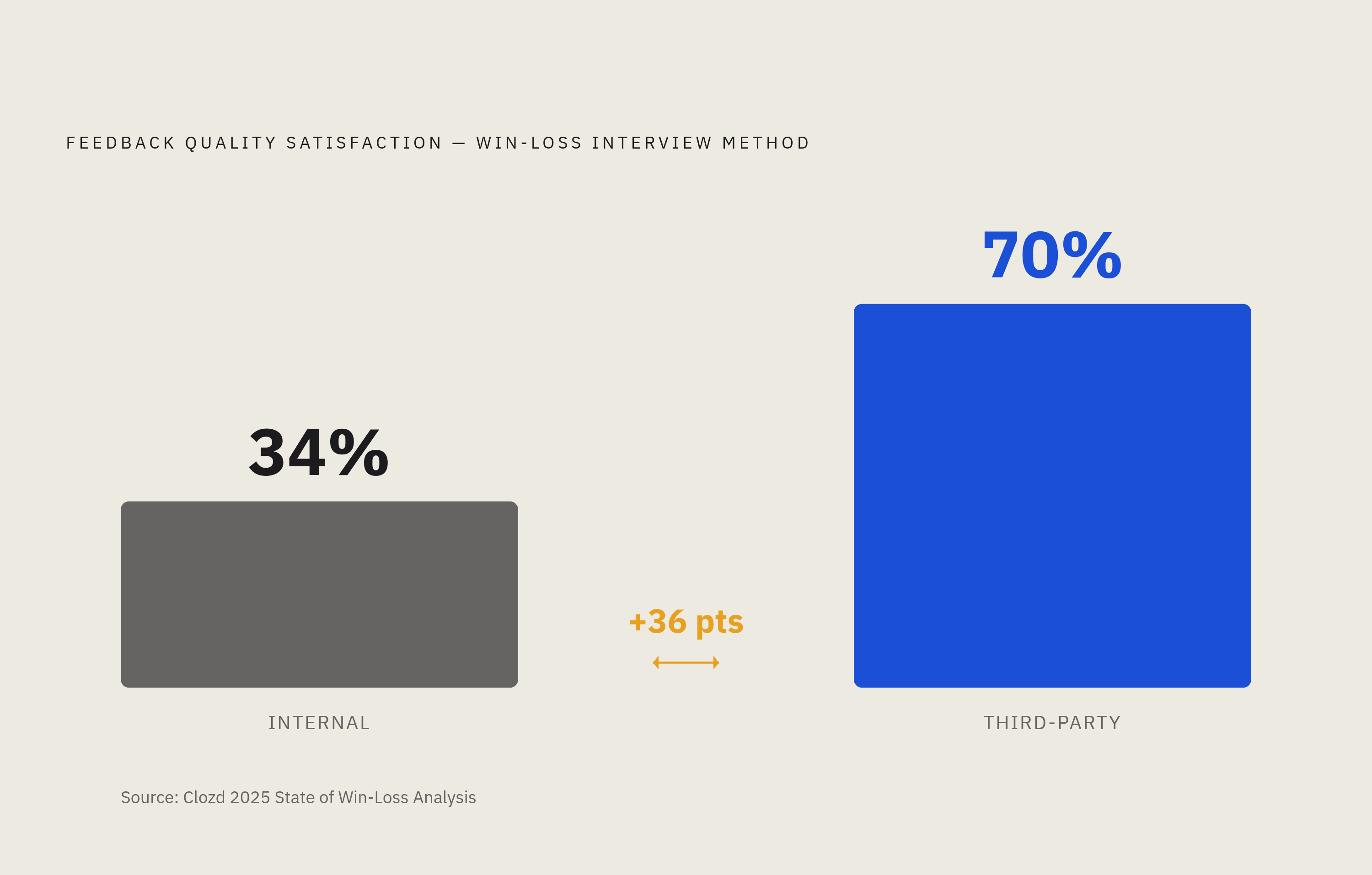
The gap isn't subjective, either. Clozd's 2025 State of Win-Loss report found companies using third-party interviewers were more than twice as likely to report satisfaction with the quality of the feedback they got: 70% versus 34% for internally run programs. That's a big enough gap to build a decision around.
Internal interviews still have their place. Early-stage programs without budget for outside research, won deals where the relationship is warm enough that candor isn't as constrained, and warm-up rounds to sharpen your question set before handing it to outside help. Beyond that, you've got real options. Boutique win-loss research firms deliver the highest quality at the highest cost and the slowest turnaround, which suits enterprise programs closing a handful of huge deals a year. AI-powered interview platforms, like User Intuition, run structured buyer interviews for around $20 each with results back in 48 to 72 hours instead of the two to four weeks traditional research takes, which is what makes ongoing analysis affordable for teams under $10 million ARR closing 15 to 40 deals a quarter. Specialist consultants are handy for designing the program initially, less so for running it at scale every quarter.
Match the format to the deal. A high-ACV enterprise loss deserves a human on the phone, while mid-market volume is exactly what AI-assisted structured interviews were built for. Skipping the interview entirely because nothing on the menu felt affordable is the one option that guarantees you learn nothing.
Structuring the interview to get honest, actionable answers
Frame it right from the first sentence: this is a learning exercise for future buyers, not a performance review for the rep. Say that out loud, because buyers relax once they know they're not about to get someone fired.
Build the conversation in stages. Start with context: what triggered the search, who got pulled into it, what success was supposed to look like. That gives you the buyer's frame before any vendor name enters the conversation. Then move into evaluation: how the shortlist got built, which criteria actually mattered, which conversations shifted their opinion one way or another. That's where you find out who was seriously in the running and who was just there for optics.
Then probe the decision itself: what tipped it, what almost tipped it the other way, what they'd tell a friend evaluating the same category next year. This is the richest part of the interview, and it's usually where teams rush.
Close by asking what would have to change for a lost buyer to reconsider, or what would make a won buyer expand. And avoid a few traps: don't ask "was our pricing competitive," because that question hands the buyer the answer before they've thought about it. Don't ask "did our rep do a good job," because that just invites politeness. And don't ask any question that assumes a specific feature gap caused the loss; that's testing your own theory, not listening to theirs.
Write down what buyers actually say, word for word, wherever you can. Paraphrasing loses the texture that makes this data useful; exact phrasing is what ends up in your battle cards and your website copy later. Keep the conversation focused and time-bounded; past a certain point, you're usually just circling the same answer twice.
Analyzing patterns across interviews without over-indexing on outliers
Now you've got a stack of transcripts, and the job is figuring out what's a pattern and what's just one person having a bad day. Tag every finding against a consistent set of categories: product (features present, absent, or seen as weaker than a competitor's), sales process (trust, responsiveness, how good discovery felt, how clear the proposal was), pricing and packaging (not just the number, but how the deal was structured against alternatives), competitive positioning (who else was seriously in the mix and why), and relationship or brand (did the buyer already have a preference walking in, before your team said a word).
Set a threshold. If a finding shows up only rarely across interviews within a segment, treat it as one person's opinion, not a company priority. Frequency should drive your urgency, not how loudly someone said it.
Watch for the price trap specifically. Buyers say "it came down to price" because it's the least awkward thing to tell a vendor they just rejected. Cross-check those claims: if pricing was genuinely comparable across the shortlist and the deal still went elsewhere, price wasn't the real reason, it was the cover story.
Then run the number that actually gets budget approved. A company with $10 million in quarterly pipeline and a 20% win rate would add roughly $1 million a quarter — or $4 million a year — from just a two-point improvement in win rate, per Clozd's win-loss ROI framework. That math is what separates the fixes worth acting on this quarter from the ones that can wait for the roadmap.
Distributing findings to the teams that can act on them
A single 40-slide report that goes to everyone helps no one. Sales wants to know what to say differently in the deals sitting in their pipeline right now. Product wants to know which gaps actually cost deals versus which ones just got name-checked in passing. Marketing wants the exact words buyers used, so they can put them on a landing page instead of guessing.
Build the output around the team, not around the research. Sales gets specific objection patterns and the exact points in the process where deals started wobbling; something they can use in this quarter's active pipeline, not next year's. Product gets a ranked list of capability gaps, weighted by how often they showed up in losses, and just as important, whether those same gaps also showed up in wins (so nobody builds a feature nobody actually needed to win the deal). Marketing gets verbatim buyer language for the category and the competition, straight into positioning and battle cards. Leadership gets the macro view: are losses piling up in one segment, one deal size, against one specific competitor?
Tie all of it to the quarterly planning cycle, so findings land while there's still time to do something with them instead of becoming a historical footnote. And name an owner in each function responsible for exactly one change per quarter based on the findings. Without a name attached, this becomes a report people nod at in a meeting and never open again.
The gap here is real and it's measurable. Clozd's 2025 State of Win-Loss Analysis Report found 98% of companies running continuous win-loss programs report a deeper understanding of their buyers, but only 63% report an actual win-rate increase from it. That 35-point gap is the distance between knowing something and doing something about it.
Closing the loop — turning findings into sales-floor behavior change
Here's where most programs quietly die: the findings get a nice slide in the quarterly business review, everyone nods, and then next quarter's pipeline pressure buries the whole thing. Insight without a mechanism for action is just trivia.
So build the mechanism. Turn patterns into updated call scripts, sharper discovery questions, and objection-handling language reps can say word for word, not vague coaching notes nobody remembers by Thursday. Build competitive battle cards straight from what buyers said about your rivals; a card built on real buyer quotes lands with more weight than one written by product marketing in a conference room. And if a whole segment or deal type keeps losing no matter what you change, that's a targeting problem, not a closing problem. Fix the qualification criteria before you burn more pipeline on deals that were never winnable to begin with.
Getting reps to actually believe this stuff is its own battle. Reps hear "here's what you did wrong" and shut down instantly; frame it instead as "here's what buyers told us about evaluations like this one," and the wall comes down. Sharing anonymized buyer quotes directly does more work than any summary slide ever will, because hearing someone's actual words is harder to argue with than a bullet point about them.
The real payoff shows up over time. The changes you make to the sales process this quarter become the hypothesis you test in next quarter's round of interviews, and the cycle compounds, because each round gets calibrated against what actually happened in real deals instead of what the team assumed happened. That compounding is the whole point, since win-loss analysis is a habit that gets sharper every time you run it.