Competitive Positioning Matrix for SaaS Startups
Build your position on how buyers actually decide, not on slides that flatter your product.

94% of B2B buyers build a shortlist before a vendor ever hears from them, and whoever leads that shortlist on day one wins the deal about 80% of the time. That's the whole game, and a competitive positioning matrix is the tool that gets you onto the list, assuming you build one that does actual work instead of decorating a slide deck.
Quick gut check on the pressure you're building it under: something like 30,000 SaaS companies exist right now, and AI is making it cheaper to launch a new one every week. Wynter ran a 2025 survey and found 94% of SaaS companies describe themselves as stuck in "a sea of sameness." Only 6% call their own brand distinctive. Everyone sounds the same because everyone built their positioning the same lazy way: as an afterthought, in a deck, the week before the Series A pitch.
Positioning works better as a strategic layer than a marketing deliverable you hand off and forget about. It decides whether a buyer considers you at all, before your sales team gets to open its mouth.
What a competitive positioning matrix actually is and what it is not
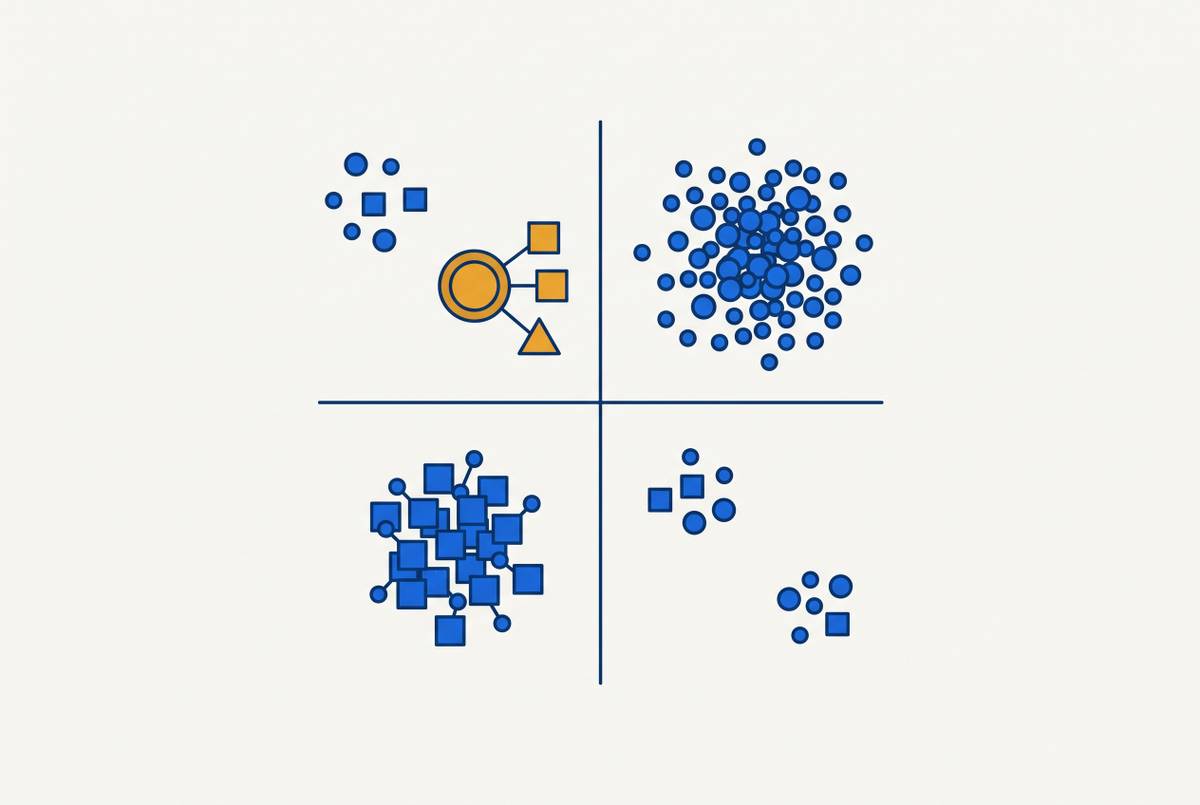
Strip away the buzzwords and it's simple. A competitive positioning matrix maps your company against every real alternative on two dimensions that actually drive how buyers choose, usually a 2x2. Two axes, picked because they reflect real buying criteria, not because they flatter your product, with every meaningful competitor plotted somewhere on the grid.
There's a cousin worth knowing: the perceptual map, which plots how customers actually perceive the players in a market rather than how the market wants to be seen. Run one and you'll sometimes find an ugly gap between how you describe yourself and the box buyers already put you in. Stings, but it's useful.
A real matrix earns its keep through use. It gets updated as the market moves, and it stays tied to real buying criteria, not a feature checklist with green checkmarks next to your name, and not a list of ways your competitors supposedly stink.
Here's what actually trips people up: a static matrix is a photo of a market that no longer exists by the time you print it. A living one tracks where the mental real estate is shifting, close to real time, and shows you the empty lot before someone else builds on it. Buyers size up a vendor in something like 6 seconds before mentally filing them somewhere (that number comes from branding research floating around in 2026, take it with a grain of salt on precision but not on direction). Your matrix has to encode a position that survives that first glance. If it takes a 45-minute call to explain, it's homework wearing a positioning costume.
The sequence that makes positioning real: why starting with category is the most common mistake
Most founders build this backwards, and it's the single most common way a matrix ends up useless. They start by naming their category: "We're the Salesforce for dog groomers." Cute, but meaningless. Category, in April Dunford's model, comes last, not first.
The order runs: competitive alternatives, then unique attributes, then value and proof, then target market, then, finally, market category.
Start with competitive alternatives, and be honest about it. That means everything a buyer would realistically do instead of hiring you, including nothing. In B2B, doing nothing is usually the most popular competitor on the list: Excel, a tired intern, a manual process somebody's been meaning to fix since 2019. Skip the status quo in your matrix and you're aiming your whole differentiation strategy at a target that isn't even in the room.
From there: unique attributes, the things genuinely different from every option on that honest list, not just different from the one competitor you like to badmouth in sales calls. Then value and proof, meaning what those attributes actually produce for the buyer, backed by named customers and real numbers, not vibes. Then target market, the specific segment for whom that value is worth switching for. Only after all that do you get to name a category. The category gets discovered from customer reality; it doesn't get declared from founder ambition on a random Tuesday.
Choosing axes that reflect how buyers actually decide
Quick test for any axis you're eyeing: would a buyer's answer to it actually change which vendor they pick? If not, cut it, because an axis that doesn't move a decision is decoration, and decoration doesn't win deals.
The usual mistakes come in a few flavors. Founders pick axes where their product wins by design, turning the matrix into a participation trophy for themselves. Or they pick axes tied to internal priorities, like implementation speed or how elegant the engineering is, when buyers were never asking about any of that. Or, worst case, every competitor clusters in the same corner and the whole exercise produces a diagram that shows nothing at all.
Finding the right axes means going back to the source: buyer interviews, win/loss calls, actual recordings of sales conversations, not the summary your rep wrote afterward. One question does most of the work: what mattered most, in the exact moment you chose us, or chose someone else?
Once real competitors sit on real axes, look for the empty quadrant. A patch of white space with no strong incumbent in it is the whole point of the exercise. Product marketers already know this instinct matters: a 2025 Product Marketing Alliance survey found 91% of them own positioning and messaging directly, and over half track revenue as a KPI tied to that work. Hold your axis selection to the same bar those numbers imply. Which axes, if you planted your flag there, would actually move win rates, not just make a prettier chart?
Category competition versus category creation, and when each is the right call
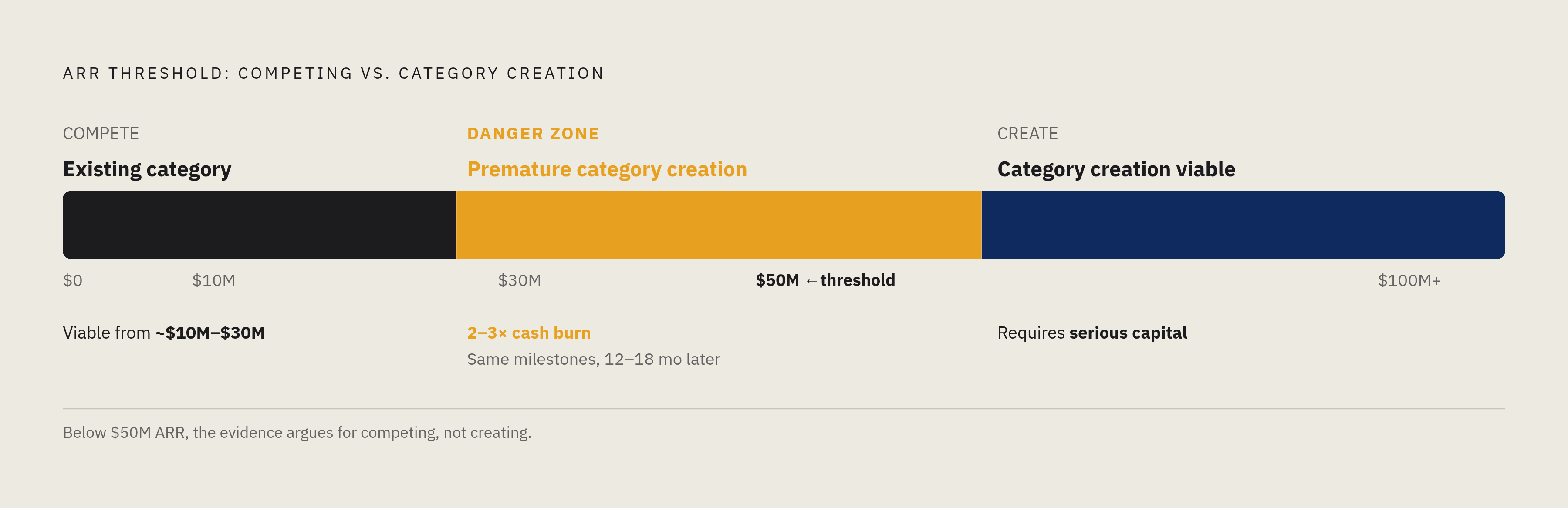
Two paths here, and they cost wildly different amounts of money: compete inside an existing category with a sharper, narrower position, or try to build a brand-new category that reframes the whole conversation.
ICONIQ Growth's GTM research from 2025 draws a fairly clean line. Somewhere between $10M and $30M ARR, the smart move is sharpening your position inside a category that already exists, or niching down hard enough to own a sub-segment outright. Category design, the kind where you invent a new label for a new kind of problem, doesn't really become viable until you're past $50M ARR with serious capital behind you. Companies that try category creation too early burn two to three times more cash, according to that research, and still hit the same revenue milestones 12 to 18 months later than peers who left the map alone.
The reason is education debt. Creating a category means teaching buyers a problem exists before you can sell them anything that solves it, and that teaching is slow, expensive, and rarely goes the way the deck promised.
It does work sometimes, though. AtoB grew from 72 customers to a 7% market share by positioning itself as the category leader in fleet fintech. TruckX went from $2M to $16M ARR in 18 months building its go-to-market around defining a new corner of freight tech. Both had real funding runway, and both were solving a problem buyers already felt but hadn't named yet. For most founders reading this, the boring answer wins anyway: compete inside a category people already understand, find the quadrant nobody strong has claimed, plant your flag there.
How fast the competitive landscape moves and what that means for your matrix
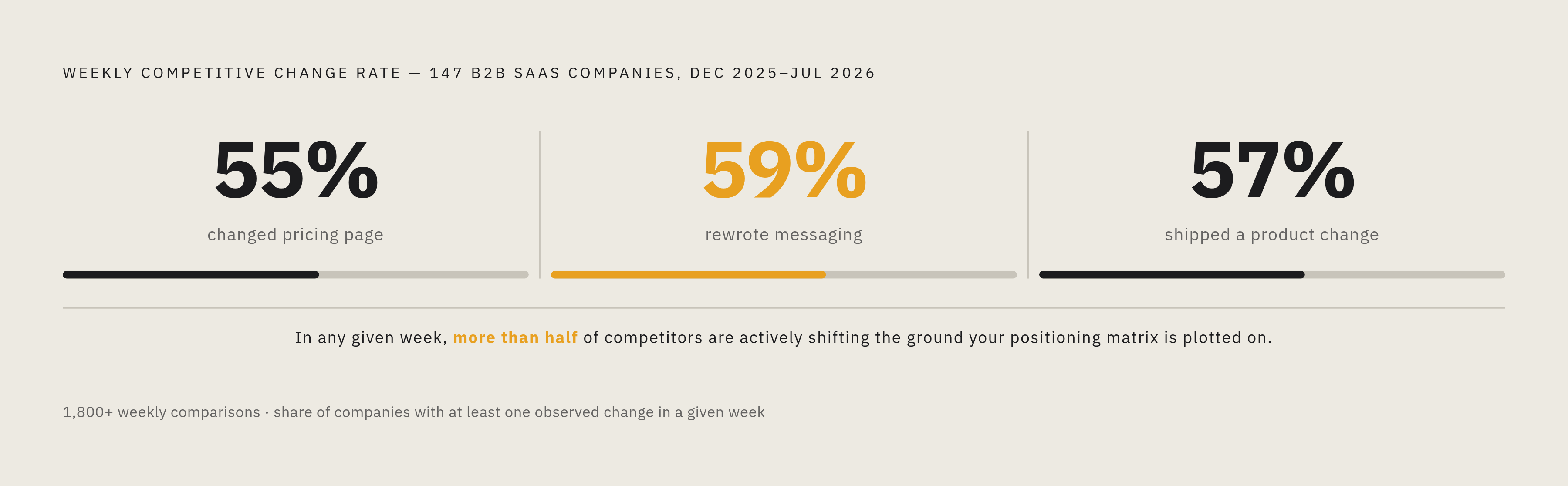
Here's the number that should actually worry you. A tracking study followed 147 B2B SaaS competitors weekly from December 2025 through July 2026, over 1,800 comparisons total. In any given week, roughly 55% of competitors changed their pricing page, close to 59% rewrote their messaging, and around 57% shipped a product change, all in a single week. Every one of those edits touches a cell in your matrix.
So the matrix you built last quarter is drifting already, probably before you even finished animating the slide transitions. And the risk compounds. A competitor that rewrites its homepage and ships a new feature in the same seven-day stretch might have jumped an entire quadrant, which means your placement for them is now flat wrong.
A stale matrix does damage in two directions. Internally, sales and marketing keep repeating messaging that no longer differentiates anything, because nobody told them the ground moved. Externally, buyers who did their own homework show up already knowing things your team doesn't, and that's a credibility hole you don't climb out of mid-pitch.
The fix is discipline, not complexity. Review the matrix on a set cadence, quarterly at minimum, and layer a trigger rule on top: any competitor makes a major pricing, messaging, or product move, you update that cell the same week, not the same quarter.
Translating the matrix into the content that shapes pre-sales perception
A gap you find on a matrix but never talk about publicly is a Google Doc gathering dust, not a strategy.
Here's where pre-sales opinion actually forms, and it's probably not where your marketing budget goes. DSMN8's feed research found personal LinkedIn profiles account for roughly 62% of what people actually see in their feed, versus about 5% for company pages. Meanwhile, 6Sense's 2025 research puts buyers at completing 61% of their decision-making before ever contacting a vendor. Put those two together and the takeaway's obvious: the quadrant you claim on the matrix has to be the quadrant you visibly, repeatedly own in somebody's feed.
Practically, that means treating each axis on your matrix as a content topic, and your claimed position as the point of view you keep repeating, in different forms, week after week. The competitors you're differentiating from become the implicit foil in your takes, even when you never say their name.
There's a cadence that matters more than most founders want to admit. Founders posting three to four times a week, with content that's specific rather than daily filler, see something like ten times the engagement of the ones posting once a month with a polished announcement. Content from a CEO's personal account gets roughly four times the engagement of the same idea posted from the company page. Document, don't create, is the whole principle underneath it. Post the decision you just made, the experiment that flopped, the metric that surprised you last week. That's positioning evidence, published where people can actually see it.
One reported case found that a SaaS founder closed $2.3 million in enterprise deals in 2025 where prospects brought up the founder's LinkedIn posts, unprompted, during discovery calls. Those buyers had been following for three to six months before ever booking a demo. The founder pegged the sales cycle at roughly 40% shorter than what cold outbound usually produced.
The dark social layer: positioning influence that never shows up in your attribution model
Here's the part that should mess with your head a little. Dark social is all the sharing and discussion happening in places no attribution tool can reach: Slack channels, WhatsApp threads, a DM someone forwards to their VP without ever tagging you. A buyer screenshots your post and drops it in a private channel with the caption "this is what I mean." You'll never see that, and your dashboard definitely won't either. But it happened, and it moved you up a rung on somebody's shortlist.
Edelman and LinkedIn ran a 2025 study on B2B thought leadership, surveying almost 2,000 management-level professionals, and found that a large majority of what they call "hidden decision-makers" say thought leadership helps them recognize challenges they hadn't named yet. Sharper still: These hidden decision-makers, the ones who never fill out a form and never show up in your CRM, are disproportionately the people passing your content around behind closed doors.
You cannot buy your way into dark social. No ad targeting reaches it, no SEO trick unlocks it. The only lever is content people actually want to forward to a coworker, and that has to be earned one post at a time. So treat the visible engagement number on your LinkedIn post, the visible engagement percentage you see in the analytics tab, as a small window onto a much bigger room you can't see into. The visible metric understates the real reach every single time, by design.
Running the matrix as an ongoing system, not a one-time exercise
Three layers have to stay in sync for any of this to hold. First, the matrix itself: axis choices, competitor placements, the quadrant you've claimed. Second, the messaging that comes out of it, the specific language showing up in sales calls, on the website, in cold outbound. Third, the content motion, the founder-led presence pushing that positioning into the feed where buyers are already forming opinions, whether you're watching or not.
Keeping those three in sync takes three kinds of triggers. Scheduled reviews, quarterly at minimum, run as a standing ritual rather than something that happens whenever someone remembers. Event-driven updates, the moment a competitor reprices or ships something big or rewrites its homepage. And signal-driven updates, the moment your sales team hears a new objection or a competitor's name they've never heard before, which usually means the ground shifted before your matrix caught up with it.
The content cadence that keeps this all visible sits around two to three real posts a week, each tied to a theme off your matrix, not filler for filler's sake. LinkedIn's algorithm now resurfaces older posts, two or three weeks out, when they're still relevant, which means a consistent narrative builds a searchable trail that's quietly pre-warming buyers long before anyone books a call.
The founder's job settles into something pretty specific here: be the visible, credible person standing in the quadrant the matrix identified, and let the content serve as proof the claim is real. A matrix on its own is just a diagram, but keep updating it and keep showing up in the position it points to, and eventually buyers already know where you stand before your sales team ever picks up the phone.