Category Creation vs Category Entry in B2B SaaS
Category kings dominate markets, but most founders underestimate the cost.

Let's clear this up right away, because a lot of founders get this wrong in ways that cost them years.
Category creation means introducing a problem frame that doesn't yet exist in buyers' minds, then owning that frame. You're defining a new market entirely, on your terms, before anyone else does. That's a different thing from better positioning, a rebrand, or publishing a manifesto.
The actual distinction:
- Positioning is how you're perceived within a category that already exists.
- Category creation is defining the category itself. You're not competing on someone else's scorecard. You're writing the rules.
When you reposition, buyers still measure you against alternatives they already know. When you create a category, you decide what the right alternatives even are. It's like being a referee who also wrote the rulebook.
The clearest examples are worth looking at directly:
- HubSpot didn't build a better direct mail tool. It named "inbound marketing" as a new mode, then built a platform to do it.
- Gainsight avoided competing with CRM vendors. It invented "customer success" as a formal business function that didn't previously exist.
- Gong didn't position against call recording software. It created "revenue intelligence" as its own category, with its own buyer vocabulary.
In every case, the company defined a new problem first, then offered the solution. The product is the solution. The problem frame is the category. That sequence is what most people miss.
Category creation also requires sustained market education over years. Renaming your product, inventing jargon for the sake of it, publishing a single whitepaper. None of that is category creation. Without sustained effort behind it, the category never forms. You just end up with a confused sales team and a website nobody understands.
The Category King math and why it makes creation look irresistible
There's a reason "we're creating a new category" shows up in so many pitch decks.
The research behind the Play Bigger framework found that category kings capture roughly 76% of total market cap in their category. Second and third place split what's left. That's not just winning bigger. That's a structural lock-in where everyone else competes on your terms, uses your vocabulary, and gets measured against your benchmark.
The insight underneath the hype is legitimate. In winner-take-most SaaS markets, structural advantages compound fast. The category definer sets buyer expectations, shapes analyst coverage, and controls the hiring narrative before anyone else is even in the room. If you become the category king, you've essentially written the rules for an entire market before the fight starts.
But here's what the data leaves unanswered: what does it cost to get there, and who actually survives the journey?
The real cost of category creation: time, capital, and organizational patience
Creating a category means educating a market of buyers who don't yet know they have the problem you're solving. That's not a launch quarter. That's a sustained multi-year operating posture, and most founders dramatically underestimate what that actually means in practice.
Expect to invest significantly more in content, thought leadership, events, and analyst relations than you would on a category entry strategy. The timeline to a durable market position typically runs three to five years. What that investment actually covers:
- Teaching buyers that the problem exists before they'll ever consider your solution
- Building relationships with analysts so the category gets formal research coverage
- Creating the vocabulary, the whitepapers, the frameworks, the conferences. The full infrastructure that teaches a market how to think about the space.
- Sustaining the narrative through the long middle period where buyers understand the category but aren't buying yet
That last one is the real killer. There's a trough between "buyers get it" and "buyers have budget approved for it." You have to live in that trough, keep spending, and keep educating while your bank account shrinks. It's like being a farmer who planted the seeds, built the barn, and is now watching it rain for three straight years before the harvest comes. Except your investors are emailing you every quarter asking where the crops are.
The survivorship bias problem is real, too. HubSpot and Gainsight are visible. The companies that burned through their runway educating a market they never captured are invisible. Nobody writes case studies about those. That asymmetry makes category creation look safer than it is.
What category entry actually requires (and why "just positioning better" undersells it)
Category entry means stepping into a market buyers already understand and winning a specific segment of it better than the incumbent does.
That's not a consolation prize. It's a genuine strategic advantage, and a financially efficient one. Buyers already know they have the problem. Budget lines already exist for this kind of software. You don't spend a dollar teaching anyone what the product category is.
The best example of category entry done at its highest level is Linear.
Linear entered issue tracking. That's a market Jira has dominated for years. Linear didn't claim a new category. It positioned as the issue tracker for software teams who care about craft. Hyper-specific ICP. Not a broad reinvention. The whole bet was that Jira had gotten so big, so generalized, that a certain kind of buyer felt abandoned by it.
While Jira expanded horizontally to serve marketing teams, HR teams, and operations, Linear contracted its stated audience deliberately. It went deep where Jira went wide. The result was a high-value, high-loyalty segment captured without spending anything on category education.
What this requires, though, is a genuine point of difference that a specific buyer segment cares about intensely. Not a slightly different tagline. Not a cleaner homepage. A specific outcome for a specific person that no one else is offering with the same depth. Tweaking copy and dropping your price won't get you there. A longer feature list won't either.
The four conditions that make category creation worth attempting
Most founders who pursue category creation do it because the narrative is exciting, not because the conditions are right. Here's what actually has to be true for it to work.
The problem is genuinely invisible to buyers today. Buyers aren't searching for a solution because they haven't named the problem yet. Describe the problem out loud to a potential buyer. If they say "I've never thought about it that way, but yes, that's real," you have something. If they say "yeah, we already use X for that," you don't.
The timing lines up with something that just changed. The underlying technology, behavior shift, or regulatory change has just made the problem newly solvable or newly urgent. Gainsight's timing was perfect because the shift to SaaS subscription models suddenly made customer churn a boardroom-level financial issue. The problem always existed. The business model made it acute. Timing is a condition you have to verify before you commit, and luck alone is never enough.
You have the runway and content infrastructure to educate before you monetize at scale. This is where most category creation ambitions quietly die. The sustained content investment required is something you can't spin up in your first quarter. Founders who can't point to 18 or more months of runway and a content program already in motion should be honest with themselves about what they're actually attempting.
The founder can own the category narrative publicly and credibly. Category creation is a narrative war, and narratives require human voices. Company pages don't create categories. People do. That means LinkedIn thought leadership, speaking, writing, analyst briefings. Showing up consistently, not just at launch.
If fewer than three of these are true, category creation is a rationalized ambition. Not a strategy.
The four conditions that make category entry the stronger bet
Category entry done well isn't the fallback. It's often the smarter move, and it's underrated partly because it sounds less exciting in a pitch.
Buyers are already searching and in-market. Named budget, existing analyst coverage, recognized incumbents. That's confirmation the problem is funded and urgent. It's a gift, and a strong foundation to build from.
The incumbent has grown horizontally and left real gaps. The Linear-Jira dynamic is the template here. The larger the incumbent's market, the more gaps it creates by choosing breadth over depth. That generalization is your opening, and the bigger they get, the wider those gaps tend to be.
Your differentiation is specific enough to actually own. "Faster and easier to use" is not a position. "Built exclusively for this specific ICP who needs this specific outcome" is a position. The tighter the ICP, the more defensible the entry. Broad claims get ignored. Specific ones create loyalty.
Your capital position favors speed to revenue. Seed and early Series A companies with 12 to 18 months of runway cannot afford a three to five year category creation timeline. Category entry can generate qualified pipeline in months. Category creation will take years to do the same. That math is obvious, but it's surprisingly easy to ignore when a compelling narrative is involved.
The underrated upside of entry done well is that owning a specific segment so thoroughly makes you the de facto standard for that ICP. That compounds. It just looks less cinematic in a pitch deck.
How the go-to-market motion differs between the two paths
The choice you make upstream determines nearly every downstream GTM decision. These two paths don't just have different narratives. They require genuinely different machinery.
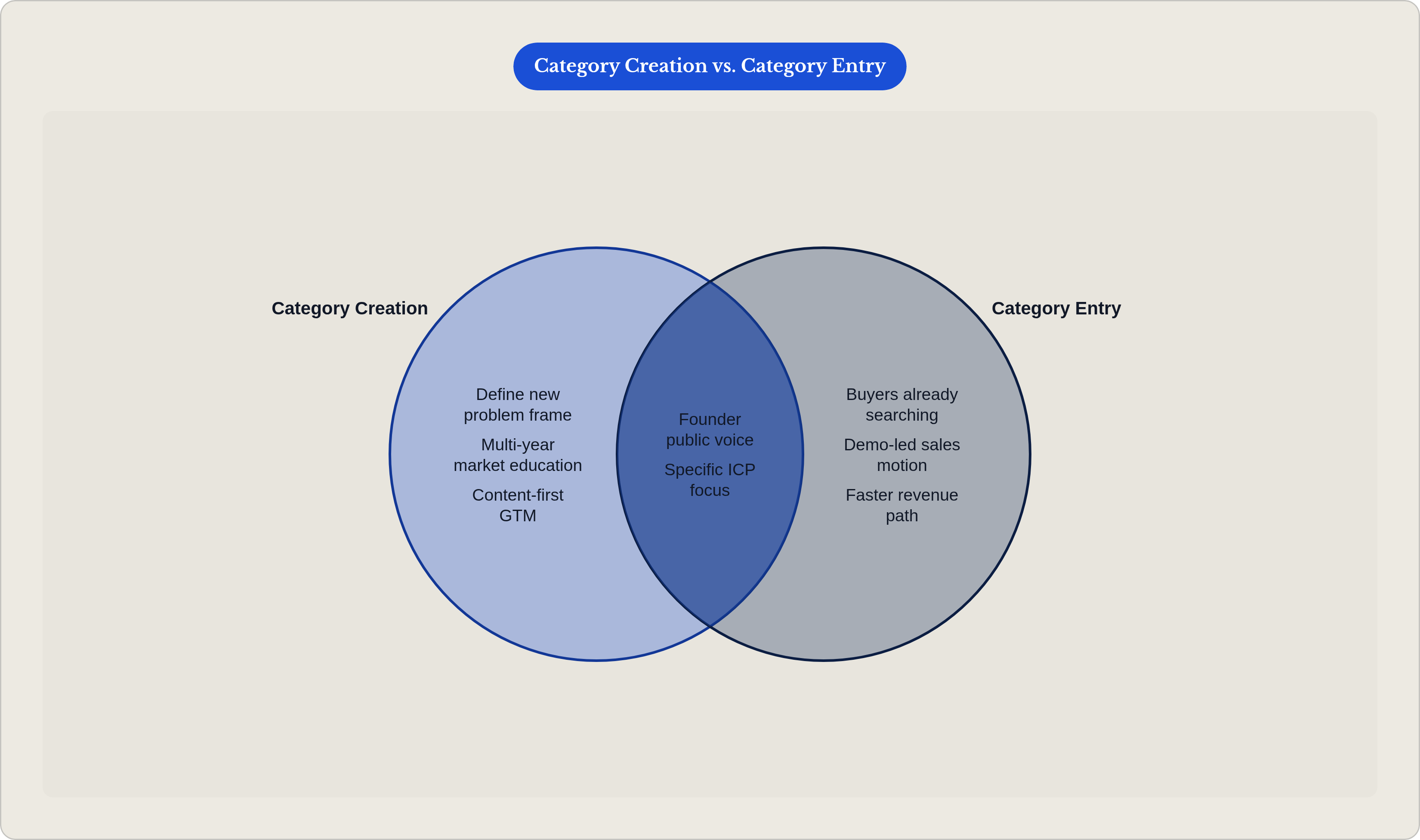
Category creation GTM is content-first, education-first, patience-required. Marketing's first job is naming and spreading a new problem frame before product demos even happen. Distribution priority goes to thought leadership, analyst relations, keynote presence, and category-defining research. The sales motion is consultative and long. Buyers need to believe the problem is real before they evaluate a solution. The founder's public presence is not optional.
Category entry GTM is closer to what most B2B founders picture when they imagine go-to-market. Positioning and distribution lead. Get in front of buyers who are already looking for a solution in this space. SEO, paid channels, review sites, and comparison content are all fair game. The sales motion is shorter and demo-led. The problem frame is shared. Differentiation is what needs proving, not the problem itself.
The overlap is worth noting. In both cases, the founder's visible, opinionated presence accelerates trust and pipeline. The category creator uses LinkedIn to teach buyers how to see a new problem. The category entrant uses it to demonstrate deep expertise in a specific buyer's world. Same channel, different job.
Most B2B companies underperform on content not because they publish too little, but because their content is doing no specific strategic job tied to the path they've actually chosen.
Why the founder's public narrative is the GTM lever in both paths (and what differs)
Category creation is a narrative war. The company that names the problem owns it. That naming happens through sustained, credible, public voice from a person buyers can actually trust. Not through a product launch. Not through a press release.
Category entry is a credibility contest with a specific ICP. Buyers choosing between options in a known category pick the vendor whose founder most clearly understands their specific world.
The platform where this plays out, almost universally in B2B SaaS, is LinkedIn. Personal profiles generate significantly more engagement than company pages. Company pages receive a fraction of the feed allocation that personal profiles do. B2B buyers routinely research company leadership before purchasing, and they're more likely to consider companies where leadership is actively visible online.
For category creators, the founder's LinkedIn presence is functionally the most efficient form of category education available. Naming the problem publicly. Publishing frameworks. Sharing early customer language. That is how categories get built in the attention economy. You're planting vocabulary, not posting for engagement.
For category entrants, sharp, opinionated takes on the specific ICP's world build the kind of trust that converts in-market buyers faster than any comparison page or analyst report. The founder who is visibly expert in the buyer's domain closes deals before the sales call happens. The buyer already trusts them before they get on a call.
Both paths require this layer. What differs is the content's job, and how you'd know if it's working.
The fundraising dimension: how each path reads to investors
Category creation is a more compelling investor narrative when it's credible. The category king concentration thesis is exactly what VC fund math rewards. Big outcomes, winner-take-most dynamics, structural moats. It reads well in a deck.
But "we're creating a new category" without evidence of market education already underway is a red flag. Investors have seen this story from plenty of companies that burned through capital trying to will a category into existence. The narrative without proof points reads as wishful thinking.
What actually lands with investors on the category creation path is evidence that the market is starting to use your language. Customer quotes that reflect the problem frame you defined. Analyst mentions. Organic search traction on category terms you coined. These signals tell investors the category is forming, not just being claimed.
Category entry can look less exciting on paper, but it signals market literacy. It says: we know the buyer, we know the incumbent's weakness, we know our specific segment, and we have a line of sight to revenue. That's what a founder who has done the work actually sounds like.
Early stage investors reward the bold category creation narrative if the conditions are right. Later stage investors reward proof of category traction or segment dominance. Knowing which conversation you're in shapes how you frame the choice you've made. And making the choice intentionally, with eyes open to the cost of each path, is what separates founders who build real companies from those who just have a great story in a deck.