B2B SaaS Analyst Relations vs Media Relations Tradeoffs
Analyst reports shape enterprise shortlists; media relations builds the category around them.

Most B2B SaaS founders treat PR as one thing. They pick a lane, usually media relations because it feels more tangible, and they run with it. The problem is that analyst relations and media relations are not two versions of the same tool. They reach different buyers at different moments in the purchase cycle, through completely different mechanisms. Think of them less as siblings and more as a scalpel and a megaphone — one built for precision inside the room where decisions get made, the other built to shape the world outside it. Founders who understand that distinction can actually allocate resources toward the channel that moves deals. The ones who don't end up spending money on coverage that nobody in their buying committee ever reads.
Here is the map.
How Analyst Relations Actually Works and What It Costs to Do It Seriously
The basic mechanic is this: your team briefs analysts. You walk them through your product roadmap, your positioning, and your customer outcomes. Analysts absorb that, factor it into their research, and eventually your company shows up (or doesn't) in the reports that buyers read before they build a vendor shortlist.
The flagship deliverables are things like Gartner's Magic Quadrant and the Forrester Wave. The Magic Quadrant alone covers roughly 130 technology categories annually, scoring vendors on Completeness of Vision and Ability to Execute. A Leader position in a relevant Magic Quadrant is about as close to a cheat code as enterprise B2B gets; it is among the most consequential third-party validations in the industry.
The Forrester Wave updated its methodology in 2024. It added a third scoring dimension that reflects customer feedback rather than just market presence. That matters because it means the Wave is now partly a measure of validated customer experience, not just analyst perception of your positioning.
Beyond Gartner and Forrester, there is a second tier that has grown considerably in influence: firms like IDC, S&P 451 Research, Constellation, Omdia, GigaOm, HFS, ISG, and Everest Group. Enterprise buyers increasingly pull from multiple research sources, so this tier is no longer optional for vendors trying to cover their bases.
Now. The cost reality.
This is where a lot of founders get their first cold shower. Analyst relations is not a marketing line item; it is a strategic infrastructure investment, and it prices like one.
- Early-stage vendor programs: $300,000 to $800,000 annually
- Growth-stage vendors: $1.5 million to $4 million annually
- Enterprise vendors above $250 million ARR: $5 million to $15 million annually
- Gartner enterprise inquiry retainers alone: $80,000 to $250,000 annually
- Advisory days: $15,000 to $50,000 per day
- Reprint licenses (to use a report in sales materials): $25,000 to $75,000 per report per year
In 2025, LinkedIn listed more than 2,000 open AR positions in the United States. A 2024 IIAR survey found AR team sizes range from fewer than five staff to departments of more than a dozen specialists. Securing executive sponsorship was among the most frequently cited challenges. That last point is worth sitting with; this is not a program you hand to a coordinator and check in on quarterly. It requires dedicated headcount, executive time for briefings, and a multi-year commitment before you can expect to see real ROI.
If you are pre-Series A and reading that cost structure, this is your sign to close this tab on AR for now and keep reading.
Why Enterprise Buyers Reach for Analyst Reports Before They Reach for Your Website
The short answer: because they have to.
In regulated and risk-averse sectors, including financial services, healthcare, and government-adjacent technology, vendor selection is not a gut call. It requires defensible justification. Procurement teams need to show that they evaluated the market systematically. Analyst reports are the mechanism for that. They are not content that buyers choose to read for fun; they are part of the buying process infrastructure.
Per Babel PR's 2024 research, analyst and industry reports were the most influential channel for 58% of IT decision-makers. That was the single highest-influence channel reported. Not LinkedIn. Not vendor websites. Not press coverage.
Approximately 90% of enterprise buyers consult analysts before purchasing. That number implies something specific: if your company does not appear in the reports your target buyers are consulting, you may not enter the evaluation at all. Not because your product is bad. Because you were invisible at the moment the shortlist was being built.
B2B buying committees averaged 11 stakeholders in 2024, and each additional stakeholder reduces purchase probability. Analyst reports serve a coordination function here. A distributed committee of 11 people from different functions needs a shared reference point that is not a vendor's own sales deck; analyst frameworks give them that. It is a neutral-ish (nothing is perfectly neutral) common language for evaluating options.
What this means practically: the buying committee is often using analyst frameworks to reduce the vendor field before your sales team ever gets involved. You are not losing those deals in a sales conversation. You are losing them before the sales conversation exists.
One important counterpoint to hold: analyst reports are one input among several. Peer recommendations, LinkedIn content, and AI-generated summaries are all competing for that same pre-sales attention. More on that in a minute.
What Media Relations Does That Analyst Relations Cannot
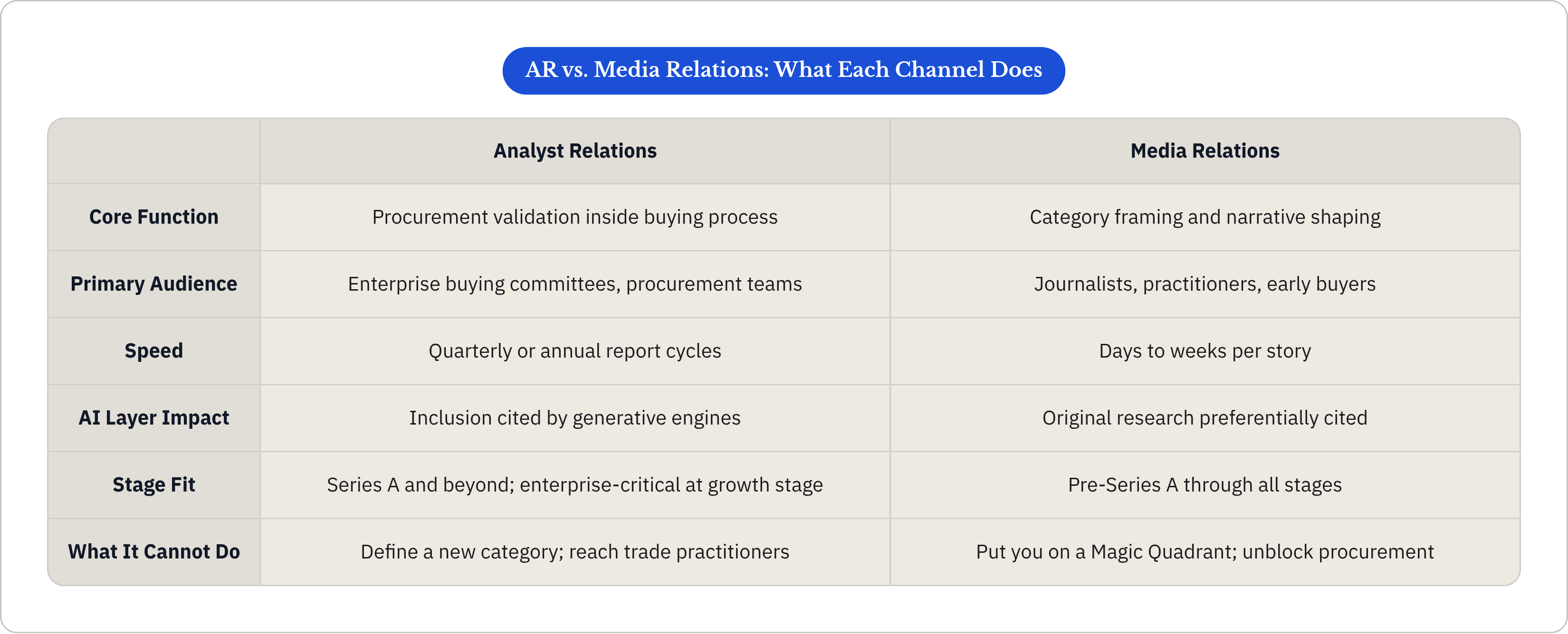
Analyst relations validates you within a category that already exists. Media relations can help define what the category is and why anyone should care. That is a structurally different job, and it is one AR simply cannot do. If AR is the lock that opens procurement doors, media relations is the hand that draws the map buyers use to find the door in the first place.
The best B2B SaaS PR programs spend the first three to six months defining the category before running any launch campaigns. That definitional work happens through media. You are shaping how journalists, practitioners, and early buyers think about the problem space. By the time you have something to announce, the audience already has a frame for why it matters.
Speed is the other major advantage. A well-pitched story can publish in days; an analyst report cycle runs quarterly or annually. If you need to respond to a market moment, a competitor's stumble, or a regulatory shift, media relations is the right tool. AR has no fast lane.
What earns coverage today is not press releases about features. SaaS companies that generate their own research, surveys, proprietary datasets, benchmark reports, trend analyses, consistently earn coverage because they give reporters something they cannot source anywhere else. You own the story because you own the data.
Trade and vertical media deserve specific mention. Industry-specific publications reach practitioners who influence buying decisions without holding an analyst subscription. A facilities manager reading a trade publication about operational technology is not on Gartner's mailing list; media relations reaches them. AR does not.
Then there is dark social. Research reports and executive thought leadership generate the highest private sharing rates among B2B buyers. A Forbes piece or a TechCrunch mention gets forwarded in Slack channels and email threads in ways that never show up in your attribution model. You will never be able to prove it happened. It still happens constantly. This is part of why media relations produces value that is genuinely hard to measure, which is also part of why founders underinvest in it.
What media relations cannot do: it cannot put you on a Magic Quadrant. Press coverage does not carry procurement-defensibility. A strong media presence alone will not unblock an enterprise deal that is stuck in procurement waiting for analyst validation. That is the ceiling.
Where Buyer Behavior Has Shifted and What It Means for Both Channels
Gartner's 2025 research puts a number on something every B2B marketer already suspects: 80% of buyers complete the majority of their research independently before contacting any vendor. Both channels are now competing for attention in a self-directed research process that vendors largely cannot see.
Buyers contacted sellers at 61% of the journey in 2025, down from 69% just before that. The untracked portion of influence is growing. The competitive window is early, private, and largely invisible to the vendor.
The data on peer recommendations is striking. 64% of B2B buyers cite peer recommendations from private dark social channels as their most trusted research source. That ranks ahead of analyst reports and vendor content combined. And 77% of B2B buyers read user reviews during decision-making; 54% speak directly with current users before purchasing. Both formal channels operate alongside a peer layer that neither fully controls.
What moves through dark social? Research reports, competitive analyses, and executive thought leadership. The exact content formats that both AR and media relations produce. They just circulate through channels neither program can directly track or influence.
The practical picture that emerges: winning the pre-sales research phase requires presence in analyst reports (for procurement validation), media coverage (for category framing and narrative), and peer-shared content (for trusted, untracked influence). These channels reinforce each other at different moments. They are not redundant. They are sequential.
How AI-Driven Research Is Changing What Both Channels Are Actually For
Here is where it gets interesting. Enterprise buyers increasingly begin vendor research inside ChatGPT, Perplexity, Claude, or Google AI Overviews, asking for a vendor comparison or shortlist before they open an analyst report or a trade publication.
In 2025, 71% of B2B technology buyers used generative AI tools during evaluation. Those buyers are 2.3 times more likely to finalize shortlists before contacting any vendor. The pre-sales window is compressing further.
AI engines synthesize analyst research alongside trade press, vendor pages, and community discussions to produce a single answer. The brand cited in that answer wins the consideration set. Buyers who get an AI-generated shortlist of five vendors are rarely motivated to go find a sixth.
What this means for AR: Gartner and Forrester inclusion still matters; but its value now partly flows through whether AI systems cite that inclusion when composing answers. Analyst relations is becoming part of Generative Engine Optimization, not just procurement validation. The goal post moved slightly.
What this means for media relations: original research, named expert content, and credible third-party coverage are the inputs AI systems preferentially cite. SaaS companies generating their own data are building AI visibility and media authority at the same time. One investment, two payoffs.
The strategic insight is simple. Investing in genuine authority, meaning original research, real analyst relationships, and substantive founder thought leadership, does double duty across both channels and the AI layer above them.
The risk for companies that do neither: a buyer asks an AI to compare vendors in a crowded SaaS category and gets an answer that excludes your company. You will never know it happened.
Which Stage of Company Growth Each Channel Fits, and Why the Fit Changes
Pre-Series A and Seed Stage
AR is premature here. Analyst firms require customer evidence, market presence, and product maturity before they will include a vendor in meaningful research. The cost structure is also prohibitive. Spending $300,000+ on AR before you have product-market fit is a fast way to run out of runway.
Media relations and founder thought leadership on LinkedIn are the primary tools at this stage. The work is category framing, investor narrative, and early buyer awareness. The three-to-six month category-definition phase matters most here. Founders who define what problem they solve before they start pitching features build a durable narrative frame that holds through later-stage growth.
Series A to Series B
This is when AR groundwork begins. Initiating analyst briefings, building relationships with tier-two firms before attempting Gartner and Forrester, and establishing a track record all take time; you are planting seeds that will take 12 to 18 months to grow. Starting now means you are not starting from zero when it actually matters.
Media relations remains the faster-moving channel for competitive positioning, recruitment narrative, and customer-facing credibility. It carries the full load while AR is warming up.
Original research serves both channels simultaneously at this stage. A well-constructed survey or benchmark report earns media coverage and gives analysts substantive data to cite. One content investment, two programs fed.
Growth Stage and Enterprise
AR becomes a revenue-critical function. Enterprise procurement often requires analyst validation before deals can proceed. Absence from key reports is not a gap you can compensate for with good press; it is a disqualifier.
The cost commitment matches the stage. Growth-stage programs run $1.5 million to $4 million annually. If your buyers are enterprise IT decision-makers who reference analyst reports in procurement, this is not optional spending. It is table stakes.
Media relations shifts from category creation to category reinforcement and competitive differentiation. The narrative is set. The job is to hold the position and keep the competitive distance visible.
The Mistake at Every Stage
Spending on AR too early (before there is analyst-ready evidence) is one mistake. Abandoning media relations too early because you assume AR alone will carry top-of-funnel work is the other. Both errors are common. Both are expensive.
How to Allocate Between the Two Channels When Resources Are Finite
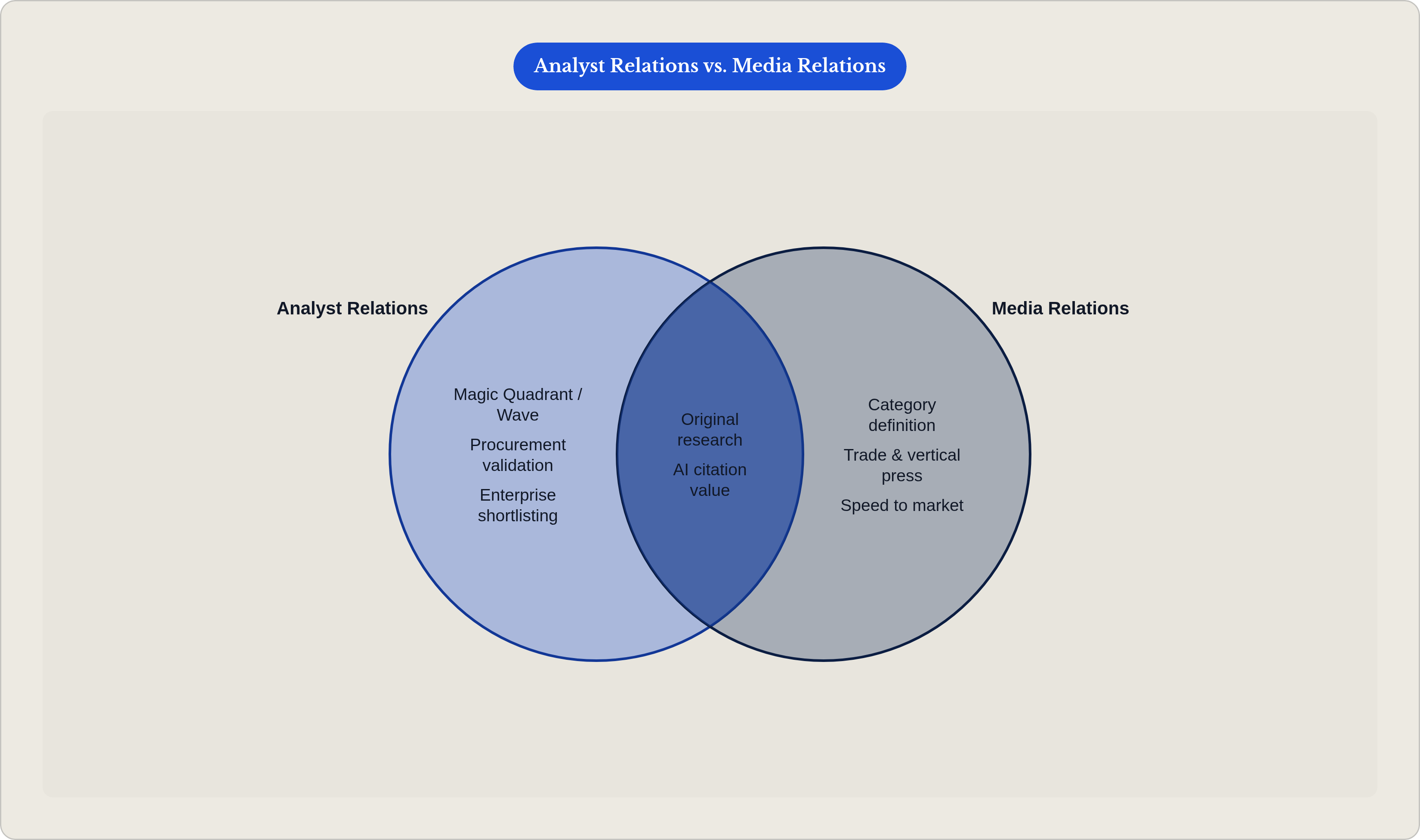
The framing question is not "AR or media relations." It is: which buyer moment are you trying to own, and which channel reaches that moment?
If the primary goal is enterprise procurement inclusion, AR deserves the larger share of resources; media relations supports it but cannot substitute for it.
If the primary goal is category definition, competitive repositioning, or top-of-funnel mindshare, media relations and founder thought leadership carry more weight. AR is a longer-term parallel investment running in the background.
Where the channels genuinely reinforce each other:
- Original proprietary research earns media coverage and gives analysts substantive material. One investment that serves both programs.
- A Gartner Leader placement generates media coverage and earns social sharing. AR success becomes media story material.
- Founder LinkedIn thought leadership reaches dark social channels that neither formal program can access. It operates in the peer-trust layer above both.
One practical heuristic: if your buyers are IT decision-makers in enterprise accounts who reference analyst reports in procurement, AR is not optional past Series A. The 58% influence figure is a procurement reality, not a preference.
The channels also serve different internal stakeholders, which founders often forget. Media relations supports sales enablement, recruitment, and investor narrative; AR supports procurement, enterprise sales, and board-level credibility. Map which internal need is most urgent before you start allocating budget. The answer is usually not the same thing.
The synthesis position: the most effective B2B SaaS PR strategy combines founder thought leadership, original data-driven pitching, trade and vertical media relations, and, for companies targeting enterprise accounts, analyst relations. These are not competing budget lines. They are sequenced investments. The sequence just depends on where you are.