Press Release Examples for B2B SaaS Funding Announcements
How to write a press release that journalists actually pick up.

Most B2B SaaS funding press releases get written for the wrong reader. Founders write them for their team, their investors, maybe their mom. Journalists cover what funding makes possible for a specific buyer, and that gap is why so many releases land in a folder nobody opens twice. This piece breaks down the structure that actually gets picked up, with a real example, a template you can steal, and what changes about all of this depending on where the SaaS funding market sits right now.
Here's the blunt version of the threshold question every release has to clear: does this tell a specific buyer what changes for them? If the answer's no, the rest of the release doesn't matter much. Per a 2024 Muck Rack analysis, 68% of journalists said whether the lead paragraph answers their immediate questions is the single biggest factor in whether they cover something. One paragraph is the whole audition.
"Earns coverage" means the release gets picked up somewhere real, gets seeded into LinkedIn conversations by people who don't work for you, gets referenced by investors doing diligence on the next deal. A wire drop that nobody reshares belongs in a filing cabinet.
The structural logic behind releases that get picked up
Every release that gets covered answers the same five questions, in the same order, before it does anything else. Skip one, and you've made a journalist's job harder, which means you've made your odds worse.
Start with the headline formula, because it's the whole game in miniature: "[Company] raises $[Amount] [Round] to [Outcome] for [ICP]." That's the whole formula, nothing more. The variable that separates a release that gets read from one that gets deleted is the specificity of the outcome, tied to a named buyer.
"Raises $12M Series A" is a fact, and facts are boring. "Raises $12M Series A to eliminate manual billing reconciliation for mid-market SaaS teams" is a story, because now I know who benefits and how. Same check clearing, wildly different odds of coverage.
From there, the body runs in sequence and the order isn't optional:
- Headline: round, amount, buyer-facing outcome
- Money paragraph: two product-impact metrics proving traction already happened, not traction that's coming
- Founder quote: strategic intent, plain human voice
- Investor quote: rationale for backing this team and market, not a validation clap
- CTA: one link, one action
- Boilerplate: 50 to 75 words that explain the company clearly enough for someone who's never heard of it
The boilerplate is your last credibility check. If you could swap in a competitor's name and the paragraph still reads fine, it's failed its one job. The quote slot carries real weight too: it's the one spot in the entire document where you get to say, in your own voice, what this money actually lets you build, enter, or defend. Waste it on gratitude and you've wasted the most valuable real estate in the release.
An annotated real example: SaaS Capital's $100M Fund V announcement
In October 2025, SaaS Capital announced the close of Fund V at $100 million, distributed over PRNewswire. Worth pulling apart, because it does a few things right that most founder releases skip entirely.
The investor language stayed anchored on rationale: "Founder-friendly, flexible growth debt has helped hundreds of recurring-revenue companies scale efficiently while preserving control." That sentence makes a claim about why this capital model matters, backed by a number (hundreds of companies) instead of an adjective.
The release also named its purpose specifically: expanding support for "B2B SaaS and Subscription AI Application" businesses with non-dilutive, flexible capital. That's a named category, a named financial structure, and an implicit but unmistakable ICP, recurring-revenue founders who want to grow without giving up equity.
What should founders circle in red pen here? The absences are the tell: no "thrilled to announce," no fuzzy market-size flex, no paragraph about how far the company has come. The quote does one job: reveal a value philosophy. And the boilerplate task, in two sentences, made the company's category position unmistakable.
Here's the catch, though: even a release this clean still needed somewhere to go. A wire drop, on its own, is a press release standing in an empty room, waiting for someone to walk in.
Where most SaaS founders go wrong in the quote and the headline
The headline failure shows up constantly: company name, dollar figure, done. "Acme Corp Closes $8M Seed Round." A journalist reads that and has nothing to build a story around, because you haven't told them what the story is.
Compare it to "Acme Corp Raises $8M Seed to Automate Compliance Reporting for Healthcare SaaS Teams." Same money, same round, same investors probably. Completely different headline, because now there's a buyer and a problem attached to the number.
The quote failure is even more common, and it's almost always the same sentence wearing a different company logo: "We're thrilled to have the support of [Investor] as we continue to grow and serve our customers." That's a placeholder where a quote should be, and every journalist who's read a thousand of these can spot it in the first four words.
A quote that does real work names the specific problem the capital solves, or the category the founder intends to own, or the customer outcome about to accelerate. It should sound like something only this founder, at this company, at this exact moment, could say. If you could hand the quote to a competitor and it would still make sense, rewrite it.
There's a second failure mode too, quieter but just as costly: burying the ICP. Releases that describe the product before naming who it's for make the journalist do the work of figuring out who cares. Most won't bother. Your ICP belongs in the headline or the first sentence, not paragraph three, tucked behind three sentences about your founding story.
One more thing that separates the releases treated as credible from the ones treated as noise: named sources. "According to Gartner's 2025 SaaS Market Report" is something a journalist can check and cite. "Studies show" is something they roll their eyes at and skip past.
A fill-in template founders can use for seed through Series B
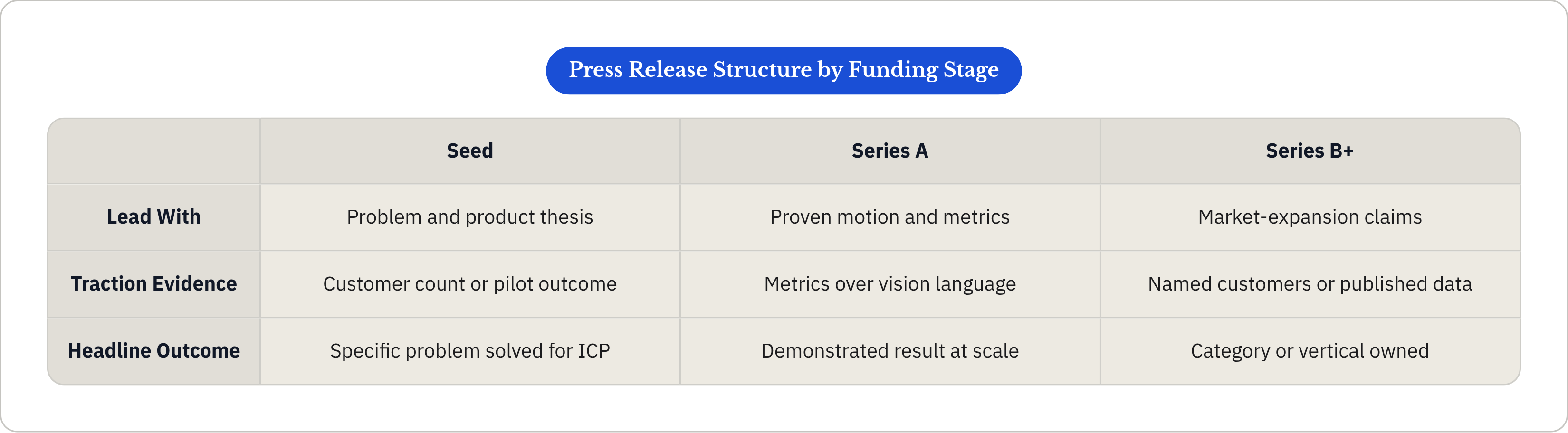
The skeleton stays the same across rounds. What changes is how much traction evidence you need to back it up.
At seed, lead with the problem and the product thesis. Traction is still early, so a customer count or a strong pilot outcome carries the paragraph. At Series A, lead with a proven motion instead, since metrics should be doing more heavy lifting than vision language by now. At Series B and beyond, market-expansion claims are earned, not assumed, so back them with named customers or published data rather than a broad TAM slide.
Here's the skeleton itself:
[CITY, DATE] — [COMPANY], [one-line ICP description], today announced [AMOUNT] in [ROUND] funding led by [INVESTOR] to [SPECIFIC OUTCOME].
Follow that with the money paragraph (two metrics showing what the product has already done, not what it will eventually do), the founder quote (the strategic intent behind the raise, what's now possible that wasn't before), the investor quote (why this market, why this team, why now, never a validation line), a plain-language use of proceeds (hire an enterprise sales team, expand into a named vertical, build a named feature), one CTA, and a boilerplate that's 50 to 75 words covering company, ICP, and one differentiating claim.
The most common way founders wreck this template: they fill in the slots in the right order but with the wrong content. The "outcome" in the headline quietly defaults to "scale" or "grow" or "transform," which are the SaaS press release equivalent of elevator music. Nobody's offended, but nobody's interested either.
Treat the boilerplate as a gut check. If you can't write 50 to 75 words that are specific to your company and nobody else's, your positioning isn't ready for a press release yet. Fix that first.
Distribution: where the release lives and dies after it's written
A release lives or dies on three channels working together, not one channel working alone.
The wire (PR Newswire, Business Wire) gives you credibility and gets you indexed, but rarely gets anyone to find you on its own. Direct outreach to journalists who cover SaaS funding or your specific vertical does more actual work than the wire ever will. And the founder's own LinkedIn thread, written in first person with real context, reaches people the wire never touches.
The pitching math is humbling, and worth knowing going in: you'll pitch a long list of reporters, roughly half will open the email, a small slice will respond, and actual coverage converts from an even smaller slice of that. Which means the release itself has to be strong enough to earn a reply purely on quality, because volume alone won't save a weak pitch.
Then there's the embargo question. A simple, clean story does well with 24 to 48 hours under embargo, since that buys you breadth across a handful of outlets at once. A deeper, more layered story does better with 3 to 7 days of exclusive access to one outlet willing to actually invest in the narrative. Neither is objectively right; it's reach versus depth, and you pick based on how much story you actually have.
The 72 hours after a round closes matter more than founders think. Investors are watching, potential hires are watching, and prospective buyers who've never heard of you before are suddenly paying attention. That window is the starting gun, and treating the release as the end of the project is the fastest way to waste it.
Worth remembering too: most B2B buying conversations don't show up in any analytics dashboard. They happen in a Slack thread someone forwards internally, a DM between two people who used to work together, a screenshot passed around without a link attached. The LinkedIn founder thread seeds that dark, untrackable circulation far more reliably than a wire ever will.
Turning the announcement window into a pipeline event on LinkedIn
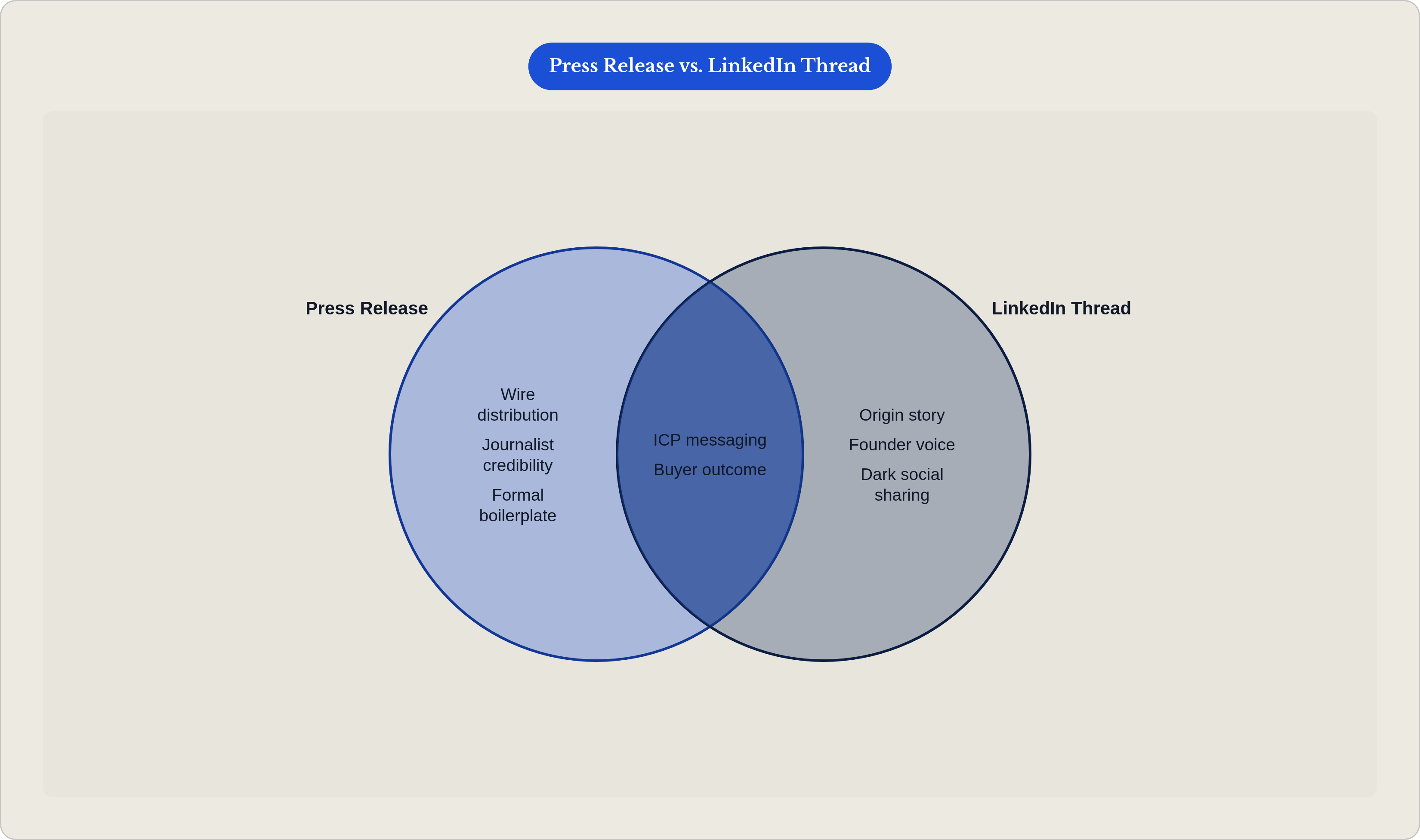
The press release and the LinkedIn thread do two different jobs, and conflating them is where a lot of founders lose the window. The release earns the coverage moment, while the LinkedIn thread earns the buyer's attention, later, when they're actually ready to look.
A strong announcement thread does things a press release structurally can't. It tells the origin story, what problem you were actually chasing, what early customers confirmed, what the money now unlocks that it couldn't before. It names the specific buyers you're going after next, which is really just ICP content wearing a narrative costume. And it makes an opinionated, quotable claim about the category you intend to own, the kind of line a press release's careful, lawyer-approved tone won't let you get away with.
Here's a number worth sitting with: per LinkedIn's B2B Institute, 95% of potential buyers aren't in-market at any given moment. So the announcement thread functions mainly as a mindshare play, reaching the 95% early enough that they think of you when they finally are ready to buy.
And post it from your own profile, not the company page. LinkedIn's 2025 B2B Marketing Report found founder-led content generates three times the engagement of the same content posted from a brand account. The algorithm, and frankly the audience, trusts a person over a logo.
Video helps here too. LinkedIn video watch time and uploads both grew meaningfully through 2025, and the format carries real distribution advantage during an announcement window specifically. For a seed round, 60 seconds covers it: problem, raise, what's next. For a Series A with named backers and real traction, 90 seconds gives you room to build the fuller story without losing anyone. Past two minutes, you need a genuinely strong arc to hold attention, and most funding announcements, if we're honest, don't have one.
The founders who treat the window as a content moment instead of a compliance box to check are the ones who see inbound from it. A static link on the company page, posted once and forgotten, wastes almost the entire opportunity. Some founders bring in specialists for this stage, agencies that focus specifically on founder-led LinkedIn strategy, to turn the press release narrative into a multi-post arc that keeps the window open past day one instead of closing it the moment the wire story runs.
What the market context means for how you frame your raise right now
SaaS companies raised more than $43 billion in 2025, spanning everything from vertical software to AI-native applications built from scratch. That's a lot of noise competing for the same trade-pub attention, and a release that doesn't differentiate its claim just disappears into it.
Investor attention right now clusters around two signals. First, proprietary AI capability, not an API wrapper with a chatbot bolted on. Releases claiming "AI-powered" with no specifics get waved off by journalists and investors alike, because everyone's heard that line already. Second, vertical specificity. Healthcare, construction, legal, financial services, these are pulling outsized funding, and a release naming one of these verticals beats a release claiming a giant horizontal market every time.
Worth grounding this in an actual number too: in a recent dataset from LeadMagic, 11 companies classified as pure B2B SaaS raised a combined $232 million, at a median deal size of $15 million. That median is not a headline-grabbing megadeal, which means most founders can't lean on the dollar figure alone to generate interest. The story has to do the work the number can't.
The founders earning coverage right now are the ones whose releases answer one question clearly: what does this capital enable, for which specific buyer, in which specific vertical, with which specific product claim? Vague category talk about "the future of X" rarely moves anyone. Coverage tends to follow what changes on Tuesday.
The press release is one piece of a bigger story you're telling in public, on the wire and on LinkedIn and everywhere else you show up. The founders who use the raise to sharpen their point of view, instead of just checking the funding-announcement box, are the ones who turn a few days of attention into pipeline that outlasts the news cycle.