Media Pitch Email Examples for B2B SaaS Announcements
Journalists reject 79% of pitches for lack of relevance—here's exactly how to make yours land.
Getting a B2B SaaS pitch covered comes down to a handful of decisions: relevance, specificity, and which story angle you pick before you write a single word. Most pitches fail before the journalist even finishes the subject line, and the examples below show exactly where that failure happens and how to avoid it.
Journalists are drowning. Per Cision's 2024 State of the Media Report, which surveyed more than 3,000 journalists globally, one in two of them sorts through more than 50 pitches a week. That's not a busy Tuesday, that's every week, forever, and when they reject a pitch, 79% say the reason is lack of relevance, not bad writing, not the wrong format, not bad timing. Just: this doesn't matter to my readers.
Three-quarters of journalists say they find value in a quarter or fewer of the pitches landing in their inbox, and per Muck Rack's State of Journalism 2024, 49% seldom or never reply at all. So the bar for a SaaS founder or PR team isn't "is this news." It's "is this news for this specific journalist's specific readers, right now, today." That distinction matters more than anything else in this piece, so let's sit with it for a second: your Series A closing is a big deal to you, your investors, and your mom, but it is not automatically a big deal to a reporter at TechCrunch. Internal significance and external newsworthiness are cousins, not twins.
What journalists need that most SaaS pitches don't give them
Journalists aren't news consumers. They're news producers, and their whole job depends on reader engagement, not on doing vendors a favor. Every pitch has to pass what I'd call the "so what" test: if it doesn't answer why a reader of that specific outlet should care, it's dead on arrival, no matter how big the announcement feels inside your Slack channel.
Here's what they actually want, based on the same Cision and Muck Rack research:
- 83% want personalized email pitches, not blast distribution, not a DM, not a cold call (Muck Rack 2024)
- 48% want PR pros to hand them data that makes the pitch relevant (Cision 2024)
- 61% value original research and market data, second only to press releases (Cision 2024)
- 37% are more likely to pursue a pitch if it includes multimedia (Cision 2024)
And here's what gets you blocked, literally: 48% of journalists will block a PR contact after repeated follow-up, and as of 2024, only 8% consider more than one follow-up acceptable, down from 17% the year before. That trend line should scare you a little. Attachments are another landmine: they trip spam filters, get flagged by newsroom security systems, and create friction nobody asked for, so stick to links instead.
On format: 65% of journalists want pitches under 200 words. The sweet spot in practice is 100 to 150 words in the body, with a subject line under 60 characters, sent Tuesday through Thursday, 8 to 9 AM in the recipient's time zone. Skip Mondays, they're still digging out from the weekend, and skip major news days, because your funding round is not beating a Fed rate decision for attention.
Which B2B SaaS announcements can actually become stories
Not every announcement is pitchable, and pretending otherwise wastes everyone's time. The ones that work share one trait: a hook bigger than the company itself.
Funding rounds work at Series A and later, when the round size or a named investor carries weight on its own. A sub-$1 million raise rarely earns a pitch unless the lead investor is a recognizable name or the space is genuinely unusual. Lead with the dollar figure, the valuation, and the investor in sentence one, and save the market angle for sentence two. That order is not optional, it's the whole game.
Original research and proprietary data is the most reliably pitchable format for SaaS companies, full stop. Something like "we analyzed 5,000 SaaS onboarding flows and found a 40% drop-off at step two" works because it's specific, it's sourced, and a journalist can use it immediately. Editors don't need to care about your company; they need a number their readers will want to quote.
Customer impact stories land when the result is dramatic and checkable: "HR platform reduced onboarding time by 60% across a Fortune 500 client." The customer's name, or at least their industry, carries more weight than whatever clever feature caused the result.
Founder journey stories work in outlets that cover startup culture or a specific vertical, but only with a twist. "Bootstrapped to seven figures in ARR without paid ads" is a story. "We grew fast because we hired well" is a LinkedIn post nobody asked for.
Product launches and feature announcements are the weakest pitch of the bunch, unless you can tie them to a market trend or sector shift the journalist already covers. On their own, they read like a press release, because they are one.
Why thought leadership pitches outperform product announcements for SaaS
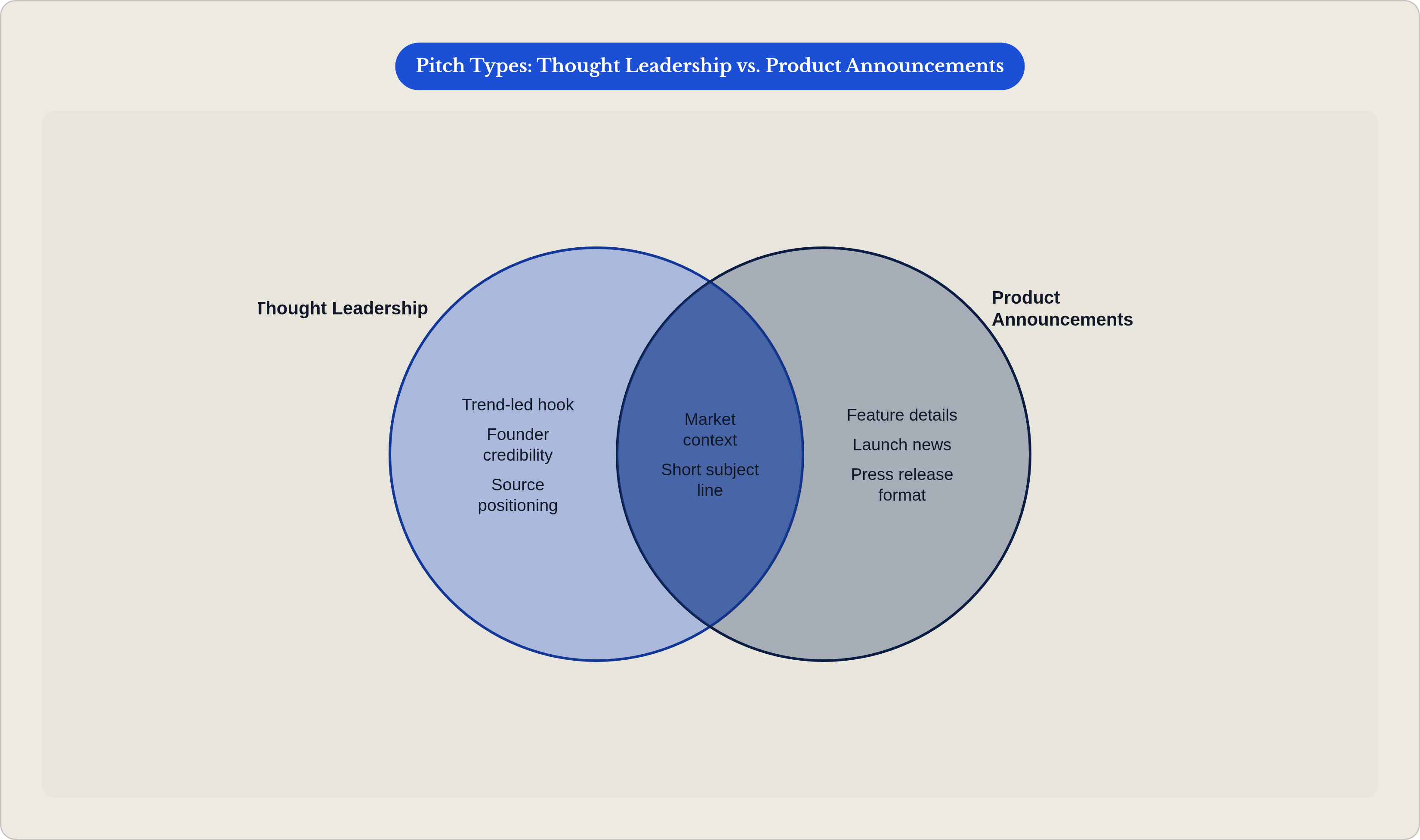
Editors aren't hunting for product updates. They're hunting for people who can explain what's happening in an industry without sounding like a brochure. A thought leadership pitch hands a journalist exactly that: a ready-made source who can speak to a trend their readers are already asking about.
SaaS founders are unusually well positioned for this, and it's worth asking why. Category expertise comes built into the job, since most founders know their problem space better than the analyst assigned to cover it, and an opinionated, specific take beats a balanced corporate statement every time, because balance is boring and journalists know it. A founder who's been documenting their thinking publicly, on LinkedIn or wherever, is also just easier to vet. The paper trail does the credibility work before the pitch even lands.
Speaking of LinkedIn: per LinkedIn's 2025 B2B Marketing Report, content shared by company leaders gets roughly 3x more engagement than content shared by company pages. A founder with a visible public voice shows up in a journalist's inbox with credibility already attached, which is a head start most pitches never get.
In practice, this pitch type leads with the trend or tension the journalist's readers are living through, not the founder's name, and it positions the founder as the person who can explain the thing, not sell against it. And it offers something concrete: a contrarian data point, a pattern seen across dozens of customers, a prediction with actual reasoning behind it. Coverage feeds LinkedIn credibility, and LinkedIn credibility makes the next pitch land easier. The two channels compound, which is the closest thing to a free lunch in this business.
How a funding announcement pitch is structured
The subject line should be specific, not clever. Put the lead investor's name or the round size right there; journalists scan for news value in under two seconds and cleverness just slows that down.
Opening sentence: dollar figure, round type, lead investor, one line of market context, all in that order. Second sentence: the "why now." What market condition made this raise happen, and why should a reader of this particular outlet care?
The body, kept to 100 to 150 words, needs one concrete traction metric, revenue growth, customer count, or a named enterprise logo, not "strong momentum," an actual number. Say what the capital funds specifically: product, go-to-market, a new geography, since editors need this to know where the story goes next. Include one founder quote that adds a real voice, because "we're excited to announce" burns the only line a journalist might have pulled for the piece.
Close with a single link to a press kit or shared drive folder (no attachments, ever) and an explicit offer of founder availability for a short call. Skip the boilerplate company paragraph entirely, and don't bury the round size three sentences in. And don't pitch a round below the threshold that carries independent news weight, unless the investor's name is doing that work for you. One more thing: reference a recent piece the journalist wrote on a comparable raise, one sentence, specific, not flattery. That's the line that gets read twice.
How a data-led research pitch is structured
Cision's 2024 report puts 61% of journalists valuing original research and market data, second only to press releases. This is the category where SaaS companies actually have a structural edge, because you're sitting on behavioral data nobody else has access to.
The hook is the data point itself. "We analyzed 5,000 SaaS onboarding flows and found a 40% drop-off at step two" gets coverage because it's specific, sourced, and citable without your company needing to be the subject of the story. The subject line should lead with the finding, not the methodology: "40% of SaaS users abandon onboarding at step two" beats "Our onboarding research report is live" every single time.
Structure the body around the finding first, stated plainly with the sample size named, then explain why it matters to this journalist's audience right now, tied to something they've already covered or a debate their readers are having. Add two or three supporting data points, not a data dump, a thread that holds together. And offer something exclusive: first-use rights, or an embargo window. Journalists like being early to a story almost as much as they like being right about one.
What kills this pitch: burying the finding under a company announcement, using the data as a Trojan horse for a product pitch, or calling something "our survey" without naming the sample size. The company here is the source, not the subject. That restraint is the entire trick.
How a thought leadership pitch is structured
This pitch sells access to a credible voice, not a news event. The journalist is buying a source they can use now, or come back to later when the topic resurfaces.
Subject line names the trend, not the founder. "Why enterprise SaaS churn is rising even as NRR holds" will outperform "[Founder Name] available for comment on SaaS retention" nearly every time, because one is a headline and the other is a business card. Open with the specific market observation the founder holds, something true and not yet obvious, framed for the journalist's beat.
Add a credibility signal, brief and specific: not a bio paragraph, just one fact that earns the founder the right to have an opinion here (customer count, years in the space, proprietary data they're sitting on). Then offer three options ranked by effort: a 15-minute call, a contributed piece, or a quote for something already in progress. Tie the whole pitch to a specific article the journalist recently wrote, one sentence showing the founder actually read it and has something to add. That's the line that gets a reply.
A founder with a real following (LinkedIn, wherever) who's documented a point of view publicly is easier to quote than someone nobody's heard of, and including the profile link matters, since it's an implicit credential. Keep this one short: of all the pitch types, this is the one where length undercuts the message, since a pitch about "this founder communicates clearly" that runs 400 words is its own punchline.
How a customer impact pitch is structured
This works when the outcome is specific, dramatic, and tied to a recognizable customer or vertical. "HR platform reduced onboarding time by 60% across a Fortune 500 client" travels. "Customers love our product" does not, and never will, no matter how you dress it up.
The journalist's math is simple: can I build a story around this outcome that my readers will recognize themselves in? Your pitch has to answer yes in the first two sentences, not the fifth paragraph, and the subject line leads with the result and the customer's industry, not the product name, because nobody's Googling your product name yet.
In the body, sentence one is the outcome itself, a specific percentage, time saved, or cost cut, with the customer's vertical named even if the company itself is under NDA. Sentence two is the before state: what was the customer doing instead, and why did it fail? Without that contrast, the result is just a number floating in space with no weight behind it. If you can get a direct customer quote the journalist can pull without doing their own interview, include it, since that lowers the barrier to coverage more than almost anything else you can offer. Close with an offer: the customer available for a short on-record chat, or case materials under embargo.
The product is the enabler here, not the star. The customer's story is the story, and if the customer's name can be disclosed, put it in sentence one. Enterprise logos and Fortune 500 clients do credibility work no product feature ever will.
The subject line decisions that determine open rate before anything else
A subject line under 60 characters that names the actual news is the floor, and everything past that is optimization, not foundation.
What earns an open: a number, a named company, a specific finding, or a real tension the journalist's audience is already living through. What kills an open: "Exciting announcement from [Company]," "Thought you'd find this interesting," or anything that requires opening the email just to figure out what it's about. If your subject line needs a decoder ring, it's already failed.
Here's a quick test: swap out your company name from the subject line. If it still makes sense, it's generic, and if it collapses without the company name in there, it's probably too promotional. The target sits in the middle, specific to the actual news, obviously relevant to that journalist's beat, and legible without you standing next to it explaining the joke.
A few formatting notes worth knowing. Question marks perform inconsistently across outlets, so don't lean on them as a crutch. Title case reads more like a headline and tends to work for data pitches, while sentence case reads more like an email from a colleague and tends to work better for source and thought leadership pitches. Test one variable at a time, not five, or you'll never know which change actually moved the needle. Small stuff, but it's the difference between landing in a journalist's "yes" pile and landing in the one they empty every Friday without opening.