Crisis Communication Playbook for B2B SaaS Companies
You have 10-30 minutes to respond before silence reads as concealment.

Speed is the part nobody really internalizes until they're inside one.
A crisis hashtag now generates around a million impressions within 90 minutes. That's not a hypothetical. That's roughly how long you have before the narrative is being written by people who aren't you — like a fire spreading through dry grass, the story catches before you've had a chance to pour water on it. The window for a controlled first response closes fast, often before a founder has even confirmed what actually happened.
The B2B SaaS version of this is nastier than most. Your customers aren't just annoyed when something breaks. They're running their own businesses on your product. An outage or a data breach doesn't just inconvenience them. It becomes a material threat to their clients, their revenue, their reputation. The emotional temperature in the room is already higher before you've typed a single word.
And then compliance shows up. A single incident can now trigger multi-jurisdictional investigations within hours. By mid-2025, the vast majority of global firms cite compliance complexity as their top operational concern, and that number keeps climbing. The communications surface area multiplies overnight, sometimes before anyone has figured out what happened in the first place.
The practical implication is uncomfortable but simple. Initial acknowledgment needs to happen within 10 to 30 minutes of a crisis becoming known. Not a full statement. Not legal sign-off. A human signal that says someone is aware and responding. Silence in the first hour doesn't read as caution. It reads as chaos, or it reads as concealment. Your customers will pick the worse interpretation every time — silence is the original self-fulfilling prophecy.
What a working crisis communication structure looks like before anything goes wrong
A crisis plan is not a document you file in a shared drive and feel good about. It's a set of decisions made in advance so you're not making them while your Slack is on fire.
Most large companies have a documented plan. Most smaller companies don't. The companies least prepared are often the ones where the founder's personal credibility is the primary trust asset. That's where the gap is most expensive.
What the plan needs to include:
- One designated spokesperson. One. Credible. Publicly visible. In most B2B SaaS companies, that's the founder or CEO. The PR manager stays in a support role. If your customers have never heard of the person speaking, the credibility doesn't transfer. Full stop.
- Clear internal role assignments. Who handles legal. Who owns internal employee communications. Who manages customer-facing updates. Who monitors social in real time. Everyone knows their lane before anything breaks.
- A stakeholder messaging map. Customers need empathy and specific action steps. Investors need reassurance and financial framing. Employees need transparency. Regulators need data. These audiences require different messages, drafted in advance by someone who isn't panicking.
- Pre-approved channel protocols. Which channels are used for what, and who can post without waiting on a full approval loop. Approval loops are the enemy of response speed in the first hour when it matters most.
There are two common failure modes worth naming. The first is designating a communications manager as the spokesperson. If your customers don't know who that person is, you've lost the credibility race before you started.
The second failure mode is writing the plan and never stress-testing it. Plans don't fail at the messaging points. They fail at the decision points. You find out what's broken when you actually run through the scenarios, not when you read the document.
The specific role the founder's voice plays when trust is under pressure
B2B buyers make most of their decisions before they ever talk to sales. The trust they build during that process gets deposited under the founder's name, not the company's. That's the trust equity sitting on the line when a crisis hits. And only the founder can protect it or burn it.
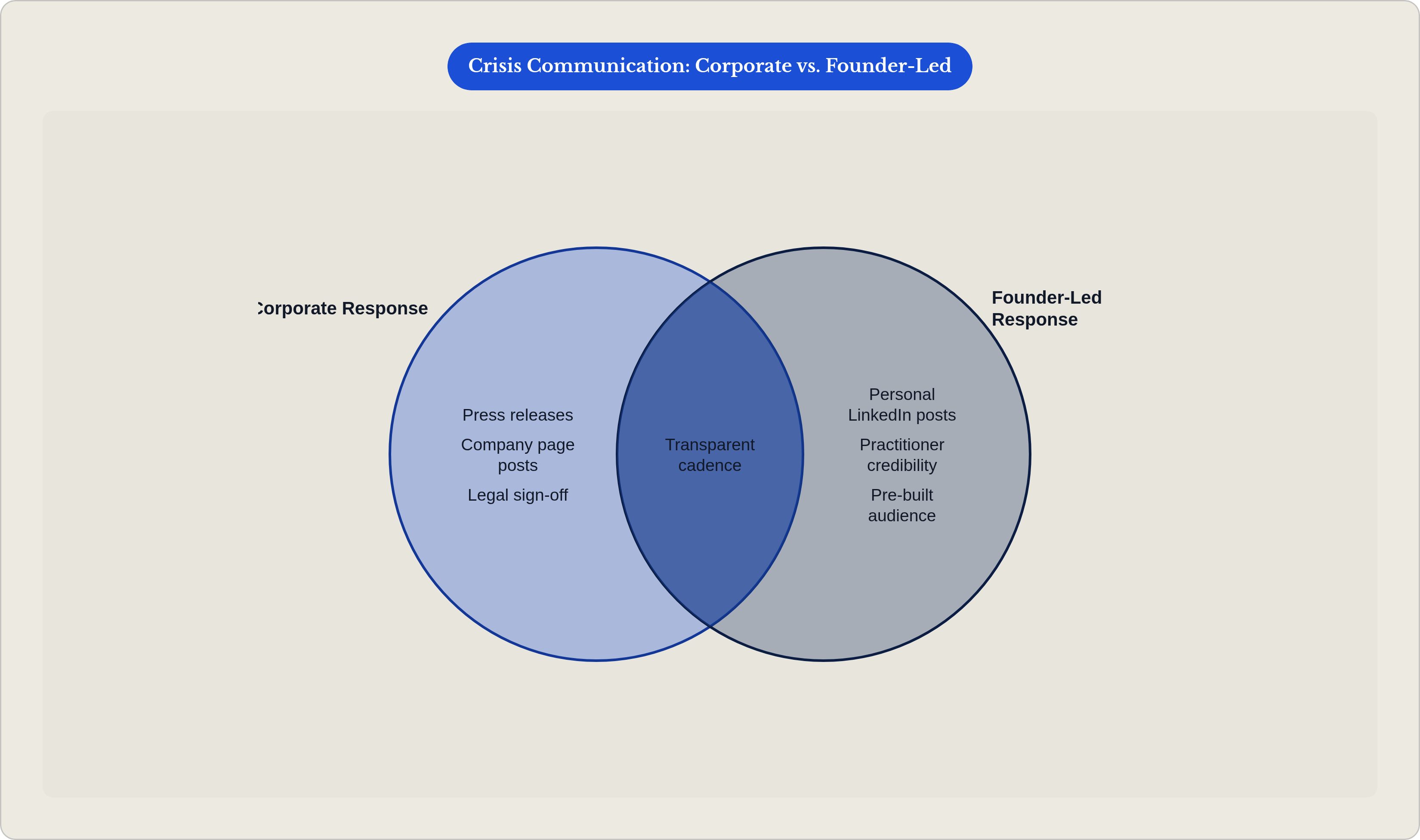
A corporate statement without a named human voice signals: we are managing this. A founder post signals: I am responsible for this, and here is what I'm doing about it. That's not a subtle distinction. In a B2B relationship where a customer has staked their own operations on your product, that's the difference between trust maintenance and trust destruction — a corporate statement is a locked door; a founder's post is someone answering it in person.
Buyers know the company page is marketing. Everyone knows it. A founder speaking directly reads as a person taking accountability, which is a completely different signal. Founders often carry genuine practitioner credibility in the industries they serve. Customers extend trust to the company through the founder. In a crisis, that mechanism runs in reverse: founder accountability protects the company.
This is also why crisis communication can't be improvised. The founder-led trust model is the dominant mechanism in B2B SaaS today precisely because buyers have grown skeptical of traditional brand content. A crisis is the highest-stakes moment to activate that mechanism. And improvisation, at that moment, lands badly.
How Slack and Microsoft actually handled high-visibility SaaS crises — and what held
Two cases worth studying. Both illuminate specific principles that hold up beyond their own contexts.
Slack's 2022 outage
Slack's response is now a frequently cited example of the transparency-and-cadence model, and for good reason.
They created a public status page updated every 30 minutes. That single decision turned a reactive crisis into a structured information feed. They used Twitter (now X) to meet users where the conversation was already happening. The tone was openly apologetic. Not defensive, not legalistic. Just sorry and specific.
Customer trust stabilized instead of eroding.
The underlying lesson isn't just about tone. Predictable cadence is itself a trust signal. It tells customers the company is in control even when something has obviously gone wrong. The 30-minute rhythm communicated competence more than any individual update did.
Microsoft and the SolarWinds supply chain attack (2020)
This one operated at a different scale entirely. A supply chain attack with a large blast radius and complicated stakeholder dynamics across government and enterprise customers.
Microsoft proactively disclosed its own exposure rather than waiting to be named. They issued regular public updates on findings. They gave customers specific protective steps. They collaborated visibly with government agencies. They led with transparency instead of trying to contain the narrative, and that decision changed the reputational outcome significantly.
The B2B-specific takeaway matters here. When a crisis has technical depth (and most SaaS incidents do), the response has to match. Customers whose own operations are affected need incident analyses and remediation specifics. Reassurance alone is not sufficient. It will feel hollow, and they will know it.
What both cases share
Both used a visible, named response posture rather than hiding behind corporate statements. Both used multi-channel, real-time communication rather than a single press release and a prayer. Neither relied on a clean PR narrative taking hold on its own.
What neither case fully illustrates is founder-specific voice as the anchor. Slack and Microsoft are large enough that institutional brand credibility carries real weight. For founders of companies where they personally are the trust source, that's the gap worth filling.
Using LinkedIn as the operational center of founder-led crisis communication
LinkedIn is where B2B buyers form category opinions, evaluate vendors, and research founders before any sales conversation happens. That makes it the highest-leverage channel for founder credibility under normal conditions. In a crisis, that dynamic doesn't change. It intensifies.
Personal profiles substantially outperform company pages for organic distribution on LinkedIn. A founder's personal profile is where the audience actually lives. The company page is largely wallpaper for most B2B SaaS companies, and honestly, that's fine given how the platform works.
LinkedIn's algorithm currently rewards depth over volume and genuine expertise over engagement bait. A considered, specific crisis update from a founder is structurally favored over a polished brand statement from a company page. The audience is active, engagement is up, and people are paying attention.
In a crisis, LinkedIn serves three distinct functions at once:
- Real-time acknowledgment channel. The first post, within the initial response window, signals that a human is aware and responding. That signal matters even if the post contains limited information.
- Ongoing update feed. Subsequent posts maintain the cadence of transparency without requiring a formal press release for each development.
- Trust re-establishment surface. As the crisis resolves, the founder's continued presence on LinkedIn bridges from crisis mode back to normal thought leadership. The credibility relationship gets rebuilt in public.
A quick LinkedIn update also gets ahead of misinformation circulating elsewhere. That speed advantage is especially valuable in the first 90 minutes when a crisis narrative is building momentum and the people writing it aren't you.
One format note worth keeping: text-only posts are often the right call for crisis communications. They read as direct and unpolished, which signals authenticity rather than spin. A produced graphic during a crisis moment can feel tone-deaf. The unpolished is the point.
What the founder actually posts during each phase of a crisis
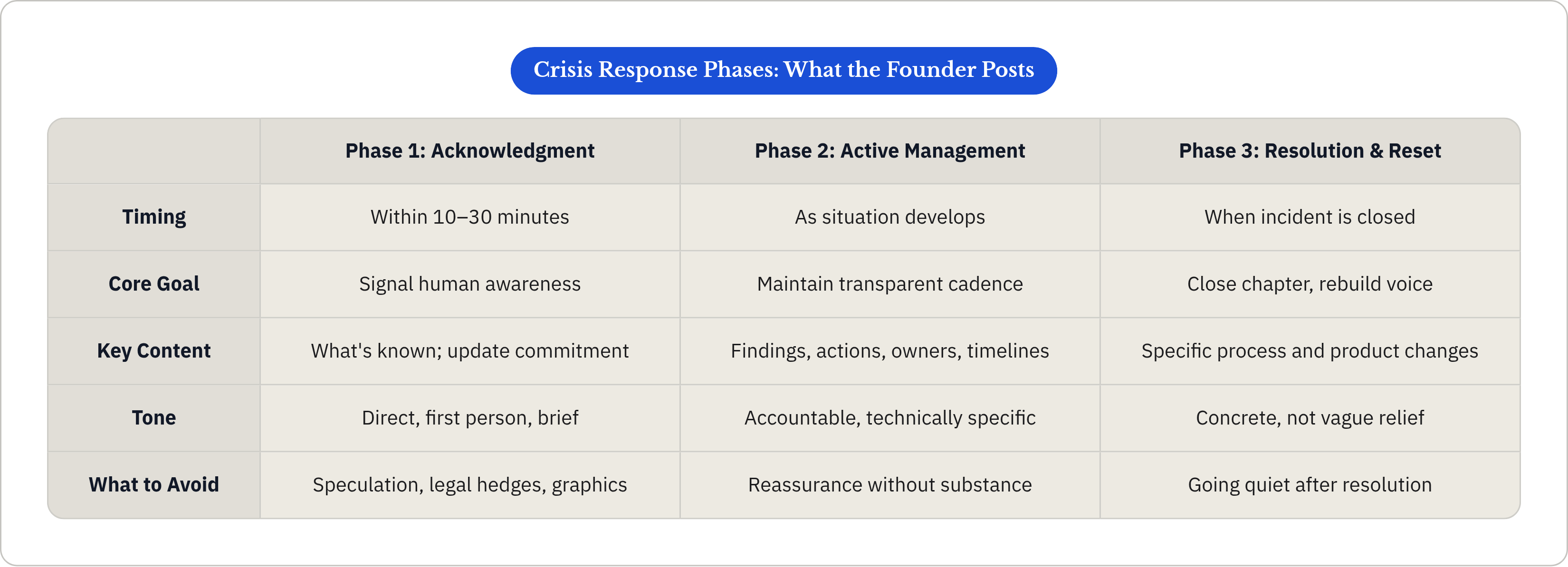
Phase 1: Acknowledgment (within 10 to 30 minutes)
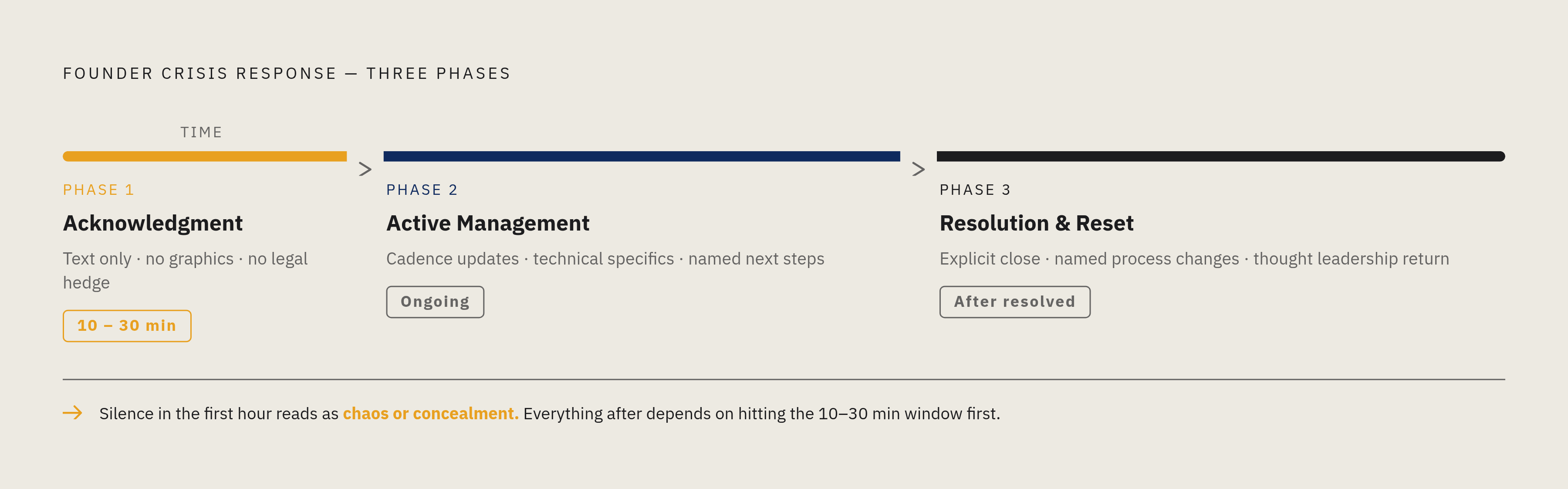
Goal: signal human awareness before speculation fills the vacuum.
Keep it brief. Keep it direct. First person throughout. Confirm you're aware of the situation. State what's known, even if that's limited. Commit to updates on a specific cadence.
What to avoid:
- Speculation or premature conclusions
- Defensive framing
- Legal-sounding hedges that read as evasion
- Graphics, links, or anything that slows the post down
The post doesn't need to be perfect. It needs to exist. Speed and directness are the signal. Everything else is secondary.
Phase 2: Active management (as the situation develops)
Goal: maintain the cadence of transparency. Predictability is reassuring even when the news isn't great.
Update on what's been learned. What's being done. Specific next steps with owners and timelines where possible. For B2B SaaS specifically, technical specificity is not optional. Customers whose own operations are affected need to understand the scope and the remediation path. Reassurance without substance doesn't land with enterprise buyers. They've seen it before.
The tone is accountable without being catastrophizing. Direct without being defensive. You're not performing calm. You're demonstrating it.
One structural note: the stakeholder-segmented messaging your internal team is sending out (customer emails, regulatory filings, investor updates) needs to be consistent in substance with what you're saying publicly. Contradictions between channels become a secondary crisis, and that one is entirely self-inflicted.
Phase 3: Resolution and reset
Goal: close the crisis chapter explicitly and start re-establishing the normal thought leadership voice.
This is where specifics matter most. What actually changed? Process improvements, product changes, policy updates. Name them specifically. Vague resolution posts feel like relief statements. Specific ones feel like accountability, and the distinction is obvious to everyone reading.
A well-handled crisis, when it ends, can increase credibility with the audience that watched it unfold. They saw accountability in action. The first non-crisis post after a handled incident often carries more weight than anything before the crisis, because trust was earned under pressure. That's a real thing.
What to avoid after things resolve: going quiet. Disappearing after the crisis calms down reads as relief-driven retreat. It undermines everything built during the crisis itself.
The cross-phase principle
The founder's LinkedIn posts are the narrative spine. Everything else (status pages, customer emails, press statements, regulatory communications) should connect back to and be consistent with what the founder is saying publicly. The founder's voice is the through-line. Everything else is supporting material.
Building the pre-crisis LinkedIn presence that makes crisis communication credible
A founder posting on LinkedIn for the first time during a crisis has no audience, no established tone, and no trust equity to draw on. That's the actual problem. Crisis communication works because of the credibility built during ordinary time. You can't manufacture it when you need it. You have to build it before the need shows up.
Think of it this way: showing up on LinkedIn only during a crisis is like calling a friend only when you need to borrow their car. The relationship isn't there, and everyone knows it.
In that same analysis of B2B SaaS companies that reached $5M ARR, the overwhelming majority had founders actively posting on LinkedIn. The audience that buys during normal conditions is the same audience the founder needs to reassure during a crisis. They're not different people.
Consistent posting before a crisis establishes three things:
- A recognizable voice. Customers know what the founder sounds like. An authentic crisis post lands differently than an anonymous corporate statement because the reader already has a relationship with the voice. That relationship is the whole point.
- An existing audience. The post reaches people who already trust the founder. That accelerates trust maintenance when speed matters.
- Demonstrated accountability norms. Founders who share failures, hard lessons, and difficult calls in ordinary content have already signaled, publicly, that they stay present when things go wrong.
LinkedIn rewards two to three substantial posts per week over daily low-effort updates. The cadence that builds a durable pre-crisis presence is the same cadence the platform structurally favors. Worth noting, even if it sounds a little too convenient.
The real asset being built is a distribution channel the founder actually controls. A proprietary audience that trusts them and pays attention without requiring paid promotion. That audience is what makes crisis communication land rather than disappear.
For founders who haven't built that presence yet: start now. After the next hire is too late. After the next funding round is too late. Every week of consistent, specific, opinionated LinkedIn content is infrastructure. It doesn't feel like crisis communication infrastructure because nothing has broken yet. That's exactly the point.
The founder's voice on LinkedIn is the primary trust channel the company runs on. Which makes it the crisis communication infrastructure the company will eventually need. And something will eventually go wrong.