B2B SaaS Positioning Statement Fundamentals
A clear positioning statement aligns your entire team on who you serve and why you win.

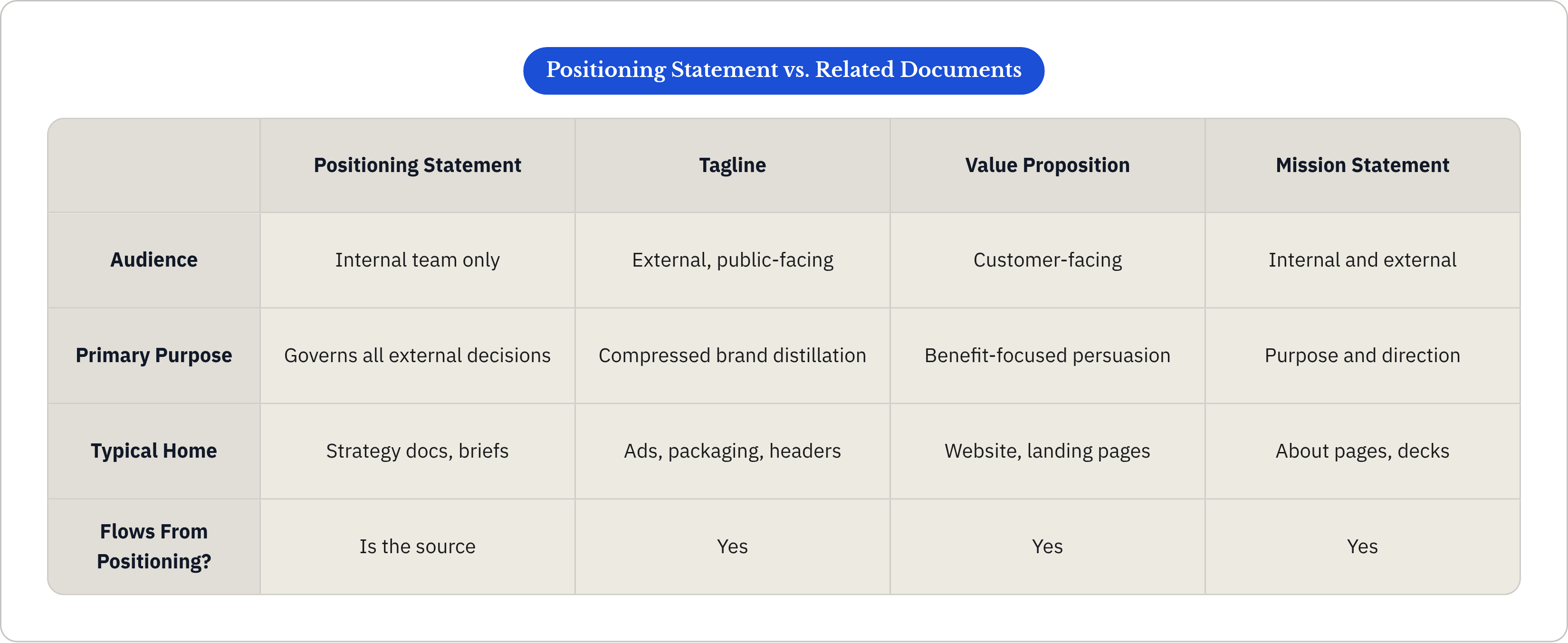
Let's clear something up. A positioning statement is an internal document that governs every external decision you make. It is not your tagline. It is not your mission statement. It is not your value proposition. All of those should flow from it, but none of them are it.
It answers four questions your team must agree on before anything goes to market:
- Who exactly is the customer?
- What category does the product belong to?
- What is the primary benefit the product delivers?
- Why should the customer believe that claim?
These related documents each serve a different purpose:
- A tagline (compressed, outward-facing distillation of positioning)
- A value proposition (customer-facing, benefit-focused, lives on the website)
- A mission statement (inward-facing, purpose-driven)
- A product description (features list with a friendly tone)
Mixing them up is where the confusion starts, and it's also where strategy quietly falls apart before anyone has named the problem.
Most B2B SaaS products fail because nobody could explain what the product was for, who it was for, or why it beat the alternative. That's a positioning problem. And it shows up everywhere downstream before anyone names it.
When positioning is clear internally, everything aligns. ICP selection, pricing, channel decisions, sales talk tracks, and even what the founder posts on LinkedIn all pull in the same direction. When it's muddy, every team makes locally rational but globally incoherent decisions. The product team ships for one customer. Sales pitches to another. Marketing writes copy for a third. Think of it like a choir where every section is reading a different sheet of music — each part sounds fine in isolation, but together it's noise. Specific, benefit-focused headlines convert meaningfully better than generic ones, and the positioning statement is what makes that specificity possible in the first place.
The Components That Force Real Clarity
A positioning statement isn't just a template you fill in. Each component has a job. If any one of them is vague, the whole thing falls apart.
Target customer. A description precise enough to disqualify someone. "Mid-market B2B SaaS companies" leaves too many people in. "VP of Revenue at a Series B SaaS company with a 10-plus-person sales team that has outgrown spreadsheet-based forecasting" is closer to something you can actually use. The point is to be specific enough that someone reads it and immediately knows whether they're in or out.
Market category. The frame that tells the buyer how to evaluate your product. Get it wrong and you're competing against the wrong alternatives before the conversation even starts.
Primary benefit. The single most important thing your product does for the customer. "Faster reporting" is a feature claim. "Finance teams close their books three days earlier" is a positioning claim. One describes what the product does. The other describes what the customer gets.
Reason to believe. Specific metrics. Named case studies. A mechanism that explains how the outcome is achieved. Without this, you're just asserting things, and assertion is not positioning.
Differentiation from named alternatives. "We're better" describes a preference. "Unlike [alternative], we do X without requiring Y" describes a difference. Buyers can tell the two apart.
Geoffrey Moore's template from "Crossing the Chasm" gives you a usable starting structure: "For [target customer] who [has this need], [product name] is a [market category] that [primary benefit]. Unlike [competitive alternative], our product [key differentiator]."
Here's the test. Can someone on your team memorize it? Can a competitor swap their name in and have it still make sense? If yes to the second question, it's not specific enough yet. Go back and try again.
Category Choice Is the Most Consequential Decision You'll Make
Category isn't just a label. It's the frame that determines which competitors you're measured against, which buyer problems you're expected to solve, and what "winning" even looks like in the customer's mind. Most founders underestimate this, and then wonder why their product keeps losing evaluations they thought they were set up to win.
The trap for early-stage companies is claiming a dominant, well-understood category because it feels safe. Declare yourself a "collaborative design tool" and Figma is in every conversation. Most challengers can't win that comparison. More importantly, it's the wrong fight entirely.
The smarter move is use-case positioning. Own a specific workflow or problem rather than an established category.
- Calendly didn't win by owning the calendar category. It won by owning one specific workflow: killing the email back-and-forth of scheduling.
- Loom positioned against meetings, not screen recorders.
- Slack didn't launch against Microsoft Teams (which didn't exist yet). It positioned against internal email.
Your real competitive alternative is often another SaaS product, a spreadsheet, an email thread, a manual process, or a behavior. If you don't know what you're actually replacing, your positioning will miss. And it will miss in ways that are hard to diagnose, because every number looks plausible until a deal falls apart and nobody can explain why.
April Dunford's "Obviously Awesome" framework centers on exactly this. Identify your unique attributes first, then choose the category that makes those attributes look like strengths rather than gaps. The goal is choosing the category where you look most obviously right, not finding the one you technically belong to.
Category choice also shapes where you show up publicly. Which analyst conversations you belong in. Which search terms surface you in an AI-assisted shortlist. This is a go-to-market call, not a branding exercise.
You're Not Selling to a Buyer. You're Selling to a Committee.
B2B buying committees averaged 11 stakeholders in 2024. Each additional stakeholder in the process reduces purchase probability by 10 percentage points. That dynamic creates a positioning problem, not just a negotiation problem.
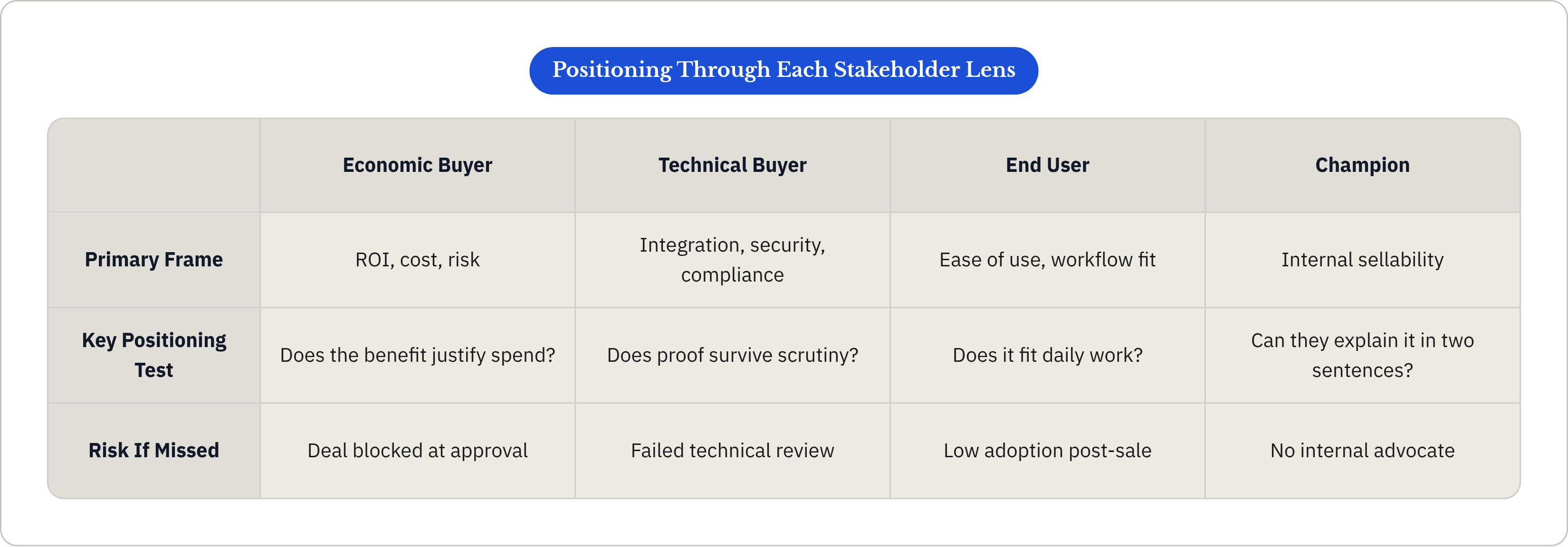
Each stakeholder is effectively a different buyer with a different frame of reference:
- Economic buyer: ROI, cost, risk
- Technical buyer: integration, security, compliance
- End user: ease of use, workflow fit
- Champion: needs to sell internally on your behalf (this one is almost always the most important and the most overlooked)
Your positioning statement must be singular and coherent. But the messaging you derive from it has to flex for each audience without contradicting the core claim. A statement that resonates only with end users will stall at the economic buyer. One built only for the C-suite won't survive the technical review.
Here's a practical check. Take your primary benefit and reason-to-believe and test them against each role. Does the benefit land for the economic buyer? Does the proof hold up for the technical reviewer? Can the champion explain it to a skeptical CFO in two sentences?
If the statement breaks for any one of those roles, it's incomplete. And incomplete positioning in the room where the deal gets decided is effectively no positioning at all.
By the Time You Know They're Evaluating You, It's Already Over
This is the part that surprises most founders. Buyers define their purchase requirements before talking to vendors the vast majority of the time, and the winning vendor is already on the shortlist at Day One of the formal process nearly all the time. Both figures come from 6Sense's 2025 Buyer Experience Report.
That shortlist wasn't built by your sales team. It was built by your positioning.
Here's how it actually happens. Buyers do private research first. According to 2025 data from The Starr Conspiracy, nearly two-thirds of B2B buyers cite peer recommendations from private channels as their most trusted source, ahead of analyst reports and vendor content. More than 84% of content sharing happens in Slack threads, LinkedIn DMs, and email chains. None of it is tracked. The content traveling through those channels is executive thought leadership, competitive analyses, research reports. Exactly where a founder's public positioning shows up, if it exists.
There's another layer. More than 70% of B2B technology buyers used generative AI tools during vendor evaluation in 2025, and they're more than twice as likely to finalize shortlists before contacting any vendor. AI-assisted shortlisting rewards clarity. A vague or generic positioning statement is harder to surface in an LLM-generated comparison. Category language and specific benefit claims in public content directly affect whether you appear in AI-generated evaluations.
A positioning statement that only lives in a sales deck is already too late. It needs to be expressed consistently in founder content, website copy, and category-level conversations long before any buyer raises their hand.
Start With What Customers Are Trying to Accomplish, Not What You Built
The most common positioning failure is inside-out thinking. You start with features, work backward to benefits, and end up with messaging that sounds like it was written by the engineering team for the engineering team. The output is technically accurate and completely useless to the person you're trying to sell to.
Jobs-to-Be-Done flips that. Buyers hire outcomes, not software. Those outcomes have three layers:
- Functional job: What the product actually does. Automates the approval workflow.
- Emotional job: How it makes the buyer feel. Not nervous before the board meeting.
- Social job: How it makes them look. Competent, ahead of the curve, decisive.
The primary benefit in your positioning statement should reflect the functional job. The reason-to-believe should speak to the emotional and social jobs. Proof that the outcome actually arrives, rather than just that the feature works.
The research method that surfaces this is structured customer interviews. Three questions do most of the work:
- "What were you trying to do before you found us?"
- "What was failing?"
- "What would you lose if this tool disappeared tomorrow?"
I've run enough of these interviews, and watched enough founders run them, to tell you the answers are almost never what anyone expected. One founder I know sat down expecting customers to talk about a competitor. What he got instead was a 20-minute story about a color-coded spreadsheet, a shared Google Doc with 14 conflicting versions, and a genuine prayer every Monday morning that the numbers would reconcile before the 9am standup. That single conversation rewrote his entire positioning statement. It also told him exactly what he was replacing, which was nothing as glamorous as a named competitor. It was chaos with a formula bar.
Skip the interviews and you're writing fiction. Confident, well-formatted fiction, but fiction.
Positioning Goes Stale. Treat It Like a Living Document.
A positioning statement written at founding and never revisited will drift out of alignment with the market. Usually silently. Usually through slowly worsening conversion rates and increasingly vague sales conversations where everyone leaves the call feeling fine and nothing closes.
For early-stage SaaS companies, a six-month review cadence is a reasonable standard. Markets shift, competitors add features, and ICP understanding deepens as more customer data comes in.
Watch for these signals. They mean it's time to revisit:
- Conversion rates dropping without an obvious cause
- Sales cycles getting longer
- Customers churning at the "bad fit" stage (they bought thinking you did X, discovered you do Y)
- Sales team telling different stories to different prospects
- A competitor launches something that sounds exactly like your positioning statement
Enterprise sales cycles grew 24% between 2022 and 2024, even as individual buyer research time shrank by 18%, per The Starr Conspiracy. The bottleneck is now consensus, not evaluation. Clear positioning helps champions sell internally, and that's where most deals are actually won or lost. The sales team closes the conversation. The positioning closes the deal.
A positioning review is a structured check, not a rebrand. Has the target customer definition stayed accurate? Does the category frame still serve you? Is the reason-to-believe still credible and current? Three questions. Twice a year.
The Founder's Voice Is the Highest-Leverage Distribution Channel You Have
A positioning statement that stays internal is a strategy that never leaves the building.
It only generates returns when expressed consistently in every public-facing context. And no channel has a higher return on that expression than the founder's personal voice. The founder, posting like a human being who has opinions about the problem they're solving, outperforms the company blog and press releases alike.
Personal accounts generate better organic reach and engagement than company pages. LinkedIn's algorithm favors individuals because they read as conversational rather than promotional. Founders also carry practitioner credibility that a brand logo cannot. Buyers transfer existing trust in a founder to the product more readily than to a company name. More than a billion people use LinkedIn globally, and for B2B buyers specifically, it's where categories form, vendors get evaluated, and trust is established before any sales conversation begins.
What founder-led LinkedIn content derived from positioning actually looks like in practice:
- Naming the category you've chosen and making the case for why it's the right frame
- Articulating the customer's functional and emotional job in language they recognize as their own
- Sharing specific proof: customer outcomes, metrics, case studies. The reason-to-believe expressed in public.
- Taking a visible stance on the competitive alternative. Naming what you replace, not just what you do.
Every post that expresses the category, the customer, the benefit, and the proof is doing positioning work in the channels where buyers are doing their research before they ever show up in your CRM.
The founder who shows up consistently with a clear point of view, grounded in a real positioning statement, is building the shortlist before the buyer even knows they're in the market. Given everything we know about how B2B buying actually happens now, that's the only place to be.