Competitive Differentiation Messaging for SaaS
Your story matters more than your features—shape buyer belief before they ever reach out.

Most SaaS founders think they have a product problem. The features aren't sharp enough. The roadmap is too slow. The dev team needs to ship faster. But in most crowded SaaS categories right now, the product is fine. The problem is the story. And the founders who figure that out early build pipelines, communities, and investor conviction that competitors can't replicate, no matter how fast they move.
The commoditization trap is genuinely punishing. In almost every SaaS category today, multiple credible vendors have near-identical feature sets. Something that differentiates you in Q1 is table stakes by Q3. When buyers can't tell the difference on capability alone, decisions default to price, familiarity, or whoever got to them first mentally. That last one is the one founders underestimate most. It's like showing up to a party where everyone already has a best friend — if you're not already in someone's mental guest list, you're not getting past the door.
Then there's the comparison trap, which makes everything worse. When you position on a feature matrix, you hand buyers a scorecard and say "judge us on these criteria." You will eventually lose that game. Someone will match you. Someone will beat you on one line item. The whole exercise trains buyers to evaluate you on terms that don't actually favor you.
The real question your differentiation messaging needs to answer is: "why are we the only coherent answer to this specific problem, framed this way?" That's a different question entirely. Answering it is the whole job.
Here's the uncomfortable part. Research consistently shows buyers complete the majority of their decision process before contacting a vendor at all. Most deals go to a vendor already on the buyer's shortlist before the first call. By the time someone books a demo, they've often already picked you. Or already ruled you out.
The sales call is mostly a ratification. A verdict read aloud after the jury has already voted. That verdict got shaped by content, reputation, and whatever the buyer read, watched, or heard about you in the weeks before they reached out.
What preference formation actually looks like: buyers are reading posts, clicking founder profiles, forwarding links to colleagues in Slack, mentioning vendors in private conversations. None of that shows up in your attribution dashboard. All of it shapes who ends up on the shortlist.
Studies on B2B purchasing behavior consistently find that the majority of buyers research company leadership before making purchasing decisions, and that visible leadership online meaningfully increases the likelihood of consideration. That's a structural advantage that keeps accruing to founders who show up consistently with a clear point of view.
Most of this preference formation is invisible. It happens in channels you can't track. But it can be influenced. The founder who is already familiar when a buyer reaches out has already won the first trust battle. You can't win that battle with a sales team. You win it with presence, over time.
What Makes a Differentiation Narrative Work at the Level of Belief
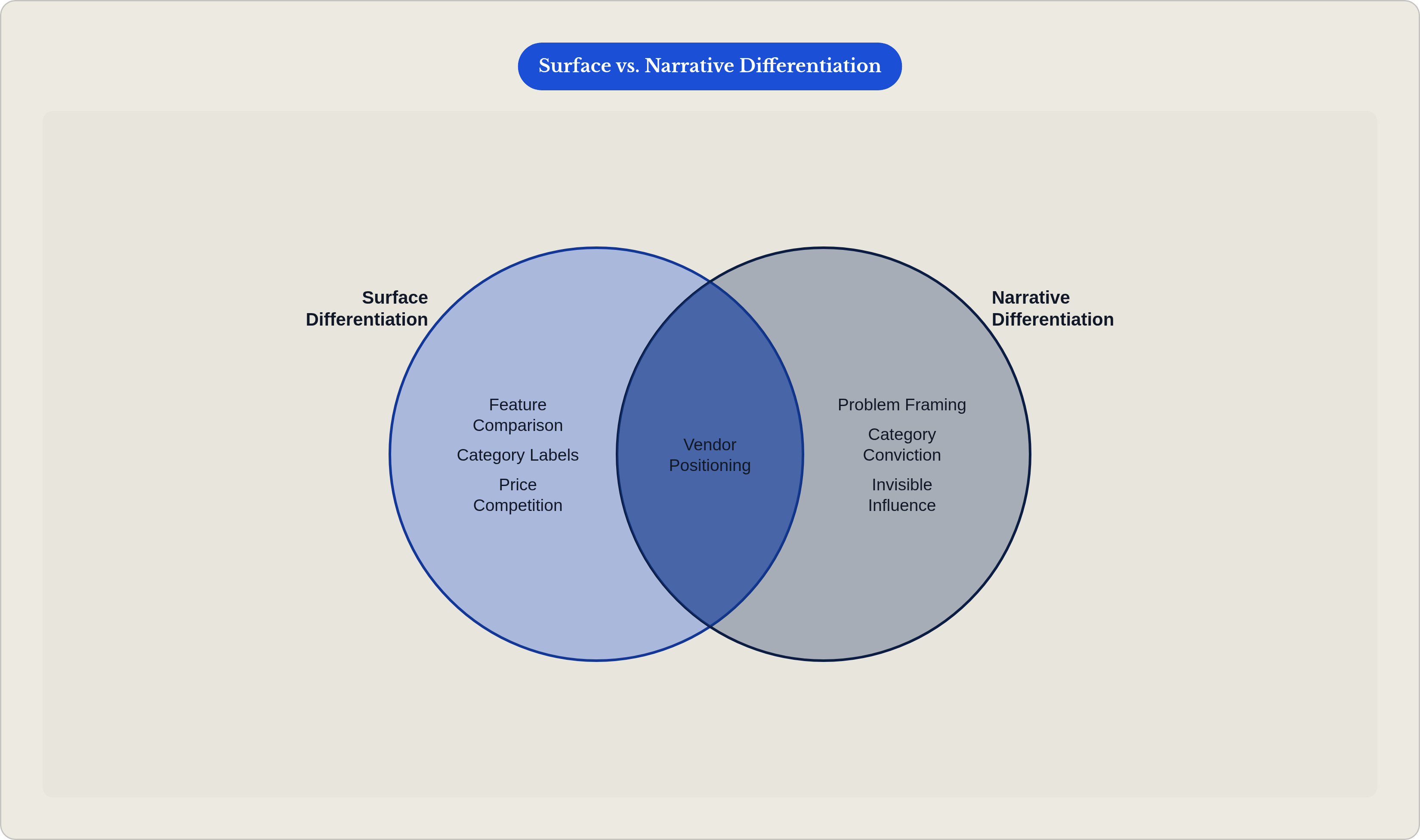
There are two levels at which you can try to differentiate. Surface level works through comparison: taglines, feature bullets, category labels. The buyer sees it, mentally stacks it next to competitors, and scores it. It's exhausting for them and fragile for you.
Narrative differentiation works at the level of belief. The buyer stops comparing you to alternatives. Instead, they adopt a worldview in which your solution is the logical conclusion. That's a very different outcome.
A good differentiation narrative does three things:
- It names the problem in a way that makes the buyer feel genuinely seen — here is why this pain exists structurally, and here is why most people haven't understood it that way.
- It explains why existing solutions, including whatever the buyer is doing right now, are structurally inadequate. They are structurally inadequate — not just imperfect.
- It makes your specific approach feel like the inevitable response to that inadequacy. The coherent next step, not one option among many.
Here's a useful test. If a buyer reads your narrative and can substitute a competitor's name into the story without it breaking, the narrative isn't differentiated enough. The story should only make sense coming from you.
Opinionated framing is what makes this stick. A narrative built on a genuine, defensible conviction about how the category should work is much harder to copy than one built on features. Anyone can build a feature. Nobody can claim your conviction as their own without validating your narrative. And if they try, they'd be pointing buyers toward you anyway.
The mechanism is a shift in belief. Research from Edelman and LinkedIn consistently finds that strong thought leadership leads executive buyers to reconsider their current vendor relationships — because they started seeing their problem differently. Why did the buyer cross the road? Because a founder reframed which side the problem was on.
Building the Positioning Layer: Problem Framing as Competitive Strategy
Most SaaS positioning starts with the product and works backward to the problem. That's the wrong sequence. It produces positioning that sounds like everyone else's, because everyone else is doing the same thing.
Start with problem framing. Specifically, how you uniquely understand why the problem exists. Not just what the problem is.
The problem origin story. What structural or behavioral shift created this problem? This makes the problem feel real and inevitable, not manufactured by a marketing team. If you can explain why this problem exists now, in this market, at this moment, buyers trust that you actually understand their situation.
Why legacy approaches fail. This is where category creation or disruption actually happens. Name the specific mechanism by which the current approach falls short. There's a reason the old way keeps producing the same outcome. Name it.
The solution logic. The principle behind why your approach works, distinct from the features that implement it. Buyers buy the logic before they buy the product. If they agree with the logic, evaluating your features is just confirmation.
Drift is worth looking at here. They didn't sell chatbots. They sold the argument that forms and drip email sequences were fundamentally broken, and that "conversational marketing" was the right model. The product was proof of the argument. The argument was the pitch. Whether or not you liked Drift, you probably knew what they stood against.
Try this: write one paragraph that describes why the category problem exists, without mentioning your product. If you can't do it convincingly, the positioning layer isn't done yet. That paragraph is the foundation of everything else.
A competitor can copy your features within a product cycle. They cannot adopt your problem framing without validating your narrative. If they try, they'd be pointing buyers toward you. That's the moat, and it's not metaphorical.
How the Founder's Voice Translates Positioning into Market-Moving Content
Positioning without distribution is just a slide deck living in Google Drive. The founder's LinkedIn presence is the primary distribution channel for differentiation messaging in B2B SaaS right now, and the gap between companies using it well and companies ignoring it is widening.
The structural reason is simple. Personal profiles account for the overwhelming majority of what LinkedIn users actually see, compared to company pages which get a small fraction of that reach. The platform favors individual accounts because they signal conversation, not broadcast.
But the structural reason matters less than the epistemic one. "I built this because I watched this problem break companies" lands differently than "our platform solves X." The founder's voice carries authority a brand voice can't replicate. It's personal. It's earned. It has a face and a history behind it.
What differentiation content actually looks like:
- Category-framing posts. Why is the problem bigger or different than the market currently understands? This is where you reframe the conversation before a sales call ever happens.
- Contrarian takes on conventional wisdom. Signal that you think independently, not just competitively.
- Narrative case examples. Show the solution logic working in the real world without turning it into a product demo.
- Point-of-view pieces on where the category is going. Claim intellectual leadership over the direction of the space.
Storylane, a B2B SaaS company, is a decent example. Their VP of Marketing, Madhav Bhandari, has stated publicly that a majority of their pipeline comes from LinkedIn. Paid campaigns are only part of the picture. Consistent founder and executive presence, building narrative over time, does most of the work.
Generic content adds to category noise rather than cutting through it. A post any competitor could have written doesn't differentiate. The founder's specific perspective, specific examples, and specific convictions are the signal. Everything else is static.
Reaching Buyers Who Aren't in Market Yet — and Why This Is Where Positioning Compounds
The vast majority of your eventual buyers are not actively looking for a solution at any given moment. That's essentially your entire future pipeline, currently forming impressions with no purchase intent.
You can't reach those people with a demo request ad. They're not looking. But you can influence how they understand their problem. And that influence is worth a lot, because when they do enter the market, they'll enter with a mental model someone shaped for them. It might as well be yours.
Research from Edelman and LinkedIn on B2B thought leadership consistently finds that a large share of decision-makers said thought leadership prompted them to research products or services they hadn't previously considered. The mechanism is subtle. A well-framed piece of content reshapes how a buyer understands their own situation — they recognized a problem they didn't know they had.
This is where "mindshare" stops being a fuzzy marketing concept and starts being a concrete competitive advantage. The founder who has been consistently reframing the category problem for twelve months has a real structural advantage when a buyer enters the market. The buyer already has a mental model shaped by that founder's narrative. They're pre-sold on the framing before any sales conversation begins.
The compounding dynamic is worth being specific about. Early posts keep generating profile views and inbound long after publication. A body of category-framing content builds a searchable intellectual record that works without ongoing effort. Paid acquisition reaches in-market buyers efficiently but does almost nothing to shape the beliefs of everyone who isn't looking yet. Founder content does the opposite. The effects accumulate.
A meaningful portion of what you publish should be written for buyers who don't yet know they need the product. Conversion content alone won't reach them. Education and reframing will. You're trying to be the person who helped them see the problem clearly, so that when they're ready, you're the obvious first call.
What Separates Differentiation Messaging That Builds Pipeline from Content That Just Fills a Feed
The Edelman-LinkedIn B2B Thought Leadership research found that less than half of decision-makers rate the quality of thought leadership they consume as good or excellent. Most of what founders publish doesn't clear the bar. That's the uncomfortable benchmark.
What decision-makers actually say makes thought leadership useful:
- Strong research and data backing the perspective.
- Genuine help understanding the challenges and opportunities facing their business.
- Concrete guidance and real case examples, not abstract principles.
The failure mode is specific. Founders often produce content that is accurate but not opinionated. Informative but not perspective-shifting. It answers questions the buyer already knew to ask, rather than reframing how they understand the problem. That's not a bad piece of content. It's just not differentiation content. It doesn't move anything.
There's another problem worth naming. A significant portion of B2B deals stall because of internal misalignment within buying groups. Your content needs to work for stakeholders who will never see a sales deck: the procurement lead, the skeptical VP who got forwarded a link, the board member who Googled you before a meeting. These people will read a LinkedIn post. They probably won't sit through a product demo.
Quality markers worth holding yourself to:
- The post takes a position a competitor would be uncomfortable agreeing with.
- It names a mechanism. Not just "this is a problem" but "here is specifically why it keeps happening."
- It's recognizably your voice. Not interchangeable with any other SaaS company's content.
Volume without quality actively damages your positioning. A feed full of generic takes trains buyers to scroll past you. That's worse than silence, because you burned the attention and gave nothing back.
Turning Differentiation Messaging into a Repeatable Content System
The gap between founders who understand this and founders who execute consistently is almost entirely an infrastructure problem. Talent and conviction are rarely what's missing. Infrastructure is.
A repeatable system needs a few foundational pieces:
- A positioning document that captures the three-layer narrative: problem framing, solution logic, category conviction. This is the source material, not a one-time exercise.
- A content pillar structure derived from that positioning. Three to five recurring angles that all express the same underlying differentiation from different directions.
- A cadence that matches how the LinkedIn algorithm actually works. Two to three substantial posts per week outperform daily superficial updates. Depth of engagement matters more than volume.
The organic timeline is worth being honest about. Three to six months of consistent, quality posting is the realistic window before compounding effects become visible. Founders who quit at month two never see the return. They conclude it doesn't work. It was just starting to work.
Repurposing is the leverage mechanism. A single well-developed positioning insight can become a text post, a carousel, a short video take, and the foundation for a longer piece. The differentiation message doesn't change. The format adapts.
What the founder must personally own:
- The convictions.
- The specific examples.
- The genuine point of view.
These cannot be ghostwritten without losing the authority that makes the content work in the first place. The moment it sounds like it could've come from a content agency, it loses the thing that made it valuable.
What can be supported by outside expertise:
- Structure and editing.
- Production and formatting.
- Distribution strategy.
- Analytics interpretation.
That division of labor matters. The founder's job is to have something real to say. The system's job is to make sure it actually gets said, consistently, without the founder having to become a full-time content creator to pull it off.
How Differentiation Messaging Serves Fundraising, Not Just Sales
Everything described so far is also a fundraising asset. The same work, doing double duty.
Investors evaluate founders, not just products. The same narrative clarity that makes a buyer feel the vendor choice is inevitable makes an investor feel the bet is obvious. Those are functionally the same cognitive outcome, just in two different rooms.
A founder who has spent six months publicly articulating a category-level conviction arrives at a fundraise with proof. Not just a pitch deck. A track record of intellectual leadership. Posts. Engagement. Inbound. A community forming around a point of view. That's evidence of something real.
What a strong public narrative signals to VCs specifically:
- The founder understands the problem at a structural level, not just a feature level.
- The founder can recruit, sell, and lead in public. All things that determine whether the company can scale past the founding team.
- Founder-led traction, meaning inbound pipeline and community forming around a conviction, is one of the clearest early signals of product-market fit.
Here's a coherence test worth running. If the same story that explains the company to a buyer also explains the market opportunity to an investor, the positioning is working at the right level of abstraction. If those are two completely different stories, something is off.
Founders who treat their public narrative as a fundraising asset build it continuously. The track record of consistent conviction is the signal, and a sprint before a round is too late to establish it. By the time you're in a partner meeting, the narrative should already be legible in public, with months of evidence behind it.
The positioning work described throughout this piece is the substance of the founder's public intellectual identity. Every post, every reframe, every contrarian take adds to a searchable record of how this founder thinks. That record does work while you sleep. It shapes buyers, earns shortlist placement, and signals to investors that this is someone worth betting on.
Learning how to tell the truth about your category in a way only you can tell it turns out to be a pretty durable advantage. Most founders just never get around to it.