Account-Based Content Marketing Strategy and Execution
Skip account selection and your ABM content fails before you start writing.

Most ABM programs fail before the first piece of content is ever written. They fail at account selection.
That's not a knock on content teams. It's just what happens when you skip the slow, unglamorous work of figuring out which accounts actually deserve the investment. ABM content requires named accounts with real context attached. Without that, you're doing personalization theater. The company logo in the header, the company name in the intro, and nothing underneath that justifies the extra effort.
The inputs that make an account worth targeting with custom content:
- Firmographic fit. Industry, size, tech stack, growth stage. The basics, but they have to actually match. "Close enough" is not fit.
- Intent signals. Topic research activity, competitor engagement, hiring patterns in relevant functions. These tell you where an account is in a decision process before they've said a word to you.
- Relationship proximity. Existing contacts, warm introductions, shared connections to key stakeholders. Cold is hard. Warm is leverage. The difference matters.
- Strategic value. Expansion potential, reference-customer quality, category relevance. Not every account that fits the ICP is worth the same level of investment.
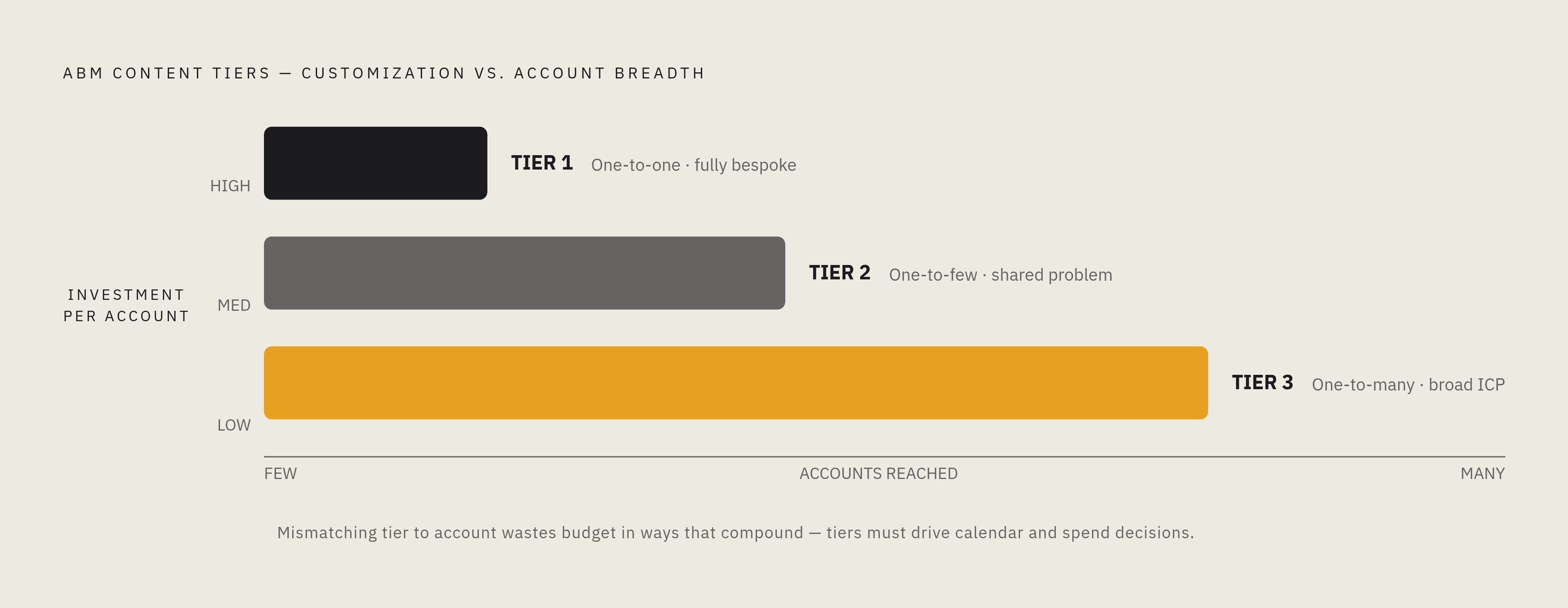
Once you have a pool of qualified accounts, tier them by how much customization the opportunity actually justifies:
- Tier 1 (one-to-one). Fully bespoke content built for a single named account. Expensive. Justified when the deal size and strategic value are real.
- Tier 2 (one-to-few). Content built around a shared problem across a handful of similar accounts. You do the research once and adapt it. Good economics.
- Tier 3 (one-to-many). Lightly personalized content for a broad ICP segment. Closest to traditional content marketing, but still account-informed rather than just broadcast.
The tier decision should drive your budget and your calendar. Tier 1 accounts justify real investment. Tier 3 does not. Getting that ratio wrong (spending Tier 1 effort on Tier 3 accounts, or starving Tier 1 accounts of the attention they deserve) wastes both money and time in ways that are genuinely hard to recover from.
Most teams rush past the research phase because research feels slower than production. The result is content that is "personalized" in name only. It's regular content with a mail merge.
Mapping the buying committee before writing a single line of content
In enterprise sales, the person who evaluates your product is rarely the person who controls the budget. And the person who controls the budget is often not the person who can kill the deal in legal or procurement review. You probably know this already. Most teams still write content as if there's one decision-maker.
More than 40% of B2B deals stall due to internal misalignment within buying groups, according to the 2025 Edelman-LinkedIn B2B Thought Leadership Impact Report, which surveyed 1,934 global business executives. Finance, legal, compliance, and operations stakeholders often don't touch the product at all. They just hold veto power. And 63% of those hidden buyers spend more than an hour a week consuming thought leadership. They're reachable. Just not through product-focused content that has nothing to say to them.
So your ABM content plan needs distinct threads for distinct stakeholders within the same account. A single message delivered to everyone leaves most of the buying committee with nothing useful to hold onto.
Map the buying committee before anything goes into production:
- Identify each role in the account's likely buying group. Champion, economic buyer, technical evaluator, legal, procurement, compliance. Whoever realistically ends up in the room.
- Assign a primary concern to each role. ROI, risk, implementation complexity, team adoption, compliance exposure. Each person has a different reason to say yes or no.
- Map what content type and channel each role is likely to trust. A CFO and a CTO are both reachable. Not the same way.
This is where ABM content and thought leadership intersect in a practical way. Content that earns trust with hidden stakeholders is doing pipeline work that a sales deck never gets near. The CFO forwarding your article to their VP of Finance before the deal hits procurement. That's not a trackable conversion event. It's also not luck if you planned for it.
What account intelligence actually looks like and how to gather it systematically
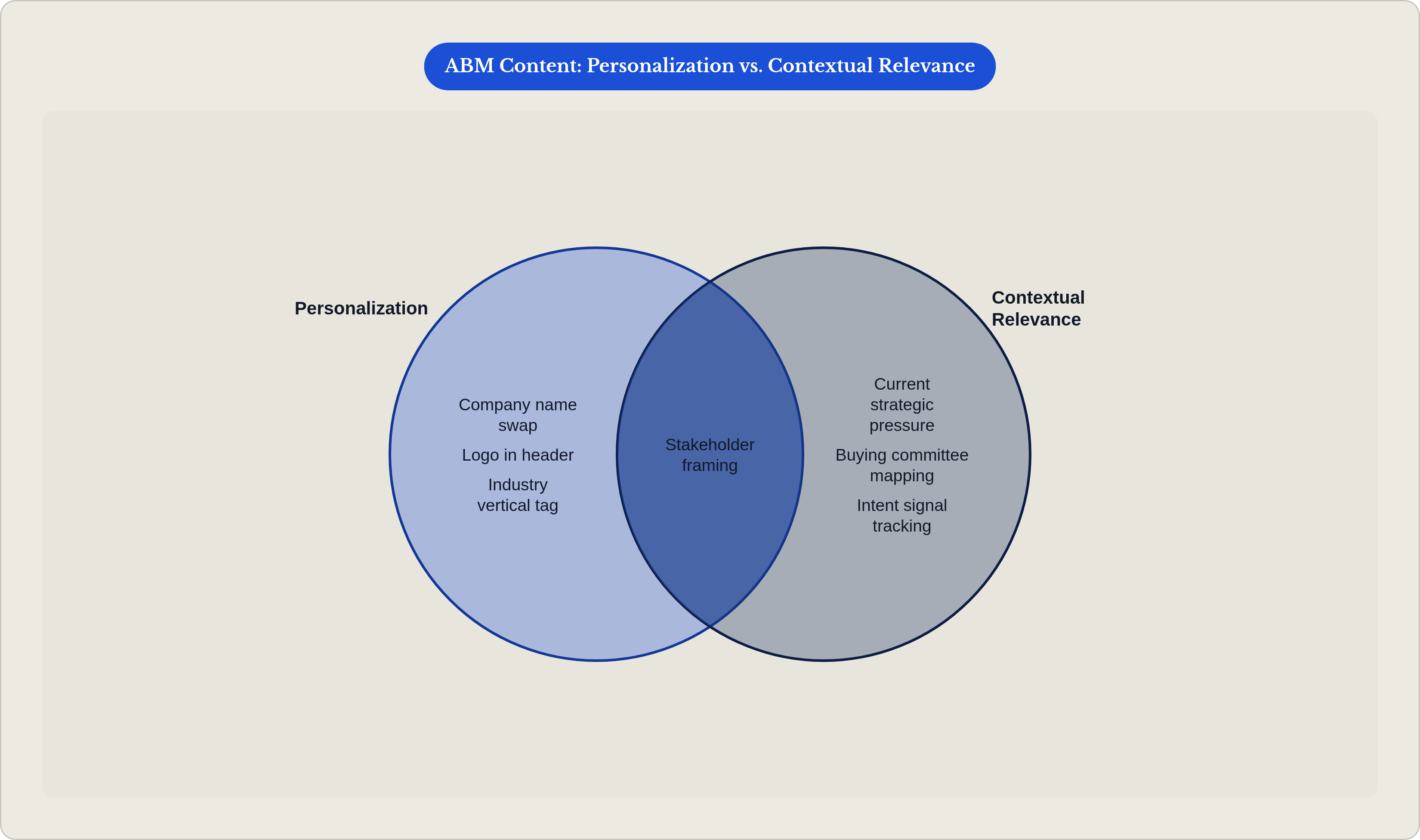
There's a difference between personalization and genuine contextual relevance, and it's worth being precise about what that means.
Personalization is swapping in a company name or an industry vertical. Contextual relevance is content that reflects the account's specific situation right now. Their current pressures, their strategic moment, the particular flavor of their problem. That second level is the only level that actually works. Everything else is noise with a custom header.
Sources of account intelligence worth building into a real process:
- LinkedIn activity. What stakeholders publish, comment on, and share tells you exactly what's keeping them up at night. Someone publicly lamenting their team's operational chaos is telling you what to write about. Take notes.
- Company news. Earnings calls, press releases, executive hires, product launches. A company that just hired a Chief Compliance Officer is probably not in "move fast and break things" mode. That shift in posture is relevant.
- Job postings. What they're hiring for reveals where they're investing and where they have gaps. Ten open data engineering roles means a data problem they're trying to solve.
- Tech stack data. The tools a company already uses reveal their maturity level, budget appetite, and integration requirements.
- Intent data platforms. Topic-level research signals that indicate where an account is in a decision process.
- Patterns from existing customers. If the last three companies at this stage asked the same three questions, the fourth one probably will too. That's not a guess. It's a sample.
Translate all of this into a content brief before anything goes into production. Four questions the brief needs to answer:
- What is this account's current strategic priority?
- What problem are they trying to solve that we can credibly address?
- What objections are most likely to surface, and from which stakeholder?
- What proof will actually land for this specific buyer?
One thing worth calling out separately: most teams treat LinkedIn as a distribution channel. It's also a live intelligence layer. If you consistently follow the stakeholders at your target accounts (what they post, what they engage with, the specific language they use) you build a real-time picture of what matters to them. That picture makes the content better. It also creates natural openings for outreach that doesn't feel like outreach.
Building the content itself: matching message, format, and depth to each stakeholder's context
Every content decision (format, length, tone, angle) should come directly from the stakeholder profile and the account brief. Not from internal preferences. Not from whatever's trending on LinkedIn this week.
Message architecture by stakeholder type
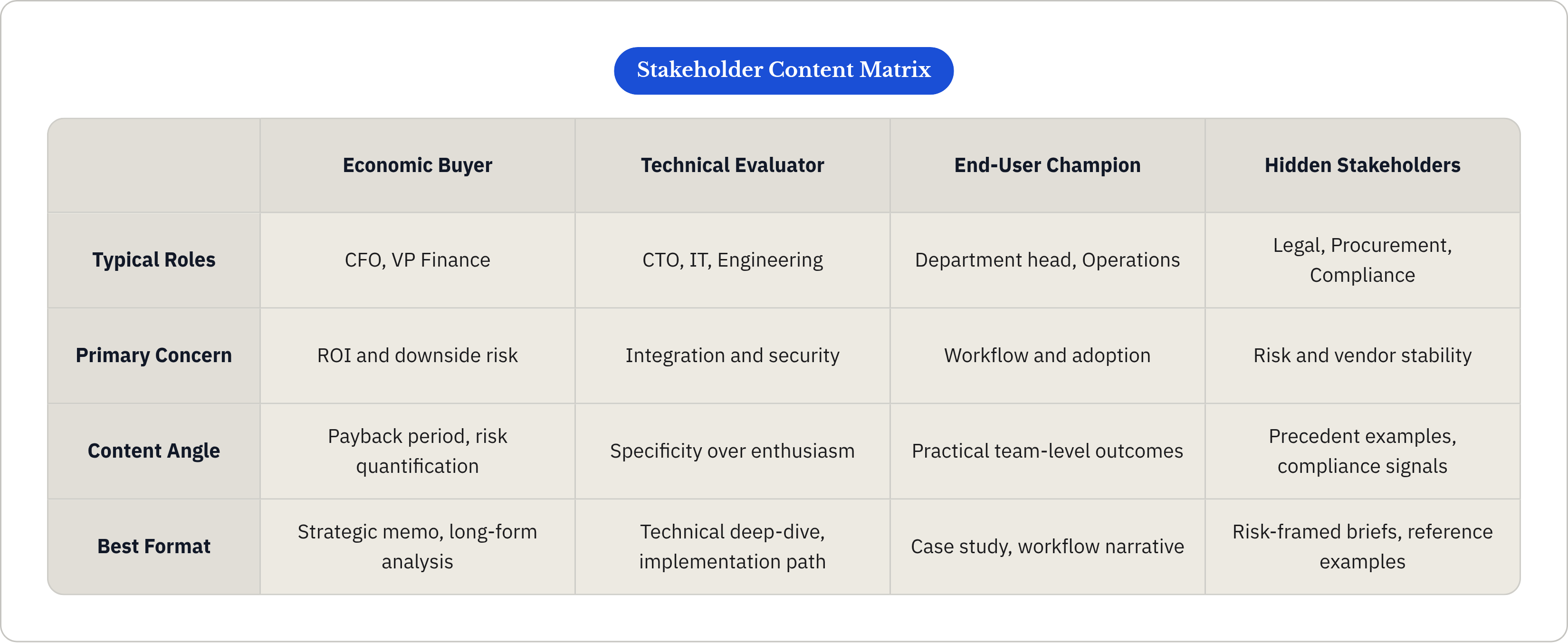
The same conversation needs to land differently depending on who's reading it:
- Economic buyer (CFO, VP Finance). ROI framing, risk quantification, payback period evidence. They want to know what happens if this goes wrong almost as much as they want to know what happens if it goes right.
- Technical evaluator (CTO, IT, engineering). Integration depth, security posture, implementation path. Specificity over enthusiasm. Vague claims actively hurt you here.
- End-user champion (department head, operations). Workflow impact, adoption ease, team-level outcomes. Practical over strategic. They're going to live with this decision every day.
- Hidden stakeholders (legal, procurement, compliance). Risk language, precedent examples, vendor stability signals. They're not trying to get excited about your product. They're trying not to get fired over it.
Format selection logic
The right format is whichever one your stakeholder will actually read:
- Long-form analysis or strategic memo. Earns time from senior buyers doing independent research before they talk to anyone in sales. This is the format that reaches people before your sales team does.
- Case study or reference customer narrative. Most effective when the reference account closely mirrors the target's situation. "A company your size, in your industry, with your exact problem" is a fundamentally different read than a generic success story.
- Custom benchmark or data slice. Uses the account's own context as the frame. High perceived value. Hard to ignore.
- Short-form insight (LinkedIn post, brief email). Works as a first-touch trigger before deeper content is offered. Not the place for the full argument.
On quality: the 2024 Edelman-LinkedIn B2B Thought Leadership Impact Report found that fewer than half of executives say the thought leadership they consume is actually good. Only 15% say it's very good or excellent. The bar is genuinely low. Decision-makers in that same study said they want research-backed claims, concrete guidance, and case examples. Actual substance, with the depth and specificity that most thought leadership skips.
Founder voice fits into this meaningfully. Content that carries a founder's perspective (real trade-off thinking, a genuine market point of view) reaches hidden buyers differently than polished marketing assets. According to those same Edelman-LinkedIn findings, 75% of decision-makers say thought leadership has prompted them to research products or services they hadn't previously considered. And 70% of C-suite executives say thought leadership has led them to reconsider their current vendor relationship. The right content can displace an incumbent before your sales team ever books a meeting.
Distributing account-based content: getting the right asset to the right person through the right channel
The failure mode that kills otherwise excellent ABM programs: producing highly specific, contextually relevant content, then distributing it like generic content. Newsletter blast. Company blog. Social share from the brand account. That's not distribution. That's hope.
Channels that actually move content to named stakeholders
- Direct outreach from the founder or account executive. Referencing a specific piece of content in the context of something the recipient recently published or said. This only works when it's signal-triggered. "I saw your post about X and wrote something directly on that problem" is a completely different message than "thought you might find this useful." One earns a response. The other earns an archive.
- LinkedIn personal profile. Personal profiles get roughly five times more reach than company pages. Content shared by executives gets approximately four times more engagement than content from company accounts. The founder's LinkedIn profile is the highest-leverage organic distribution surface available. Posts designed around a named account's publicly visible challenge work simultaneously as content and as a visible signal to that account's stakeholders.
- LinkedIn paid targeting layered on organic. Targeting by company name, job function, and seniority to make sure specific assets reach specific people. For ABM, expect higher CPCs than standard B2B targeting, often in the $5–10 range with cost per lead running $60–150. Tighter audience definition means higher cost per impression. It also means more relevant impressions. That trade-off is usually worth it.
- Email sequences tied to content engagement. Triggered by a stakeholder's interaction with a previous asset, not by a calendar schedule someone set three months ago.
- Sales enablement delivery. Content handed to sales as account-specific tools, with context on why this piece matters for this account. Not just dropped into a general asset library where it quietly collects dust.
The dark social problem
A significant share of B2B content influence moves through private channels. DMs, Slack messages, internal email forwards. None of it leaves an attribution trace. LinkedIn's 2025 algorithm changes toward rewarding "depth score" (time spent, saves, private shares) mean content that earns private sharing is also rewarded algorithmically. The same behavior that signals real ABM influence improves organic distribution. Optimize for content worth forwarding internally, not content optimized for public reaction counts.
Cadence matters here too. Account-based content should follow a deliberate sequence: awareness-building content first, then proof content, then decision-stage assets. Sequence creates momentum. Dropping everything at once creates noise.
How to measure whether account-based content is actually working
The measurement trap is using content metrics to evaluate a program whose success is defined by account-level pipeline outcomes. Impressions, engagement rate, downloads. These things are not the same as pipeline. Treating them as proxies for pipeline is how teams end up optimizing for the wrong thing for a year straight.
The right unit of measurement is the account, not the content asset.
Leading indicators worth tracking
- Content engagement from named accounts. LinkedIn profile views from target account stakeholders, post saves, DMs sharing specific assets. These are weak signals individually. In combination, they tell a story.
- Sales-reported content influence. Which accounts mentioned a specific piece of content in a sales conversation? This requires a simple, consistent habit from sales: logging it when it happens.
- Intent signal lift. After an account is exposed to a content sequence, does their topic research activity increase?
- Meeting quality. Are stakeholders walking in already oriented to your positioning? Are fewer meetings starting from scratch?
Lagging indicators that confirm the program is working
- Average deal size in ABM-targeted accounts versus non-targeted accounts.
- Sales cycle length. ABM strategies have been linked to average deal value increases of 171% and sales cycle reductions of 40% at a program level.
- Win rate against named competitors in targeted accounts.
Attribution in ABM is structurally difficult. Much of the influence happens in channels that don't track. The practical move is to use a multi-signal approach: self-reported attribution from buyers, pipeline correlation analysis, and content engagement data together. No single source tells the whole story. None of them have to.
Set realistic timelines. ABM is a long-cycle motion. Meaningful account-level pipeline signal typically takes two to four quarters to accumulate in complex enterprise sales. Measuring success at 90 days means measuring the wrong thing.
Turning a successful ABM content program into a repeatable system rather than a one-off campaign
The scaling tension in ABM is real. The content succeeds because it's specific and contextual. That specificity is exactly what makes it expensive to repeat at scale. Solving that tension is the difference between a one-time win and something that actually compounds.
The answer is a tiered production system built on modular components.
Create reusable building blocks: core frameworks, proof points, case study blocks, benchmark data. Build them once at a high standard. Adapt them per account rather than rebuilding from scratch every time. The structure stays consistent. The context changes.
Separate research from production. Assign account intelligence gathering to a structured pre-production step so writers work from a brief, not a blank page. The brief does the heavy contextual lifting. Production gets faster and more focused. Writers stop reinventing the wheel on every engagement.
A few other habits that make the system durable:
- Document what worked per account tier. What message landed for a CFO at a mid-market SaaS company at Series B? Write it down. That pattern repeats more often than you'd think.
- Build account handoff templates. When a Tier 1 account moves from content engagement into active sales conversations, the intelligence gathered during the content phase should transfer cleanly to the sales team. It usually doesn't, because nobody built the handoff. Build the handoff.
- Review and update account tiers quarterly. Accounts move. Intent signals change. An account that was Tier 3 six months ago might be Tier 1 today because of a new hire, a funding round, or a competitor contract coming up for renewal. The tier list is not a set-it-and-forget-it document.
The goal is a system where quality doesn't depend on one person carrying everything. Where the next content piece for a new account takes days to research and produce instead of weeks, because the process is already there waiting. That's when ABM content becomes a durable pipeline motion rather than a campaign you're always rebuilding from scratch.