Podcast Advertising for B2B SaaS Audience Building
B2B buyers are already listening; the question is which shows and what format will make them act.
Podcast advertising works for B2B SaaS founders because the audience is already leaning in. Listeners chose the show, chose the host, and stuck around for forty-five minutes of content they didn't have to finish. A founder buying ad space in that show is buying a room full of people who already trust the person talking, a fundamentally different transaction than buying a banner ad nobody asked for.
When's the last time you passively half-watched a podcast the way you half-scroll Instagram? Probably never, because that's not really how the medium works. You picked that show because you like the host's take on go-to-market, or supply chain, or whatever niche keeps you up past midnight, and that self-selection is working in the advertiser's favor before a single ad even runs.
The numbers back it up, though I'll admit numbers like these always feel a little too convenient. Research puts 75% of B2B decision-makers as podcast listeners, with 51% tuning in daily. Senior executives are even more consistent: 83% listen at least weekly. Cumulus Media and Signal Hill Insights' Audioscape 2024 study found podcast listeners run 33% more likely to clear $100K household income, 37% more likely to hold a white-collar job, and 29% more likely to be employed full-time. Edison Research's Podcast Consumer 2024 adds that 56% of monthly US listeners live in households earning above $75K.
A founder sponsoring the right show walks into a room where a professional community already assembled itself around a shared interest. Everything downstream, the format, the show, the measurement, depends on that one fact.
The scale of the market that now exists around these audiences
Podcasting stopped being a niche hobby a while back. Global listenership hit 584.1 million in 2025, growing 6.8% year over year, with projections putting it at 619.2 million by 2026. In the US, Edison Research's Infinite Dial 2026 study found 58% of Americans 12 and older listened in the past month (roughly 167 million people), and 45% listen weekly, around 130 million.
There are over 4.5 million active podcasts as of November 2025, and anyone with a decent mic and a strong opinion can start a show, and plenty do. Saturation in supply, though, has a limited effect on attention within a focused niche. A show about mid-market fintech compliance competes for its listener's attention with maybe a dozen other shows, most of which the listener has already tried and abandoned, rather than with the full 4.5 million.
Ad dollars followed the audience, as they tend to do. US podcast ad revenue hit $2.86 billion in 2025, up 17.6% from 2024, according to IAB and PwC data, a steady climb from just $105.7 million back in 2015. Marketers aren't slowing down either: 91% planned to hold or increase their podcast spend in 2025, per research aggregated by Beomniscient.
Whether podcasts deserve a line item in the marketing budget is settled at this point. The real question is which shows, in what format, because the window to be the memorable early advertiser in a tight niche closes fast once competitors catch on.
How ad formats and placements determine whether trust transfers to the advertiser
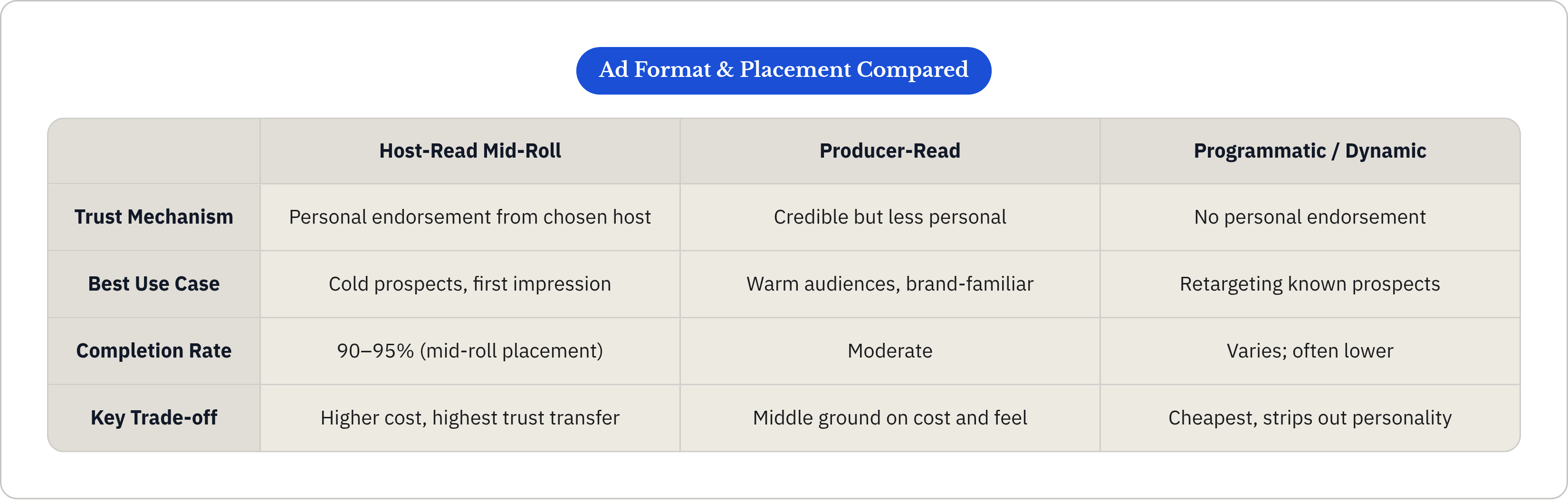
Podcast ads work through a simple transfer mechanism. The host's credibility rubs off on whatever they're selling, but only if the format lets that happen, and a generic voiceover slapped in the middle of an episode plays like a radio commercial that wandered in from 1998.
Host-read ads outperform programmatic placements by 1.7x, according to GTM8020, and Podscribe's Q2 2025 benchmark found host-read spots beat producer-read ones by 31% on purchase rate. The reason isn't complicated: when a host reads an ad in their own voice and their own style, listeners hear a recommendation from someone they chose to spend forty-five minutes with. That's the same trust mechanic a founder's LinkedIn posts are trying to build, just running through a different pipe.
Placement matters almost as much as who's reading it. Mid-roll ads land 90 to 95% completion rates because the listener is already deep into the episode and locked in. Programmatic or dynamic ad insertion is cheap and scales fine, but it strips out the personal endorsement entirely, which makes it fine for retargeting someone who already knows you but a poor first impression for a cold prospect who's never heard your name.
Listeners don't seem to mind the ads much, for what it's worth. Edison Research's Podcast Consumer 2025 study found 88% of weekly listeners agree that hearing ads is a fair trade for free content. Try getting that kind of goodwill out of a pre-roll YouTube ad someone's actively trying to skip.
Great placement gets your foot in the door. Whether the listener cares once you're inside still comes down to what you actually say.
What a SaaS founder actually needs to say in a podcast ad
Most B2B SaaS podcast ads fail because they talk about the product instead of the problem the listener is dealing with right then, mid-commute, half-listening while merging onto the highway. Nobody wants a feature list read aloud at that moment.
Podcast listeners pay closer attention than most ad audiences, so a generic pitch sticks out faster here than it would in a banner ad nobody was looking at anyway, and the bar for relevance goes up, not down. A structure that tends to work: name the problem specifically, establish why you're credible to solve it, state the outcome plainly, then give a low-friction next step. Podcast-specific promo codes or custom URLs handle that last part and double as your attribution trail, proof to the listener this is a curated placement and not an automated ad drop.
Trust here starts in your favor before you say a word, a strange kind of head start most channels don't give you. Command Your Brand found 68% of B2B podcast listeners trust companies advertised on podcasts more than those advertised elsewhere. Don't squander that with a script that sounds like it was written by committee and approved by three people who've never heard the show.
Don't expect the ad to close deals on the spot, either. Edison Research's Podcast Consumer 2024 study found 46% of listeners say they're more likely to consider a product after hearing it on a podcast. Consideration is the honest first output, and it's still a good one.
Worth doing: if the founder's own voice shows up in the ad, instead of a script read cold by the host, it builds a bridge to whatever the founder's already posting on LinkedIn. Same voice, new room. And frame the ad around the category, not the feature set, so the listener's brain files you under "the company that solves X problem" instead of "some SaaS tool I heard about once, I think, on a Tuesday."
Choosing which podcasts to advertise on, and why niche outperforms reach
Every founder's first instinct is to chase the biggest show in a category that sounds adjacent to their buyer. Resist it. The better move, almost always, is the smallest show with the tightest overlap to your actual ICP.
CPMs tell the story. Broad shows run $18 to $50 CPM, while specialized B2B shows with sharply defined professional audiences can run past $100. That premium isn't a pricing error, it's the market pricing in what buyers already know: tightly niched inventory converts better. A $100 CPM on the right show beats an $18 CPM on the wrong one every time you measure against qualified pipeline instead of raw reach.
A few things matter more than download count when you're sizing up a show. The host's standing with your ICP, independent of the show's size, tells you a lot. Would your buyer recognize the host's name if they ran into them at a conference? How narrow the topics run matters too; a show that covers "business" broadly pulls in a broad, unfocused audience, while a show built around one specific operational headache pulls in people who live that headache daily. And the guest roster tells you who's actually listening better than any media kit will.
Engagement signals often predict results better than downloads. Reviews, social mentions from people you can identify as your buyer, community activity in a Slack or Discord tied to the show, these tell you more than raw play counts ever will. Downloads measure how many people hit play. They say nothing about whether those people run companies that would ever buy from you.
B2B podcast networks are worth a look too. These are groups of shows under one umbrella, built to own a specific vertical, and sponsoring across a network saves you the headache of vetting a dozen shows one by one since audience quality tends to hold steady across the group. What you want to avoid is the large general-business show where your ICP makes up 2% of listeners. That's spray-and-pray wearing a nicer suit.
How podcast advertising fits into the full B2B SaaS funnel, and where it actually moves the needle
Podcast ads live at the top of the funnel. Their job is moving someone from never-heard-of-you to familiar-enough-to-consider-you, well before any deal closes.
That 46% consideration lift from earlier is the handoff point, the moment someone shifts from ignoring you to actively wondering if you solve their problem. From there, the realistic path looks something like: podcast ad, branded search or promo code, a scroll through the founder's LinkedIn posts, eventually a demo request or an inbound email. The podcast rarely closes the loop by itself. Expecting it to is the fastest way to call the channel a failure before it had a chance to work.
A lot of this path is invisible to standard attribution tools, and this is where things get genuinely messy. Someone hears your ad on a Tuesday, doesn't act, googles your company three weeks later after seeing your name pop up again on LinkedIn, and converts, and your CRM logs that as "organic" or "direct." The podcast gets zero credit even though it started the whole chain. GTM8020's research found the vast majority of B2B podcasts lack real attribution infrastructure, meaning most founders are flying blind on whether the spend is working at all.
Fix that before you spend, not after. Set up promo codes and tracking URLs on day one; they won't catch everything, but they'll catch more than nothing, which is the current baseline for most people running this playbook.
There's a bigger decision buried in here too: build your own show, or buy ads on ones that already exist? Branded podcasts, according to Casted, hit around 90% completion rates versus 12% for branded video, a wide gap by any measure. Running your own show is a long game, months of production before you see traction, while paid placement on an existing audience is faster to test. For an early-stage founder with a limited budget, sponsoring three to five tightly niched shows for a quarter is a much easier bet to size up than building a branded show from nothing.
Why podcast advertising amplifies LinkedIn thought leadership rather than replacing it
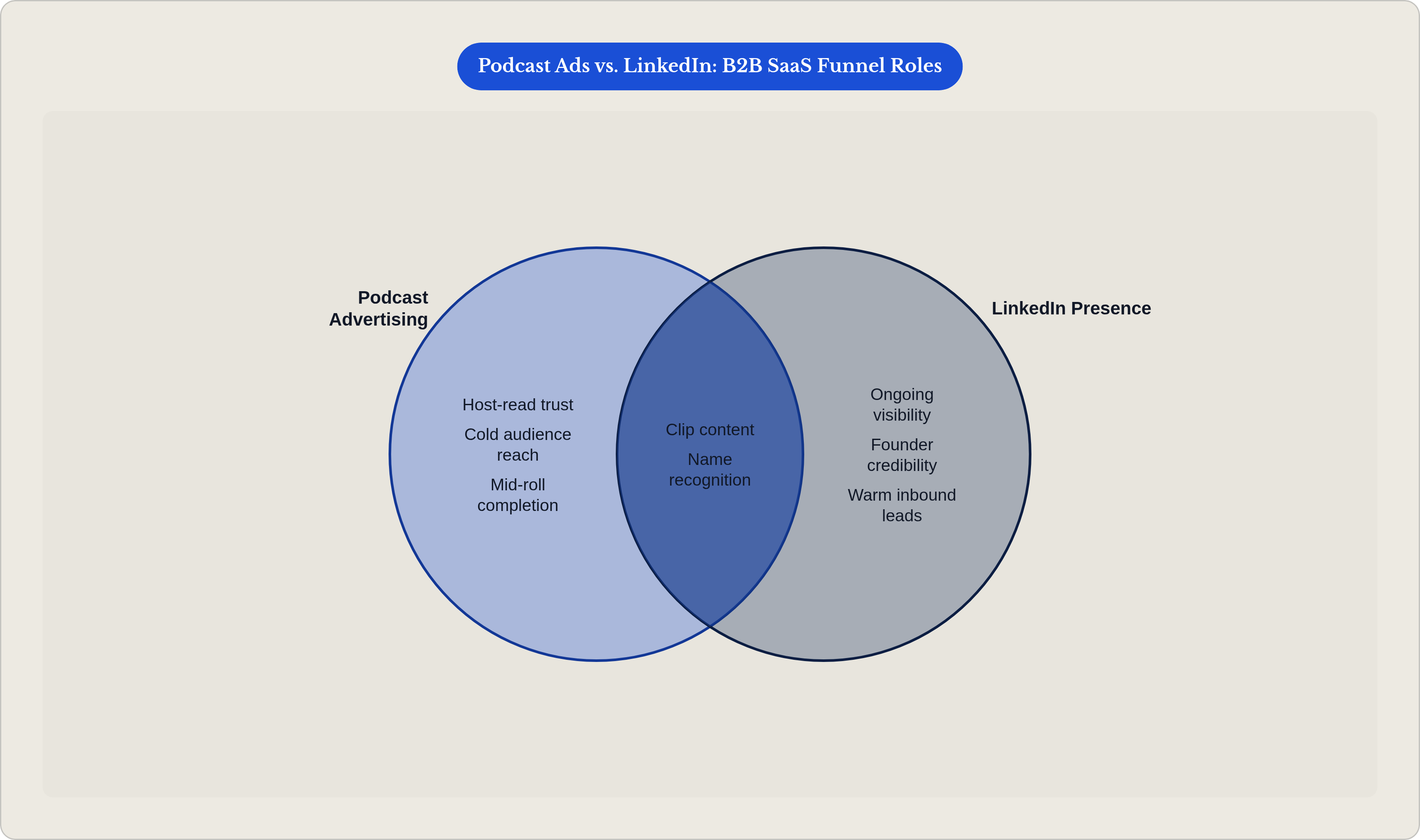
A podcast ad puts the founder's name in front of a new audience. LinkedIn is where that audience goes to check if the name is legit, which happens more often than most founders assume.
Founder profiles tend to generate meaningfully more engagement than company pages, and that reality alone should change where you send podcast traffic. Point people toward the founder's profile, not the company page, because someone who just heard your ad wants a human being with opinions, not a logo next to a mission statement nobody wrote with any conviction.
Research on B2B buying behavior consistently finds buyers complete a substantial share of their decision-making before they ever talk to a salesperson. So a listener who hears your ad, then finds a founder consistently posting sharp, opinionated takes on LinkedIn, has basically fast-tracked their own research for you. You didn't have to do much except keep showing up, week after week, saying something worth reading. The pattern tracks with what's happening here: the podcast ad creates the spark, LinkedIn keeps the fire lit.
Podcast ad plants the name, and LinkedIn posts keep that name resurfacing in the feed over the following weeks. Repetition builds familiarity, and familiarity is what makes a cold demo request feel like a warm one.
There's a bonus multiplier worth mentioning. Podcast appearances, whether you're the guest or the sponsor, generate clip content that performs well natively on LinkedIn. Research has found a large share of companies now film video during podcast production specifically for this reason. One recording session can fund weeks of posts.
So if you're running podcast ads but your LinkedIn presence is dead air, you're paying for a consideration lift and then letting it evaporate into nothing. That's like buying a billboard and forgetting to put your phone number on it.
Building a measurement framework that captures what download metrics miss
Download counts tell you about supply. They tell you nothing about demand from the specific people you're trying to sell to. A show with hundreds of thousands of downloads and three listeners who match your ICP is worse for you than a show with a few thousand downloads where half the audience is exactly who you're targeting, and this is the part founders get backwards constantly.
Research has found companies with sharper measurement setups generate meaningfully more qualified pipeline than companies chasing raw audience size. The gap isn't about spending more money. It's about tracking the right things from the start, instead of backfilling attribution three months in.
Watch these instead of, or alongside, downloads: promo code and custom URL redemptions (the clearest direct signal you'll get), branded search volume during and right after the campaign runs, LinkedIn follower growth on the founder's profile during active ad windows, CRM pipeline tagged to podcast-influenced contacts even when the final touch came from somewhere else, and deal size and speed for podcast-influenced pipeline versus everything else.
There's also the low-tech option that still works fine: ask prospects on discovery calls how they first heard of you. Not scientific, people misremember things constantly, but it's often the most honest data point you'll get all quarter.
The math for early-stage SaaS actually works in your favor here. A handful of enterprise deals can justify a real podcast ad budget, since deal sizes are large enough that you don't need huge conversion volume to make the spend worth it.
Build the measurement framework before the first ad airs, not three months in when someone asks for results and all you've got is a download count and a shrug. Founders who can point to actual pipeline and say "this came from the podcast" stop treating the channel like a science experiment. That's the point it turns into a real lever instead of a line item you're quietly hoping pays off.