B2B Content Strategy for Early-Stage SaaS Teams
Founders need a content strategy before they need a marketer—or their product dies unknown.
92% of SaaS startups don't make it past three years, and a good chunk of those deaths trace back to bad go-to-market execution rather than a bad product. So the real question for a team with two people, one laptop, and eleven months of runway is less "what do we build first" and more "who do we tell about it, and how."
Most founders treat content like a reward: get the funding, hire the marketer, then start posting. I've watched this order kill good products more times than I can count, and it's always the same story: great tool, nobody's ever heard of it, dead in eighteen months.
What "content strategy" actually means at the early stage — and what it doesn't
A blog calendar won't save you, and neither will a brand guidelines PDF rotting in a shared drive nobody opens, or an agency retainer that sends you a monthly report full of impressions you can't spend at the grocery store.
At the early stage, content strategy comes down to three decisions: who you're talking to, what you actually believe about the problem you're solving, and which single channel you're willing to bet your limited hours on. That's the whole thing, and you don't have the budget to be everywhere, so stop pretending you do.
Here's the weird upside though: being broke forces a kind of discipline that well-funded teams almost never bother developing. A Series C company can throw six figures at an agency, get forgettable output, and survive anyway because the budget papers over the weak strategy. You don't get that cushion, so you're forced to get specific about three things: make the right buyers aware you exist, build enough trust that they'll take a call before your sales team ever cold-emails them, and put a founder point of view out there sharp enough to compete with incumbents who have ten times your headcount and a fraction of your urgency.
Notice what's not on that list. SEO domain authority isn't there, and neither is brand awareness at scale, or a content library stuffed with forty evergreen posts nobody asked for. Those things matter eventually, but they don't matter yet, and mixing up "eventually" with "now" is how a founder torches a whole quarter making content nobody sees.
Think of this less as marketing and more as plumbing. It's the pipe that decides whether the right people find you before the money runs out.
How B2B buyers now make decisions before they ever talk to your sales team
Buyers do their homework in private now, and by the time someone fills out your contact form, they've usually already made up their mind, or at least narrowed it to two options. The real evaluation happened somewhere your analytics dashboard will never see.
There's a name for this: dark social. It's the Slack message someone sends a coworker that says "have you seen this thing," the DM, the private LinkedIn share screenshotted into a group chat. None of it shows up in your attribution model, which is exactly why so many founders underestimate how much of their pipeline started with a post they wrote six months ago and forgot about.
The numbers back this up, and honestly they're a little wild. Per the 2024 Edelman-LinkedIn B2B Thought Leadership Impact Report, a large majority of decision-makers said a piece of thought leadership got them researching a product they weren't even considering before they read it. Content builds your brand, and it also manufactures demand for a category the buyer didn't know they needed, a very different job than "get more followers."
Winning over the person holding the checkbook isn't the whole job, either. The 2025 version of that same report found finance, legal, compliance, and procurement people are reading thought leadership too, quietly forming opinions about your company before anyone on your team has heard their names.
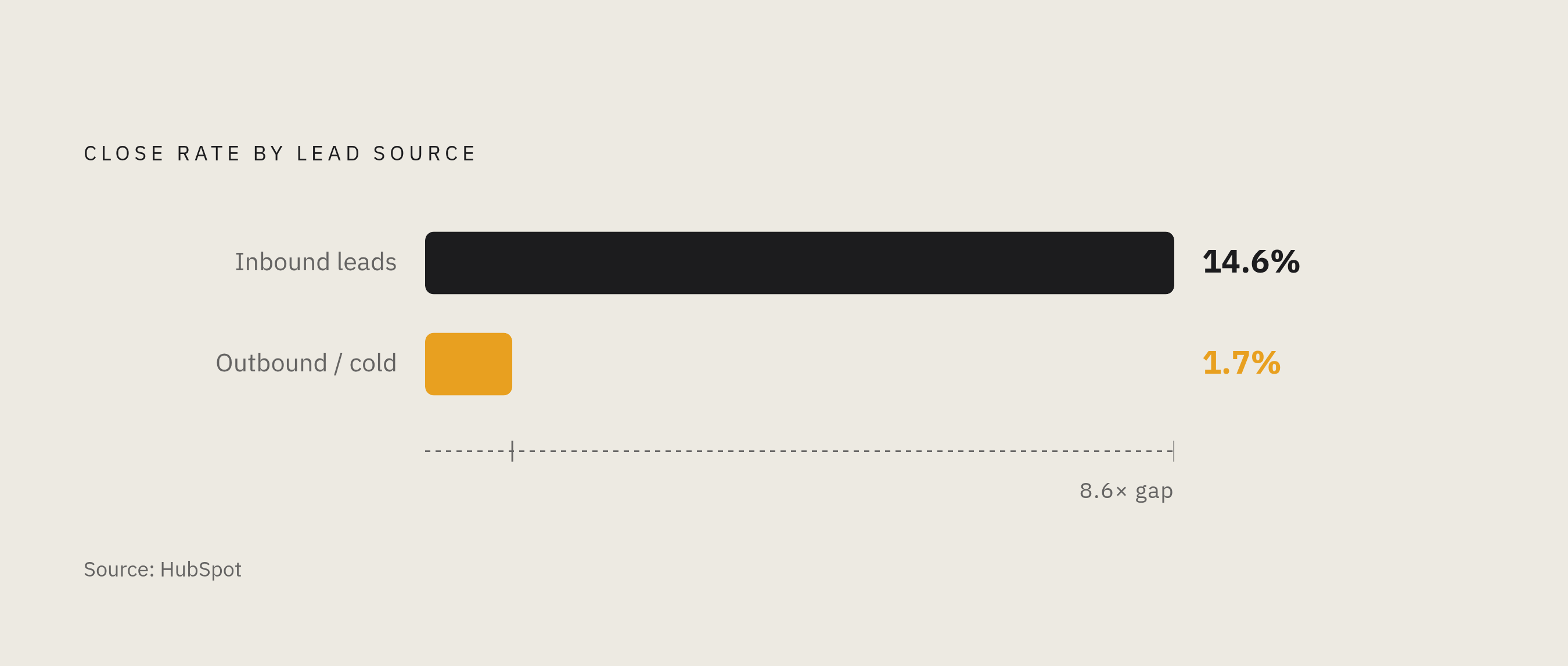
Here's the part that should reshape how you think about sales entirely. HubSpot data puts inbound lead close rates at 14.6%, against 1.7% for outbound, roughly an order of magnitude apart. Cold outreach starts every conversation from zero trust; content that pulls someone toward you starts from somewhere completely different, and your sales team only ever performs as well as the content did the work beforehand.
Why the founder's voice is the only content asset that matters at the start
People trust people more than they trust logos, taglines, or a company page that posts twice a month about "exciting updates" nobody asked to hear about. Edelman's 2026 Trust Barometer found 74% of B2B buyers trust content from a company's leadership over content from the brand's own channels. Makes sense: your logo has no track record, while you, standing there with an actual face and an actual opinion, at least have something to point to.
Research cited by DSMN8 found 82% of people trust a company more when its leaders are visible and active on social media, and personal profiles pull roughly eight times the engagement of company pages. So every hour a founder spends polishing a post for the company page instead of writing under their own name is, structurally, mostly wasted.
The pipeline math gets more interesting from there. Harvard Business Review's 2024 Digital Leadership Study found 78% of B2B buyers research company leadership before buying, and 64% say they're more likely to consider a company where leadership shows up online consistently. Founders who post regularly on LinkedIn report sales cycles 30 to 40% shorter than quieter peers, mostly because the prospect walks into the first call half-convinced already.
Take Lara Acosta. She built her tool Kleo to $60,000 in monthly recurring revenue by its second month, with zero paid acquisition, off a handful of LinkedIn posts to an audience she'd spent two years building by hand. The distribution she'd built created the room the product needed to land.
That's the structural reason this works so well right at the early stage, when you have no brand recognition, no logo wall, no case study with a name anyone recognizes on it. Your only trust signal is you, so the content has to argue a point of view about the problem, more than describe a feature set. Buyers follow thinking, not spec sheets, and nobody forwards a features list to a colleague at 11pm.
Why LinkedIn is where early-stage SaaS content should concentrate first
LinkedIn generates 80% of B2B social media leads, and nothing else comes close, which makes the "where do we even start" debate a pretty short conversation.
The gap only gets wider up close. B2B leads sourced from LinkedIn are considered 277% more effective than leads from Facebook, and the average LinkedIn lead for a SaaS company carries roughly three times the lifetime value of leads from other social channels. For a team with zero marketing budget to gamble, that's about as clean an argument for where to spend your Tuesday afternoon as you'll find.
The algorithm has also drifted in a direction that happens to reward exactly what a scrappy founder can actually produce. Ghost's Q1 2026 internal data found posts using phrases like "here's what I learned" or "this mistake cost us" pull 280% higher engagement than posts full of corporate buzzwords. Two or three substantial posts a week now beat daily filler, because the platform's started scoring for depth, whether a post holds attention and sparks a real comment thread instead of a fast thumbs-up and scroll.
Mass outbound automation, meanwhile, is getting squeezed hard. After recent API restrictions, people in the trenches started calling the penalty on high-volume automated outreach the "Volume Tax." Translation: blasting five hundred cold connection requests a week and hoping something sticks doesn't work like it used to, and earned attention is the lever still open.
LinkedIn added saves and sends to its analytics in late 2025, and that metric matters more than almost anything else on the platform now. A save means someone wants to come back to it later, and a send means someone thought a coworker needed to see it. That's the pre-sales influence you're actually chasing, finally showing up as a number instead of a gut feeling.
One honest caveat, because I'd rather tell you now than have you find out the hard way: organic reach is shrinking. Richard van der Blom's 2025 research found organic views down roughly half year over year. Quality and consistency simply carry more of the weight now, which is exactly why trying to run a newsletter, a podcast, and an SEO push at the same time this early is usually a mistake. Own one channel first, and spread out later, once you've actually got something worth spreading.
What a high-leverage early-stage LinkedIn content system actually looks like
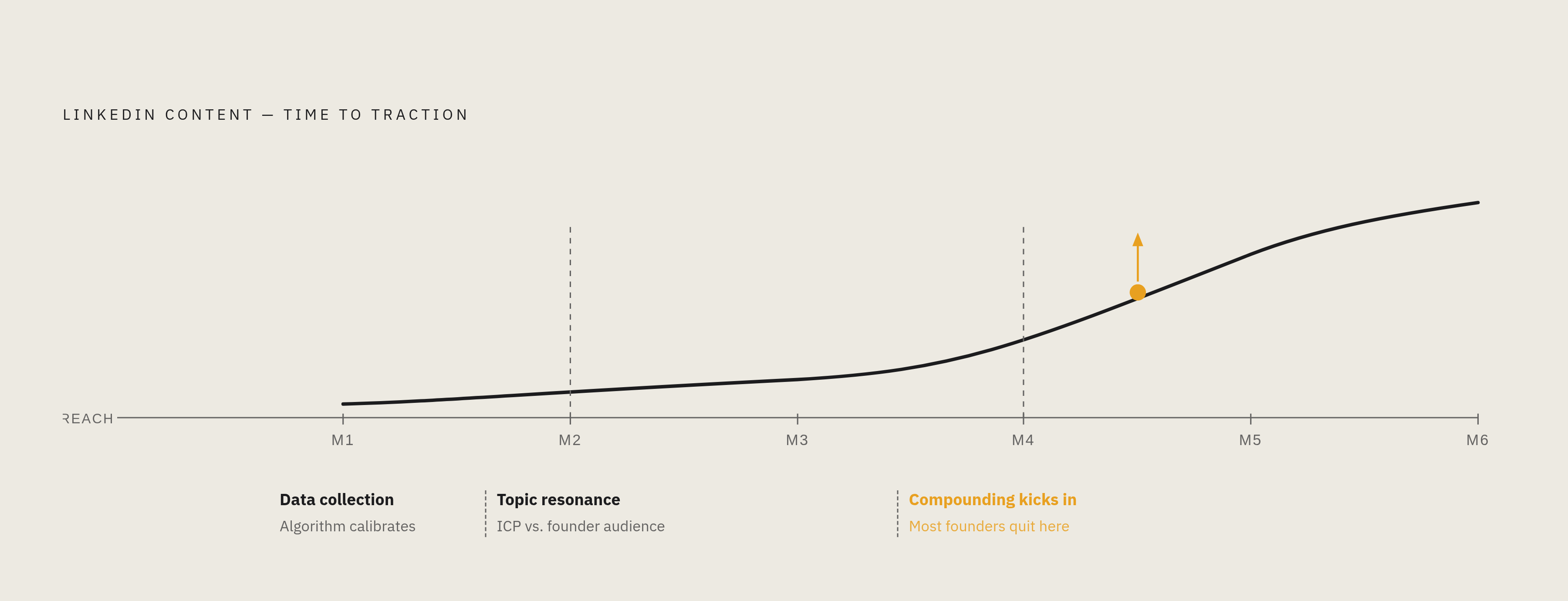
Nobody builds an audience overnight, and anyone telling you otherwise is selling something, probably a course. Realistically you're looking at three to six months of consistent, decent posting before anything resembling traction shows up.
Month one is mostly data collection, figuring out what the algorithm even makes of you yet. Months two and three, you start noticing which topics land with the buyers you actually care about, as opposed to the ones that just get liked by other founders doing the exact same thing you're doing. Somewhere around month four or five, the compounding kicks in. Engagement builds reach, reach builds inbound, and the whole exercise stops feeling like shouting into an empty room.
Keep the content mix simple. Point-of-view posts on the problem space (not your product) build category authority over time. Behind-the-scenes posts on decisions that went sideways hit that "this mistake cost us" frame that keeps outperforming polished corporate language by a wide margin. Educational breakdowns of things you know that your buyers don't round things out, since that knowledge gap is genuinely one of the only assets you've got right now.
Format matters more than people expect, too. Carousels uploaded as PDFs pull a 6.60% average engagement rate, the highest of any format on the platform. They tell a full story in one scrollable unit, which happens to be exactly the kind of thing a buyer forwards to a colleague without needing to explain any context first.
Stick to two or three substantial posts a week. Daily posting sounds impressive right up until you realize the algorithm actively punishes volume without depth. You're better off writing one thing worth saving than five things worth scrolling past on the way to something else.
The company page can wait. It underperforms a founder's personal profile by roughly 8x, and every hour spent feeding it is an hour not spent building the thing that actually moves the needle. If you've got even one or two early employees, get them sharing the founder's posts. Employee-shared content drives roughly five times more leads than brand-page content alone, so a team of four can multiply reach without spending a dollar on ads.
Teract's 2026 research looked at 200 B2B SaaS companies that grew from early-stage to significant ARR in the first quarter of 2026, and found 78% had founders actively posting on LinkedIn. The average founder-led company in that group generated 20 to 30 qualified enterprise leads a month from LinkedIn alone, counted as real leads, not impressions dressed up to look like something.
The thought leadership gap that makes this the right moment to enter the conversation
Here's the part that should make you feel better about your odds. the vast majority of organizations produce some form of thought leadership, per the 2024 Edelman-LinkedIn Impact Report and CMI's 2024 data, yet only a small fraction of buyers rate what they read as very good. Almost everybody's writing, and almost none of it's worth reading.
What separates the 15% from the noise is a specific, opinionated point of view built on actual practitioner experience, which a founder who's lived inside the problem has by default, and a generalist agency writer never will, no matter how good the brief is.
The payoff for clearing that low bar is real, not theoretical. That same 2024 report found roughly one in four decision-makers who researched a company because of its thought leadership went on to actually do business with them, nearly one in four. And a majority said strong thought leadership matters more to them than a brand's overall name recognition, which is the single most useful stat you'll read all week if your company has zero name recognition to lean on.
It opens commercial doors directly, too. a strong majority of decision-makers said they'd be more likely to invite an organization with consistently strong thought leadership to participate in an RFP, per the same study. Content builds awareness, sure, but it also buys you a seat at a table you wouldn't have been invited to otherwise.
So a seed-stage founder with a sharp, consistent LinkedIn presence can genuinely out-credibility a Series B competitor running a big, safe company page fed by a content team pumping out generalities nobody remembers. The bar in most categories is sitting on the floor right now, so step over it.
What to skip, delay, or deprioritize when resources are constrained
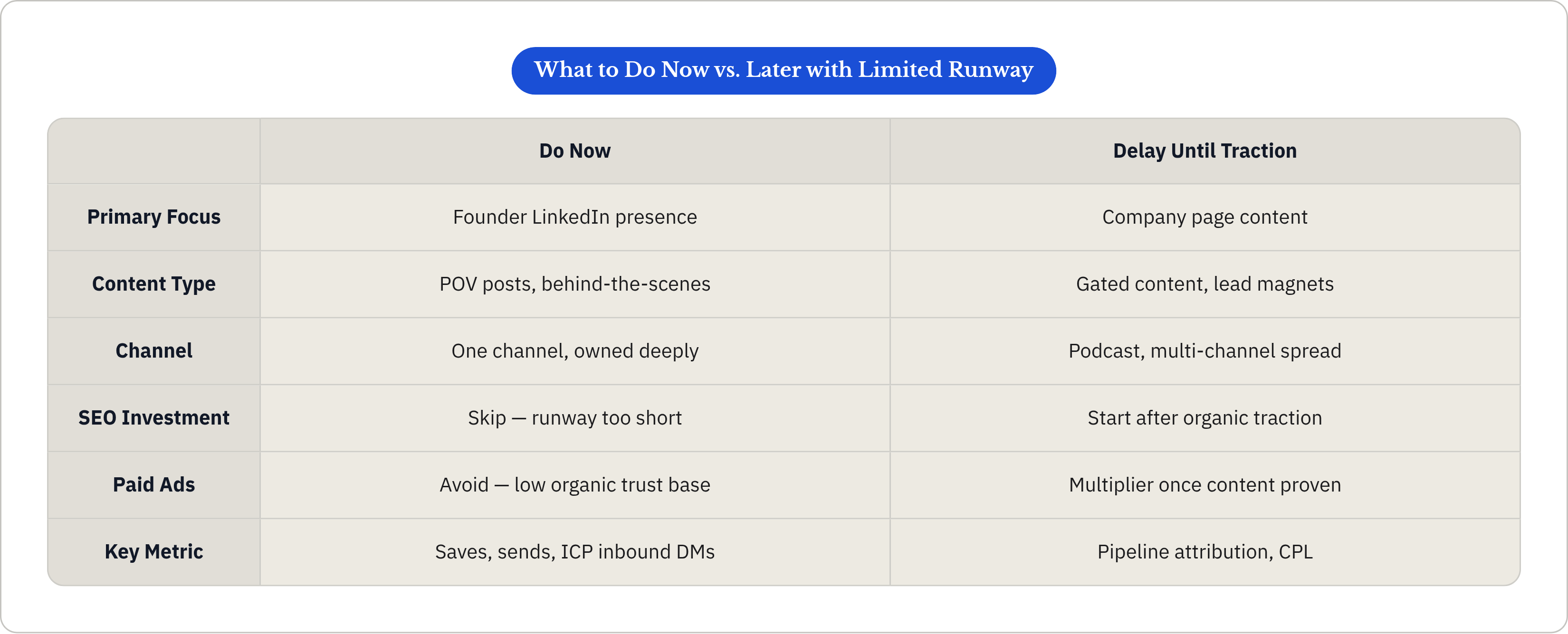
Most content advice floating around assumes you already have a content manager, a designer, and a six-month editorial calendar sitting in Notion. Following that advice at the early stage is how a founder burns an entire quarter with nothing but a nice-looking calendar to show for it.
SEO-driven blog content can wait. Domain authority takes 12 to 18 months to build meaningfully, and while it compounds beautifully long-term, it's not a short-runway asset, and you have a short runway. Podcasts can wait too, given the high effort, slow audience growth, and how nearly impossible it is to trace back to pipeline this early. Company page content on LinkedIn, as already covered, sits well behind personal profile posts, so file it under someday. Gated content and lead magnets are useful eventually, but they need existing traffic to convert against, and you don't have traffic yet, so a gate in front of nothing is just a locked door.
Paid deserves a mention here too, mostly as a warning label. LinkedIn's average cost per click hit $5.74 in 2026, up 9% year over year, and average cost per lead reached $94 and climbing. Paid works as a multiplier on content that's already proven to resonate, but it doesn't manufacture the organic trust-building you skipped.
The principle underneath all this is simple, even if it's not easy: go deep on one channel and one format until you've got proof it works, then expand from there. Skipping something now doesn't mean never doing it. It means waiting until organic LinkedIn traction starts producing real inbound, at which point reinvesting into SEO and other channels finally starts to pencil out.
How to measure whether early-stage content is actually working
Impressions and follower counts feel great to screenshot, but they're also nearly meaningless for early-stage revenue, so resist the urge to build a whole dashboard around them.
Watch saves and sends instead, the metrics LinkedIn added in late 2025. A save means someone found it worth coming back to, and a send means it got forwarded, dark social pipeline activity finally showing up somewhere you can actually see it. Watch inbound connection requests from people who match your ideal customer profile, especially right after a specific post goes out. Listen for a prospect saying "I saw your post about X" on an early sales call, because that's content doing real pre-sales work in the background, and track the DMs asking for more detail on a problem you wrote about last week.
Give it three to six months of steady, decent posting before drawing any conclusions at all. Plenty of founders quit around week eight because "nothing's happening," not realizing they pulled the plug right before the compounding would've kicked in. Thought leadership tends to produce dramatically higher ROI over 18 months, against far more modest returns from PPC over 90 days. Real return, just not an instant one, and judging it on a three-week clock is measuring the wrong thing on the wrong timeline.
Operationally: commit to six months before you judge the channel at all. Check leading indicators (DMs, saves, inbound ICP connections) weekly, and check lagging indicators (pipeline you can actually attribute to content) quarterly. Then ask the honest question underneath all of it: are the people engaging with your posts the people you actually want in your pipeline? A thousand likes from other founders running the exact same playbook isn't the same as ten comments from your actual buyer.
Building a distribution moat before you need one
Distribution is the thing nobody thinks about until they desperately need it, and by then it's too late to start digging. A moat isn't something you carve out the week before launch. It's something you've been quietly filling in for months while everyone else was still debating whether content was "worth it."
The founders who win the attention game early usually don't have the best product on day one. They have four thousand people who already trust their point of view by the time the product's ready to sell. That trust doesn't transfer to a competitor just because the competitor raised more money. It has to be built, post by post, mistake by mistake, one honest "here's what I learned" at a time.
The real question was never whether you have time for content strategy. Every week without a founder's voice in the market is a week your buyers spend forming opinions about the category, and they're forming them without you anywhere in the room.