Account-Based Marketing vs Lead Generation for B2B SaaS
Deal size and sales cycle determine which approach pays off, not ideology.

ABM and lead gen get treated like two rival religions, and that framing has cost B2B SaaS companies real money. One camp says precision wins, the other says volume wins, and somewhere in between a lot of marketing budgets get lit on fire because someone picked a side before checking whether it fit their business. The actual question is which motion matches your deal size, your sales motion, and where your company sits in its growth arc.
Get that match wrong and you'll blame the strategy when the real problem was fit.
What each approach actually does mechanically
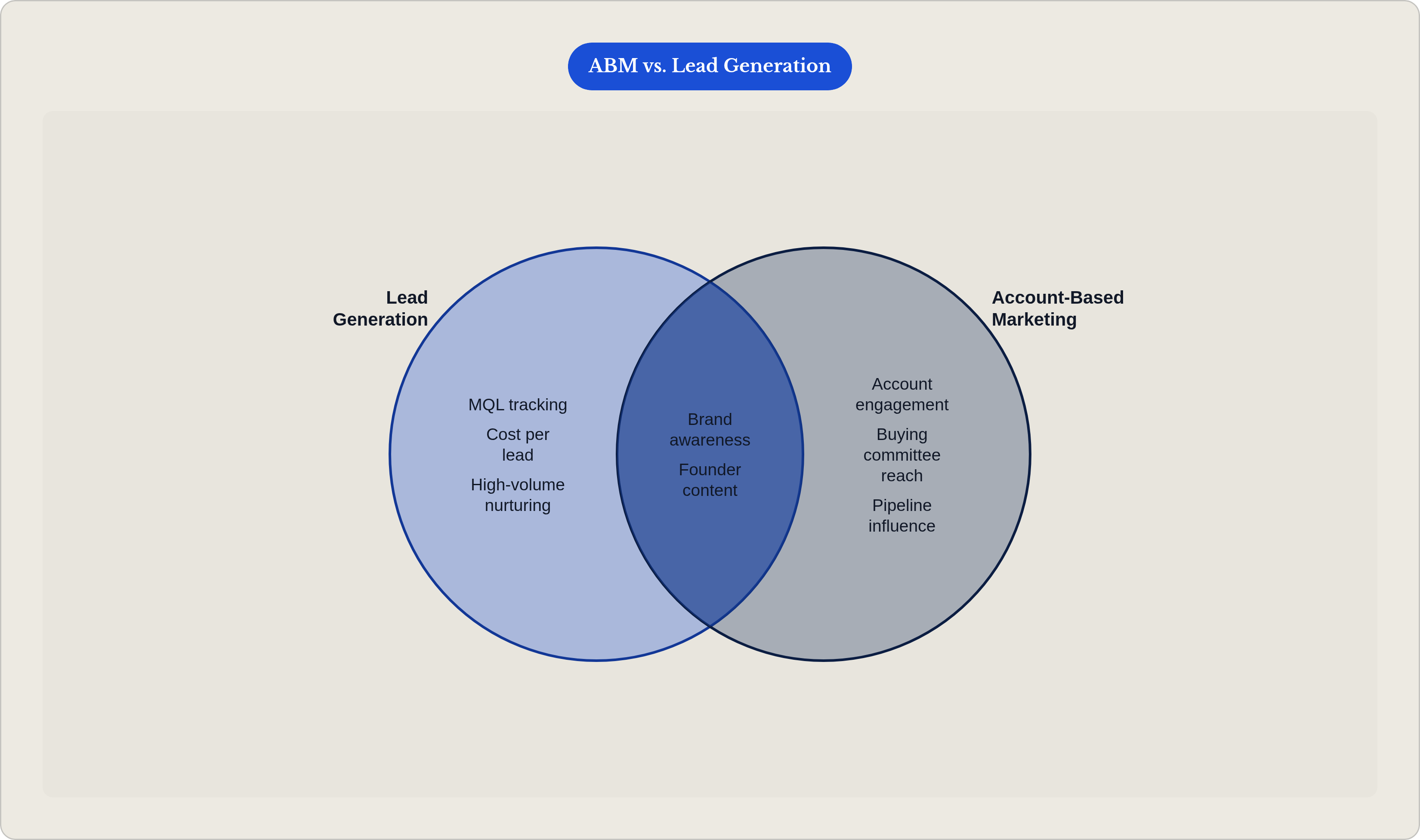
Lead gen is a volume game. You cast a wide net, pull in contacts through form fills, demo requests, and content downloads, then nurture them through email and paid channels until they're ready for sales. The funnel runs one direction: big pool of prospects narrows down to qualified contacts, which gets handed to sales. Every part of that process gets measured at the individual level. MQLs, cost per lead, conversion rate. It's a numbers business.
ABM flips the funnel inside out. Instead of waiting to see who raises their hand, you pick your target accounts first, then work to reach everyone inside that account who has a say in the buying decision. The account is the unit of work, not the lead. A company running ABM cares whether the whole buying committee, procurement included, knows who you are and trusts you by the time a decision gets made, more than it cares that one VP downloaded a whitepaper.
That difference in mechanics changes what "success" looks like on a dashboard. Lead gen tracks MQLs and cost per lead. ABM tracks account engagement, how deep you've penetrated the org chart, meeting quality, and how much pipeline the program actually influenced. Here's the part that trips people up constantly: judge ABM by lead-gen numbers and it will look like a failure every single time. The payoff shows up as better pipeline and a faster close, on a different scoreboard entirely.
The deal-size threshold that separates which motion makes economic sense
Annual contract value is the cleanest sorting tool available, because the economics of the sale dictate the economics of the marketing behind it.
Under roughly the mid-five-figures ACV range, the math doesn't support personalized, multi-stakeholder outreach. You can't justify spending weeks mapping a buying committee and crafting account-specific content for a deal that size; the cost of the motion eats the margin on the deal. Volume and low-touch nurturing is the only version of the math that works, so lead gen becomes the default, not a compromise.
Cross above that threshold and the equation flips. Now the deal is big enough to absorb the cost of identifying the right accounts, building out personalized campaigns, and coordinating touches across multiple stakeholders. ABM starts earning its keep.
This isn't a matter of taste. A company closing seven-figure enterprise contracts while running broad lead gen is leaving revenue on the table, plain and simple. Flip it around: a high-volume SMB SaaS company pouring budget into full-blown ABM is burning cash on a mismatch nobody asked for. Sales cycle length tends to track with deal size too, and longer cycles mean more stakeholders to manage, which is exactly the terrain ABM was built for.
One wrinkle worth flagging: deal size alone doesn't settle it. A mid-five-figure product sold self-serve to one buyer doesn't need ABM's stakeholder machinery just because the number clears the threshold. Check the buying motion, not just the invoice.
How growth stage shifts the calculus beyond deal size
Early-stage companies, pre-product-market fit, aren't trying to be efficient. They're trying to learn. Broad lead gen at this stage tells you which segments respond, which use cases land, and whether your assumptions about your ideal customer hold up under contact with reality.
Run pure ABM before you have that information and you're betting on a target account list before you know who actually buys from you. The signal just isn't there yet to make that bet intelligently.
Once a company hits growth stage, post-PMF, scaling its go-to-market motion, the picture sharpens. The ideal customer profile is clearer, the category is defined, competitors are real and named. That's the moment narrowing focus to high-value accounts starts paying dividends, because now you actually know which accounts are worth the investment.
At enterprise stage, with an established motion and a crowded competitive field, ABM typically becomes the main engine, with lead gen persisting underneath as a discovery layer and a supplement.
A pattern shows up again and again in the companies that struggle with ABM: they adopted it before they had the account intelligence, the sales alignment, or the content depth to run it well. ABM is a mature-motion strategy, and running it on immature infrastructure is like putting a jet engine on a bicycle. Real coordination across marketing, sales, and often customer success is also required, and that coordination cost is a lot easier to absorb at Series B than it is at seed, when the whole team might fit around one table.
The buying behavior shift that makes this choice more consequential than it used to be
Here's a number that should reset how you think about "capturing demand": Edelman's 2024 B2B Thought Leadership Report found that 95% of business buyers aren't actively looking for a solution at any given moment. Most of your future buyers are, functionally, invisible to you right now. You're trying to get onto a list that forms quietly, long before anyone fills out a form.
Layer on Gartner's 2024 research, which found that typical complex-solution buying groups now run six to ten decision-makers, each one doing their own independent research before the group even talks. Grabbing one contact off that committee and logging it as "a lead" misreads how the decision actually gets made.
That reality is rough on classic lead gen, since one form fill from a ten-person committee tells you almost nothing about whether the deal will close. ABM's whole logic, reach the account and everyone in it, fits this buying pattern much better, but only if the account list and the content are sharp enough to land before the shortlist locks in. The shortlist also locks in earlier than most marketing teams assume. Whichever motion you run, it has to start working further upstream than it used to.
Where lead generation still earns its place, even in ABM-dominant companies
Here's the argument against going all-in on ABM that nobody likes to say out loud: ABM still needs lead gen to find and feed its own account list. Without a discovery layer bringing in new signal, the target account list calcifies. It shrinks. Eventually you're just re-marketing to the same twenty logos on a loop.
Lead gen also owns territory ABM was never built for. High-velocity SMB pipelines. Product-led growth motions. Self-serve funnels where the individual sign-up is the whole point.
The healthiest B2B SaaS marketing functions run both at once. Lead gen handles breadth and discovery. ABM handles depth and conversion on the accounts that matter most. According to State of ABM 2025 data, organizations dedicate roughly a quarter to a third of their marketing budget to ABM on average, while keeping a lead-gen engine running the whole time underneath it, as a genuine second track rather than a backup plan.
The failure mode worth naming directly: teams run both programs side by side, then measure both of them with lead-gen metrics. ABM's contribution vanishes in that model, because ABM was never designed to produce lead-gen numbers. Leadership then cuts the "underperforming" program, and it's usually the wrong one that gets cut. The fix is separating the scoreboards. Lead-level metrics for the discovery engine. Account-level metrics, engagement score, pipeline influence, sales-cycle velocity, for the ABM motion.
Why ABM fails when it runs on firmographic data alone
A lot of ABM programs between 2020 and 2024 didn't fail because the strategy was flawed. They failed because teams built target account lists out of firmographic data, company size, industry, revenue band, and called that precision targeting.
Firmographics tell you who a company is. They say little about what that company is doing this week, whether anyone inside is actually evaluating a purchase, or whether now is even a reasonable time to reach out. Sending "personalized" campaigns to accounts that aren't in-market wastes the exact resource ABM is supposed to protect: your sales team's limited time and attention.
The fix is layering intent data on top of the firmographic baseline, signals showing which accounts are actively researching relevant topics, checking out competitors, or engaging with content in your category right now.
Dark social makes this harder still. A large chunk of the modern buying journey happens in places no analytics tool can see: private Slack threads, forwarded emails, closed community chats. When someone on a buying committee forwards a founder's LinkedIn post to the rest of the team, that's a serious intent signal, and it never shows up in any dashboard. ABM programs that rely only on trackable engagement are flying blind on some of the most important moments of influence in the whole deal.
Account selection and timing carry as much weight as the personalization itself. The sharpest content aimed at the wrong account, at the wrong moment, still falls flat.
What founder-led content on LinkedIn does for both motions that paid programs cannot replicate
ABM and lead gen share one dependency neither of them likes to admit: both need the company to already be known and trusted before the outreach lands or the form gets filled. Skip that step and conversion rates suffer on both sides of the aisle.
That pre-contact window, before anyone's had a sales conversation, is where founder-led content on LinkedIn does its quiet work. It shapes shortlists. It builds familiarity. It creates that "oh, I already know these guys" reaction that changes how both inbound leads and ABM outreach get received.
For ABM, a founder whose posts are already reaching decision-makers inside a target account has warmed that account before the first sales email ever goes out. The outreach lands on a name people recognize rather than as a cold interruption in someone's inbox. For lead gen, that same content drives inbound discovery on its own, buyers find the founder, follow them, and convert later, building a trust asset that no amount of paid spend buys at the same rate.
Research consistently shows that a strong majority of B2B buyers research a company's leadership before making a purchase decision, and buyers are more likely to consider companies whose leaders show up visibly online. Add to that a structural quirk of the platform itself: personal profiles on LinkedIn are widely observed to reach decision-makers at a higher rate than company pages do, because the algorithm consistently favors individual voices over brand accounts.
A founder running an ABM motion who isn't posting anything with a point of view on LinkedIn is leaving the entire pre-contact window undefended, and that's often the window where the deal gets decided before your sales team ever picks up the phone.
Matching the motion to the moment: a practical decision framework
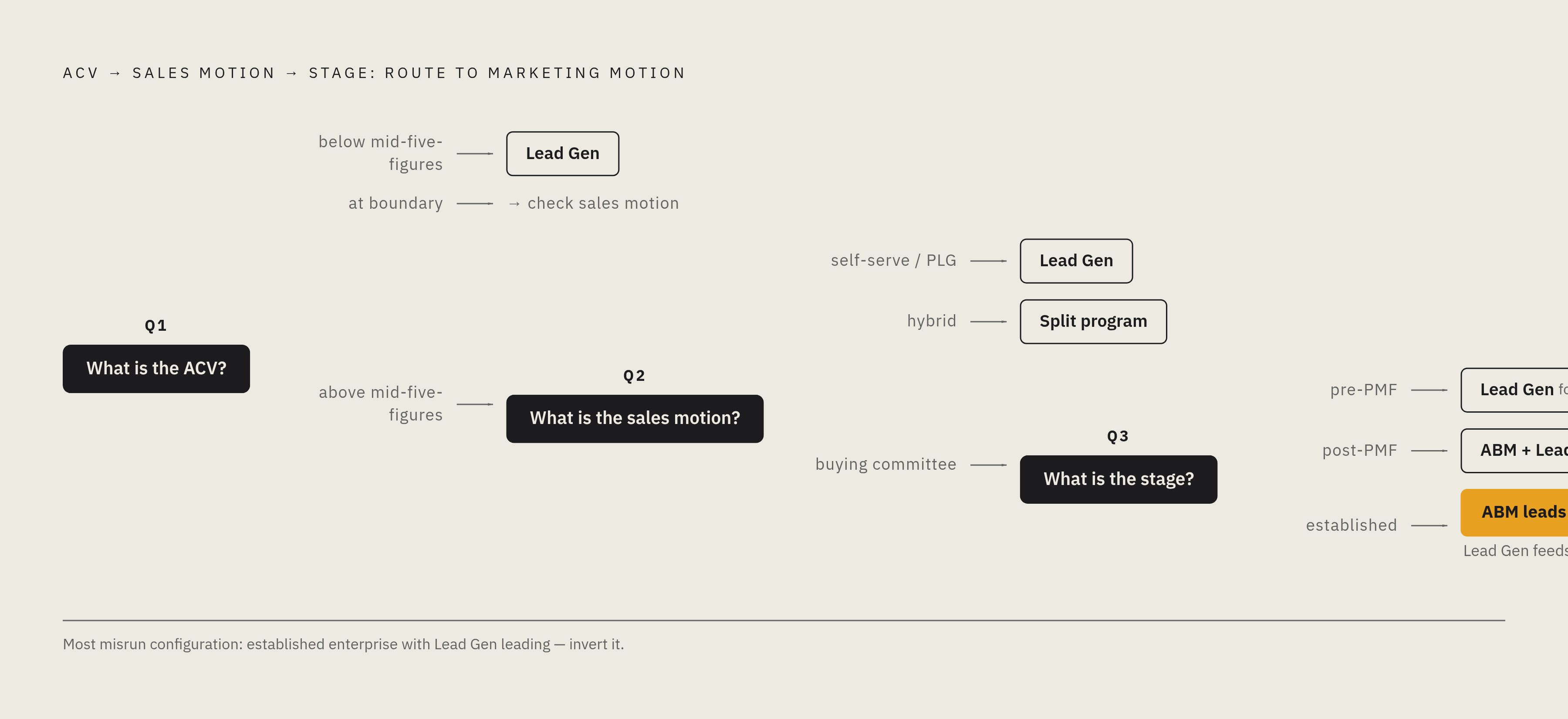
Three questions, asked in order, get you most of the way to the right answer.
First, what's the ACV? Below the mid-five-figures range, lead gen is your default. Above it, ABM earns the investment. Sitting right at the boundary, look past the number and check the sales motion instead.
Second, what's the sales motion? Self-serve or product-led motions run on volume, so lead gen fits. A sales-assisted motion with a real buying committee fits ABM's design. A hybrid motion probably needs a split program, with separate metrics tracking each track so nobody grades one against the other's scoreboard.
Third, what stage is the company at? Pre-PMF, lead gen gathers the signal you need. Post-PMF and scaling, layer ABM onto your highest-value segment while lead gen keeps discovering new territory and covering SMB. Established enterprise motion, ABM leads and lead gen becomes the feeder system underneath.
Whatever you choose, hold the line on measurement. Never grade ABM against lead-gen numbers. Account engagement, pipeline influence, and sales-cycle velocity are the honest scoreboard for that motion, while MQL volume belongs to the other one.
None of this is a one-time call, either. ACV shifts, growth stage moves, and the right split between the two motions changes with it. Companies that locked in their answer at Series A and never looked at it again are frequently running the wrong program by the time Series B rolls around.
Founder-led content on LinkedIn functions as a layer underneath both motions rather than a third one competing for a slot in this framework, the thing that makes whichever motion you pick more efficient, by building the kind of credibility and familiarity that no ad campaign or cold outbound sequence can manufacture on its own.