Founder Brand vs Company Brand Distinction
Strategic clarity on founder versus company brand prevents costly brand misalignment.

Most founders don't consciously decide between building their personal brand and building their company brand. They just start doing things. They post on LinkedIn. They write content. They put up a website. And then a few years in, they look around and realize the business either lives or dies based on their personal reputation. Or nobody really knows who they are. Both outcomes feel uncomfortable. Neither had to happen.
The distinction between founder brand and company brand is one of the most practically important things a founder can work out early. Not because it unlocks some secret, but because it forces an honest answer to a harder question underneath: what are you actually building?
Founder brand is the market's accumulated associations with a specific person. Your expertise, your voice, your story, your public track record, your values as people have come to understand them over time. Company brand is the market's associations with the business itself. What it does, who it serves, what it stands for, how it behaves, why it can be trusted.
In early-stage companies, these two overlap so heavily that most founders treat them as the same thing. That overlap is normal. It is not permanent. And "normal" is not the same as "strategic."
One more thing before we go further: branding and brand building are not interchangeable. Branding is what the entity is. Positioning, identity, the deliberate choices that define how you show up. Brand building is what the entity does. The ongoing content, campaigns, and presence work that creates awareness over time. A founder has a positioning and a content practice. A company has a brand strategy and a marketing engine. Conflating these leads founders to mistake activity (posting constantly, running campaigns, being loud) for strategic clarity. They are not the same. Doing a lot of things loudly is not the same as knowing what you stand for.
So here is the honest prior question, the one that shapes every brand investment decision you will make: are you building a platform for yourself that a business sits under, or a business that briefly uses your face to get traction? Both are legitimate. Conflating them is where things get genuinely messy.
There are two failure modes, and most founders only worry about one of them.
Over-indexed on founder. Every business decision becomes personal. Critical feedback lands as a personal attack. The brand is essentially a projection of the founder's identity rather than a considered strategic position. It ends up inconsistent and reactive. It cannot scale because it requires the founder's emotional investment in everything.
Over-indexed on company. The founder's actual point of view gets scrubbed out in the name of professionalism. The brand loses the human signal that earns early trust. It sounds like every other company in the category. Nobody particularly cares about it.
The productive framing is not "which brand should I build?" It is "what does each brand do well, and when does one do it better than the other?" That question is answerable. It leads somewhere useful.
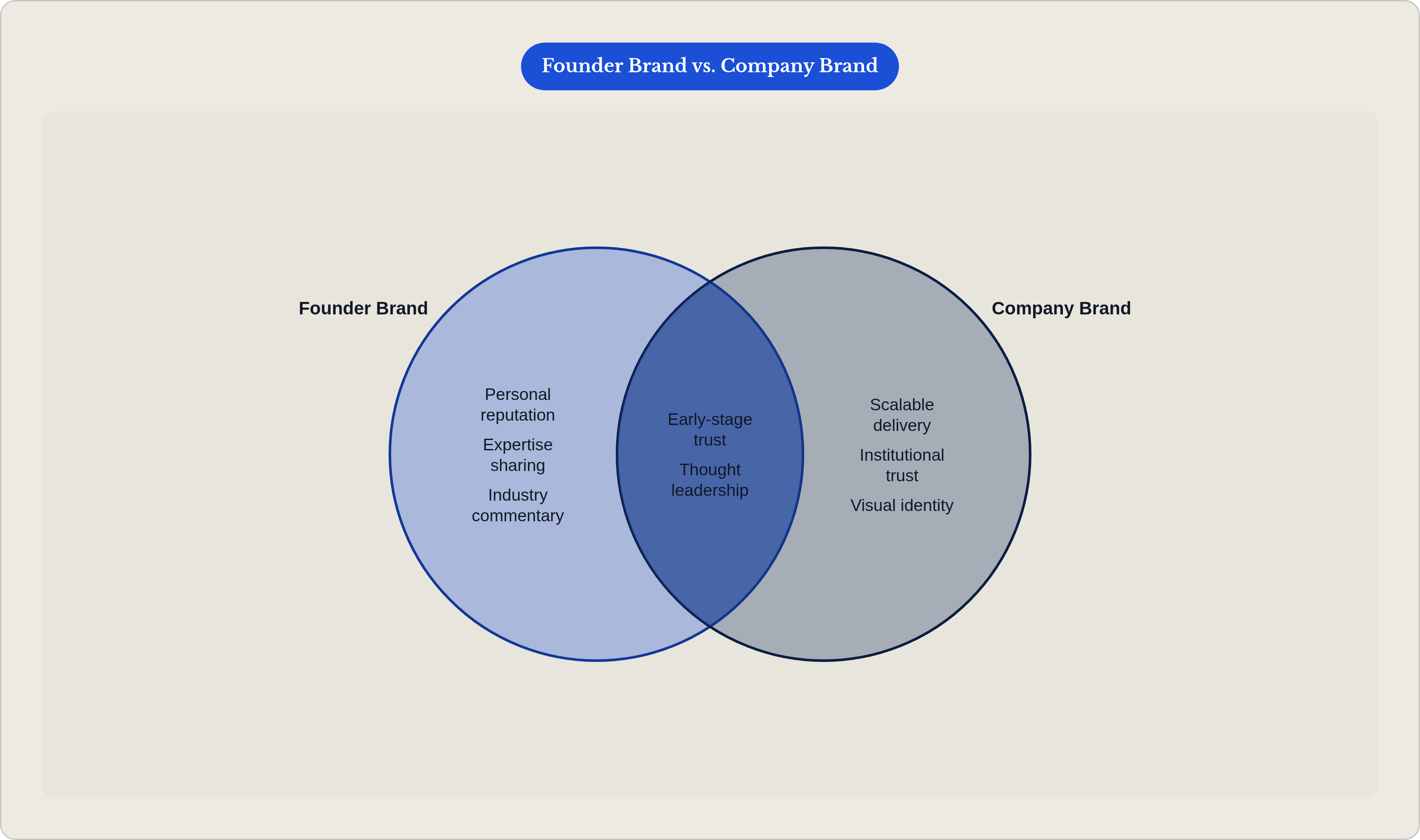
What Founder Brand Does That Company Brand Cannot Replicate Early On
Company brand builds trust through size, longevity, and consistency. That takes time. Founder brand builds trust through insight and presence. That can happen in six months.
Think about it from a buyer's perspective. Nobody trusts a logo with a pitch deck attached. But a founder who has been sharing sharp, relevant thinking in their category for six months? That person has earned something real. You have read their takes. You have watched them be right about a few things. You have seen how they handle pushback. That is trust. It is not manufactured.
Founder brand operates most powerfully in three modes:
- Expertise sharing. Teaching, not self-promotion. Positions the founder as the credible authority in a specific domain, without requiring them to say "trust me" out loud.
- Transparent storytelling. Sharing the real experience of building, including the failures, especially the failures. This creates authentic connection in a way polished content never does.
- Industry commentary. Taking a clear point of view on what is happening in the category. This earns respect and signals confidence, which are actually different things that happen to travel together.
Platform mechanics reinforce this reality in ways that feel almost unfair. Per Richard van der Blom's 2025 analysis of 1.8 million posts, organic reach for LinkedIn company pages has dropped to 1.6% of followers. It was 7% in 2021. Meanwhile, LinkedIn's own data shows CEO content earns four times more engagement than content from other LinkedIn members. The algorithm is not subtle about what it rewards.
Weber Shandwick research found that 44% of a company's market value is attributable to the CEO's reputation. For early-stage companies without an established corporate brand, that concentration is even higher. The founder is not just the face. The founder is a significant chunk of what the business is actually worth at that stage.
This dynamic is especially powerful in consulting, B2B services, professional services, expert-led software, education, and coaching. Basically any category where the purchase feels risky and the buyer wants to understand who is behind the business before committing. The founder brand does the trust-building work that the company brand has not had time to earn yet.
What Company Brand Does That Founder Brand Structurally Cannot
Here is the thing founder brand cannot do: scale.
Company brand translates the founder's vision into repeatable, deliverable value. It gives customers, employees, and partners a stable reference point that does not depend on the founder being in every conversation. Message architecture, positioning, visual identity, service standards, templates. That infrastructure is what lets teams deliver the brand promise consistently across contexts, without the founder in the room.
The buying decision shifts toward company brand the moment it depends on reliability, repeatability, compliance, team depth, or long-term service delivery. Enterprise buyers and procurement teams need confidence that the business can perform without heroics from one person. Strategic partners and investors are evaluating the institution, not just the person. A strong founder story gets you the meeting. Company-brand infrastructure closes the deal and keeps the client.
Consumer categories tell a similar story from a different direction. Fashion, food, beauty, wellness, lifestyle. In these spaces, product experience and brand aesthetic often carry the full weight of conversion. The founder is interesting. The product world is what people are actually buying into. Company brand has to carry that weight, and when it does not, the category punishes you for it.
Edelman's 2025 Brand Trust report, a 15-market survey conducted in June 2025, found that trust is now equal to price and quality in purchase decisions. That trust, at scale, accrues to the company brand. The founder opened the door. The institution holds the relationship.
The simplest way I have found to think about this: if people are buying because of the business, its delivery record, its team, its product, the company brand is doing the work. The founder brand opened the door. The company brand closes it and keeps people from leaving.
How the Right Balance Shifts as the Business Grows
Early stage, the founder brand earns trust, creates attention, and generates clarity faster than a young company logo can. The founder is often the only credible signal the market has. Use it without guilt.
Then something changes. Delivery has to scale. Hiring has to happen. Sales has to close without the founder in every meeting. Customer success has to run without the founder on every call. When any of those things become true, company-brand assets become the strategic priority. The founder should remain visible, but the business needs infrastructure that functions without constant founder presence.
When both are working well, something clicks. Founder brand generates attention and trust. Company brand converts that attention into scalable results. Each reinforces the other instead of competing with it. It is genuinely satisfying to watch when it works. It is genuinely painful to watch when it does not.
A practical test worth sitting with: if you removed your name and face from the business tomorrow, what would remain? The strength of that answer tells you exactly how much company-brand equity you have actually built. Most founders who ask themselves that question honestly are surprised by what they find on the other side of it.
What Happens When Founder Brand Runs Too Far Ahead
Key-person dependency is the structural risk nobody likes to talk about until it becomes their problem. If the founder is the brand, the business is exposed every time the founder steps back, burns out, or becomes controversial. There is no institutional brand to retreat behind.
A PR crisis around the founder becomes a brand crisis for the company. Full stop.
Tesla and Elon Musk is the obvious reference point. Each alignment with polarizing political movements or controversies produced measurable hits to Tesla's stock and brand reputation, and drew real customer defections. The company had no brand identity independent enough to absorb the conduct of its founder. That is an unusual example at an unusual scale, but the underlying dynamic is not.
Prime Energy, the drink brand built around Logan Paul and KSI, generated UK sales of £112 million in 2023. By 2024, sales had declined 70%. That is what it looks like when a founder-dependent brand unwinds as creator relevance shifts. Per Skadden's June 2026 analysis of founder-led brand acquisitions, buyers of these businesses must navigate earn-outs, equity rollovers, and persona-rights confirmations precisely because value is so tied to the founder's continued engagement and cultural relevance. A brand that cannot be separated from its founder is genuinely difficult to sell at full value, and buyers know it.
There is also a subtler risk that does not make the news. When the founder's story dominates everything, the customer narrative gets crowded out. The brand communicates who built it rather than what it does for the buyer. Founder stories are often static. They are tied to the origin. They must eventually give way to a larger brand narrative. If that transition never happens, the brand ages poorly and quietly. You do not always notice until the momentum is already gone.
The Hybrid Model Most Durable Founder-Led Businesses Actually Use
The model that actually holds up over time is the personality-driven business brand. A company brand with a highly visible founder as its human champion. Distinct from the founder's personal identity, but not scrubbed of it. Harder to build than either pure version. Worth it.
The founder remains the face and voice. But the brand identity is designed to function and grow beyond any single person. The values and point of view are baked into the company's positioning, not just the founder's LinkedIn bio.
In practice, the division of labor looks something like this:
- Brand assets, positioning, and customer relationships attach to the company, not solely to the individual
- Thought leadership, storytelling, and public presence attach to the founder, amplifying the company brand rather than replacing it
- Founder content earns authority in the category; company brand captures and converts that authority into pipeline and retention
- Hiring, delivery, and customer success run on company-brand systems, not founder availability
- The founder's values and point of view get embedded into the company's positioning, so they survive even if the founder eventually steps back
That Weber Shandwick finding again: 44% of company market value attributable to CEO reputation. That is an argument for keeping the founder visible. The company brand should complement that visibility, not make it redundant.
For founders with exit goals, this hybrid model is the one that actually works. It preserves every founder-brand advantage during the growth phase while building the company-brand equity that makes the business acquirable and independently valuable. You are not choosing between the two. You are sequencing them correctly.
Practical Signals for Deciding Which Brand to Prioritize Right Now
Lead with founder brand when:
- The category is new, confusing, or high-trust. Buyers need to understand the thinking before they trust the product.
- The business is early-stage and the company brand has no track record yet.
- The founder's name is already associated with expertise in the relevant domain.
- The sales motion depends on relationships, referrals, or the founder's direct credibility. Consulting, B2B services, professional services, expert-led SaaS.
- AI tools and search platforms are being used to evaluate vendors. They surface named authors and thought leaders, not anonymous company pages.
Lead with company brand when:
- The buyer needs institutional confidence. Enterprise procurement, compliance-sensitive categories, long-term service contracts.
- The product or brand experience is the marketing. Consumer goods, fashion, food, beauty, lifestyle.
- The business is preparing for acquisition, fundraising at scale, or geographic expansion where the founder cannot be present.
- The founder does not want to be the public face, the personal name is non-brandable, or the founder's goals simply do not include a public platform.
The clearest forcing function: as soon as any business function must operate without the founder in the room, invest proportionally in company-brand assets to carry what founder presence was carrying. That transition is not optional. It is just a question of whether you do it proactively or scramble to do it after something breaks. Most founders learn this the hard way. You do not have to.
This is not a one-time decision. The right weighting is a live question. It should be revisited at each stage of growth, at each major product or market expansion, and any time the founder's public role or available bandwidth changes.
The founders who work this out early build businesses that are both enjoyable to run and worth something when it is time to move on. The ones who do not build something that requires them to show up indefinitely, at full strength, without rest. That works until it does not. And when it stops working, the gap in company-brand equity becomes very obvious, very fast.