Media Pitch Strategies for B2B SaaS Founders Without News Hooks
Position your expertise as the story journalists need, not the announcement they're waiting for.

Founders assume media coverage is a reward for milestones. Raise a round, get a write-up. Ship a major feature, get a mention. Hire a notable executive, someone covers it. That logic is reasonable. It's also why most founders spend years on the sidelines, waiting for news that earns them permission to pitch.
Here's the actual situation: journalists covering B2B technology are not waiting for your announcement. They're already inside a story. They've identified a trend, a tension, a debate their readers care about. What they need is a smart practitioner who can help them explain it. If you operate inside a real problem, you are already a source. The only issue is you haven't pitched like one.
The 2025 Cision State of the Media Report found that 86% of journalists immediately reject pitches that aren't aligned with their beat. Not pitches that lack news. Pitches that miss the beat entirely. That distinction matters more than most founders realize, because it means the bar isn't "do I have an announcement?" The bar is "does what I know fit inside the story they're already writing?"
When a journalist decides whether a founder is worth quoting, they're running a quick mental audit. Does this person operate inside the problem, or are they describing it from a safe distance? Does their experience map to what my readers are trying to solve? Can I drop their perspective into a paragraph and make my story better? Being a company is the locked door. Being a useful perspective is the key. Journalists quote the latter, and most of the time they aren't even looking for someone running a notable company. They're looking for someone who has seen the thing they're writing about up close.
The Cision data also shows that 72% of journalists cite press releases as the most useful resource PR teams offer. Not because press releases are well-written. Because they contain verifiable, attributable facts a journalist can actually use. An expertise-led pitch needs to do the same structural job. Give the journalist something usable. The difference is you're building it from insight, not from an announcement.
How to Identify the Angle a Founder Is Already Qualified to Pitch
Most founders dramatically underestimate the pitch value of what they witness every day. The patterns of problems customers bring to sales calls. The questions prospects ask before they decide to buy. The workarounds users built before they found the product. None of that is background noise. It's proprietary signal, and most of it is invisible to anyone who doesn't run your company.
A few angles that consistently work without a news event:
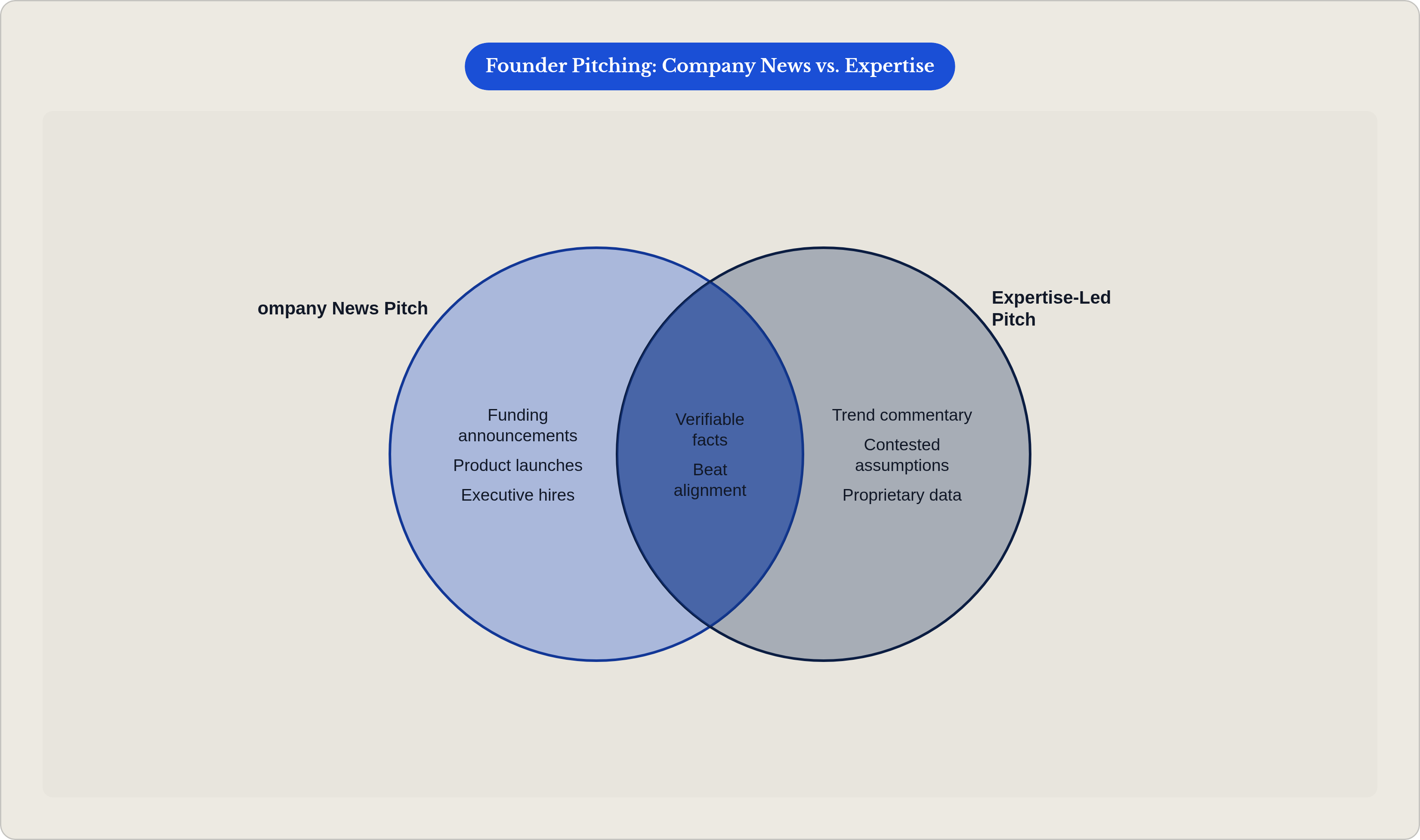
Trend commentary. A macro shift your customer base is visibly experiencing, one you have ground-level evidence for that most outside observers don't. Industry analysts can describe the trend from 30,000 feet. You can describe what it actually looks like when someone is living it at 9 a.m. on a Tuesday, panicking in a Slack thread.
Contested assumptions. A widely repeated belief in your category that your customer data or direct experience contradicts. These pitches work because they give journalists built-in tension, and tension makes stories more interesting to write and more interesting to read.
Problem framing. A problem your buyers face that journalists covering those buyers haven't cleanly named yet. If you can name a problem more precisely than anyone else has, you own that framing for a while. That's not a small thing.
Proprietary data deserves its own mention. If your platform processes a meaningful volume of transactions, sessions, or workflow events, the aggregate patterns in that data are a story. A project management platform that sees a measurable uptick in automation workflows among distributed teams gives a journalist a concrete, attributable data point. Not a company announcement. A contribution to a story already being written about how remote work is reshaping operations. The data doesn't need to be dramatic. It needs to be specific, verifiable, and tied to something the journalist's readers actually care about.
Before pitching anything, run this self-audit:
- What do your best customers tell you their peers still don't understand about this problem?
- What does your sales data show that contradicts the standard category narrative?
- What industry debate are you watching where you have an actual opinion, not a diplomatic one?
The answers to those questions are your pitchable angles. All of them exist right now, before any announcement, and they've probably been sitting in your inbox or your CRM for months.
Constructing the Pitch Itself: What to Lead With When There's No Announcement
The structural swap is simple to describe and genuinely hard to execute, because it requires suppressing every instinct you have about your own company.
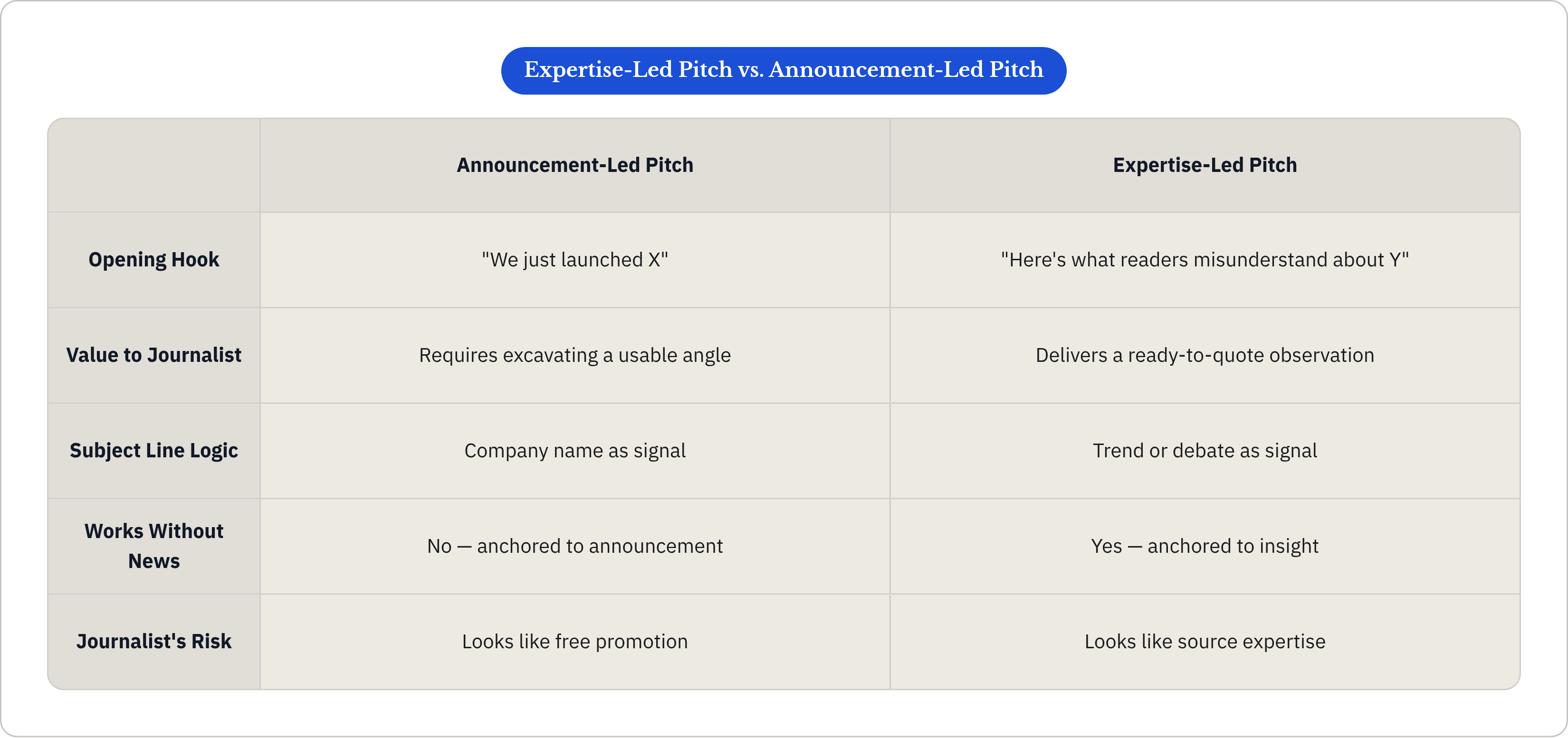
Replace the news lede ("We just launched X") with a journalist-serving lede ("Here's what your readers are misunderstanding about Y, and here's why it matters right now"). Almost nobody does this. It's the kind of thing that's obvious once someone points it out, and then you go back and read your last three pitches and wince a little.
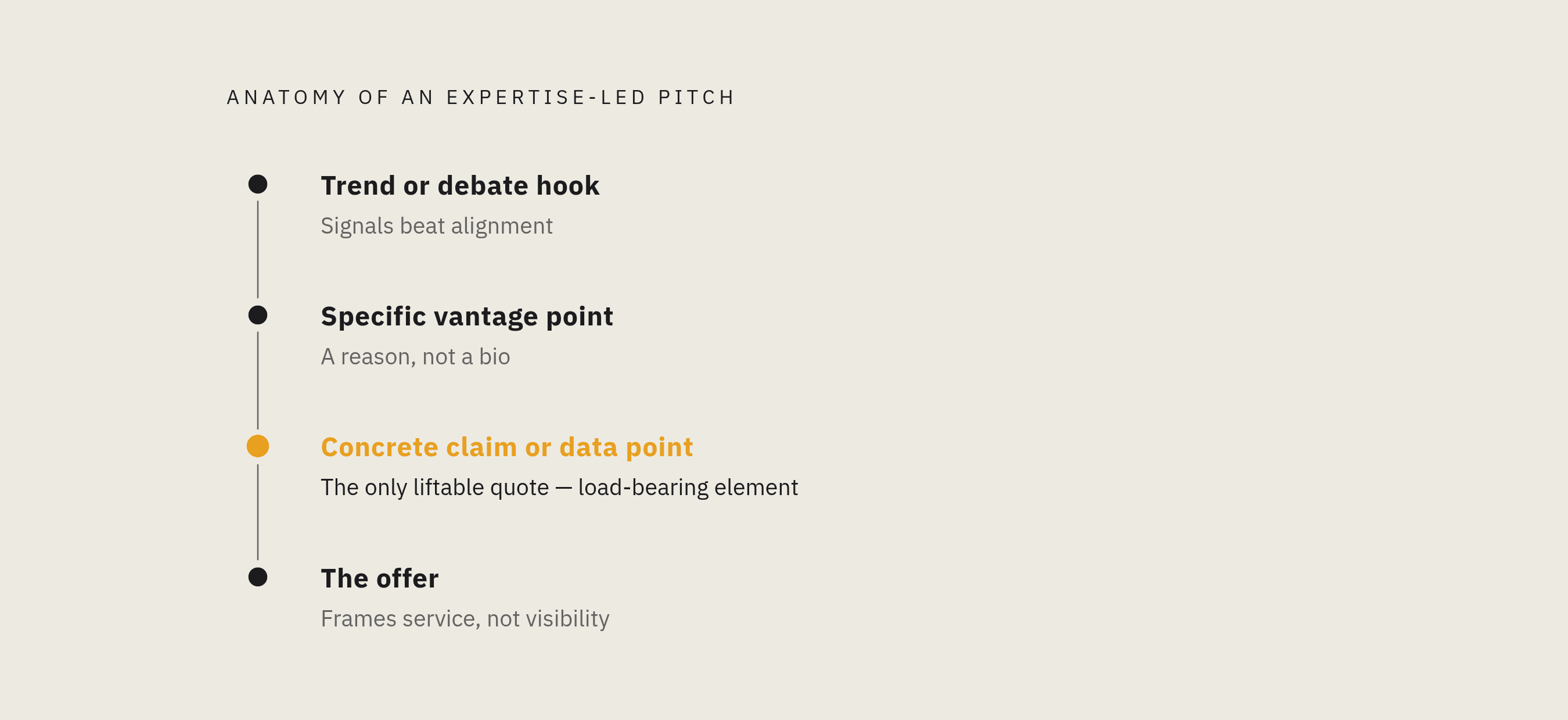
Four things belong in an expertise-led pitch that actually earns a response:
The trend or debate hook. Name the specific story the journalist is already covering, or the category question their audience is actively asking. This signals beat alignment in the first sentence. Get this right, and the journalist already knows why you're in their inbox before they've finished the first line.
Your specific vantage point. One sentence on why your operational position gives you a view that a generalist analyst or a PR-driven spokesperson doesn't have. Not a bio. A reason.
The concrete claim or data point. The specific, attributable observation. A pattern from customer data. A named counterexample. A precise operational finding. This is the part the journalist can actually quote. Make it easy to lift straight into a paragraph.
The offer. What they get: a quote, a short interview, access to aggregate platform data, a customer willing to go on record. Frame it as serving their story, not your visibility. That framing matters more than most founders realize.
Pitch length is non-negotiable. Skimmable in 30 seconds. If the journalist has to reach the third paragraph to find the point, you've already lost them.
Subject lines follow the same logic. Name the trend or debate, not your company. Signal a position, not a topic. "Why mid-market security teams are still measuring the wrong breach metric" earns an open. "Cybersecurity insights from [Company]" earns a delete. Strip out everything that makes the journalist's job harder: funding status, product features, company background, award mentions. If it forces them to excavate a usable angle from promotional material, it goes.
One follow-up, one week later, with an added data point or a new development that makes the pitch more timely. Skip the check-in asking whether they saw your email. They saw it.
Building the Journalist Relationship Before the Pitch Is Sent
A well-constructed expertise-led pitch is still a cold pitch if the journalist has never heard of you. Cold pitches compete against sources the journalist already knows and trusts. That's not an impossible race. It's just a harder one than it needs to be.
LinkedIn is where a lot of that familiarity gets built now. Reporters actively search for practitioners with visible, specific opinions on the topics they cover. A founder who publishes sharp, opinionated takes on a trend a journalist is already tracking is doing pre-pitch work every time they post. By the time the pitch lands, the name isn't cold. It's already attached to a perspective the journalist found useful somewhere else first.
A few moves that build familiarity without feeling transactional:
- Engage with a journalist's published work by adding a specific observation in a comment. Not "great piece." Something that extends the argument or adds a data point they didn't have.
- Reference their work in a LinkedIn post, tagging them. You're giving them visibility while introducing your own thinking in context.
- When a journalist posts a question or puts out a call for sources on LinkedIn or X, respond with something actually useful. A real answer, not a pitch wearing a disguise.
There's also an editorial consideration that's easy to overlook. When a journalist quotes a source, they're thinking about whether that source has an audience that will engage with the story. Visible engagement on your LinkedIn content is evidence of that audience. It's not vanity data. It's a signal the journalist can use to justify the quote to their editor.
The 2025 LinkedIn B2B Benchmark Report puts the engagement differential at 8x: individual employee and founder content outperforms company-page content by that margin. Your personal presence is the strategically valuable asset here. Not your company account.
Why a Founder's Consistent Public Voice Compounds Media Access Over Time
There's a real performance gap between founders who pitch ad hoc, whenever they have news, and founders who maintain a consistent public voice over time. The gap compounds in one direction only. The consistent voice gets easier to pitch, gets cited more often, and eventually stops needing to pitch at all.
What "consistent public voice" actually means in practice:
- A recognizable position on a category debate. Journalists know what angle you'll take before they ask. That predictability is genuinely useful to them on deadline.
- A track record of being quotable. Specific, attributable, non-generic. The opposite of the spokesperson who gives every reporter the same three talking points and hopes no one notices.
- Visible audience response. Engagement on your content is evidence your perspective has reach. Journalists notice, even if they'd never say so directly.
Here's how the compounding works. A founder quoted once in a relevant trade publication becomes easier to pitch to adjacent publications. A founder quoted repeatedly becomes the source a journalist calls without being pitched at all. Their name autocompletes in the journalist's contacts when the story is being written. At some point, the journalist isn't waiting for a pitch. They're just calling.
The audience that benefits from this isn't only journalists. The 2025 Edelman-LinkedIn B2B Thought Leadership Impact Report found that 95% of hidden B2B buyers say strong thought leadership makes them more receptive to sales and marketing outreach. The same credibility that earns media coverage also reaches the people influencing deals before sales is ever involved. Same signal, same audience, two different channels running at the same time.
Media coverage and LinkedIn thought leadership aren't separate programs running in parallel. Each one makes the other more credible. A placement gets published to LinkedIn, reinforcing the founder's authority for buyers and future journalists simultaneously. A LinkedIn post gets seen by a journalist, reducing the friction of the next pitch. The loop builds on itself, slowly and then faster.
The founder who builds a specific, opinionated public voice over time doesn't eventually get a news hook. They become the news hook. The expert a journalist reaches for when a story is already in motion. That's a completely different position than waiting for your next funding round to justify a pitch. And it's available right now to any founder willing to say something specific out loud.