PR Strategy for B2B SaaS Startups Before Series A
Build credibility before buyers know you exist.

Most founders treat PR like a fire alarm. Something happens (a funding round, a product launch, a milestone) and suddenly it's time to "get the word out." You hire a firm, write a press release, pitch TechCrunch, and wait. You get a hit. Traffic spikes for a week. Then it's quiet again.
That model was always a little broken. Before Series A, it's close to useless.
Here's the thing: the B2B SaaS market hit $390 billion in 2025 and is projected to cross $1.5 trillion by 2031. The competitive density that comes with those numbers means buyers are drowning in options. They're not waiting for journalists to sort it out for them. They're doing their own research, in private, before you know they exist. And investors are doing the same thing. The founders who understand this stop chasing coverage and start building what actually matters: credibility infrastructure. The kind that works quietly, compounds over time, and puts you on shortlists before a single sales conversation happens.
That's what this piece is about.
The Shortlist Gets Built Before You're Invited
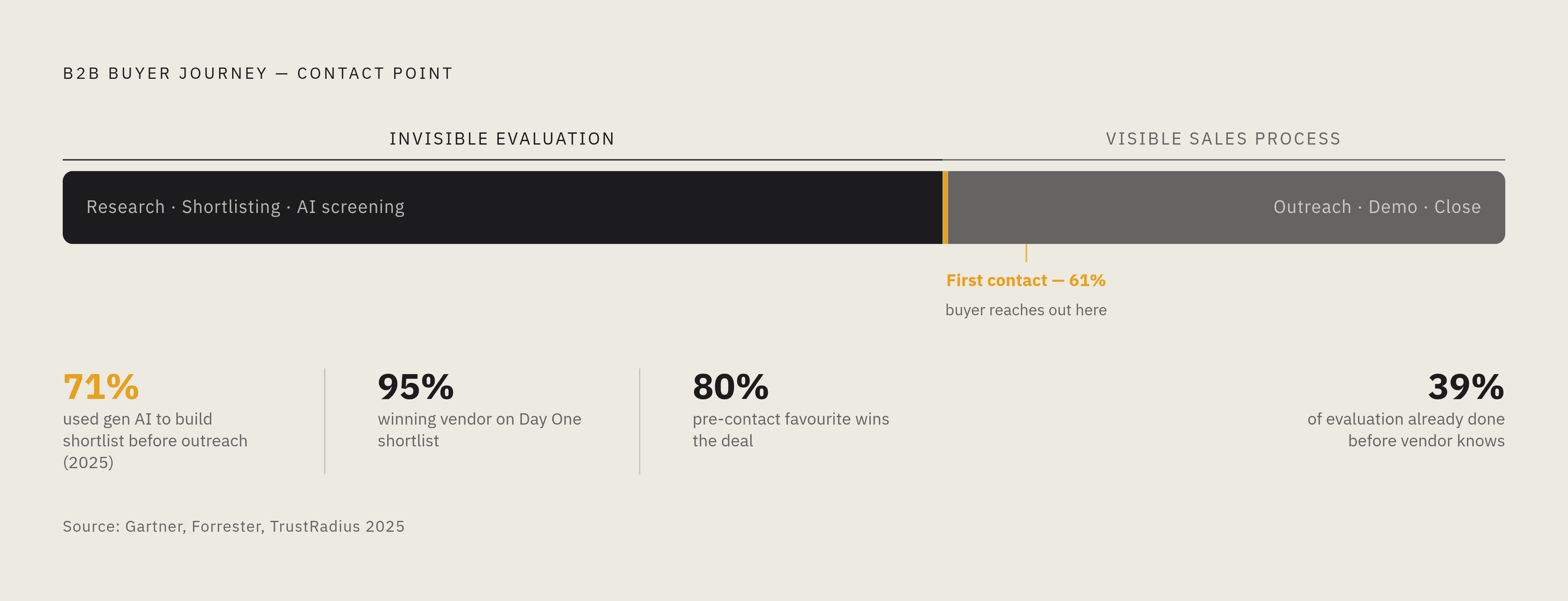
Here's a stat that should stop you in your tracks. According to 6sense's 2025 Buyer Experience Report, 95% of the time the winning vendor is already on the buyer's Day One shortlist. And the pre-contact favorite wins roughly 80% of deals.
Read that again. The deal is mostly over before it starts.
Buyers contact sellers at 61% of the way through their journey. That means 39% of the influential evaluation happens before any founder even knows they're being evaluated. And AI has made this worse (or better, depending on your position). In 2025, 71% of B2B technology buyers used generative AI tools during their evaluation process, and they're 2.3x more likely to finalize shortlists before reaching out to any vendor.
Then there's dark social, which is the invisible layer most founders ignore entirely.
- 64% of B2B buyers cite peer recommendations from private channels as their most trusted research source. More trusted than analyst reports. More trusted than vendor content.
- When a buying committee shares your LinkedIn post in their internal Slack, that signal never shows up in your analytics.
- You only catch hints of it: branded search spikes, odd attribution answers on demo request forms, unsolicited DMs that reference something specific you wrote.
And it's not just one buyer you're trying to reach. Buying committees averaged 11 stakeholders in 2024. Each stakeholder added reduces purchase probability by 10 percentage points. Finance, legal, procurement, all of them are quietly influencing the decision without ever touching your sales funnel.
What this means for a pre-Series A founder is simple and a little uncomfortable: the PR job is to show up in a research phase you'll never be invited to.
Investors Are Running the Same Playbook
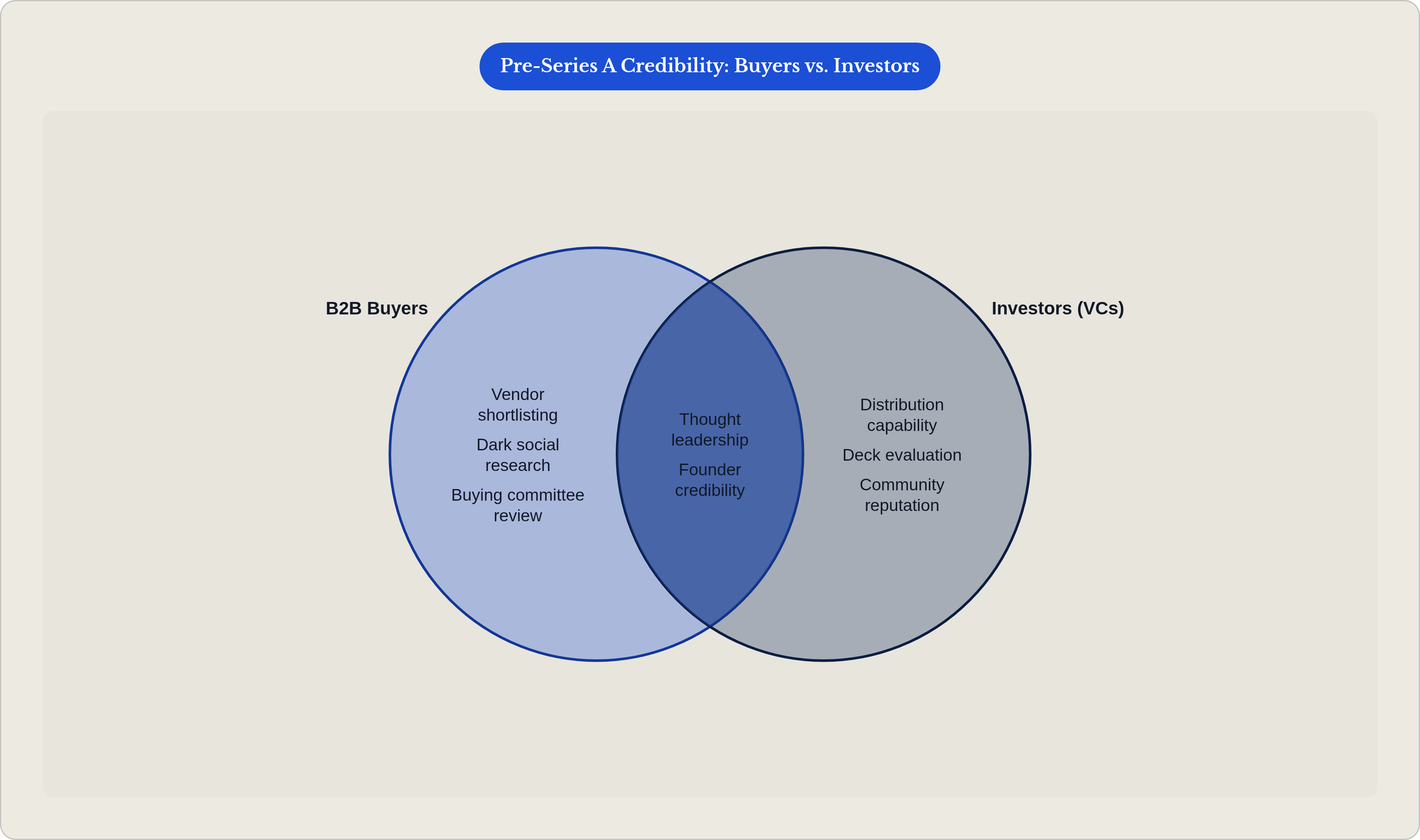
VCs diligence founders the same way buyers diligence vendors. They check your LinkedIn. They look for earned media appearances. They listen for your reputation in communities they respect. They search for public opinions on the category.
A founder who has publicly shaped a category narrative demonstrates two things investors care about before Series A. Domain conviction, meaning you actually understand the space at a deep level. And distribution capability, meaning you can build an audience before you have a product or a marketing budget.
Founder-led traction is one of the strongest early proxies for product-market fit. It shows the market is listening before they've been formally sold to. An audience that showed up organically is evidence. A polished deck is a hypothesis.
There's also a practical fundraising dynamic at play here.
- Investors are tired of decks with no public track record behind them.
- Founders who've documented their thinking publicly arrive at pitch meetings with proof of intellectual credibility, not just slides.
- The speed and size of rounds correlate with how clearly and consistently a founder has narrated their vision before the raise.
The best part: every piece of content that builds trust with buyers simultaneously builds trust with investors. One investment, two audiences. That's capital efficiency.
Thought Leadership Isn't a Buzzword. It's a Mechanism.
The 2025 Edelman-LinkedIn report found that 86% of B2B decision-makers say thought leadership is a more trustworthy way to assess a company's capabilities than marketing materials or product sheets.
That number is wild. People trust what you think more than what you sell. And that trust has measurable downstream effects.
- 42% of decision-makers have invited an organization to bid after engaging with valuable thought leadership content.
- 75% say strong thought leadership can convince them to research a product they weren't previously considering.
- Around 60% said good thought leadership makes them more willing to pay a premium.
Now think about where thought leadership has its highest-leverage role. It's not with the champion who already likes you. It's with the hidden stakeholders: finance, legal, compliance, procurement. The ones who exert real influence but never touch your sales process. Thought leadership reaches them because it doesn't require a sales touchpoint. It reaches them through the Slack shares and internal forwards that dark social carries.
There's also a retention signal worth noting. Per a 2024 Bain & Company report, SaaS companies producing ongoing educational content have 20 to 25% lower churn than those that don't. Credibility built before the sale keeps working after it.
Here's what fails: most founders post a few things, watch the impressions roll in, and assume it's working. If your content isn't shaping how buyers think and isn't remembered at buying time, it's not serving the business. The 2024 Edelman-LinkedIn data showed 55% of decision-makers have stopped engaging with brands that publish generic content. The cost of bland content isn't missed upside. It's active audience loss.
The Company Brand Cannot Do This Job
Let's be honest about what a pre-Series A company page looks like on LinkedIn. Product updates. Hiring posts. A "we're excited to announce" every few months. Minimal engagement. The algorithm treats company pages as advertisers, not participants, and organic reach reflects that.
Personal accounts earn better organic reach because LinkedIn's algorithm favors individuals. They read as conversational. They read as human.
But it goes deeper than the algorithm. Buyers at this stage don't buy from logos. They buy into a person's credibility, their judgment, their track record in the problem space. Founders who are already practitioners or recognized voices in the industry they serve allow customers to transfer existing trust to the new company. A brand logo can't inherit that.
An analysis of 200 B2B SaaS companies that grew from $0 to $5M ARR found 78% had founders actively posting on LinkedIn, with the average founder-led company generating 20 to 30 qualified enterprise leads monthly from LinkedIn alone.
Enterprise buyers routinely research founders on LinkedIn before taking a sales call. The founder's profile is diligence infrastructure. It is not a social media presence.
One tension worth being honest about: founder credibility is a concentrated asset. It creates early momentum but can constrain scale as the company grows beyond one person's reach. That's a real problem, and it's a later problem. Before Series A, the founder's time is the cheapest it will ever be. Build the audience now.
LinkedIn as Credibility Infrastructure, Not Content Marketing
There's a difference between posting on LinkedIn and building on LinkedIn. Most founders are doing the former and wondering why it's not working.
Profile First
The profile is often the first thing an investor or buyer checks after encountering a piece of content. It has to convert curiosity into conviction.
- Headline: lead with the customer problem being solved, not your job title or product name
- About section: open with the problem, establish domain credentials, close with customer outcomes in specific metrics
- Think of it as a landing page, not a resume
Content Strategy: Depth Over Volume
LinkedIn's algorithm has shifted. The primary ranking signal now centers on dwell time (how long someone actually reads before scrolling). A post that makes someone stop and think outperforms one that makes them double-tap and move on.
- 2 to 3 substantial posts per week outperforms daily shallow updates
- Organic reach has declined roughly 50% year-over-year. Consistency and depth are the only offsets.
The Content Mix
- Anchor content (2 to 3x per week): Carousels in PDF format average the highest engagement rate of any LinkedIn format because each swipe signals engagement to the algorithm. These are for your category arguments, frameworks, and detailed takes.
- Engagement drivers (1 to 2x per week): Polls, discussion prompts, direct questions. These generate conversation and surface your audience.
- Quick-value text posts (1 to 2x per week): Sharp opinions, contrarian takes, short frameworks from direct experience. Fast to write. Often the most shared.
What the Content Should Actually Cover
- How you see the problem space, not just what your product does
- The real product development process: what you tried, what failed, what you learned
- Customer success stories told as stories, not case study summaries
- Contrarian perspectives backed by evidence or firsthand experience
Companies posting weekly see 2x more engagement than inconsistent posters. Consistency is a trust signal to both the algorithm and the audience.
When to Add Paid
LinkedIn Thought Leader Ads (which promote organic founder posts directly) carry a CPM of $5 to $8 with reported 10 to 20% click-through rates for cold audiences and up to 45% brand lift in 2025 benchmarks. Use them to accelerate reach once organic content is proven, not as a substitute for it. Paid amplification on weak content is just faster failure.
Earned Media Compounds What LinkedIn Starts
LinkedIn is the hub, not the whole strategy.
Podcast appearances generate content that can be repurposed into LinkedIn posts, and they reach audiences who would never find you through search. A byline in a trade publication reaches the segment of buyers and investors who don't follow founders on LinkedIn but do read their industry press. Public speaking appearances are the most durable credibility signal: they show up in investor bios, get shared by audience members, and are discoverable in search years later.
Among B2B SaaS channels in 2025, public speaking and thought leadership rank highest for ROI, ahead of SEO and email. That's where the time investment actually pays off at the pre-Series A scale.
The dark social amplification loop is where this gets interesting.
- A founder who appears on a podcast gets shared in Slack channels by listeners who never follow them on LinkedIn.
- A byline gets forwarded by a procurement stakeholder to their VP before a vendor call.
- These invisible touchpoints are the ones that put founders on shortlists.
The PR job is to generate these systematically, not wait for them accidentally.
A practical note on format: choose earned media opportunities that let you speak at length about your category view. Long-form podcast conversations and bylines over quick press quotes. Depth is what builds the hidden-buyer trust that dark social carries. A founder who gets quoted in a roundup of opinions is forgettable. A founder who hosts a 45-minute conversation about why the whole category is solving the wrong problem is not.
Measurement here is imperfect. Dark social will make much of this invisible in standard analytics. Track branded search volume, unsolicited inbound that references specific content, and attribution answers on demo request forms. Those are better proxies than traffic reports.
What the Calendar Actually Looks Like
The goal is not volume. It's consistent presence in the places where target investors and buyers form opinions.
The Weekly Rhythm
- 2 to 3 LinkedIn posts: one anchor piece (carousel or longer-form opinion), one engagement driver, one quick-value text post
- One earned media outreach or follow-up: podcast pitch, byline proposal, speaking application
- One piece of operational transparency: a real customer insight, a product decision and its reasoning, a metric worth sharing. This builds the authentic narrative investors want before a pitch.
That's it. That's the whole calendar. It's not complicated. It is consistent, and consistency is where most founders fall off.
The 90-Day Compounding Arc
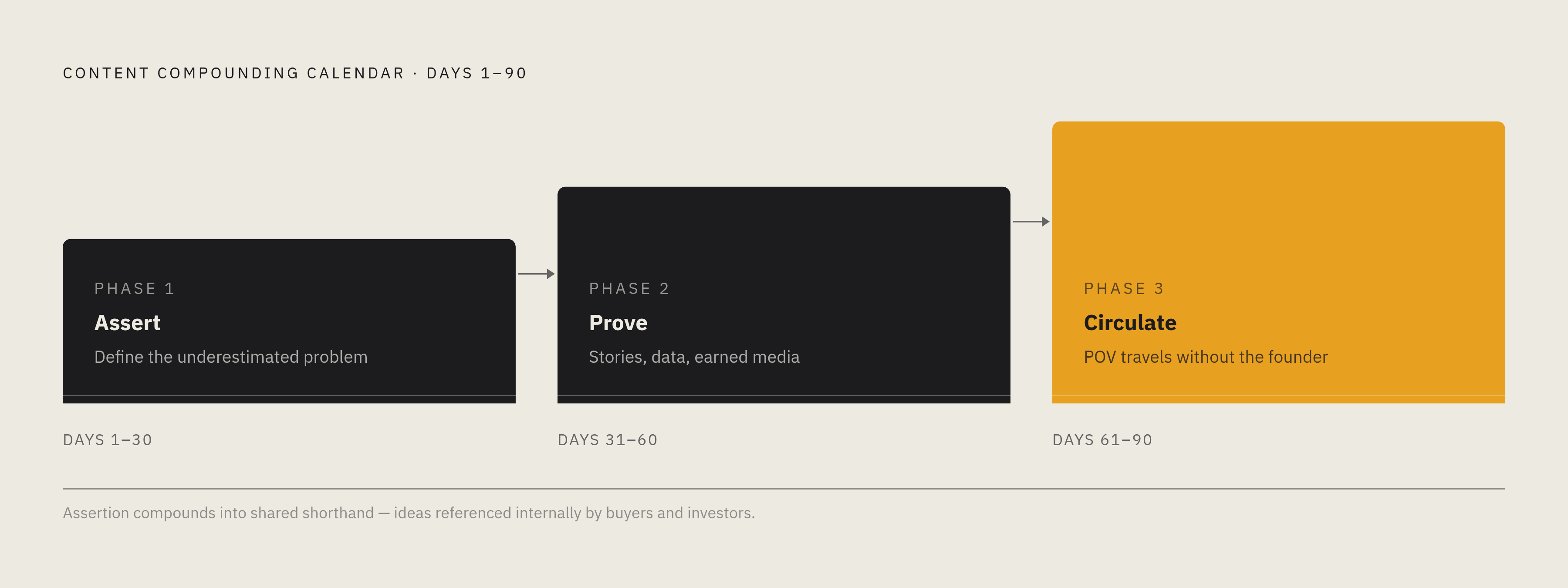
Days 1 to 30: Establish the category argument. What problem does this founder believe is underestimated? What does the prevailing wisdom get wrong? This is the intellectual foundation. Everything else references it.
Days 31 to 60: Build proof. Customer stories. Data points from the business. Earned media appearances that validate the category argument externally. You're no longer just asserting a point of view. You're demonstrating it.
Days 61 to 90: Make the POV referenceable. Content that investors and buyers can share internally as a shorthand for "this founder understands the space." The kind of post someone screenshots and drops in a Slack channel without context, because the context is already obvious.
What This Builds Toward
By the time the Series A roadshow begins, the category argument is already on record. The audience is already built. Investors arriving at the pitch have already encountered the founder's thinking somewhere. The pitch becomes confirmation, not introduction.
That's a completely different dynamic than walking in cold with a deck.
Track what matters: pipeline-sourced conversations, inbound investor interest, demo requests that reference specific content. Not impressions. Not follower counts. Those are vanity metrics. 40% of B2B marketers cite LinkedIn as the most effective channel for high-quality leads, with 62% reporting it produces leads effectively (2025 data). But only for founders who treat it as infrastructure, not a broadcast channel. Mindshare Lab, a ghostwriting agency that builds and manages LinkedIn thought-leadership programs for B2B SaaS founders on a monthly retainer, is one option for founders who want this done without pulling themselves off the product. Not a highlight reel. Infrastructure. The kind that works whether or not you're watching.