Original Research as a B2B PR and Pipeline Asset
Original data breaks through the noise when buyers are deciding which vendors to consider.
Most B2B SaaS founders are fighting for attention with the same five statistics, the same three frameworks, and the same general vibe. The competitor above you on Google? Same thing. The newsletter that just landed in your buyer's inbox? Also the same thing. This is the content echo chamber, and it is genuinely difficult to escape by just writing better. The founder who publishes data nobody else has breaks out of that echo chamber structurally. Not stylistically. Structurally. That is a different category of advantage, and it compounds in ways most founders never fully account for.
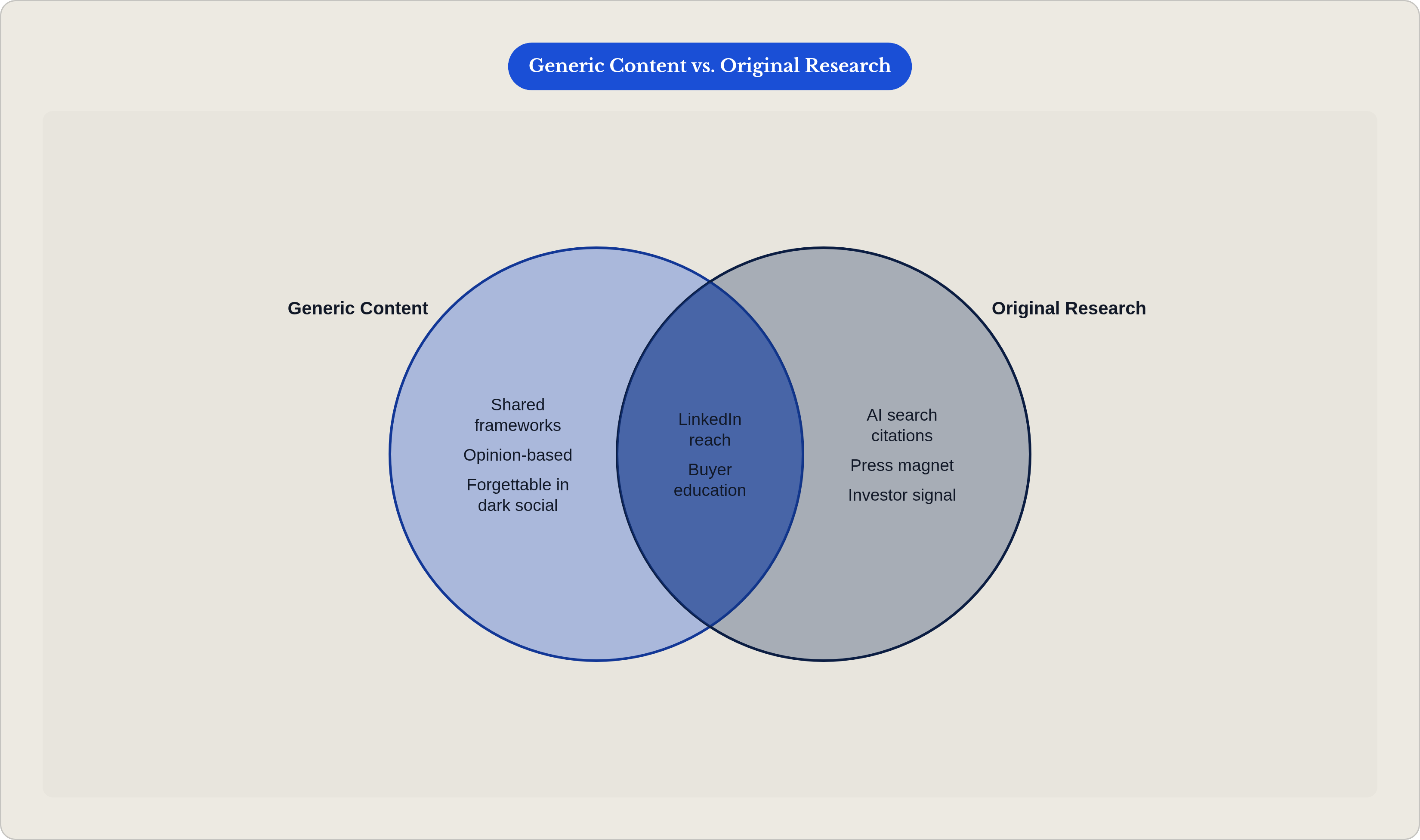
The B2B SaaS market is projected to grow from hundreds of billions of dollars in 2026 to well over a trillion by 2031. More entrants. More noise. More content fighting for the same finite slice of buyer attention. The instinct most founders follow is to produce more content. The better move is to own a dataset. A single, well-designed original research study becomes a press magnet, a backlink engine, a LinkedIn content arc, a fundraising signal, and a pipeline asset. All from one survey. That is the argument this piece makes, and it is going to walk you through exactly how it works.
Your Buyer Already Has a Shortlist. You Just Don't Know If You're On It.
Here is the uncomfortable truth about how modern B2B deals actually get done. According to 6sense's 2025 Buyer Experience Report, 80% of B2B deals are won by the vendor the buyer already favored before they ever contacted sales. And 92% of buyers begin their journey with a vendor already in mind. That shortlist forms in a phase that is almost entirely self-directed and almost entirely invisible to you.
Gartner data backs this up. Buyers spend only about 17% of their total buying time in direct contact with vendors. The other 80-plus percent is research they are doing on their own. And that percentage of self-directed research is growing. By 2025, buyers were not contacting sellers until they were 61% of the way through their journey, down from 69% a few years earlier. The influential early stage is expanding, not shrinking.
There is also a strong preference for skipping the sales rep entirely:
- 75% of B2B buyers prefer a rep-free buying experience
- Among buyers under 40, that figure rises to 89% (Gartner, 2024 survey of 750 B2B buyers)
So the content your buyer encounters in months one through four of their journey is shaping a shortlist that may not surface in your CRM until month ten. The founder who shows up in that invisible early phase with original data is answering questions no competitor can answer, because the data belongs to them. Generic blog posts are forgettable in that phase. Proprietary research is not.
The Two Distribution Channels Nobody Is Measuring (And Why That's Actually Good News)
Even when original research performs well, most founders underestimate how far it travels. There are two distribution channels that systematically escape standard analytics, and they happen to be among the highest-intent channels in B2B.
Dark social is the first one. Private sharing in Slack, Teams, email, WhatsApp. When a buying committee drops your research into their internal Slack channel with a note like "this is actually relevant to what we're evaluating," that influence is real and material. It just never shows up in your attribution report. Dreamdata's 2026 benchmarks found that the average B2B buyer journey spans 272 days across 88 touchpoints, many in private channels that standard tools cannot track. Your original data is moving through those channels whether or not you can see it.
AI search is the second one. Around 60% of B2B buyers use tools like ChatGPT or Gemini to augment vendor lists and summarize content, per Google's October 2025 research. Forrester's 2024 data puts B2B adoption of generative AI as a self-guided research source at 89%, roughly three times the consumer rate. These AI systems cite proprietary data. A founder's original survey findings surface in AI-generated answers in ways that generic opinion content simply does not. The AI needs a source. Give it yours.
The practical implication here is genuinely exciting if you think about it. Your original data earns citations in private buying-committee conversations and AI-generated research outputs simultaneously. Both compound over time. Neither shows up cleanly in your attribution model. Most founders interpret a lack of visible attribution as a lack of impact. It is not.
The Evidence on Thought Leadership's Direct Pipeline Contribution Is Stronger Than Most Founders Realize
Let's talk about what the data actually says, because the numbers here are not soft brand-awareness figures. They are pipeline numbers.
Start with the quality gap, because it matters. According to the 2024 Edelman-LinkedIn B2B Thought Leadership Impact Report (roughly 3,500 respondents), 71% of decision-makers say less than half of the thought leadership they consume delivers valuable insights. Most content is already failing the standard buyers are applying to it. Original research with proprietary data is the clearest structural fix. It gives buyers something they cannot get elsewhere.
From that same Edelman-LinkedIn study:
- 73% of decision-makers rate thought leadership as more trustworthy than traditional marketing materials
- 60% say strong thought leadership makes them more willing to pay a premium
- 75% say a compelling thought leadership piece prompted them to research a product they were not originally considering (demand creation, not just brand awareness)
- Among buyers who engaged with thought leadership that made them curious about a company, roughly 23% ultimately became customers
That last one is worth sitting with. 23% conversion from curiosity to customer is not a vanity metric. That is a pipeline mechanism.
B2B International's 2024 Superpowers Index, which studies 30 decision drivers across global B2B buyers, found that "being an active thought leader in the category" jumped from 20th to 3rd place globally. For Gen Z and Millennial buyers, it ranks 2nd. Only 25% of B2B buyers believe the brands they engage with are doing thought leadership well. No improvement from the prior year.
The gap between importance (3rd globally) and execution (75% rating brands as poor) is the strategic opening. The bar is low. The reward for clearing it is high. HubSpot's 2025 report found that companies with active thought leaders see roughly 2.7 times more qualified leads than competitors without. The market is rewarding this, and most founders are leaving it on the table.
Original Research Doesn't Just Earn Coverage. It Becomes the News Hook.
Here is how most press pitches fail. A founder writes a press release about a product update, a funding round, or a hot take on an industry trend. The journalist reads it, files it in a mental folder labeled "vendor talking about vendor stuff," and moves on. The pitch has no independent news value.
Original research changes the dynamic entirely. Journalists are roughly 3.2 times more likely to cover stories featuring original data compared to standard press releases. Over 90% of the most effective digital PR campaigns are built on data-led content or expert commentary. The study is not supporting the pitch. The study is the pitch.
A concrete example worth knowing: one B2B financial services brand's original research campaign generated thousands of links and brand mentions from unique sites, including Fox Business, The Wall Street Journal, MSN, and Kiplinger. Organic traffic grew several times over during the campaign period. But the more interesting part is what happened over time. That brand's research reports grew from earning roughly 5 to 20 citations in 2024 to 70 to 200 citations in 2026. The asset appreciated. It did not depreciate.
TopRank Marketing's 2025 B2B Influencer Marketing Report, first published in November 2024, was still earning new placement in major trade outlets in early 2026. The launch window does not close as quickly as founders assume. Asana's "State of Work Innovation" report, which surveyed knowledge workers across multiple countries, earned editorial coverage from VentureBeat and Forbes. Scale is not required. Specificity and proprietary data are.
The mechanism to internalize: every year you publish a new wave of original data, you give journalists a fresh reason to cover the same topic again, and you give analysts and buyers a reason to update their understanding of the category. The asset earns coverage on a recurring schedule rather than a single spike.
The Difference Between a Forgettable Study and a Category-Defining One
Not all research is created equal. Here is what separates the studies that become reference assets from the ones that earn a single LinkedIn post and fade.
Topic selection matters more than anything else. The study should answer the question buyers are already asking in their self-directed research phase. Not the question that validates your product roadmap. The question that has no good data source yet. Fill a genuine gap in the category's knowledge base and you become the source journalists call when they need a quote.
Naming the study matters. A named annual report signals commitment to recurring publication. "The State of [Your Category] Report" is not just a title. It is a promise to show up every year with fresh data, which is how a dataset becomes a reference asset rather than a one-time PR stunt. Asana's sample covered tens of thousands of people across multiple countries. That scale and geographic breadth were part of why the methodology held up to editorial scrutiny.
The findings need to challenge something. Research that confirms the obvious earns neither coverage nor conversation. If your data surprises a skeptical reader or contradicts a widely held assumption, you have a story. If it confirms what everyone already assumed, you have a PDF.
Your point of view must be embedded. The data alone is not the asset. The founder's interpretation of what the data means for the category is where the authority actually lives. Anyone can run a survey. Not everyone can explain what the results mean for where the category is heading.
Design for atomization before you launch. A single dataset should visibly break into at least six formats before the survey even goes out:
- A primary report
- A LinkedIn post series (one finding at a time)
- Media pitches with an exclusive angle for top-tier targets
- A webinar or live Q&A
- A sales enablement one-pager
- A slide or data point for the investor narrative
Plan those outputs first. Then design the survey to feed all of them.
LinkedIn Is Where the Data Reaches Buyers Who Will Never Visit Your Blog
Personal LinkedIn profiles generate roughly 7 times more impressions and 4 times more engagement than company pages. The founder's voice carries the data further than the brand account ever will. This is not a knock on brand accounts. It is just a fact about how LinkedIn distributes content.
Research is not a single post. It is a content arc that can run for weeks:
- A teaser before launch (what you're studying and why it matters)
- Individual finding reveals (one surprising data point per post)
- The founder's interpretation of what the data means
- Coverage shares when press hits land
- A "one year later" revisit when the next wave of data is coming
Each finding becomes a standalone opinion post. The data point is the evidence. The founder's interpretation is the content. That combination is what builds category authority, not just awareness.
The dark social effect activates here too. When the founder posts original data with a clear, shareable framing, buying committees forward it internally. The data compounds in private channels where you have no visibility but where purchase decisions are actually being made.
Two practical things on distribution:
First, tag journalists, analysts, and category influencers who are already covering the topic. LinkedIn distribution can trigger earned media when the right people see the data in their feed. Second, do not gate everything. The full report can sit behind a form for lead capture. But the most compelling findings must be free and shareable. Gating everything kills the dark social circulation and removes the content AI systems need to cite your work.
74% of B2B purchasing decisions are now influenced by original research. That influence is most accessible when the data is in the format buyers already consume daily, not buried in a PDF that requires an email address to unlock.
Investors Notice When a Founder Owns the Category's Data
Here is something that does not get discussed enough in the content strategy conversation. Original research is a fundraising signal.
Investors are evaluating whether a founder understands their category deeply enough to shape it. Publishing proprietary data and earning press coverage from it is a demonstrated claim to that authority. Not a stated claim. A demonstrated one. That distinction matters enormously in a room with a skeptical investor.
Global SaaS investment reached $159 billion in 2024 (Sapphire Ventures), with $38.6 billion deployed across 2,143 deals in North America in the first half of 2024 alone. Investors are choosing between a lot of technically similar products from technically credible founders. The founder whose name is attached to the category's defining dataset arrives in that room with third-party validation that no pitch deck language can replicate.
There is also a direct narrative use case. Research findings that quantify the market problem your product solves translate directly into TAM framing and urgency arguments inside a pitch deck. You are not just claiming the problem is big. You are citing your own data to prove it.
Thought leadership budgets increased 53% in 2024 (Thought LDR Report). Investors are watching whether founders treat content as a strategic lever. Commissioning original research and putting it to work across press, LinkedIn, and sales signals exactly that kind of intentionality.
The Operational Mistake That Wastes the Entire Asset
Most founders treat original research as a launch event. They commission the study. They publish the PDF. They send the launch email. They move on.
This is the single most common way to destroy the value of an asset that took months and real budget to create.
The compounding evidence is clear. The financial services brand that grew from a handful of citations to hundreds did it across multiple annual iterations of the same report. The journalists who cover your study this year become contacts you can call next year. The AI systems that index your findings now will encounter your next wave of data when you publish it. Annual cadence is not just a content calendar decision. It is the mechanism by which a founder becomes the authoritative source of record on a category question.
The operational model that actually works looks like this:
Before launch: Design the survey to feed every distribution format. Identify five to ten journalists and analysts who cover the category. Plan the LinkedIn arc by finding specific data points in the survey results that will each become standalone posts.
At launch: Release with a media embargo to top-tier targets so they have time to write the story before it goes public. Send the full dataset to analysts. Post the first finding on LinkedIn.
Weeks two through six: Roll out the remaining findings as individual posts. Share press coverage as it lands. Run the webinar. Hand the sales enablement one-pager to your team.
Ongoing: Track backlinks earned, media mentions, LinkedIn engagement by post, gated report downloads, and pipeline sourced from content. Not just launch-week traffic, which tells you almost nothing about long-term value.
Year two: Launch the new wave with a comparison to last year's findings. The delta between this year and last year is itself a story. That story earns new coverage. The cycle accelerates.
High-growth SaaS startups allocate up to $140,000 annually to thought leadership SEO. Original research is the highest-leverage single investment within that budget because it generates the data that every other content format can use. One dataset, six or more content formats, near-zero marginal cost for each additional use.
After two or three annual iterations, something genuinely useful happens. The report's name becomes the category's reference point. Buyers cite it without being prompted. Journalists pull it without being pitched. Investors ask about it in diligence calls. That is what mindshare actually means in practice. And it starts with one well-designed survey.