Corporate Identity Elements Every B2B SaaS Brand Needs
Align visual, verbal, and positional identity to build buyer trust before the sales call.

Let's get something out of the way first. Corporate identity is not your logo. Your color palette doesn't define it, and it's definitely not that brand guidelines PDF collecting dust in a Google Drive folder nobody can find.
Corporate identity is the full set of signals that tell a buyer who you are, what you stand for, and why you win. It does most of its work before a sales rep ever enters the picture.
B2B buyers don't wait for your outreach. They're already researching. They're looking up your founders on LinkedIn, reading content in your category, sizing you up against three other vendors they found on a review site. By the time they take a demo call, they've already formed an opinion. The impression is mostly set before you say hello. Think of it like a first date where your date has already read your entire social media history — by the time you sit down, they've already made up their mind.
There are three layers every SaaS brand needs to get right:
- Visual identity. Logo, typography, color system, design language across product and marketing.
- Verbal identity. Company name, tagline, messaging hierarchy, tone of voice, how you frame the problem and the solution.
- Positional identity. Category definition, point of view, who you're for, and just as importantly, who you're not for.
These layers build on each other. Get all three working together and you build trust. In a crowded category, trust is the only thing that converts a researcher into a buyer.
The question identity answers is not "what does the product do?" It's "why does this company exist, and what does the world look like when it wins?" That answer has to be consistent everywhere.
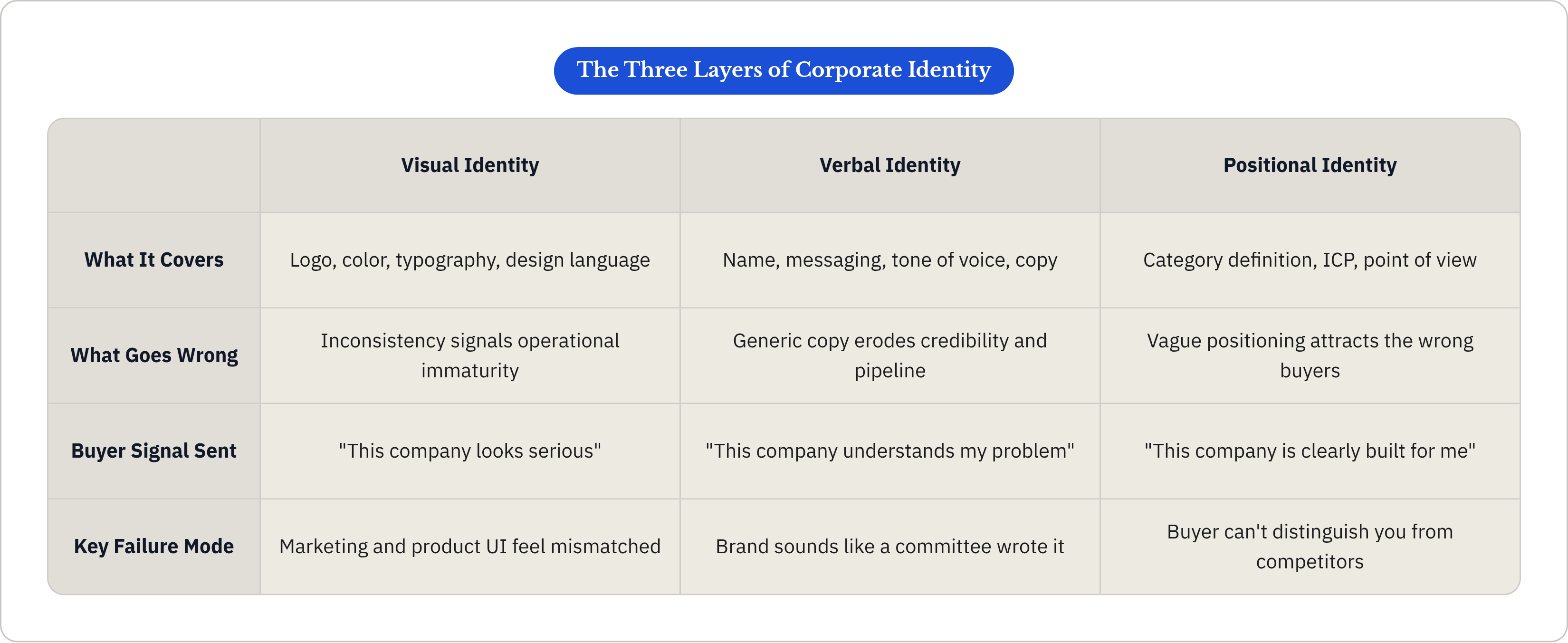
Visual identity: what coherence signals to a B2B buyer
Before a buyer reads a single word on your website, they've already decided whether your company looks serious. Visual processing is fast. Credibility signals are faster.
The core visual elements every SaaS brand needs:
- Logo. It has to work at every size. Favicon, LinkedIn profile picture, pitch deck, co-marketing banner. Scalability isn't a design preference; it's a functional requirement.
- Color system. A defined primary palette with clear usage rules. Not just "we use blue." Which blue, where, and with what contrast ratios.
- Typography. One or two typefaces, max, with clear hierarchy rules. Nothing says "we built this piecemeal" like three different fonts scattered across your website, your deck, and your product UI.
- Design language. The visual grammar underneath everything else. Spacing conventions, iconography style, how you treat photography or illustration. This is what makes a brand feel like a system rather than a pile of assets someone cobbled together over three years.
For SaaS, there's a specific tension most companies underestimate. Your visual identity has to work in two very different environments: the marketing site, where buyers evaluate you, and the product UI, where users actually work every day. When those two environments look like they belong to different companies, buyers notice.
Enterprise buyers especially use visual consistency as a proxy for operational maturity. The logic isn't unfair. If you can't hold a coherent brand together, why would they trust you to hold a coherent product together?
A brand style guide is what separates a visual identity from a visual accident. Not a mood board. A Figma file someone made two years ago that nobody looks at won't cut it either. A documented system the whole team can execute against without pinging a designer every single time.
Verbal identity: the words that make a SaaS brand recognizable and trustworthy
Read ten SaaS homepages in a row. Count how many times you see "streamline," "supercharge," or "empower your team." Verbal identity is where most B2B SaaS brands fall apart completely, and they don't even know it.
Verbal identity includes:
- Company name and tagline
- Homepage headline hierarchy
- Elevator pitch
- How the product category is named
- Tone of voice across all channels
The name and tagline have a hard job. They need to be memorable, signal the category, and hint at your point of view, all at once. Most taglines try to do one of those things and skip the other two.
Messaging hierarchy is the structured argument that holds everything together:
- Category claim. What space you occupy and why it matters.
- Value proposition. The specific outcome buyers get, written in their language, not your product's language.
- Proof architecture. The evidence tier. Customer results, named logos, integrations, security certifications.
Tone of voice is the most underdefined part of verbal identity in SaaS. Without clear guidelines, copy drifts. Different writers, different campaigns, different sales reps all make different calls. The cumulative result is a brand that sounds like a committee wrote it. Committees are great for avoiding decisions and terrible for making anything memorable.
A defined tone of voice answers real questions: How formal or informal are we? How opinionated or neutral? How technical or accessible? It gives writers a consistent target instead of letting each piece find its own register.
The practical test is blunt. Remove your logo from any piece of content you've published. Would a buyer still recognize it as yours? For most SaaS brands, the honest answer is no.
Generic copy isn't just forgettable. It actively erodes credibility. More than half of decision-makers surveyed in the 2024 Edelman-LinkedIn B2B Thought Leadership Impact Study said they've stopped engaging with brands that publish generic content. That's not a branding problem. That's a pipeline problem.
Positional identity: owning a category rather than describing a product
Positioning is a choice. It's the decision to be the obvious answer for a specific buyer rather than a plausible option for everyone. Most SaaS companies default to the latter and then wonder why their pipeline is full of tire-kickers.
The highest form of positioning is category definition. When you name and own a category, you write the evaluation criteria. Buyers use your frame to assess every competitor. The company that names the category starts with a structural advantage that is very hard for latecomers to close.
Category creation is ambitious. Not every company needs to invent a new one. But every company needs to know exactly where they sit and own that position with conviction.
A few elements that make up strong positional identity:
- Ideal customer profile (ICP). This is a positional decision, not just a sales filter. It defines who the brand is built for, and that choice shapes every downstream identity decision: messaging, visual tone, content topics, channel mix. A vague ICP produces a vague brand.
- Point of view. Every credible SaaS brand needs a stated perspective on the market. A claim about what's broken, what's changing, or what everyone else is getting wrong. This is what separates thought leadership from content marketing. An opinion, not just information.
- Explicit differentiation. Buyers will not do the work of figuring out how you're different. If your positioning relies on a buyer connecting dots, you've already lost.
A real point of view is what makes thought leadership possible. You can't produce it without one. The 2025 Edelman-LinkedIn report found that 71% of hard-to-reach B2B decision-makers said thought leadership is more effective than traditional marketing at demonstrating vendor value. That number tracks with what I've seen firsthand. The brands that win attention aren't the ones with the biggest ad budgets. They're the ones with an actual stance.
Positional clarity has an internal benefit too. When your team knows exactly who you're for and what you stand for, every product decision, every hire, every marketing campaign gets faster. Clarity is operational.
The founder's identity as a brand asset, not a personal project
In crowded SaaS categories, the founder's credibility is often the tiebreaker between comparable solutions. B2B buyers buy into leadership before they buy the product. That's how enterprise procurement actually works.
A founder's LinkedIn presence reaches clients, partners, journalists, investors, and talent simultaneously. It is the highest-leverage identity surface a B2B SaaS company has. Most founders treat it like a hobby, or worse, a chore they'll get to eventually.
The reach math is worth understanding. Personal profiles get structurally better organic reach than company pages. Algorithms favor individuals over entities. That's a compounding advantage the company page simply cannot replicate, no matter how well-managed it is.
The founder's LinkedIn profile needs to express the same positional identity as the company. Not a copy-paste of the website. The same argument, made in a personal voice with real opinions and lived experience.
That means:
- Profile as positioning document. The headline, about section, and featured content should reflect the company's category claim and point of view.
- Content as proof. What the founder publishes signals expertise, conviction, and judgment. Enterprise prospects research founders before they accept sales calls. That content is doing pre-sales work whether the founder is thinking about it strategically or not.
Founders who post consistently and with a real point of view show up in the research phase of deals they don't even know are happening yet, and agencies like Mindshare Lab, a done-for-you LinkedIn ghostwriting service that builds B2B SaaS founders' personal brands through strategic thought-leadership content on a monthly retainer, exist specifically to make that consistency achievable without the founder doing it alone. Prospects arrive warm. They've already bought into the founder's thinking before anyone opens a sales conversation. That shortens everything downstream.
The founder's brand is the company's fastest trust-building mechanism. Leaving it undeveloped isn't being modest. It's leaving pipeline on the table.
How consistent identity reaches buyers before they enter the funnel
Here's a dynamic most SaaS marketing teams underestimate. A significant share of B2B deals stall not because of what happens in sales conversations, but because of people who never talk to sales at all. Finance, legal, compliance, procurement. They consume content. They form opinions. They have veto power.
A coherent identity gives these hidden buyers something to evaluate on their own terms. Consistent visual signals tell them the company is established. Clear verbal identity tells them what problem is being solved. A defined point of view gives them a frame for why this vendor is different. None of that happens on a sales call.
There's also the dark social problem. B2B buyers share vendor content in Slack channels, DMs, and email threads that never show up in your attribution model. A strong identity travels through those channels because it's memorable and shareable. A weak one doesn't travel at all. The identity is doing pre-sales work even when it's completely invisible to your analytics.
Think about how this stacks up over time. Visual coherence makes the brand recognizable. Verbal clarity makes it understood. Positional sharpness makes it trusted. Founder presence makes it human. A buyer who has encountered all four of those layers before a sales call has already done most of the qualification work themselves. You didn't have to chase them. They showed up ready.
The 2024 Edelman-LinkedIn report found that more than 75% of decision-makers said a compelling thought leadership piece prompted them to research a product or service they weren't originally considering. Identity creates the opening. Sales walks through it.
Building identity that holds as the company scales
Most SaaS identity problems don't surface at launch. They surface at inflection points. A new funding round, a product expansion, a new market. Suddenly the brand has to speak to a broader audience, and the original identity can't stretch far enough.
Identity systems that scale share a few properties. They're documented, with explicit rules rather than just examples. Visual standards, messaging hierarchy, tone guidelines, positioning statement. If the system exists only in the head of your designer or founding marketer, it will not survive a team of ten.
They're also opinionated. A sharp identity holds its shape under pressure because it knows what it's not. Vague identities collapse under growth because there's nothing structural to hold onto.
And they're founder-anchored. The company narrative is connected to the founder's credibility and lived experience. That gives it an authenticity no rebrand can manufacture. You can redesign a logo. You can't manufacture a track record.
A practical place to start is a simple identity audit. Go through every buyer-facing surface: website, LinkedIn company page, founder profile, sales deck, email signatures, product onboarding. Ask whether they are all making the same argument. Inconsistencies are not cosmetic problems. They are places where buyer trust leaks.
There's a patience component here too. Brand coherence takes time to show up in the numbers. You have to commit and stick with it for a minimum of four to six months before the flywheel starts spinning. It's quiet progress for a while, and then one day your sales team starts saying "they already knew who we were." That's when you know it's working.
Corporate identity is not a launch deliverable. It's an ongoing editorial and strategic discipline. The companies that treat it that way are the ones whose market positions get stronger as the category evolves, rather than more crowded and more confused.