Earned Media Amplification Strategies for B2B SaaS Content
Hidden buyers decide B2B deals through content most salespeople never see.

Buyers are skeptical by default. They've been sold to enough times that anything coming from a company's own website gets mentally filed under "well, they would say that, wouldn't they?" Third-party validation does something a company page simply cannot: it shows up through a channel the buyer already trusts, before the sales process even starts.
That's the whole job of earned media. Not to close deals. To be trusted before the deal starts.
Here's the timing problem most founders miss: the majority of potential buyers aren't in-market right now. So the goal of amplification isn't to convert people today. It's to be the name they already associate with credibility when they eventually do become ready. That's a patience game. Most founders aren't playing it, partly because it's genuinely uncomfortable to invest in something with no visible return for months, and partly because nobody's dashboard shows "trust built with a procurement manager who hasn't started evaluating tools yet."
There's also a structural problem that makes this harder than it looks. Research from the 2025 Edelman-LinkedIn B2B Thought Leadership Impact Report introduced the concept of the "hidden buyer." More than 40% of deals stall not because the champion lost interest, but because of internal misalignment among stakeholders in finance, legal, compliance, and procurement. People the selling team never actually talks to.
These hidden buyers are not passive. They're consuming content, forming opinions, and sometimes killing deals over a Tuesday afternoon Slack thread, without ever appearing on a call. According to the same research:
- About 63% of them spend more than an hour per week consuming thought leadership
- 81% say high-quality thought leadership helps them recognize challenges they hadn't previously identified
- Nearly 95% say strong thought leadership makes them more receptive to outreach from that vendor
That last one deserves a real pause. Almost every hidden buyer says good content makes them more open to the sales conversation. That's not a soft brand outcome. That's deal velocity. And it's the kind of finding that should completely reframe what you think amplification is for.
So amplification isn't just about reaching the known buyer who's already on a call with your sales team. It's about reaching the full room of people who will either approve the deal or quietly kill it. Earned media is the format best suited to doing that, because it travels through trusted channels rather than vendor channels. But only if it actually reaches them. Getting coverage and then not amplifying it is genuinely one of the more frustrating things I see founders do, because the hard part is already done.
LinkedIn as the primary amplification surface for earned media
If you're going to systematically amplify earned coverage anywhere, LinkedIn is the answer. Not a close call. The platform holds tens of millions of decision-makers, senior-level influencers, and C-suite executives. This is where categories get formed and where vendors get evaluated before any salesperson gets involved.
Two things are worth getting straight before you do anything else.
First: founder accounts outperform company pages. Personal profiles generate higher engagement than company pages, consistently, across every study I've seen on this. The algorithm favors individuals because personal posts read as conversation. Company posts read as advertising. LinkedIn knows the difference, and so do readers. This is not a subtle gap.
Second: external links hurt your distribution. Sharing a press mention by dropping the URL into a post and saying "check this out" is actively penalized by the platform. The coverage has to come onto LinkedIn natively, or you're doing the work of earning it and then paying a tax for trying to share it. It's a deeply annoying design choice, but it's consistent, and ignoring it has real costs.
Here's what native amplification actually looks like:
- Pull the sharpest finding from a press mention and write it as a standalone observation. Give context. Add your take. Leave out the outbound link.
- Summarize a podcast appearance as a carousel in PDF format, where each slide carries one distinct takeaway. Carousels earn some of the highest engagement rates of any format on the platform.
- Take a quoted line from a media piece and use it as the opening hook for a full post that develops the idea further. The article becomes a launching pad, not the destination.
Researcher Richard van der Blom documented in 2025 that organic views were down year-over-year while engagement per post was actually up. The platform is rewarding depth. Posts that make a real argument outperform posts that merely announce something.
The practical difference looks like this: a founder who posts "Excited to be featured in Forbes!" gets algorithmic suppression and maybe a polite like from their mom. A founder who builds a 200-word post around the central finding of that Forbes piece, connecting it to something their audience actually wrestles with every week, gets reach. Same coverage. Completely different outcomes. The asset is identical. The framing is everything.
Building a repeatable system for distributing each piece of coverage
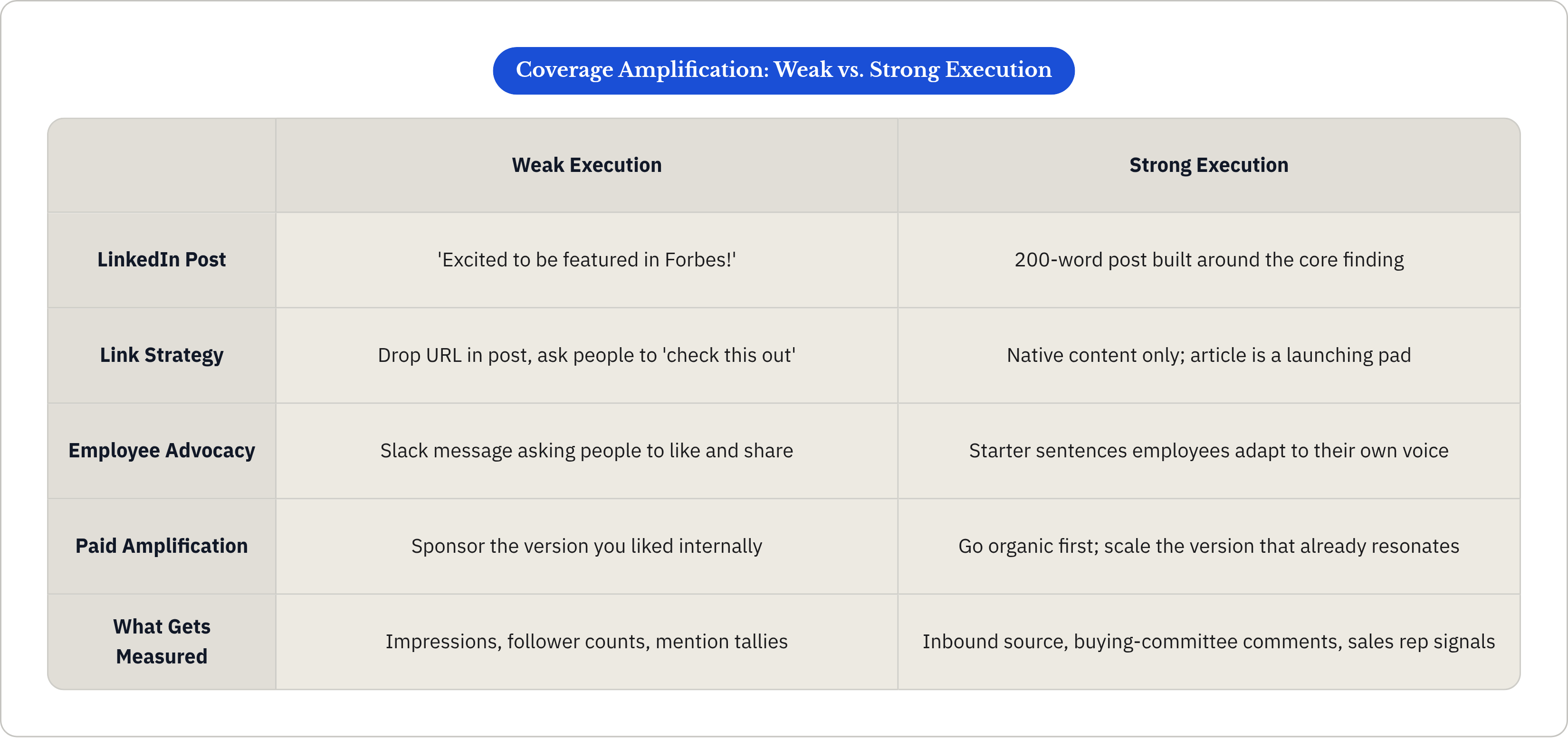
Most founders treat coverage as a single event. A system treats it as raw material.
Every time a piece of earned media lands, the process should be the same. Start with what I'd call a coverage audit: what was the core claim the piece made, what evidence did it use, and what does that actually mean for the buyer's world? Those three questions are your inputs. Everything else flows from them.
From a single placement, you can generate:
- A LinkedIn text post. The argument the coverage validated, written from your point of view. Lead with the problem, not the fact that you got coverage.
- A carousel. The reasoning or framework the coverage surfaced, broken into one idea per slide.
- Short-form commentary. A direct quote or finding, followed by a plain-language "here's what this actually means" take.
- An email to customers or prospects. Coverage embedded as social proof inside a genuinely useful update. Not a brag. An update.
- A sales enablement snippet. One sentence your reps can drop into proposals or discovery calls without it sounding forced.
Sequencing matters more than most people expect. Avoid publishing everything at once. Space these out over days or weeks, and make each one add a new layer of context rather than just restate the same point in a different format. You're building a thread of perspective, not flooding someone's feed with the same news five times.
The framing mistake most founders make: they post "we were featured in X" as if the feature is the message. It isn't. The message is the insight the feature surfaced and why it matters for the buyer's world. The coverage is evidence. The insight is the story. I've watched this mistake kill genuinely strong placements, because the founder treated the coverage as a trophy instead of a starting point.
Storylane is a useful reference point here. More than half their pipeline traced back to LinkedIn, not from announcing press, but from building consistent, perspective-driven content that turned company thinking into genuinely useful posts over time. The coverage was the fuel. The system was the engine.
How employee advocacy multiplies the reach of earned coverage
The founder's network has a ceiling. At some point, you're preaching to an audience that already knows you. Getting coverage in front of buyers who've never heard of you means traveling into adjacent networks, and that's where employee advocacy actually earns its keep.
When team members engage with and share coverage-derived posts, that content reaches their connections. An engineer's reaction to an analyst quote reaches their professional network, which includes buyers and practitioners the founder doesn't know yet. The founder's post about the same quote stays inside the founder's orbit. These are genuinely different rooms full of genuinely different people, and most amplification strategies completely ignore that.
There's also a cultural dynamic worth naming directly. Companies where C-suite executives actively post see notably higher employee participation. The founder's own behavior sets the ceiling. If you want your team to amplify, you have to go first and keep going without treating it as a project that ends after two weeks. Teams notice when leadership stops posting. They take their cues accordingly.
What effective advocacy looks like versus what it usually looks like:
- Weak: Sending a Slack message asking people to "like and share" the company post
- Strong: Giving employees two or three starter sentences they can adapt and post from their own perspective, making the coverage relevant to their specific audience rather than just the company's
Personal profiles consistently outperform company pages on engagement. Ten employees each posting a genuine reaction to the same coverage outperforms ten company-page reshares by a wide margin. Templated, robotic reposts defeat the purpose. Buyers can smell copy-pasted advocacy, and it registers as the opposite of credibility.
Practical implementation:
- Prepare two or three "starter sentences" per coverage piece. Not scripts. Starting points employees can make their own.
- Identify the two or three team members whose networks include the most buyer-adjacent contacts and prioritize them specifically.
- Leadership has to participate. If only junior employees are asked to share, it reads as a performance exercise, not a culture.
Using paid amplification to extend coverage to buyers outside the founder's organic reach
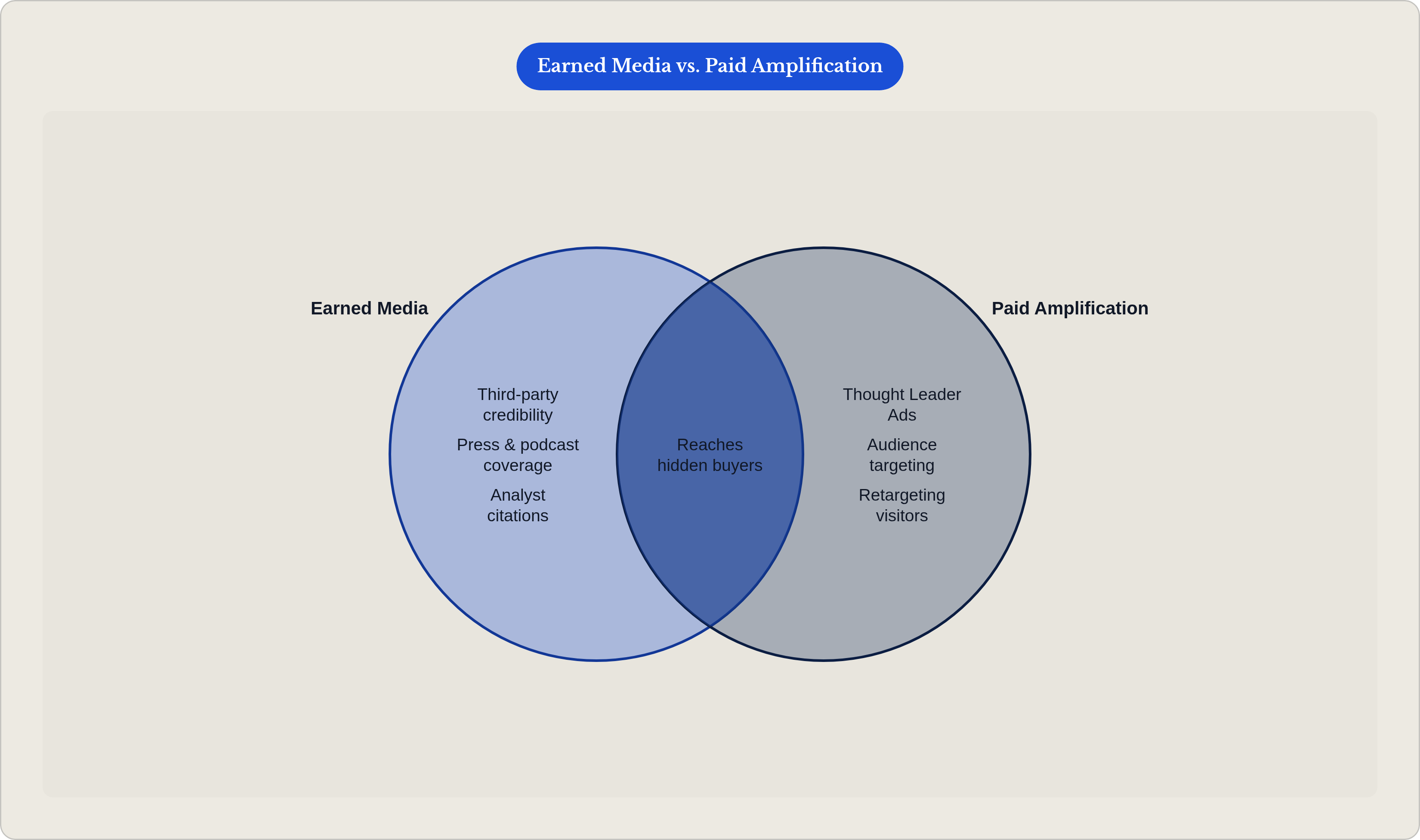
Organic reach is bounded by who already follows you. Paid reach isn't. That's it. That's the whole argument for paid amplification.
LinkedIn's Thought Leader Ads format is the right tool here. Instead of sponsoring content from a company page, it sponsors content from a personal profile. This preserves the credibility signal that personal accounts carry while buying distribution into audiences the founder's organic network can't reach on its own.
The earned media input matters a lot for this. A Thought Leader Ad built around a third-party quote or analyst finding is structurally different from a product claim ad. It's the founder presenting someone else's signal of credibility, rather than asserting it directly. That distinction reads immediately to buyers, especially the hidden buyers in finance and legal who are professionally trained to filter promotional content. They've seen every version of "we're the leading solution for X." They have not necessarily seen an analyst finding presented by a founder with a clear point of view about what it means.
LinkedIn CPCs run several times higher than Google Ads. That sounds like a problem until you look at lead quality. B2B leads from LinkedIn consistently outperform leads from other social platforms by a wide margin on pipeline quality, not just volume. The math works when the content is genuinely useful and the targeting is tight.
Targeting principles for coverage amplification:
- Job title and seniority: Aim at the full buying committee. Include finance, legal, and compliance titles. Those are your hidden buyers.
- Company size and industry: Constrain spend to accounts that could plausibly close. Don't spray.
- Website retargeting: Use coverage-derived content as a follow-up touch for visitors who already showed intent.
One more thing on sequencing: go organic first. Test which version of the coverage earns genuine engagement from real people. Then put paid spend behind the version that's already working, not the one you personally liked best. Let the audience tell you what resonates before you pay to scale it. Founders who skip this step end up paying to amplify the version of the story that felt right to them internally, which is almost never the version that actually lands.
When you include a media logo or analyst firm name in the ad creative, it signals legitimacy in a way a product screenshot simply cannot. The coverage is working twice at that point.
Compounding coverage into category authority over time
A single coverage event doesn't build authority. The pattern of coverage, consistently amplified over time, does. This is the part that requires the most patience and gets the most founders to quit right before it starts working. I've seen it happen enough times that I'd almost call it a law.
The flywheel goes like this: coverage earns new followers. Those followers engage with your ongoing content. Engagement signals attract more buyers into your orbit. A larger, more engaged audience attracts more media attention, more podcast invitations, more analyst conversations. Which leads to more coverage. Which starts the cycle again. It's boring to describe and genuinely powerful when it's running.
beehiiv is a good example of what this looks like at scale. Tyler Denk's consistent build-in-public content meant that when a new investment round opened, it filled in a single day. Not because of one announcement, but because months of compounding content had already built the trust. The announcement was the last step, not the first. Most founders try to make the announcement do all the work that should have been done in the months before it.
Building this takes longer than most founders want to wait. It generally doesn't start working until you've committed to the system for four to six months at minimum. Before that, it feels like posting into a void. That feeling is real, and it's also temporary.
The trajectory roughly looks like this:
- Months one and two: Amplifying existing coverage as posts and derivatives. Building the habit, mostly for yourself.
- Months three and four: Coverage-derived perspective starts attracting inbound. Journalists, podcast hosts, and analysts have seen your consistent point of view and want access to it.
- Months five and six: You're being cited, not just quoted. The vocabulary of your category starts carrying your framing.
The 2025 Edelman-LinkedIn report found that roughly 79% of hidden buyers say they're more likely to advocate for a vendor's proposal internally if that vendor consistently produces high-quality thought leadership. More than half of those same buyers say strong content can outweigh brand recognition alone. For challenger SaaS brands that lack decade-old name recognition, that's a real structural opening. Not a consolation prize for not being Salesforce. An actual opening.
What earned media amplification looks like when it's working, and how to measure it
The failure mode here is optimizing for the wrong things. Impressions. Follower counts. A media mention tally on a slide deck. None of those tell you whether you're building pre-sales trust with the actual buyers who matter. Founders do this constantly because those numbers are easy to pull and they look like progress. They are not progress. They're a proxy that stops being useful the moment you mistake it for the real thing.
Here's what working actually looks like in practice.
Leading indicators (the early signals):
- Inbound messages from buyers who reference specific content. ("I saw your take on X and wanted to reach out.")
- Coverage-derived posts generating comments from job titles in the buying committee, not just peers and friendly competitors
- Media and podcast inbounds that cite your point of view, not just your company name
- Sales reps reporting that prospects mention the founder's content before or during discovery calls
Lagging indicators (the compounding has taken hold):
- RFP invitations from companies that weren't in your existing pipeline
- Shorter time-to-first-meeting with cold outreach sequences
- Pricing conversations that start with noticeably less friction
On the conversion side, research consistently shows that a meaningful portion of decision-makers who discover a new vendor through thought leadership eventually start doing business with that vendor. The coverage amplification system feeds that funnel, even when you can't see it happening in real time. That invisibility is the hardest part. The data is there. You just can't watch it accumulate in the moment.
What to skip measuring: raw post reach, follower growth in isolation, or media mention counts that don't track whether the right people actually saw them.
The discipline that makes measurement useful is simple and easy to skip: note where inbound conversations originate. Tag them in your CRM. Ask new leads where they heard of you. Do it every time, without exception. Over time, the chain from coverage to amplification to pipeline becomes visible. Without that practice, you're flying blind with expensive data you can't actually use.
Earned media amplification isn't a campaign with a start and end date. It's an operating rhythm. Founders who build it into their weekly practice stop chasing individual placements and start stacking them. Some outsource that weekly discipline entirely: Mindshare Lab, a ghostwriting agency that builds B2B SaaS founders' personal brands through LinkedIn thought-leadership content on a monthly retainer, exists precisely to keep that rhythm running without the founder having to drive every post themselves. The coverage stops collecting dust and starts doing something.