Market Research Methods for B2B SaaS Companies
Sixty-one percent of B2B SaaS decisions happen before vendors hear from buyers.

B2B SaaS buying doesn't work the way a lot of founders think it does. Buyers do most of their homework before a vendor ever hears from them: per the 6sense 2025 B2B Buyer Report, 61% of purchase decisions get made before any provider contact happens. That means the research question is less about how to reach buyers and more about understanding what they've already decided by the time they show up.
Layer that on top of a market that's ballooning. Global B2B SaaS was valued at $497.41 billion in 2025 and is projected to hit $4,441.49 billion by 2034, growing at a 27.54% CAGR. More money, more competitors, more noise. And the call isn't made by one person — it's a buying committee, each with their own objections, priorities, and pet peeves about your onboarding flow.
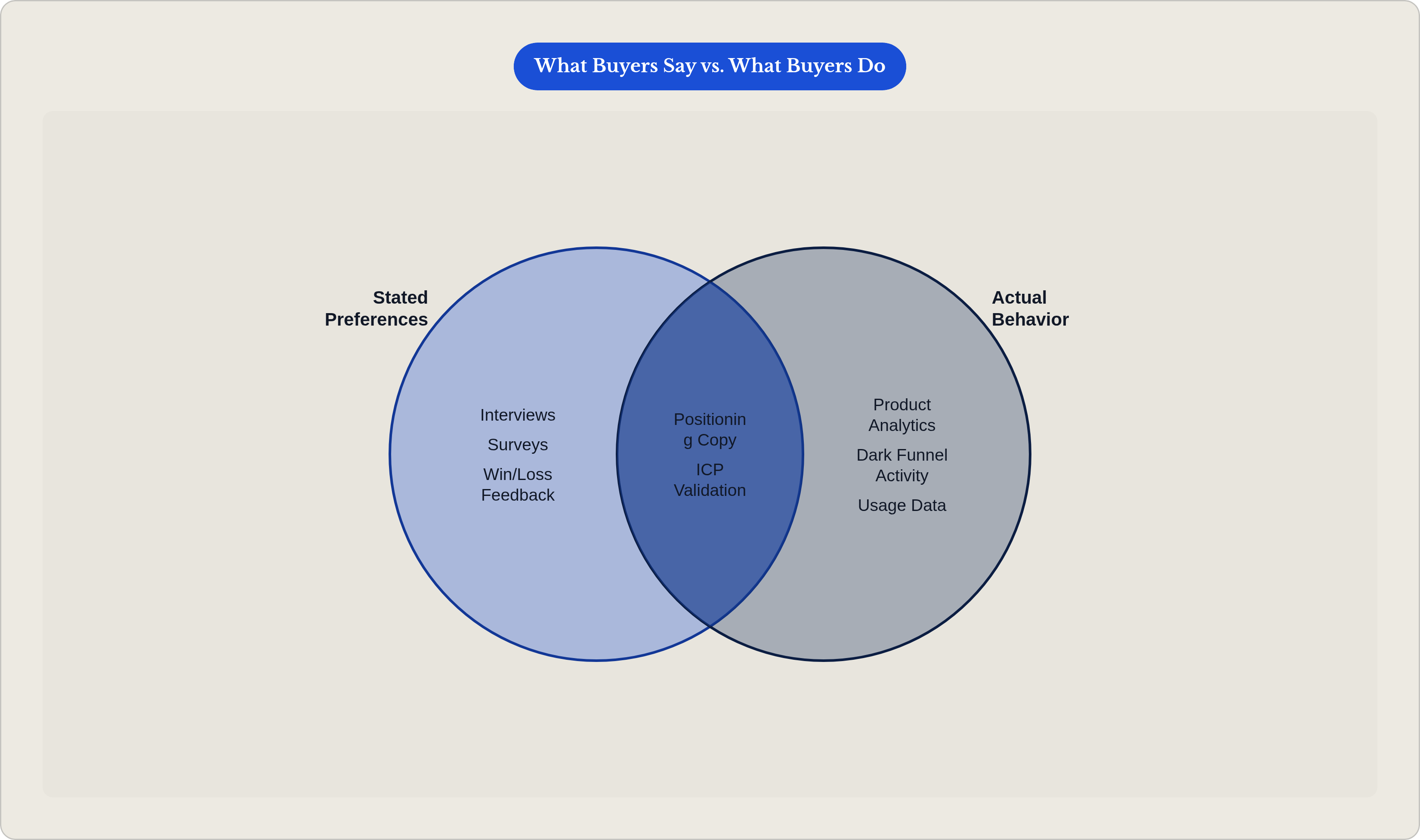
So generic surveys and desk research won't cut it. They'll tell you the market is big (thanks, we knew that) but not how buyers think, what triggers them to start looking, or why you did or didn't make the Day One shortlist. Real research in this category has to capture two different things at once: what buyers say they want, and what they actually do. Those two things disagree more often than you'd like.
Here's the frame for everything that follows: market research for B2B SaaS works best as a stack of methods rather than a single one. Each layer answers a question the others can't.
Customer interviews as the foundation — and why most founders do them wrong
Interviews go first because they surface the questions you didn't know to ask. Surveys are great at measuring things you already have a hypothesis about; they're weaker at finding the hypothesis in the first place. Interviews are where you learn what triggered a buying cycle, what words buyers actually use to describe their pain, and who else they looked at before you.
Most founders blow this by asking customers what they want instead of what they did. "What features would you like to see" gets you a wish list, and a wish list rarely reflects the truth. Use jobs-to-be-done framing instead, and interview the decision, not the product. Ask what prompted them to start looking. Ask what they were using before. Ask who else sat in the room. Ask what almost made them pick someone else. That last question is worth its weight in gold, and most founders never ask it because they're scared of the answer.
Order matters too. Talk to recently churned customers first; they'll tell you where the story broke down. Then talk to recent wins, especially competitive wins, because that's where you learn what actually tipped the scale. Lost deals show you positioning gaps and how a competitor is framing the fight. And within the same account, talk to both the power user and the person who logs in twice a month, because they will tell you two completely different stories about the same product.
A few practical notes. Stop counting interviews and start counting themes; once you hear the same thing three times, you've hit saturation, and that's your signal to stop, rather than some arbitrary number like "12 customers." Record and transcribe everything, because the exact phrases customers use will end up on your landing page whether you plan for that or not. And resist the urge to ask about features. Keep the conversation on their problem and their process.
One thing interviews can't do: show you behavior in the wild. They're retrospective, self-reported, and people are famously bad narrators of their own decisions. That's what the next methods are for.
Surveys that generate usable data rather than noise
Run surveys after interviews, not before. Interviews give you hypotheses. Surveys test whether those hypotheses hold up across a bigger group of people. Skip the interviews and run a survey cold, and you'll get clean, confident answers to questions that have nothing to do with how people actually buy.
A few survey types actually earn their keep here. Win/loss surveys, short and automated, sent the moment a deal closes or dies, catch the decision factors while they're still fresh in someone's head. ICP validation surveys check whether the customer profile you assumed lines up with who's actually buying and getting value. NPS surveys matter less for the number than for the open text box next to it; that's where the positioning language lives. And buying process surveys map who got involved, what content they read, how long the whole thing took, filling in the part of the journey that happens before you ever get a phone call.
Keep it under ten questions. Every question past that tanks your completion rate, and nobody wants to fill out your homework assignment. Use forced-choice and ranking for priorities, and save open-ended questions for the moments where language itself is the point. And be careful who you survey; blasting your entire user base when your real buyer is a narrow slice of it just gives you an average that describes nobody.
What surveys can't do: show you actual behavior. They capture what people say, not what they do, and they're largely blind to the research buyers do in private before they ever talk to you. That invisible research activity has a name, and it's a problem worth its own section later.
Competitive intelligence as a positioning tool, not just a feature comparison
Most founders think competitive research means building a feature matrix or screenshotting a G2 comparison grid. That tells you what a competitor claims to do, but very little about how they're actually winning deals. The better question: what story is your competitor telling, and who's buying it (the story, not the product)?
Go to the sources that actually carry signal. Review sites like G2, Capterra, and Trustpilot are full of language, both praise and complaints, that map directly onto positioning gaps. Competitor job postings quietly announce product direction and go-to-market investment months before any press release does. Your own sales call transcripts will tell you which competitor names keep coming up and what claims get attributed to them. And LinkedIn content from competitor founders is basically a live broadcast of their narrative strategy, if you're willing to sit and read it.
Then do something with it. Map what competitors claim against what buyers actually say in reviews; the gap between the two is usually bigger than anyone expects, and it's exploitable. Figure out which segments each competitor's narrative is aimed at, and which ones they're ignoring or badly serving. Use all of it to sharpen your language, not just your feature list. Category framing is something a founder controls through their own thought leadership, more than something inherited from a comparison chart.
None of this is a one-time project. Categories shift, competitors reposition, and the founder paying attention to the drift catches the next opportunity before it's obvious to everyone else.
Behavioral data and product analytics as a check on what buyers say they do
People lie. Not maliciously, they just say they value features they never actually touch. Usage data is the lie detector. The single highest-value question in SaaS analytics is where users hit their "aha moment," the point where the product clicks and retention starts, and how long that takes.
A few analytics questions worth building dashboards around. Which features correlate with expansion revenue, because those are the value drivers you should be leading with in your messaging. Where trial users drop off before converting, which is usually a messaging or onboarding problem more than a product problem, even though everyone's first instinct is to blame the product. And which behaviors predict churn, which more often than not points back to an ICP mismatch that started way back at acquisition.
Behavior outside the product matters too. Where do high-intent website visitors spend their time before they book a demo? Which content topics and formats generate real engagement, the kind you can build a thought leadership strategy around? And then there's the part that doesn't show up in any dashboard at all: buyers researching in Slack communities, LinkedIn comment threads, private forums, and word of mouth from peers. Real activity, zero visibility.
That invisible layer has a name in the industry: the dark funnel. Per the 6sense 2025 report, 80% of deals go to vendors already sitting on the buyer's Day One shortlist, built entirely through dark funnel exposure rather than anything your CRM logged. Consistent founder content on LinkedIn is one of the only levers that operates inside that dark funnel at scale. Buyers follow a founder for months before they ever raise their hand.
Secondary research and category-level signals that most founders underuse
Secondary research isn't for figuring out who your buyer is; that job belongs to primary research. Secondary research is for sizing the category, tracking where it's heading, and understanding where investor and analyst attention is piling up. It's also, not coincidentally, some of the best raw material for a fundraising narrative, since investors want founders who can speak fluently about the macro forces shaping their category.
Analyst reports from firms like Gartner, Forrester, and IDC hand you category definitions and adoption curves that show how enterprises frame their own buying decisions. Investment data tells you where capital is flowing; SaaS companies raised over $43 billion in 2025, and $38.6 billion moved across 2,143 deals in North America in just the first half of 2024. Worth asking which sub-categories are soaking up that money, and why. LinkedIn content trends and search data show you which topics are getting attention right now. And conference agendas in your vertical reveal what problems the industry has decided are worth talking about this year.
Here's the trap. Secondary research is somebody else's summary of a market that already happened. It tells you where the category has been, more than where it's going. The founder who actually shapes the category narrative through their own content gets ahead of the analyst reports; they don't wait around to be quoted in one.
Win/loss analysis as the research method closest to the actual buying decision
Every other method studies buyers in the abstract. Win/loss studies the specific deal your specific company just won or lost, which makes it the sharpest tool in the stack. It doesn't just tell you what happened. It tells you why, and there's usually a gap between the reason a buyer gave your sales rep and the real reason underneath it.
A program that actually works has a few non-negotiables. Interview the buyer in a short window right after the deal closes, since memory fades fast and people start rationalizing almost immediately. Have someone other than the AE who ran the deal conduct the interview; buyers soften their feedback for people they have a relationship with, which is human nature, not a character flaw. Ask about the evaluation timeline, who actually made the call, what would have flipped the outcome, and what the competitor said about you during the process.
The output feeds everything else. It tells you whether your core differentiation claims are landing or getting laughed out of the room. Patterns in your losses reveal segments you're wasting sales capacity on, segments your product or story just doesn't fit. Buyers will report competitor claims more candidly here than in almost any other research method, since they've got nothing left to lose by being honest. And loss reasons routinely point to objections that content could have handled earlier, before sales ever got looped in.
When a founder sits in on these interviews personally, or at least reviews them on a regular cadence, the insight goes straight into the content calendar. That's the loop closing in real time.
How to use LinkedIn as a live market research instrument
LinkedIn works as a research instrument as much as a distribution channel, and most founders only use half of what it offers. There are 65 million decision-makers on the platform, and the comments, reactions, and shares on a founder's posts amount to a running, live feed of buyer response data. What lands and what falls flat is direct, unfiltered feedback on your positioning.
A few signals worth watching closely. Comment quality tells you the objections and counterpoints buyers actually hold, in their own words. DMs and connection requests triggered by a specific post tell you which topic drove enough recognition that someone acted on it. Profile visits from your actual ICP, versus visits from people who'll never buy anything from you, are a positioning signal most founders never check. And competitor founder content shows you how they're framing the category and where the gaps in their story sit, wide open for you to walk through.
The algorithm does some of the work for you here. It surfaces content to the people most likely to engage with it, which means your engaged audience is a revealed-preference sample of your actual market, not a guess. And per 2026 data, personal profiles generate 8x more engagement than company pages. The founder's voice tends to carry the signal; the company page mostly archives it.
Take the topics that pull in real engagement from actual buyers (not just random likes) and feed them straight into sales enablement, positioning docs, and investor decks. Founders posting three to four times a week with deep, specific content are the ones seeing 10x engagement, according to Windmill Growth research on how the current algorithm behaves. Anything less and you're reading tea leaves.
Synthesizing across methods — how research findings become positioning decisions
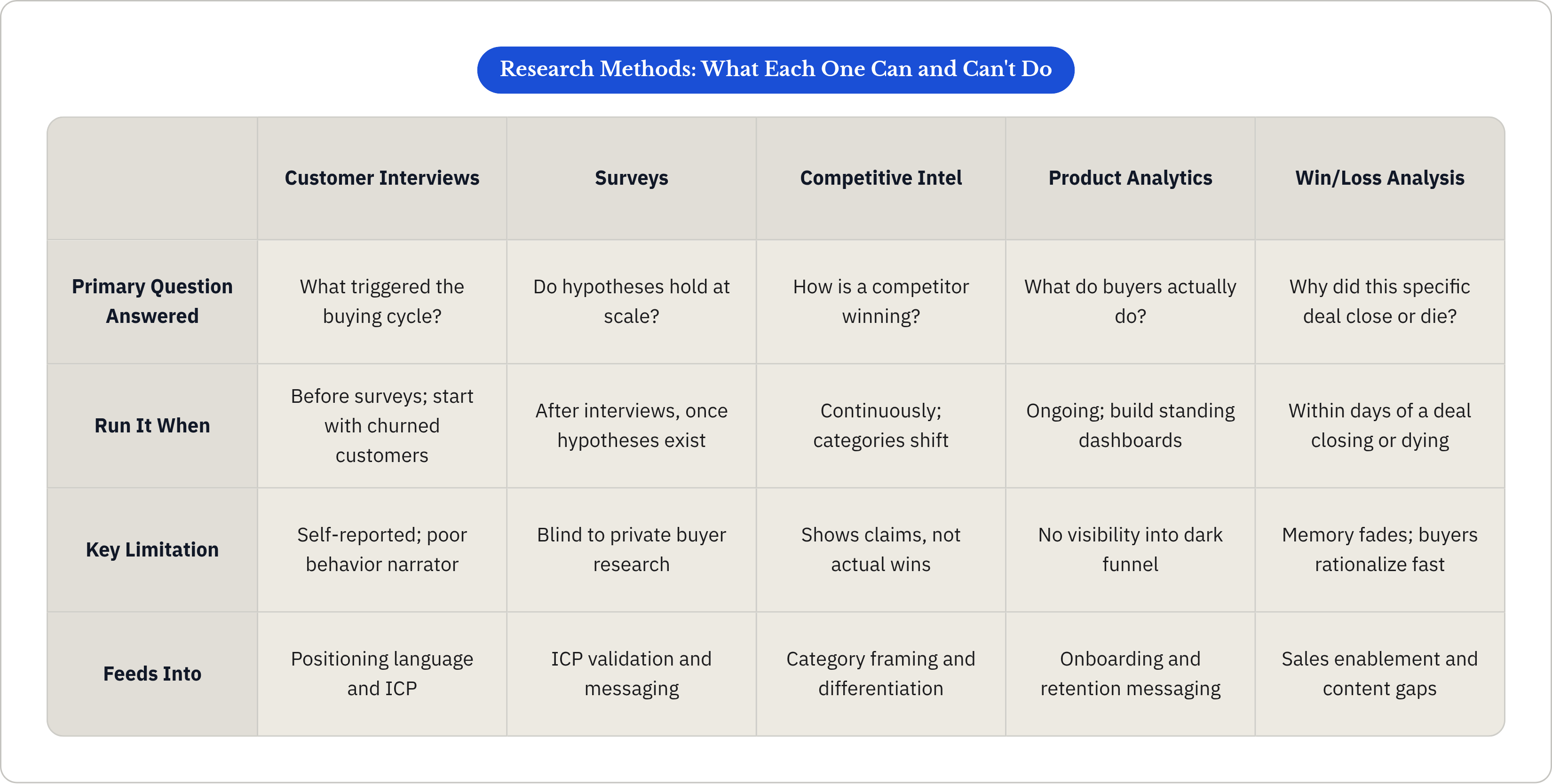
None of these methods mean much sitting alone in a spreadsheet. The whole point of running interviews, surveys, competitive intel, product analytics, secondary research, win/loss, and LinkedIn signal-watching side by side is that each one checks the others. Interviews tell you the story a buyer tells themselves. Analytics tell you what they actually did. Win/loss tells you why the deal really closed or died, stripped of the polite version. When all of those line up, you've found something real.
The synthesis work isn't glamorous. It's sitting down, pulling the recurring phrases out of interview transcripts, and checking them against the language showing up in reviews and win/loss calls. If the same phrase shows up in three separate methods, unprompted, that's not a coincidence — that's your positioning copy. If your product analytics say a feature drives expansion revenue but nobody mentions it in interviews, you've found a hidden value driver nobody's talking about yet, which might be the best insight in the whole stack because your competitors haven't found it either.
Contradictions matter just as much as agreements. If your surveys say buyers care most about price but your win/loss data shows deals dying over implementation time, trust the win/loss data. It sits closer to the actual decision than a stated preference on a form. Research methods aren't equally reliable, and treating them like they are is how founders end up chasing the wrong differentiator for two years straight.
Positioning isn't a slogan someone writes in an offsite. It's the output of this whole system running on a loop, month after month, catching the moment the market shifts before the analyst report catches up to you.