Community Building as Organic Pipeline for B2B SaaS
Designed right, communities generate pre-warmed sales pipeline instead of just engagement metrics.
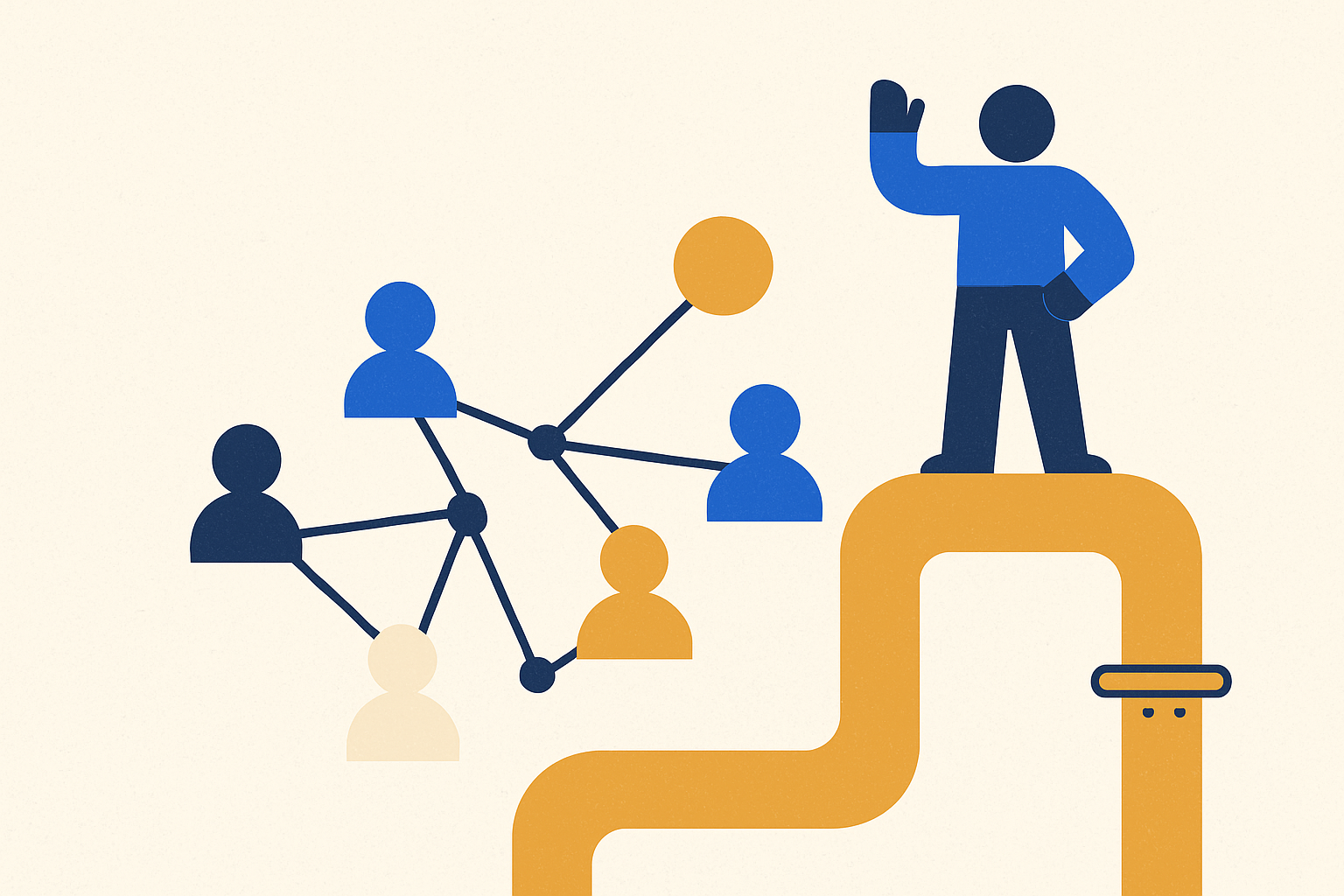
Most B2B communities are built to reduce support load or reward existing customers. Neither goal produces new pipeline. A support forum deflects tickets. A pipeline community surfaces pre-sales intent and moves prospects through trust stages before sales ever gets involved. The difference isn't cosmetic. It lives in the purpose, the conversion paths you build in from the start, and what you actually measure.
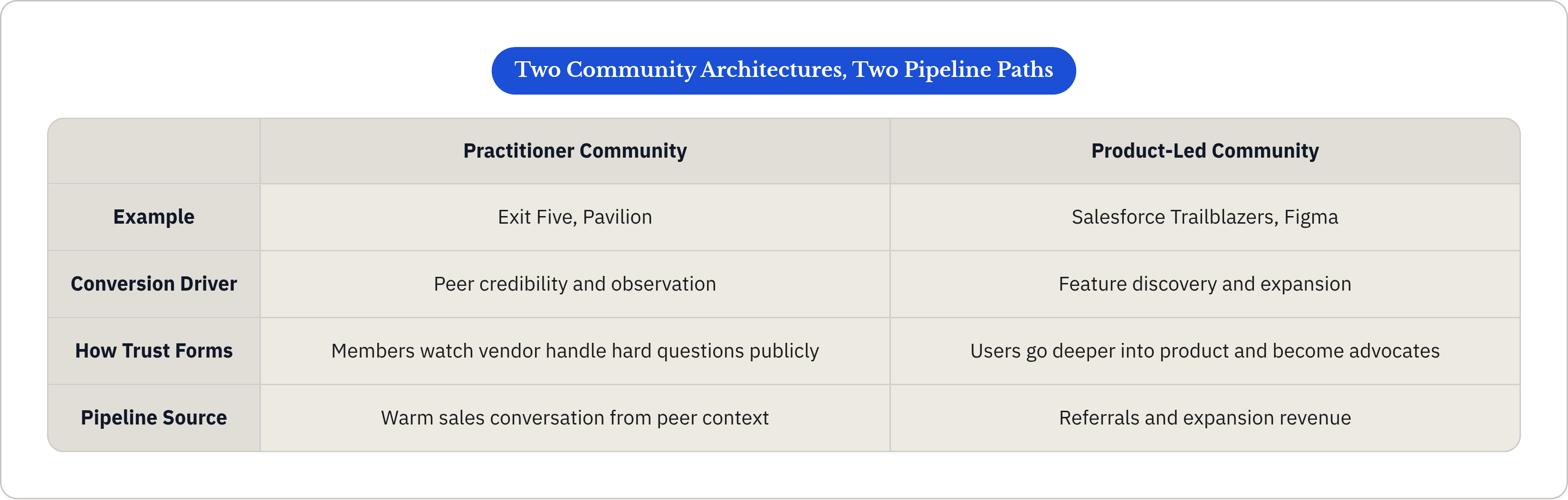
There are two distinct community architectures, and they generate pipeline in two distinct ways.
Practitioner communities (Exit Five for B2B marketers, Pavilion for revenue leaders) run their conversion path through peer credibility. A prospect joins because their peers are there. They observe real conversations. They watch how the vendor's team handles hard questions in public. Product curiosity follows. Then a sales conversation happens from a warm baseline, not a cold one.
Product-led communities (Salesforce Trailblazers, Figma's plugin ecosystem) run their path through feature discovery and expansion revenue. Users go deeper into the product. They become advocates. Referrals happen because the community makes them natural. Both paths generate real pipeline. Neither generates it by accident. The path has to be designed in before the first member shows up.
Pipeline intent means building explicit conversion architecture before launch. Office hours. Product demos. Peer referral programs. These are the mechanisms that move engaged members toward a sales conversation without feeling like a funnel. Community platform data also needs to connect to the CRM from day one. Not as an afterthought six months later when someone finally asks, "Wait, are we tracking any of this?"
Public community content also functions as an awareness layer most companies ignore. Public discussions surface in search results for questions prospects are already typing into Google. Member-generated content carries more credibility than anything your marketing team produces. It works at the top of the pipeline before someone has even heard of your community. You don't get that from a paid ad, and you definitely don't get it from a support forum nobody outside your customer base can find.
How Community Pre-Warms Buyers Before a Sales Conversation Begins
Here's what actually changes when community is working. A prospect arrives at a demo already knowing your perspective. They've watched how your team handles hard questions in public. They've talked to customers in similar roles. The sales conversation doesn't start with "let me tell you about us." It starts with "so you've already seen how we handle X. What questions do you actually have?"
That shift is worth a lot. Sales cycles shorten because trust formation happened asynchronously, inside the community, over weeks or months before anyone filled out a form.
Peer-to-peer credibility does work that vendor marketing simply cannot. A prospect reading a case study knows it was curated and approved by your legal team. A prospect watching a peer troubleshoot a real problem in a community thread and get a real answer is watching something unfiltered. That's the observation that builds confidence in both the product and the team. Case studies convince. Peer observation converts.
Think of it this way: a case study is a highlight reel, but a live community thread is game tape. Prospects know the difference.
Salesforce made this concrete. They compared Trailblazer community members to non-members and found a direct link to business value. That comparison was enough to reframe community internally from cost center to revenue driver. The internal perception shift matters as much as the data itself. Once leadership sees community as a revenue channel, it gets resourced like one.
HubSpot Academy is a slightly different version of the same idea. Free certifications train practitioners on HubSpot's methodology before they ever become customers. Certified professionals recommend HubSpot when they move to new companies. They bring colleagues into the ecosystem, who then pursue certifications themselves. It's a self-reinforcing pre-sales loop that runs largely without a direct sales motion. Once the flywheel is built and spinning, it mostly keeps spinning on its own.
The Conversion Rates Community Actually Produces and What Shapes Them
Let's put some numbers on the table. These come from practitioners in the community-led growth space, not controlled studies, so use them as reference points rather than gospel.
- Member-to-lead: roughly 3 to 8% of active members per quarter
- Member-to-opportunity: roughly 1 to 3% of active members
- Opportunity-to-close: mirrors or exceeds standard inbound rates because community-sourced leads arrive pre-warmed
For comparison, standard B2B pipeline benchmarks look something like this: lead to MQL at 20 to 25%, MQL to SQL at 12 to 18%, SQL to opportunity at 10 to 12%, and closed-won at 6 to 9%. Community-sourced deals enter the funnel further along the trust curve. The meaningful comparison isn't top-of-funnel volume. It's conversion quality and sales cycle length, both of which community tends to improve.
The activation variable is where most companies get confused. Conversion rates only mean something against active members, not total member count. A healthy community activates 20 to 30% of new members. Most programs should aim for at least 10 to 15% as a floor. Communities that chase member count over activation produce inflated-looking dashboards against a largely dormant base. Leadership sees thousands of members, asks why only a handful converted, and defunds the program. The measurement was wrong from the start. You were optimizing for a number that didn't predict anything.
You could say those communities are all dressed up with nowhere to go — a big member count that looks impressive until you realize most of those members are ghosts.
The broader revenue impact, when community matures, is real. Companies with active, well-run communities grow revenue faster than those without and see higher customer lifetime value. A meaningful share of companies in community research report that more than 30% of their revenue is influenced by their branded online community. The directional signal is consistent across multiple sources even where individual studies have vendor-involved origins. Community compounds over time in a way that paid acquisition simply does not.
The Structural Decisions That Determine Whether a Community Generates Pipeline or Just Activity
Only 24% of companies with active community programs can quantify the financial impact, according to CMX's 2025 research. The rest are measuring vanity metrics that don't predict pipeline: member counts, post frequency, event attendance. None of those reliably connect to revenue.
This measurement gap is the most common reason communities get defunded. They look like cost centers because they were never set up as revenue channels.
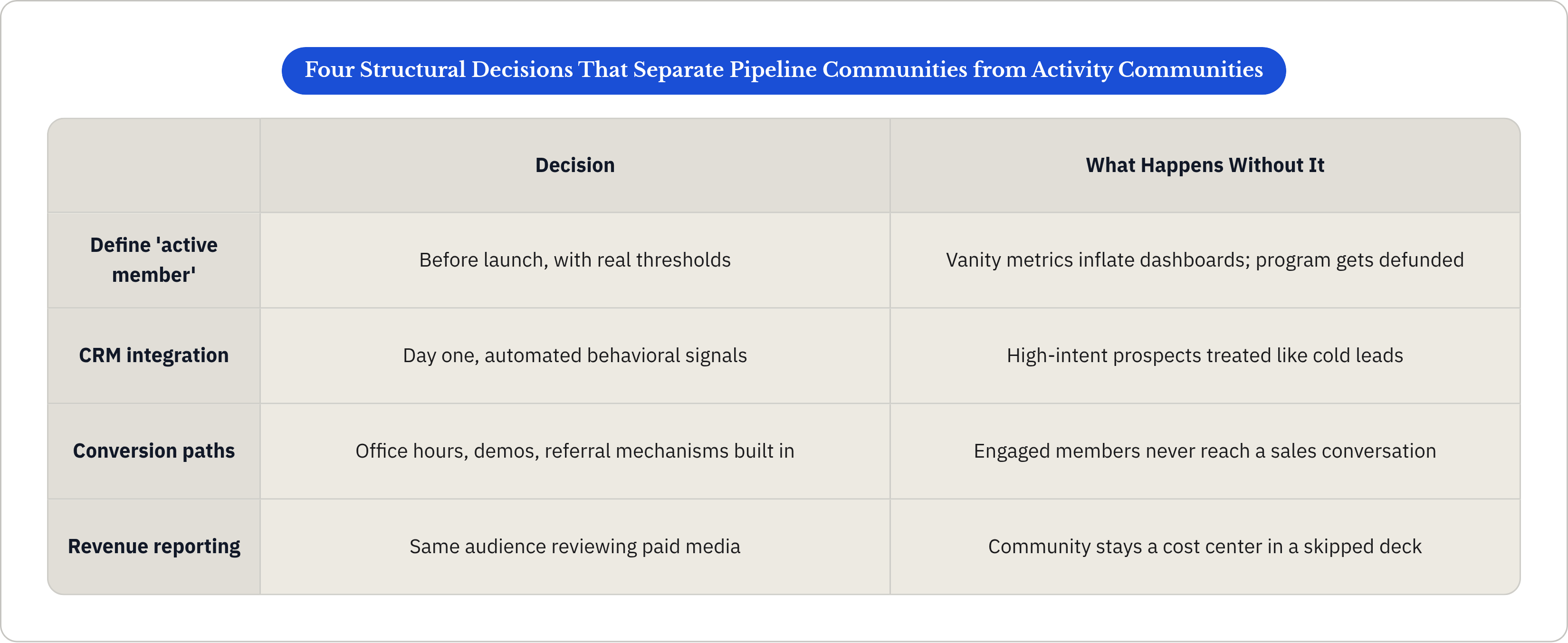
Four structural decisions separate communities that drive pipeline from expensive Slack workspaces nobody checks:
- Define "active member" with actual numbers before launch. Not six months in when someone asks what the data means.
- Integrate community platform data with the CRM on day one. Behavioral signals need to flow into pipeline tracking automatically, not via a monthly spreadsheet export.
- Build explicit conversion paths before the first member joins. Office hours, demo opportunities, peer referral mechanisms that move engaged members toward sales without feeling like a funnel.
- Report community pipeline influence to the same leadership audience reviewing paid media. It needs to live in revenue conversations, not a community team deck that gets skipped.
The design decisions that shape whether those four things actually happen come down to five foundational questions. Call them what you want, but you need answers to all five before you build.
- Purpose: What specific problem does this community solve for members, and how does that connect to pipeline goals? Both halves of that question need a clear answer. If you're fuzzy on either one, you're not ready.
- People: Who are the early members who set cultural tone? This is your founding group. Curated early believers, not a mass invite. The first 20 members matter more than the next 200 because they define what the community feels like to everyone who comes after.
- Place: Platform choice should follow where your target members already spend time. Not whatever tool the community manager happens to know best.
- Participation: What kinds of contribution are encouraged, and how are they recognized? Passive lurking generates no pipeline signal. You have to design for active participation from the start.
- Policy: Moderation norms that keep the space safe enough for honest peer exchange. No psychological safety, no candor. No candor, no peer credibility. No peer credibility, no pipeline.
Growth tends to move through three phases. An early, small, manually intensive phase where founding members establish culture and generate the first credible content. A growth phase where the community becomes a destination because recognizable contributors keep showing up. And a mature phase where participation becomes largely self-sustaining and the compounding effect starts showing up in pipeline data.
One expectation worth setting clearly: meaningful pipeline attribution typically emerges after 6 to 12 months of consistent engagement and activation work. Not in the quarter the program launches. Any executive expecting a faster payback is going to defund a working program before it proves itself.
How Community Signals Move Through the Revenue Stack When the Tooling Is Right
Here's the operational problem that doesn't get talked about enough. Community engagement data lives in a completely different system from pipeline data. Without a deliberate integration, the signals that indicate purchase intent stay invisible to sales.
A prospect who has posted five times, attended two office hours, and downloaded a template is a high-intent lead. But without CRM integration, sales has no idea. They treat that person the same as someone who clicked a cold LinkedIn ad. That's a miss, and it happens constantly.
Community signal aggregation tools are the connective layer. Platforms like Common Room pull signals from GitHub, Slack, Discord, LinkedIn, product usage, support tickets, and CRM activity into a single view per person and per account. CRM sync then pushes those signals as activities, creates or updates contact records, and can trigger workflow automation in HubSpot or Salesforce.
What this enables that traditional lead scoring cannot:
- Behavioral context: Sales receives a prospect record showing community engagement history, not just form fills and page views.
- Routing logic: Community-engaged prospects get routed differently. To a customer success-led conversation, for instance, instead of a cold outbound sequence where the rep knows nothing about them.
The cost threshold is worth naming honestly. Common Room runs roughly $2,000 to $4,000 per month based on consistent user feedback. That price-to-value ratio only makes sense when there's already substantial community engagement generating measurable pipeline. The tooling investment should follow community traction, not precede it.
The metrics an integrated stack should produce:
- Community-sourced pipeline: deals where the prospect engaged with the community before becoming an opportunity
- Activation rate: percentage of new members who become active participants, with 20 to 30% as the target
- Pipeline influence: community touches in a deal's history, even when community wasn't the original source. This one is critical for demonstrating contribution to leadership who want to see community's fingerprints on revenue.
Community's Second Pipeline Function: Reducing Churn and Expanding Existing Accounts
Pipeline generation gets all the attention. But community's second function is more valuable at scale: it keeps the customers you already have.
The mechanism is straightforward. Customers embedded in a peer community have more reasons to stay than customers who only interact with the product and a CSM. When things get confusing or frustrating, they have somewhere to turn that isn't a support ticket queue. They have peers who've solved the same problem. That changes the calculus when it comes time to renew.
Superusers answering questions faster than the company's own support team can reduce the friction that quietly turns into cancellation conversations. Atlassian, Zendesk, and HubSpot see 65 to 75% self-service resolution through community. A single community thread helps hundreds of customers. A resolved support ticket helps one, once.
Community also surfaces expansion signals that a CSM would otherwise miss entirely. Members who become superusers, contribute templates, or organize local meetups have already demonstrated investment in the product's success. They're natural candidates for upsell conversations. You don't need to manufacture the relationship. It already exists.
Figma's contributor community keeps existing users engaged beyond their own projects while simultaneously giving prospective users a compelling reason to try the product. Expansion and acquisition happening through a single motion. That's a genuinely efficient use of community investment.
Notion's subreddit has grown past 280,000 members. Thousands of user-made templates accelerate onboarding for new users without requiring content from Notion's team. The product gets users in. Community keeps them engaged, helps them succeed, and turns a portion of them into advocates who bring in new users. The flywheel closes itself, which is the whole point.
When Community-Led Growth Doesn't Work and Which Companies Should Wait
Not every company should be building a community right now. That's an uncomfortable thing to say in a piece making the case for community as a pipeline channel, but it's true and worth saying clearly.
Community-led growth fails, or stalls, in predictable circumstances. Here's when to wait.
You don't have product-market fit. Community amplifies what already exists. If the product is still finding its footing, bringing people together around it accelerates confusion, not conviction. Fix the product first. Then build the community.
Your buyers aren't community people. Some personas just don't hang out in forums. They get their answers from consultants and conference calls. Building a community for buyers who don't participate in communities is an expensive exercise in self-delusion.
You can't resource it properly for at least a year. Community is not a campaign. It's an ongoing operational commitment. A part-time community manager splitting attention across three other projects is not a community program. It's a ghost town with a nice logo and a Slack invite link nobody clicked.
You need pipeline this quarter. If the CFO is asking for short-cycle returns, community is the wrong tool. It takes 6 to 12 months for meaningful pipeline attribution to emerge under good conditions. Use paid acquisition for the short cycle. Build community for the long one.
Your category has very low transaction frequency. If buyers purchase once every five to seven years, community's retention and expansion benefits are limited and the pre-sales warming effect won't justify the investment. Community economics work best when there are multiple expansion, renewal, or referral moments to capture.
The companies best positioned to start now share four things: an existing engaged user base, a clear ICP that already participates in peer communities, leadership willing to measure community on an 18-month horizon, and at least one person who can treat community management as a primary responsibility rather than a side project.
If you have all four, the structural case is solid. If you're missing any of them, fix the prerequisite before you build the community.