How Investor Narrative and Customer Narrative Diverge After Series A
Founders must manage two competing credibility systems after Series A closes.
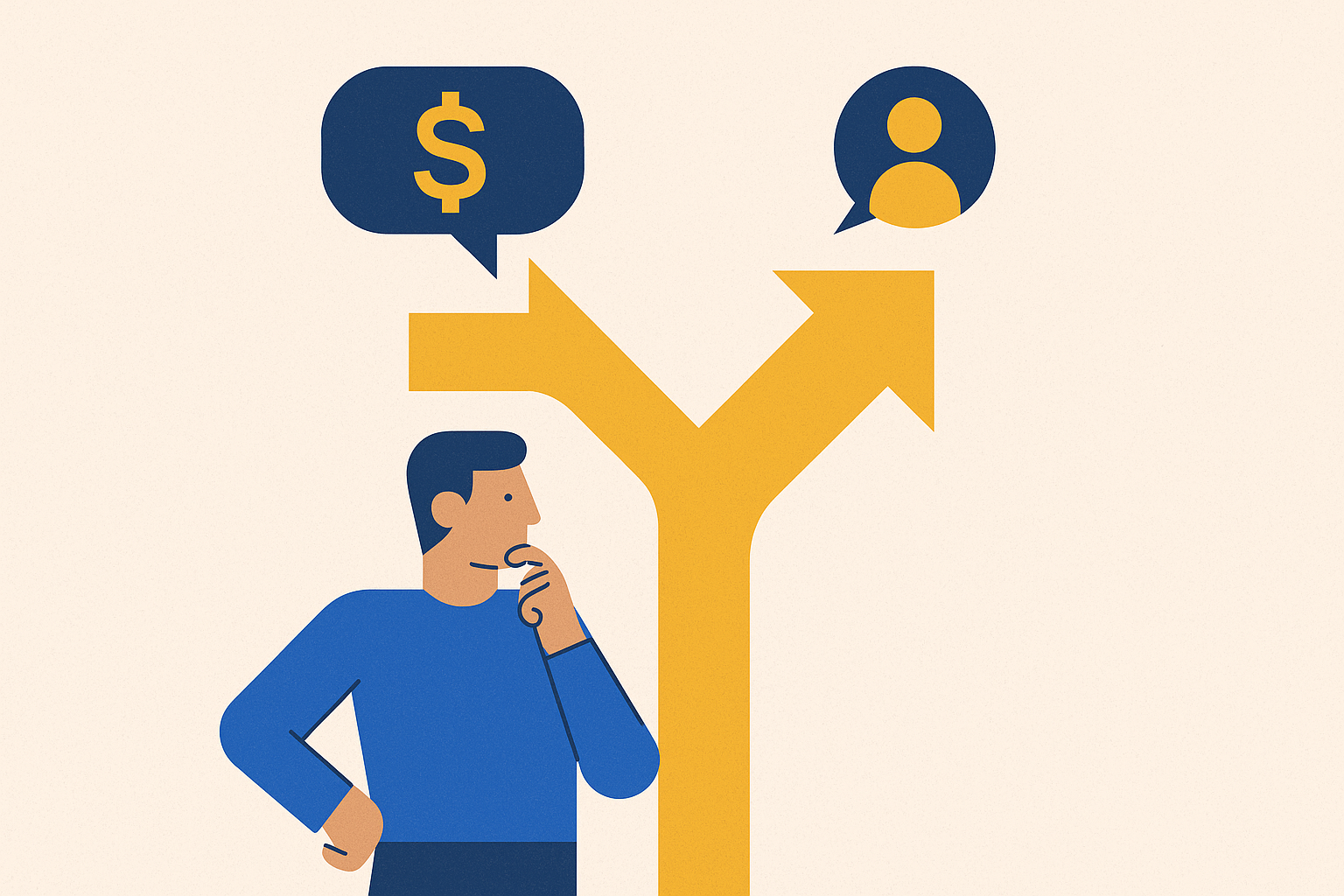
The wire hits, the round closes, and the next morning a founder wakes up managing two credibility systems instead of one. Before Series A, those two systems told the same story. After it, they run on opposite logic, and most founders don't notice the split until it's already cost them something.
Before the round, conviction did double duty. A founder's domain knowledge, early traction, and plain hustle impressed investors and customers for the same reasons. Nobody was asking whether the founder was a single point of failure. They were asking whether the founder was any good. That's a much simpler question, and it has one answer.
The moment capital closes, investors start asking a different question entirely: does this business work without the founder in the room? Customers keep asking the old one. They still want to know if the person behind the product understands their problem, still want a human to trust before they hand over a purchase order. So now there are two audiences, two sets of criteria, and a founder trying to satisfy both at once.
This split doesn't close up as the company matures. It gets wider. Each funding stage past Series A demands cleaner proof that the business runs without its founder, while B2B buyers keep rewarding founders who show up, write, and engage in public. The company grows, and the gap between what investors want to see and what customers respond to grows with it.
What investors measure at Series A and beyond
Series A diligence is built to find out one thing: does growth happen on its own, or does someone have to keep pushing it? The metrics investors lean on, net revenue retention, burn multiple, CAC payback, and ARR quality, all answer some version of that question. None of them care how charismatic the founder is on a sales call. They care whether the business keeps growing when the founder takes a week off.
CRV's 2026 Series A guide treats net revenue retention as a core signal, and it draws a sharp line: expansion revenue needs to come from customers actually using the product more, not from a founder leaning on existing accounts to upsell. The same guide calls CAC payback period "the most important efficiency metric" at this stage. Both metrics are really asking the same question from different angles: is this growth repeatable by a system, or is it one person running hard?
Burn multiple does similar work. CFO Advisors' 2026 SaaS benchmarks hub notes that burn multiple (net burn divided by net new ARR) became popular through a16z and David Sacks as the clearest read on efficiency: does growth cost a reasonable amount, or an unreasonable amount? Founder-dependent growth tends to be expensive to replicate, because it depends on one person's time, network, and energy, none of which scale by hiring more people.
By Series B, the bar moves again. Investors stop buying a growth story and start buying proof that the business model holds up under pressure, and retention quality gets tested hard before the first meeting even wraps. Big Moves Marketing's 2025-2026 investment playbook points to reference strength, meaning customers who will actively advocate for the product unprompted, as a criterion that matters more at this stage. That one matters because it's proof that doesn't depend on the founder being personally present for every deal.
None of this makes investors wrong to ask. A business that only works because one person is extraordinary is a real risk, and a reasonable one to price in. For AI-native SaaS companies, usage-driven costs like inference and model hosting pressure gross margins in ways older SaaS benchmarks never accounted for, so investors often tolerate thinner early margins in exchange for faster revenue growth. The main event is that investor diligence is, by design, a search for everything that isn't the founder.
How B2B buyers make purchase decisions
While investors are busy rewarding systems that don't need the founder, B2B buyers are doing something close to the opposite. They're building their shortlists around founders who show up, write things down, and prove in public that they understand the exact problem the buyer is dealing with.
Most of a B2B purchase decision happens before anyone picks up the phone. Buyers read, they lurk in communities, they watch what founders post, and by the time a sales call happens, the shortlist is often already set. None of that research shows up in a CRM. It happens somewhere else entirely, and that somewhere else runs on trust signals a spreadsheet can't catch.
The trust signal that actually moves a buyer is specific: a founder naming the exact tradeoffs their customers are wrestling with, admitting what the product doesn't do, and writing about decisions with enough detail that a reader can tell this person has actually lived inside the problem. That specificity is what builds authority. Vague confidence doesn't.
A newer wrinkle has shown up on top of that. Founder content increasingly feeds the responses AI tools give when someone asks for vendor recommendations. A founder who stays quiet publicly isn't just missing from LinkedIn feeds, they're missing from AI-generated shortlists too. Visibility here functions as infrastructure, the plumbing that decides whether a buyer's AI assistant even knows the company exists.
A buyer gets won over by three months of founder posts, six LinkedIn DMs, and a recommendation from a peer in a private Slack channel, and when that buyer finally converts, the dashboard says "direct" or "unknown." The investor never sees the chain of trust that actually closed the deal. They just see a number that looks like it came from nowhere.
The reporting gap that makes both audiences misread what is working
That blind spot has a name: dark social. Most B2B buying decisions travel through private messages, Slack communities, peer recommendations, and LinkedIn DMs, and none of it appears in a standard dashboard. Category trust moves through these channels constantly, and attribution tools simply can't see it.
That invisibility has a cost. Board decks show MRR, NRR, CAC payback, and burn multiple, every one of them a lagging, system-level number. None of them capture the fact that a founder's writing has been quietly compressing customer acquisition cost for months by warming up buyers before they ever hit a pricing page.
The compounding runs both directions, which makes the gap expensive. A founder who stays visible builds inbound pipeline, that pipeline improves CAC payback over time, and CAC payback is exactly the metric investors are scoring. The founder's public writing is quietly making the investor's favorite number look better. Almost nobody draws that line in a board update, so the founder doing the work gets none of the credit for it, and starts to wonder if the work is worth the time.
Why retreating from founder visibility is the wrong trade-off
Founders usually get this backwards. Feeling the investor pressure to look scalable, a founder goes quiet, pulls back from LinkedIn, stops writing, and tries to look like a CEO instead of a creator. The instinct makes sense. The execution breaks the exact pipeline that got the company to Series A.
The investor concern is legitimate and deserves a real answer, not a dismissal. A business that can't survive the founder taking a vacation is genuinely fragile, and that risk is worth pricing in. But the fix for that concern is building a documented, repeatable sales motion, hiring and training salespeople who can close deals without the founder on every call, and showing investors that the system works independent of any one person. The fix is not disappearing from public view.
Founder content and a repeatable sales playbook aren't competing priorities fighting for the same hour of the week. They do different jobs. The content builds category trust and fills the top of the funnel with buyers who already believe the founder understands their problem. The playbook takes that interest and turns it into closed revenue without requiring the founder to personally shake every hand. Cutting the content leaves the playbook with less to convert. Skipping the playbook keeps the founder stuck closing every deal alone.
The math on this trade-off is lopsided. Pulling back from content to look less founder-dependent costs pipeline immediately, and that pipeline doesn't come back just because the founder starts posting again next quarter. Meanwhile, the investor concern about founder-dependency can be solved through other means entirely: a sales hire, a documented playbook, a stack of customer case studies. One side of this trade is reversible. The other isn't. A founder who understands this writes specific, niche content that builds real authority, rather than retreating into generic posts that convince neither investors nor customers of anything.
Running two narratives simultaneously without letting one undercut the other
Running both systems at once starts with accepting that they need different proof, delivered through different channels, even though both are describing the same underlying business.
Investors need proof the business works without the founder standing in the middle of it. That means a documented sales playbook anyone on the team can execute, retention cohorts that expand on their own without the founder personally checking in on accounts, customer case studies that credit the product and the team rather than the founder's personal relationships, and unit economics that hold up on a spreadsheet with the founder's name redacted. CRV's AI SaaS investment criteria guide points out that the strongest founding teams pair deep technical knowledge with real commercial instincts, but the commercial proof investors actually want to see at the growth stage lives at the system level, not the founder level. The team matters. The dependency on any one person on that team is what gets scored down.
Customers need the opposite kind of proof. They want to see the founder's public writing, the specific problems named in plain language, the decisions explained honestly instead of spun, and the results customers are willing to put their name next to. Delivered consistently, mostly on LinkedIn, because that's where B2B buyers are already sitting while they evaluate vendors.
The operational discipline that makes this work is keeping the channels separate. Investor updates carry the systems and the metrics. Public content carries the founder's expertise and the proof customers are winning. Neither one needs to touch the other, and neither one cannibalizes the other, as long as the business both stories point to is actually building what each story claims.
Category design as the one move that serves both audiences from a single narrative
There's a cleaner answer than managing two parallel narratives forever, and it's building a category frame that satisfies both audiences from a single story instead of two.
Category design works because it changes the question a buyer is even asking. Instead of "which vendor is best at this," the question becomes "which company defined this," and whoever named the category usually wins that question by default. A founder who defines a category, rather than competing inside someone else's, hands investors a market they can size and defend, and hands customers an answer that already sounds authoritative before a single sales call happens.
That one move does the work both narratives were separately trying to do. Investors see a market big enough and distinct enough to justify the valuation. Customers see a founder who isn't just another vendor pitching inside a crowded category, but the person who drew the category's lines. The two credibility systems stop needing separate maintenance, because the same story, told once, well, is doing both jobs at the same time.