What Happens to Pipeline When a Founder Stops Posting
Silent founders lose pipeline months later, when it's too late to see the damage on a dashboard.

Pipeline doesn't plateau when a founder stops posting on LinkedIn. It erodes on a lag, in ways most dashboards can't see until the damage is already baked in. B2B buyers do 70 to 80% of their research before they ever talk to a salesperson, so the trust decision gets made before anyone at the company even knows a deal exists.
Everything below is the anatomy of that collapse, stage by stage.
How founder-led LinkedIn generates pipeline, and why the mechanism is fragile
At the early stage, before institutional funding, before a real brand exists, a founder posting three to five times a week can produce $500K to $2M in pipeline at zero media spend. No ad account. No agency retainer. Just a person, a keyboard, and an opinion worth reading. Nothing else in the acquisition stack returns that much at that size.
Personal profiles beat company pages by a wide margin, and the gap isn't close. A CEO's post pulls roughly 7x more impressions and 4x more engagement than the identical message posted from the company page. Employees sharing that content organically drive about 5x more leads than anything coming out of the brand channel. People don't trust logos. They trust the human standing behind the logo, which is a slightly inconvenient fact for anyone who spent good money on a rebrand.
About 82% of people say they are more likely to trust a company when its senior executives are active on social media. A large share of consumers say they're more likely to buy from a company whose CEO is visibly active. Close to half of a company's overall reputation traces back to the reputation of its CEO specifically: the person typing the post.
All of that leverage runs through one human being, on one platform, contingent on one fragile behavior. Does this person keep posting? If the Tuesday morning post is taken away, the company hasn't lost a marketing tactic. It's unplugged the whole trust engine.
What the LinkedIn algorithm does to a profile the moment posting stops
Reports indicate LinkedIn cut organic reach significantly in 2025, with follower growth also declining sharply across the platform. So a founder who stops posting isn't returning to the reach they had six months ago. They're stepping back onto a platform that already shrank the floor under everyone else too.
The algorithm doesn't reward fireworks. It rewards routine. Three posts a week for six months will outperform fourteen posts a week for six weeks, because LinkedIn's distribution system is learning something the whole time: who the audience is, what topics land, what pattern of engagement to expect. Consistency is the training data. Break the pattern, and the model has nothing left to learn from.
There's a resurfacing feature, "You May Have Missed," that gives strong posts a second life, extending reach out to 14 or 21 days past publish. Handy tailwind, until there's no new content behind it to resurface. Then it just quietly switches off, and nobody sends a notification telling you it happened.
The timeline for results is already longer than most founders expect. The first qualified inbound lead typically shows up only after several months of daily, consistent posting. Stop, and that clock doesn't pause. The compounding that was building takes a significant hit, and rebuilding it requires starting the consistency cycle over again.
Where the buying committee is deciding, and why silence there is disqualifying
B2B buyers were asked where they actually trust information from, and A substantial share of B2B buyers point to peer recommendations shared in private channels as their most trusted source, ranked above analyst reports, above vendor content, above whatever shows up on page one of Google.
Those conversations happen somewhere the CRM will never see: private Slack communities, LinkedIn DMs, WhatsApp threads, a podcast recommendation passed along in a group chat, a gated forum for people in the same job function. None of it appears in a pipeline report, ever.
The chain that actually plays out is why marketing dashboards lie by omission. A colleague mentions a vendor in a Slack channel. The prospect asks an AI assistant about that vendor. The assistant confirms the vendor is legit. The prospect Googles the brand name directly, lands on the site, and the CRM logs the visit as "Direct" or "Organic Search." The actual cause, a peer's offhand mention, never gets attributed to anything.
Scaled up to a full buying committee, it gets worse. When a group passes a founder's LinkedIn post around internally, that's about as high-intent a signal as B2B marketing produces: multiple stakeholders independently validating a vendor before sales even knows they exist. It generates exactly zero measurable social signal. Dark social doesn't just hide the channel. It hides the moment the deal actually got won.
The sequential stages of pipeline decay after a founder goes silent
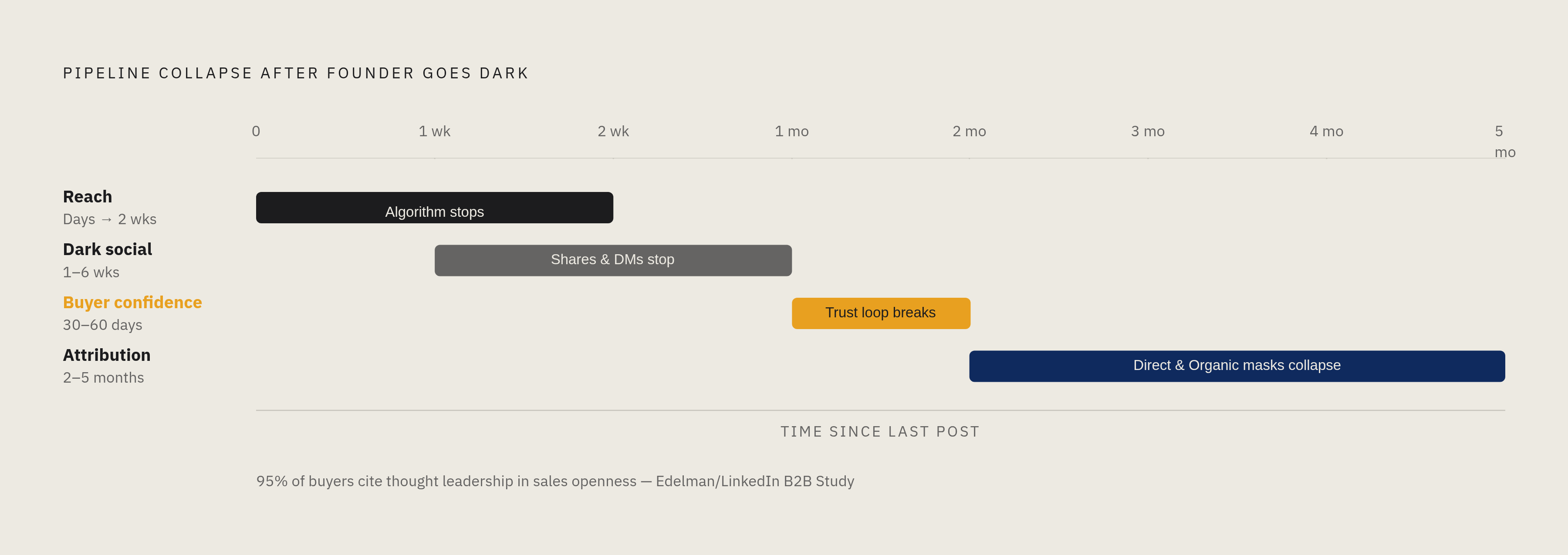
Decay doesn't hit all at once. It rolls out in stages, each with its own lag time, so it's easy to miss until it's a real problem.
Reach collapses first, within days. The algorithm stops pushing the profile to new audiences almost immediately, so no new buyers enter the top of the funnel. The resurfacing mechanism runs dry within two or three weeks once there's no fresh content behind it. The founder feels nothing at this stage, because leftover traffic from older posts and existing followers keeps trickling in for a while, masking the drop like a slow leak in a tire nobody's checked in a month.
Dark social circulation dries up next, over a matter of weeks. No new posts means nothing fresh getting screenshotted into a Slack channel or forwarded in a DM. The founder's name stops coming up in the conversations that quietly build vendor shortlists, and buyers already mid-evaluation lose the steady drip of credibility signals they were using to convince their own internal stakeholders.
Then hidden buyer confidence erodes over 30 to 60 days, and this is the real slow bleed. About 95% of buyers say strong thought leadership makes them more open to sales outreach, and the inverse holds just as well: when the content stops, so does the receptiveness. Roughly 91% of decision-makers say good thought leadership helps them recognize problems they didn't know they had, so silence carries a real cost. It's the vendor stepping back from helping the buyer build their own internal case. 63% of buyers spend over an hour a week consuming this kind of content, so a founder who goes dark falls out of a weekly habit loop that used to build familiarity on autopilot. More than 40% of B2B deals already stall from internal misalignment inside the buying group, and founder content was doing quiet work to keep everyone rowing the same direction. Pulling it makes stalls a lot more likely.
Why attribution hides the damage until it's already severe
The blind spot here is structural. When a buying committee shares a founder's post internally, that action leaves no trace in any analytics tool anywhere. The most persuasive content in the entire funnel produces zero measurable signal, which is a strange thing to build a marketing budget around, and yet.
Run the influence chain again: Slack mention, AI query, branded Google search, "Direct" traffic in the dashboard. The founder's content did the actual work. The search engine gets all the credit, the way a delivery driver gets the tip for a meal someone else cooked.
So a marketing team looks at its numbers and sees "Direct" and "Organic Search" holding flat, sometimes for months after the posting stopped. The trust infrastructure feeding those channels is falling apart, because once posting stops, the residual trust it built keeps fueling other channels only until that trust runs out. LinkedIn's share of pipeline shrinks in the reports even while total revenue keeps growing, because other channels appear to pick up the slack. Other channels appear to pick up the slack, but that's an illusion. Other channels didn't get stronger. The founder channel just stopped getting credit for work it was still quietly doing, right up until the residual trust ran dry too.
What re-entry costs, and how to avoid the restart penalty
Coming back is a full rebuild. The algorithm's memory of the audience, the topics, and the engagement rhythm all reset, and the founder walks back onto a platform whose organic reach is already lower than when they left.
The math punishes both ends of the gap. There's a multi-month runway before qualified inbound starts again, and pipeline output compounds over time as the algorithm learns the audience and engagement patterns. Stop and restart, and that compounding curve gets destroyed twice: once when the posting stops, and again on the climb back up.
The founder who never posts at all is at least a known quantity, predictable in his absence. The real damage happens to the founder who posts consistently for 18 to 24 months, watches it clearly work, and then eases off right at the moment the compounding was about to hit its steepest part of the curve. That's the worst possible time to quit, and it's also the most tempting time, because "it's working" feels like permission to coast. It's the exact opposite of permission. It's the exact opposite of permission.
Companies where the CEO posts consistently see something like 2.3x higher close rates on outbound because the prospect already knows who they're talking to by the time a rep calls. Founder presence doesn't just fill the top of the funnel. It makes every other channel, outbound included, run more efficiently. Going quiet doesn't just cost inbound leads, then. It drags down the whole go-to-market motion, quietly, on a lag, until someone finally checks the math and finds out how long the silence has actually been running.