How LinkedIn Replaces Half Your ABM Stack Before Series A
Founders can run half an ABM campaign for free on LinkedIn before paying for dedicated tools.
LinkedIn is a free ABM stack that most pre-Series A founders are too busy building an expensive one to notice. It already handles targeting, warming, and trust-building. That's three of the four jobs a real ABM system exists to do, and it runs inside an app founders are already refreshing at midnight anyway.
The wait between seed and Series A has stretched past a year and a half for most companies, and most seed-stage companies never make it to that next check. That's not a lot of runway to burn on infrastructure built for a team three times the size. Buying a five-stage ABM platform before the company has even nailed down who the buyer is doesn't just waste money. It's the wrong tool pointed at a problem that doesn't exist yet.
What ABM does, broken into the functions that matter at this stage
When the vendor decks are stripped away, ABM comes down to four jobs: find the right accounts, get in front of the right people at those accounts, warm them up before anyone dials a phone, and build enough credibility that some of them reach out first.
Agencies sell this as a five-stage loop: signal capture, ICP filtering, account scoring, multi-channel activation, attribution. Fine framework, if a company has the headcount for it. But attribution, the stage everyone gets excited about in the sales deck, only earns its keep once there's enough activity to attribute. A two-person company doesn't need five stages running at full maturity. It needs the first three working well enough to produce something worth measuring six months out.
The fork that actually matters is signal-based targeting versus list-based targeting. Upload a static list, spread the budget evenly across it, and the budget has no idea whether any of those accounts are even in a buying window this quarter. Signal-based targeting spends money where intent is visible in current buyer behavior, and it wins by a wide margin, no argument needed. It usually needs a data infrastructure no seed-stage team has lying around. LinkedIn hands over a rough version of both, no data engineer required, no vendor contract to sign.
The LinkedIn audience as an ABM targeting layer
Start with scale, because it sets up everything else. LinkedIn passed 1.3 billion registered members in 2026, with around 310 million logging in monthly. Roughly one in four members shows up active in any given stretch, which sounds thin until the makeup of that quarter comes into view.
The platform counts 10 million C-suite executives among its active users alone, and buying authority is distributed broadly across its membership beyond that top tier. Calling that a big audience undersells it. Concentrated buying authority is the more accurate description, and it makes a different claim.
The targeting mechanics will look familiar to anyone who's sat through a demo of a dedicated ABM platform. LinkedIn lets advertisers upload account lists of up to 300,000 companies, then stack filters on top for job title, seniority, and function, so ads land only on the right people inside those accounts. That's the audience-definition layer of a paid ABM tool, sitting inside an ad platform most founders already have a password for. Swap the company list for a list of named contacts. The targeting tightens to something close to one-to-one precision, the kind normally locked behind a five-figure orchestration contract.
LinkedIn's approach to account warming and trust before any sales conversation
Buyers finish most of their homework long before a salesperson enters the room. The bulk of the B2B purchase journey happens before that first call, and plenty of buyers have already decided what they need before they've spoken to a single vendor. Warming has to happen before outreach starts, not during it.
Thought leadership is what does that warming. LinkedIn's own B2B Thought Leadership Impact Report, built on interviews with nearly 2,000 professionals, found that 95% of hidden buyers (the ones quietly researching before anyone on the vendor side knows they exist) say thought leadership directly influences their purchasing decisions. That's the entire warming function of an ABM stack, running for free in a stranger's feed.
The same report surfaces something sharper: shortlist placement gets decided in the weeks or months before the sales call, by whoever kept showing up in the feed with something worth reading. The warming channel and the targeting channel turn out to be the exact same channel. Most ABM stacks stitch that connection together across two or three separate tools, paying integration fees for the privilege. LinkedIn built it in from the start, no stitching required.
The founder's personal profile as the platform's highest-leverage ABM asset
Founder profiles generate 3 to 5 times more inbound leads than company pages, and roughly 8 times more engagement. Content posted by employees pulls about 5 times more leads than the same content posted from the brand account. Yet 90% of SaaS companies post exclusively from the company page, which is the marketing equivalent of renting a billboard and hanging a sheet over the good ad.
CEO posts pull 7 times more impressions and 4 times more engagement than identical content posted under a company logo. Same words, same idea, entirely different outcome, because people trust people. Nobody trusts a stock photo with a header image behind it.
Among 200 B2B SaaS companies that went from $0 to $5M ARR in Q1 2026, 78% had a founder actively posting on LinkedIn, and that group averaged 20 to 30 qualified enterprise leads a month from LinkedIn alone, with zero ad spend attached. Enterprise buyers are quietly researching the founder before they'll even agree to a call, whether the founder knows it or not. The profile stops being a content channel at that point. It becomes due diligence, running in the background while the founder is asleep.
LinkedIn as a near-zero-cost positioning test-bed before paid ABM spend
Paying to amplify a message before the message is validated just means paying to amplify a guess, and that's the sequencing mistake early founders make on a loop: buy the media first, discover three weeks later that nobody responded to the pitch.
The fix costs time, not money. Write five posts, each built around a different value proposition, and publish them from the founder's own account, never the company page. Watch which one pulls comments naming a specific pain point, which one pulls DMs from people who actually look like the ICP, and which one gets saved instead of just liked. That's the whole test. A pile of generic likes means reach without relevance. A DM from someone who fits the buyer profile, quoting the exact problem the post named, means the message landed.
The algorithm rewards the same behavior that makes this test work. LinkedIn's 2025-2026 updates favor dwell time, comments that say something real, consistency across 3 to 5 recurring themes, and relevance to the viewer's own network. The signals telling a founder the positioning works are the same signals pushing the post further out, past the people already following them.
The paid layer: LinkedIn's ad formats as ABM tools
Once the message is proven, paid amplification comes in. The clearest numbers here come from ZenABM's LinkedIn ABM Performance Benchmarks Report, built on a large volume of ads across 211 companies.
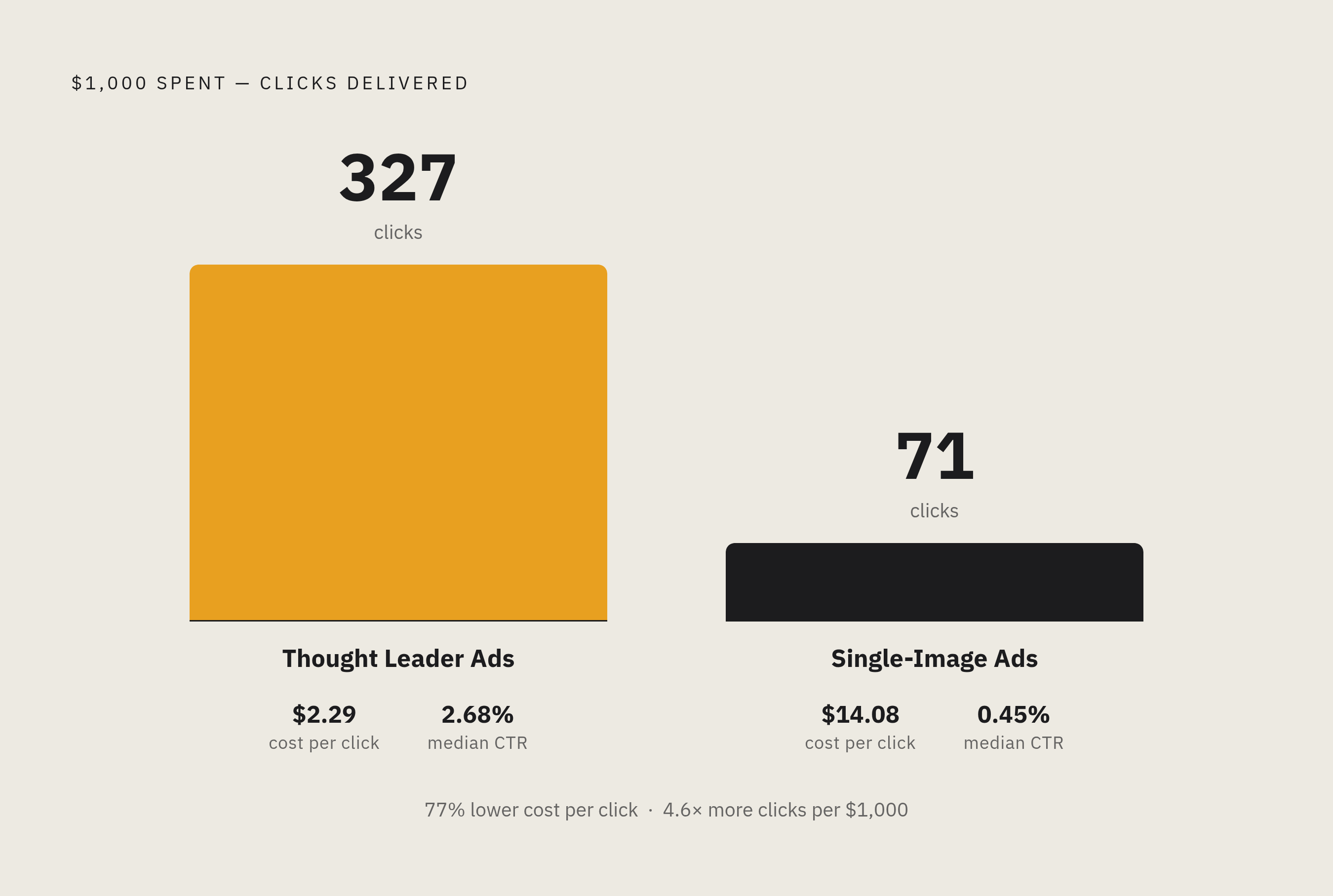
Thought Leader Ads are the standout, and it isn't close. They pull a 2.68% median click-through rate, about 6 times higher than single-image ads, at a cost per click of $2.29, which runs 77% cheaper. Put $1,000 into TLAs and get roughly 327 clicks; put the same $1,000 into single-image ads and get about 71. A TLA looks like a post from an actual person, not a corporate ad in a tie, so it fits into the feed instead of interrupting it. The gap holds across different measurement approaches and datasets, and that consistency is not a coincidence worth debating.
The ABM payoff is direct: a founder's organic post, the one that already proved it resonates, gets pushed as a paid placement straight to a named list of target accounts. Median pipeline generated is $5.21, with top-quartile performers hitting $15.20 (pipeline, not closed revenue, and that distinction matters). Dreamdata reports the average time from first LinkedIn impression to closed revenue runs 281 days. Judge LinkedIn ABM on a 30-day window and it looks like a failure for no reason other than the clock hasn't finished running yet.
The content mix and cadence that makes LinkedIn ABM work operationally
Cadence beats any single post. Posting 3 to 4 times a week keeps an account visible. Posting less than twice a week makes momentum almost impossible to build, no matter how sharp any individual post is. The algorithm rewards staying inside 3 to 5 recurring themes, not chasing whatever topic feels timely on a given Tuesday.
A workable mix for a B2B SaaS founder keeps educational and thought leadership content doing the heavy lifting, with case studies and promotional posts appearing rarely enough that they never undercut the trust built the rest of the week.
Format depends on the goal. Text-only posts pull the highest organic reach right now, and they cost nothing to make. Document carousels lead every format on engagement at a 6.60% rate, generating 278% more engagement than video, which makes them the pick for mid-funnel attention. LinkedIn Live pulls 24 times more reactions than a standard post, high effort for a high return, worth it for founders willing to actually sit in front of a camera. TLAs, again, are just the paid version of whatever organic post already earned its keep.
Prospects run into machine-generated content constantly now, and most of them can spot it on sight within a few seconds. The bar for content that lands has gone up even as the cost of producing content has dropped to nearly nothing. A founder's post reads like a person instead of a press release when it carries a real point of view, a specific detail, an actual lived-in fact. AI can fake a lot of things. That part, it can't.