Why ABM Fails Before the Campaign Even Starts
Most ABM programs fail because companies skip the structural work before launch.
ABM promises returns most channels can't touch: an average ROI of 145%, with the best programs pulling in 7.5x to 9.1x on spend, according to abmagency.com. And yet roughly 80% of programs fail to hit their own goals. Adoption isn't the issue either. Some 94% of B2B marketers now run ABM in some form, so this isn't a case of a young discipline still finding its footing. When something this widely adopted fails this often, the excuse can't be "everyone's still learning."
The usual suspects get blamed first: wrong channel, weak creative, tooling that doesn't quite fit. Swap the ad platform, hire a better copywriter, buy the shinier intent data tool. None of it moves the needle much, because none of it touches the actual problem. The failure gets baked in months before anyone writes a campaign brief, at the point where a company decides who to target, how sales and marketing will work together, and what "success" is even supposed to look like. Fix the campaign and you're rearranging furniture in a house with a cracked foundation. This piece walks through where that foundation actually cracks.
How ABM's demand on organizational discipline exposes weaknesses that other programs can hide
Most marketing programs are pretty forgiving of internal mess. Run a webinar series with so-so sales follow-up, and it still generates some leads. Run a paid social campaign with vague targeting, and it still puts a logo in front of a few thousand eyeballs. ABM doesn't offer that cushion.
It asks marketing to commit to slower-moving, account-specific programs instead of scalable, one-size-fits-many campaigns. It asks sales to hand over account intelligence and treat marketing like a partner working the same strategy. Ask two teams to narrow their focus onto a shortlist of named accounts, and every weak seam in how they operate together becomes visible immediately. There's nowhere to hide it.
That's the uncomfortable part abmagency.com's research points to: when companies are forced to focus on a small set of high-value accounts instead of chasing lead volume, most of them find out they never built the muscle to do it. A study in Industrial Marketing Management, cited by vector.co, backs this up from a different angle: most practitioner programs labeled "ABM" don't actually have the structural grounding that separates account-based marketing from plain old segmented lead generation. Slice a database by industry and headcount, call the output "accounts," and you've built a spreadsheet, not a strategy.
strategicabm.com's reporting adds a sharper point. Agencies rarely lose clients over bad creative or sloppy execution. They lose them because nobody asked, up front, whether the client was even ready for ABM, and nobody built the plan backward from revenue targets. That's a readiness question, not a tactics question, and it's one three specific structural failures keep tracing back to: a fuzzy ICP, sales and marketing pulling in different directions, and no real measurement framework. Each gets its own look below.
The ICP problem: when the target list describes a market instead of a customer
Start with the number that should stop everyone cold: 68% of B2B companies haven't clearly defined their ideal customer profile, according to landbase.com. That's not a fringe problem affecting a handful of laggards. That's most companies running ABM without knowing, in any specific sense, who they're chasing.
The classic bad ICP reads something like "any company with 50 to 500 employees." growigami.com nails why this fails: that's a market description, not a target list. If the definition doesn't rule anyone out, it isn't doing its job. An ICP that includes everyone helps no one, sales included.
Downstream, before the campaign even launches, that vagueness rots everything it touches. Content gets written to speak to "everyone in mid-market SaaS" and ends up landing with nobody. Ads reach a wide, mushy audience and convert at scraps. Sales gets handed leads that were never actually qualified, because there was no filter sharp enough to qualify against in the first place. heysid.com puts a number on the waste: 40% to 60% of marketing spend lands on accounts that were never going to buy. That's not a media-buying mistake. That's a list-building mistake, dressed up as a media-buying mistake.
landbase.com found that companies with a clearly defined ICP see meaningfully higher win rates, because sales, marketing, and product are all aiming at the exact same kind of account instead of three slightly different ones.
landbase.com names three specific ways ICPs go wrong:
Too broad. "Mid-market B2B SaaS" is a segment. It isn't a call list. Living in a slide deck instead of a CRM scoring model. Slides get presented once and forgotten. A scoring model runs every single day, quietly doing the work nobody remembers to do manually. Frozen in time. An ICP built 18 months ago, never revisited, working off assumptions the market has already outgrown.
Research from Cognism shows what a loose ICP costs in practice: deals with companies outside the defined ICP take 30% to 40% longer to close than ICP-fit deals. So the damage appears not just in win rate, it also appears in how long the sales team spends chasing deals that were always going to be a slog.
There's also what marketscale.com (July 2026) calls building a target account list around recognizable, aspirational brand names instead of real buying signals. Senior decision-makers at big enterprise accounts already get buried in outreach every week. Breaking through takes real budget and multiple relationships.
The Ehrenberg-Bass Institute's 95-5 rule, also via marketscale.com, is maybe the single most useful stat in this whole conversation: at any given moment, only about 5% of B2B buyers are actually in-market. Build a list around company size or brand prestige without filtering for active buying intent, and the overwhelming majority of the spend behind that list is aimed at people who won't act for months, maybe years. A more defensible account list runs on behavioral signals instead: repeat visits to a vendor's site, activity in relevant professional communities, an operational problem that's visibly, urgently acute inside a given account. Real-time intent, not aspiration, is what should be doing the selecting.
Sales-marketing misalignment: the organizational condition that dooms execution before it starts
demandscience.com's research points to one factor as the single most consistent predictor of whether an ABM program will work: the state of the relationship between sales and marketing before the program ever launches. Not during. Before.
Alignment means more than both teams nodding along to the same target account list. It means shared KPIs, and this is where a lot of programs quietly fall apart. exitfive.com lays out the mechanism: if marketing gets measured on lead volume while sales gets measured on close rate against a narrower, higher-quality segment, the two teams end up optimizing against each other without either one intending to. Marketing wants more names in the funnel. Sales wants fewer, better ones. Same program, opposite incentives.
Real alignment also means joint account planning instead of two teams running parallel tracks that never actually intersect. It means sales feeding account intelligence back to marketing. And it needs executive sponsorship, because without support from the top, an ABM program can't pull the cross-functional resources and priority it needs to actually run.
The payoff for getting this right is large. abmagency.com found organizations with strong sales-marketing alignment see 67% higher close rates and 24% faster revenue growth. Flip that around, and it tells you roughly how much a misaligned program is quietly forfeiting every quarter.
exitfive.com names the specific failure mode: ABM run as a marketing-only exercise, where marketing builds and operates the whole program and sales treats it like any other lead-supplier relationship, waiting for names to show up rather than helping shape the target list. That's ABM in name only, running on the same org chart as a real ABM program but none of the muscle.
That misalignment is also visible downstream, in how buying groups get handled. abmagency.com notes that the average B2B purchase now involves multiple decision-makers, each with a different set of concerns. Yet plenty of ABM programs are still built to chase a single contact at each account, because sales and marketing never sat down together to map the buying committee in the first place.
There's also a resource allocation error buried in tier selection, which marketscale.com breaks down using the Hallam Agency framework. Pick a fully bespoke, 1-to-1 program (realistically £5,000 to £20,000 or more per account, fully loaded) for a deal worth a modest five figures, and the math never works. That model only makes sense against six-figure contract values. A 1-to-few model, grouping 10 to 25 accounts by shared traits, runs an estimated £1,500 to £5,000 per cluster, though precision fades the bigger that group gets. A 1-to-many, programmatic model runs roughly £3,000 to £8,000 a month in paid media alone and works best as a top-of-funnel layer surfacing early intent. Match the wrong tier to the wrong budget, and that's a decision made and locked in before the campaign ever launches.
The domain-versus-person mismatch that runs through every ABM failure mode
ABM programs target domains, but people sign the contracts, and that mismatch sits underneath nearly every ABM failure. People sign the contracts. vector.co calls this out directly, and it explains a lot of the frustration practitioners report without always naming the cause.
Start with visibility. 41% of marketers, per vector.co, say tracking the right data inside target accounts is their single biggest ABM challenge. That's because most tools surface intent at the company level, not the contact level. A pricing-page visit logged under "Acme Corp" could be the CFO doing due diligence. It could also be an intern doing competitive research for a school project, sort of. Both appear in the dashboard exactly the same way. There are really two blind spots stacked on top of each other here: anonymous visitors on a company's own site, and all the buyer research happening somewhere else entirely, review sites, comparison pages, paid clicks that never turn into a form fill.
That same blur is visible in spend. Run a LinkedIn campaign against a target company, and the ad reaches the VP of Finance, the office manager, a couple of interns, and someone in recruiting, because the platform optimizes for firmographics, not for the specific person who actually holds budget authority. vector.co finds that many marketers point to budget constraints as a top ABM challenge, but that's mostly a precision problem wearing a budget problem's clothes. More money aimed at the wrong roles just buys a bigger miss.
Follow-up suffers the same way. An account engagement score tells sales a company is "active." It doesn't say who to call or what to say when they pick up the phone. vector.co finds that a large share of marketers struggle to deliver tailored experiences inside ABM programs, and that tracks, because a useful follow-up needs three things: a contact's name, their company, and a reason rooted in something that specific person actually did.
Then there's proof. Only 52% of companies measure ABM ROI at all, per vector.co. Meanwhile, research cited by vector.co shows tech providers running ABM see pipeline lifts compared to standard demand generation, so the upside is real and measurable, for those set up to measure it. The large share not measuring aren't necessarily lazy. They're stuck with an attribution problem that starts at the account-level data layer. Without a contact-level thread connecting activity to outcome, tracing a closed deal back to a specific touchpoint turns into guesswork. And guesswork doesn't survive a budget review.
The tech stack doesn't fix any of this on its own, either. The 2026 Demand Gen Report, cited by vector.co, names stack integration and internal AI skill gaps as major barriers to ABM adoption. AI tools only compound returns when the account list is already correct, per dmnews.com. Buy the software before doing the structural work, and the mismatch doesn't shrink. It just runs faster.
Why ABM campaigns arrive too late: the buyer journey has already closed by the time outreach lands
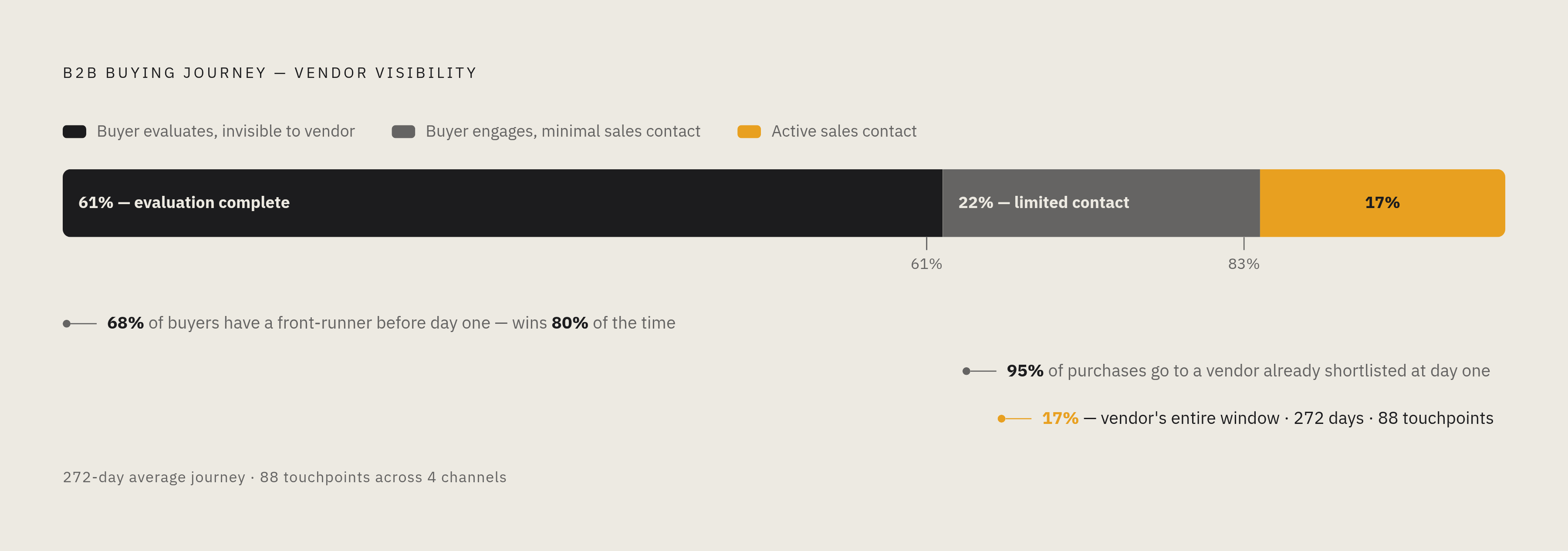
The buyer journey has stretched out considerably, and most ABM programs are still built for a shorter one. Per the Dreamdata LinkedIn Ads B2B Benchmarks Report (built on more than 66 million sessions and 3.5 million customer journeys, cited via geisheker.com), the average B2B buying journey now runs 272 days, spans 88 touchpoints across four channels, and involves ten stakeholders.
Most of that journey happens before anyone from the vendor side even knows it's underway. marketscale.com, citing Gartner and 6sense data, puts the figure at 61% of the evaluation completed before a buyer ever contacts a vendor. If an ABM program produces zero visibility during that self-directed research window, the account has already screened the vendor out, or in, before outreach ever lands. Gartner's buyer behavior report backs this from another angle: only 17% of the total buying journey involves any contact with a vendor's sales team at all. The other 83% happens in the dark, from the vendor's perspective.
And the shortlist locks in early. 6sense's Buyer Experience Report found 95% of B2B purchases go to a vendor that was already on the shortlist from day one. Forrester's Buyers' Journey Survey 2025, cited on geisheker.com, found 68% of buyers already have a front-runner in mind before the process formally starts, and that front-runner wins roughly 80% of the time. Those aren't close odds.
Buyers, per 6Sense, cited via corporatevisions.com, initiate outreach close to 80% of the time, and when they do, they reach out first to the vendor they already intend to buy from. That same research found 61% of B2B buyers prefer a sales-rep-free buying experience, and 73% actively avoid vendors that send irrelevant outreach. An ABM program that only shows up once outreach starts is showing up after the decision has, in practical terms, already been made.
Then there's the dark funnel. Some 70% to 73% of the B2B buying journey now happens before a buyer fills out a form or contacts a vendor directly, according to behavioral research cited by mental-momentum.ai. The shortlist takes shape in private Slack channels, peer conversations, and community threads that no ABM platform can see into. Similarweb data backs up just how much traffic lives in that shadow: direct traffic, the clearest available proxy for dark social sharing, makes up 72.1% of visits to Gong, 71.6% to HubSpot, 71.1% to Outreach, and 64.5% to Salesforce. More than two-thirds of traffic to some of the most aggressively marketed SaaS companies around arrives through channels attribution simply can't see.
That blind spot compounds an existing bias in how budgets get set. Research cited by mental-momentum.ai found 68% of multi-touch attribution models over-credited bottom-funnel, demand-capture channels by more than 30%. That systematically starves the top-of-funnel work that would actually win the pre-contact window, because the dashboard keeps insisting the bottom-funnel channel is where the credit belongs.
On top of all this, the research environment itself has shifted underneath everyone's feet. Forrester's Buyers' Journey Survey, covering nearly 18,000 global business buyers, found 94% now use large language models somewhere in their research process, per gameplanmarketing.ca. An ABM program built around how buyers consumed content five years ago is aimed at a buyer who, functionally, doesn't exist anymore.
Building presence during the invisible buying window before the account list is finalized
Put all of that together, and the implication is hard to avoid: ABM programs need to build visibility before the campaign starts, not somewhere inside it. The pre-launch period isn't prep work. It's a distinct demand-creation job in its own right, running on a different clock than the campaign itself.
What does presence during that invisible window actually look like? Consistent, opinionated content that earns a mention in a Slack thread or a peer conversation, the exact channels generating that 70%-plus chunk of untracked direct traffic covered above. Nobody forwards a generic blog post to a colleague. People forward the take that actually says something.
That's part of why founder voice specifically carries weight here. Buyers buy from people, not from logos on a homepage. A founder who consistently offers a sharp, specific point of view is the one who gets named when a peer asks, half-jokingly, "okay, but who do you actually trust in this space?" That's not a branding exercise. That's the mechanism by which a company ends up on a shortlist it never bought its way onto.
LinkedIn sits right in the middle of this as the pre-contact channel, the place where a meaningful chunk of that only 17% of buying-journey time is spent with a sales rep. It's also where thought leadership reaches decision-makers who will never take a sales call, never fill out a form, and never appear in a CRM report, right up until the day they do.
Sources
- Most B2B ABM programs fail before the first campaign goes live
- Common account-based marketing challenges
- What makes a great ABM agency in 2026
- Why 80% of ABM Programs Fail: The Discipline Gap in Sales-Marketing Alignment |
- Why ABM Program Marketing Fall Short: The Pitfalls Most Vendors Won't Discuss
- ABM's 2026 reckoning: AI tools compound returns only when the account list is right
- martechpanthers.com
- Ultimate ABM Marketing System: 7-Stage Framework for B2B (2026)