What a Founder's ABM Strategy Looks Like at 10 Target Accounts
How one founder lands enterprise deals with research, voice, and a tight list of ten.
Ten target accounts, one founder, no marketing department behind him. What he needs isn't headcount, it's a system: research sharp enough to earn attention, a LinkedIn voice that reads like a person instead of a brand, and a way to choreograph outreach across a dozen decision-makers per company without losing the thread. No ABM platform required, no department to build. Just leverage, aimed on purpose.
Most people assume founder-led ABM is enterprise ABM with the budget stripped out. That's backwards. Enterprise ABM was built for teams juggling tooling and cross-department coordination that doesn't always talk to itself. A founder alone has none of that infrastructure and doesn't need it. What a founder has instead is credibility from actually building the thing, a voice that sounds like a person instead of a press release, and the ability to talk to a VP or CEO peer-to-peer instead of through three layers of a sales cadence. Copying the big-company playbook at a smaller scale wastes the one advantage a founder actually has.
Ten accounts sounds small. It isn't a constraint, it's the whole point. The ABM market is growing from $1.4 billion in 2024 to a projected $3.8 billion by 2030, and the direction inside that growth is toward tighter lists, not looser ones. A small, sharp list worked hard by someone with real skin in the game beats a wide net whenever budget and attention are limited. For most founders, that's always.
This is a stage-by-stage execution playbook, not a framework to admire from a distance. Here's what it looks like, one stage at a time.
How to build the 10-account list so it earns the effort you're about to put into it
Start with the customers already paying, not the ones in the pipeline and not the ones on the wishlist. The ones who signed and stayed. What do the best of them share? Company size, growth stage, market position, tech stack, and who sat in the room when the deal actually closed. That pattern becomes the list.
A working program rests on five things: closed-won ICP data, a tiered account list, a map of the buying committee, intent signals pulled from more than one source, and account-level revenue numbers to keep everyone honest. Skip one of those and the other four wobble.
Tiering does the sorting. Tier 1 gets the founder's direct, personal attention, the 10-account treatment this whole piece is about. Tier 2 and Tier 3 wait their turn, scaled later with lighter tools once the model's proven. The 10 aren't the whole target market. They're the sharpest slice of it.
An account earns Tier 1 status on a few conditions. Deal size has to justify the time: if the contract value is small, high-touch founder attention is a bad trade no matter how flattering the logo looks on a slide. The buying committee has to be reachable, meaning known people, findable on LinkedIn, not a black box. And the company needs to show public signs of the exact problem the product solves, visible in hiring patterns, product launches, or comments from its own executives.
Active buying intent isn't actually a requirement, and this is where most founders get the list backwards. They chase the account that's "in market" this quarter and skip the one that's a perfect fit but not shopping yet. A disciplined founder-ABM list includes strategic accounts showing zero signal of shopping right now, because the founder is playing a longer game than a sales rep working a quarter.
Before any outreach goes out, each account needs real homework: a company profile (size, growth stage, market position, announced initiatives), an org structure (who's in the buying group, what their roles are, what they seem to care about), stated business challenges pulled from earnings calls or press releases, and a read on the competitive landscape, meaning incumbent vendors and whatever evaluation activity can be spotted from outside.
Skip this research phase and it shows immediately. Forrester's 2025 Buyers' Journey Survey put the average B2B buying committee at 13 people inside the organization and 9 outside it. A generic pitch aimed at a group that size gets filtered out before a human ever reads it. The output of all this homework should be one page per account, written before a single message goes out.
Mapping the buying committee at each account, who to engage and in what order
Enterprise purchases typically involve 8 to 12 decision-makers. A founder working alone can't hit all of them at once, so order matters as much as content.
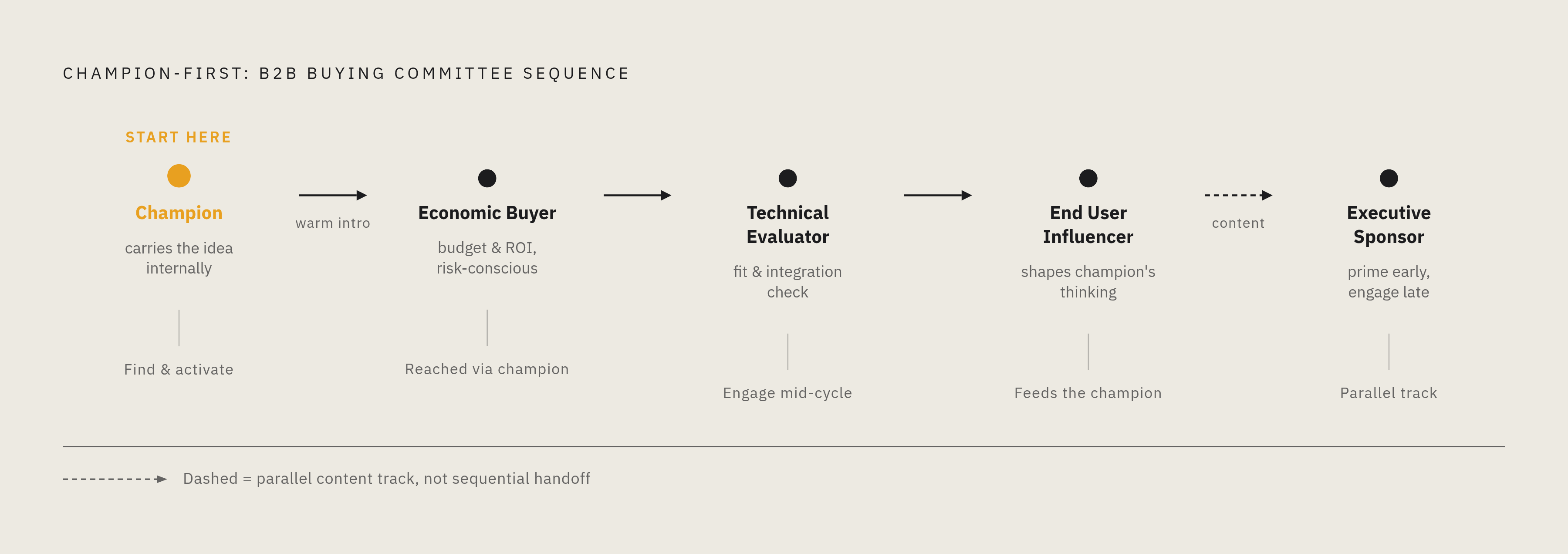
Every buying committee has roughly the same anatomy, even when titles change company to company. There's the economic buyer, who controls budget and cares about ROI and risk. The champion, who carries the idea internally and sells it to others when the founder isn't in the room. The technical evaluator, checking fit and integration. The end user influencer, easy to overlook, often shaping what the champion thinks without ever being asked directly. And the executive sponsor, who might not be reachable early but needs priming through content long before a meeting happens.
Find the champion first. That's the whole sequencing principle, simple to say and easy to get backwards. Activate the champion, then use content and a warm introduction from them to reach the economic buyer. Founders who skip this and go straight for the most senior leader tend to get a polite non-response and nothing else. A stranger asking a CEO for time reads as noise, not signal, no matter how good the product is.
A cold email from a BDR and a direct LinkedIn message from the person who actually built the product land completely differently. That's the part a hired marketer can't fake, especially with VP- and C-level contacts who get pitched fifty times a week and can smell a template from the subject line alone.
The mapping itself uses ordinary tools: LinkedIn Sales Navigator for org charts, public profiles to figure out what each stakeholder actually cares about based on what they post, and job postings, which quietly reveal internal pain points nobody puts in a press release. The output is a simple map, each person with their role, LinkedIn URL, and a short note on what they seem to care about.
Gartner describes the modern B2B buyer journey as a "big bowl of spaghetti," nonlinear, tangled across stakeholders, resistant to any tidy funnel diagram. The buying committee map doesn't untangle that spaghetti. It just hands the founder a fork.
What the founder's LinkedIn content does differently when 10 specific accounts are watching
LinkedIn is where this motion lives, and the gap between a personal profile and a company page explains why. Personal profiles generate roughly 8 times more engagement than a company page posting the exact same words. Same sentences, wildly different response, depending entirely on whose face sits next to them.
When 10 specific people at 10 specific companies are actually reading, the content math changes completely. Generic "5 tips" listicles vanish into the feed unnoticed, because everyone's seen that post before, usually written by someone else with a stock photo. What cuts through is a founder taking a real position on the category, specific enough that it reads as understanding instead of performance. Naming the exact problem a target account is quietly wrestling with, without naming the account itself, creates a small, private "they get it" moment for whoever on that buying committee happens to scroll past it that afternoon.
Tone matters more than topic here. Decision-makers broadly tend to prefer something human and unpolished over something that reads like it cleared legal, a majority say they want a more human, less formal tone. That register is exactly what a founder's own voice hits by default, and exactly what a company page structurally cannot fake.
There's also a link tax worth knowing: posts carrying external links lose a meaningful chunk of their initial reach, so the working approach is native content first, with the link dropped quietly in the comments once engagement's already moving. Best cadence for this motion: 3 to 5 posts a week, mid-morning, Tuesday through Thursday. The platform, structurally, favors humans over logos. That's not a metaphor. That's just how the algorithm's weighted.
The content formats that do the most work in a 10-account founder-ABM motion
Not every format pulls equal weight, and the gap is bigger than most founders expect. Native document posts and carousels (multi-image posts) consistently outperform plain text and outperform link posts by a wide margin. For one person running this alone, that fact should decide where the hours go, not some content calendar template downloaded from a marketing blog.
Carousels and document posts are the highest-leverage weekly habit: strong engagement without the production cost of video. Short, opinionated text posts are fast to write and tend to draw comments when they poke at a real, live disagreement inside the category. A LinkedIn newsletter on a theme the target accounts actually care about gives buying committee members a standing reason to keep following the founder's thinking. An occasional LinkedIn Live, when the founder can manage the production lift, positions them as someone worth listening to in real time, not just worth skimming between meetings.
Four content pillars carry most of this weight. Problem articulation names the exact pain target accounts live with, specific enough to read as pattern recognition rather than a pitch wearing an insight costume. Point-of-view content takes an actual position on where the category's wrong or where it's headed: what most vendors say versus what's actually true. Proof and customer narrative shows the outcome without sounding like a case study a legal team signed off on. Founder story, the "why I built this" content, gives buying committee members something to informally vet the founder against, because that vetting happens whether it's invited or not.
LinkedIn's algorithm has gotten good at spotting generic, formulaically-written content, and it quietly buries it. Founders who lean on templates lose credibility with the exact audience they're trying to earn. Authenticity beats polish here, full stop, no asterisk.
Responding to comments fast matters more than most people assume, and the mechanism is simple: early engagement tells the algorithm the post is worth showing to more people, so a comment answered within the first half hour compounds into meaningfully more total visibility. For a list of 10 high-value accounts, that window isn't a nice-to-have. It's part of the job description.
How to move from passive LinkedIn presence to active relationship choreography with each account
Content primes recognition. Direct outreach converts that recognition into an actual relationship. Skip the priming step, and even a perfectly personalized message reads as cold, because the person receiving it has no context for who's writing to them.
Before any direct message goes out, the founder should already be a familiar name. That means following target contacts and engaging with their posts in a way that's genuinely substantive, not a "Great post!" that could've been left by a bot with a heartbeat. Give it 2 to 4 weeks of this before reaching out directly. Anything less, and the warmth isn't real yet. It's just a name someone half-recognizes.
When the message finally goes out, reference something specific: a post the contact wrote, an announcement their company made, not a template with a first-name field swapped in. Framing matters too. The founder is a peer thinking about the same problem, not a vendor with a demo to book. The word "demo" itself tends to kill momentum at this stage. Ask for a conversation about the problem instead.
Reaching only the champion is a real risk, not a theoretical one. Research puts a large share of the buyer's journey as already complete before sales ever gets contacted, which means an economic buyer who's never heard the founder's name can quietly derail a deal the champion thought was settled weeks ago. So the founder has to work more than one thread inside the account, in parallel rather than sequentially, once the first relationship is warm enough to carry the weight.
A few ways to escalate without going in cold: use a shared connection for a warm introduction, quote the champion in a post or invite them onto a Live, or use an upcoming webinar as a legitimate reason to reach a second or third contact at the same company. None of this is complicated. It just has to happen on purpose, and get tracked somewhere instead of living in someone's memory.
That tracking is the coordination layer. For each of the 10 accounts, keep a running record: who's been engaged, how deep that engagement goes, which channel it happened on, and what signal came back. Skip the record, and duplicate touches happen, stalled accounts go unnoticed, and the founder ends up rediscovering the same three facts about an account every time the tab reopens.
The personalized content assets that support each account's buying committee without sounding like marketing
Running only 10 accounts means the founder can build things a marketing team running 200 accounts simply cannot afford to. A one-page document that names an account's specific situation, in its own language, beats a polished generic deck every time. The deck could've gone to anyone, and everyone on the other end knows it.
Different roles on the buying committee need different assets. The champion needs a short "here's how I'd frame this internally" document, written in the language their own org actually uses, structured around priorities that org has already signaled it cares about. That document does the champion's internal selling for them, which is the whole point of it. The economic buyer needs a tight framing of what the problem costs and what fixing it looks like, less a spreadsheet-style ROI calculator and more a narrative that makes the tradeoff obvious. The technical evaluator needs direct answers to the questions they're going to ask anyway (security, integration, implementation timeline) without a trace of marketing gloss anywhere in it. And the committee as a whole needs something shared: a post, a short point-of-view document, a piece of thinking that gives the whole group a common frame to decide around.
Hyper-personalization means something more specific than swapping in a first name. It means knowing the account's actual constraint, the specific restriction shaping their decision this quarter. Anything less reads instantly as generic vendor behavior wearing a personal-sounding subject line.
Timing counts too. Tracking who's viewing which posts, who opened the newsletter, who showed up to the Live, tells the founder when to send what. Sending the champion's internal-framing document the week after they engaged with a relevant post isn't a coincidence. It's sequencing, done on purpose, not luck dressed up as instinct.
For the highest-priority accounts, a personalized landing page or microsite, one that speaks directly to that account's industry, their stated challenges, their buying committee's specific concerns, converts at a meaningfully higher rate than a generic demo-request page ever will. It's more work to build. It's also built for an audience of exactly one company, which is the entire point of building it at all.
How a founder tracks progress across 10 accounts without a CRM team or a dedicated ABM platform
Ten accounts feels small enough to hold in memory. That's the trap, and it catches almost everyone running this alone. It feels trackable right up until the exact week a hot account goes quiet because nobody logged the last conversation, and by the time anyone notices, the champion's moved on to a different priority entirely.
A founder doesn't need enterprise software here, and buying one is usually a waste of money at this stage. A shared spreadsheet, one row per account, with columns for buying committee members, last touch, channel used, and signal received, does most of the job a full ABM platform would otherwise do. The discipline isn't in the tool, it's in updating it the same day a touch happens, not three weeks later from memory. Memory is exactly what fails first once there are 10 accounts, a dozen stakeholders apiece, and a founder still running the rest of the company at the same time.