How to Pick the 50 Accounts That Actually Matter in Pre-Series A SaaS
Focus your early sales on the 50 accounts where fit signals predict actual traction.

Roughly 42% of startups fail because nobody actually needed what they built. Not a funding problem, not a hiring problem, a "we picked the wrong 500 accounts and spread ourselves so thin nobody noticed us" problem. This piece is about the fix: how to pick 50 accounts, and only 50, based on fit signals instead of wishful thinking.
Most pre-Series A founders build their target list the way people build a fantasy football roster. They pick the accounts they'd brag about at a dinner party. The logo of a well-known corporate ranking list. The category leader everyone's heard of. That's aspiration talking, not readiness. And chasing aspiration while your runway ticks down is how a startup burns twelve months building a broad-reach GTM engine before messaging, audience, and value prop have even settled into place. That's the wrong motion, done early, at scale. Congratulations, you've automated the mistake.
Here's the part that trips people up: a longer list feels safer. Five hundred accounts feels like more surface area, more shots on goal, more room for someone to say yes. In practice it just means five hundred shallow relationships instead of fifty real ones. Depth beats breadth when you don't have the headcount to do both, and pre-Series A, you never have the headcount to do both. This is a GTM decision, not something to hand off to a sales ops spreadsheet. Here's how to make it well.
What an ICP actually is at the pre-Series A stage, and what it is not
An ICP describes a company. Not a person, not a job title, a company. If your ICP document has "VP of Marketing at a mid-size SaaS company" written on it, that's a buyer persona wearing an ICP's clothes. Keep the two separate. The persona tells you who to talk to once you've picked the account. The ICP tells you which accounts deserve the conversation in the first place.
A real ICP has three layers, and all three need to show up on the page:
- Firmographics: company size, industry, geography, revenue stage, how mature the org actually is
- Triggers: funding events, leadership churn, regulatory shifts, a competitor getting displaced, anything that signals a buying window just cracked open
- Macro trends: the "why now" layer, the market forces turning a chronic annoyance into an urgent one
Firmographics alone tells you an account could buy. Triggers tell you it might buy soon. Macro trends tell you why this is the year instead of some vague someday. Skip any layer and you're left with a list of companies that look right on paper and never respond to outreach.
For founders with a real customer base, the pattern only becomes signal rather than noise once you have enough customers per segment to reveal genuine trends rather than coincidence. Below that threshold, you're reading tea leaves.
For founders still pre-PMF, thin data is the whole situation, so the ICP starts life as a hypothesis. Built from market research, competitor teardown, a handful of early adopter interviews. It's a bet you're placing, not a conclusion you've reached, and it needs to be tested and revised as fast as new information shows up.
Why bother getting this precise? Per SiriusDecisions research, companies with a well-defined ICP see a 68% higher win rate. The gap is too large to count as a rounding error. That's the entire argument for doing this rigorously instead of running on gut feel and a good logo.
How to read your existing customers for the signal that points to the right 50
Company-wide metrics lie. Blended churn, blended LTV, average CAC across every segment you serve, all of it hides the signal by averaging it away. If ten of your accounts churn like clockwork and ten never churn at all, your "average churn rate" describes zero real customers.
Run a share-of-business breakdown instead. Split revenue, profit, and churn by segment and look for the one that's punching above its weight. The realistic distribution is never proportional. Somewhere in your customer base, a segment that's a small slice of total accounts is carrying a disproportionate share of revenue, retention, or both. That segment is telling you something.
What to actually look for:
- Highest lifetime value paired with lowest churn (clone these, don't just admire them)
- Fastest time-to-value after onboarding, which points to a tight match between product and the specific problem being solved
- Expansion revenue once the account is live, meaning the account had room to grow and someone found it
- Lowest support burden, an underrated one. High-fit accounts don't fight the product. They don't file five tickets in month one asking why a basic feature works the way it works.
Build this as a segmentation hypothesis, not a spreadsheet marathon. Start with a handful of guesses, maybe company size, maybe vertical, maybe lead source, and test each one against actual retention and expansion numbers. More segments is not better here. With a small customer base, splitting into too many buckets just gives you slices too thin to mean anything. Resist that urge. It feels like rigor. It's actually noise wearing rigor's clothes.
Layer in the qualitative side too: interview your best-fit accounts and ask what triggered the purchase. The story they tell, the thing that was breaking right before they called you, is usually the exact trigger your ICP framework should be screening for going forward.
And if the data's thin because you're pre-PMF? Use competitor analysis and early adopter feedback as a stand-in. Treat the segmentation as a first-principles hypothesis. Not a conclusion, a starting line.
The five fit signals that determine whether an account belongs on the list
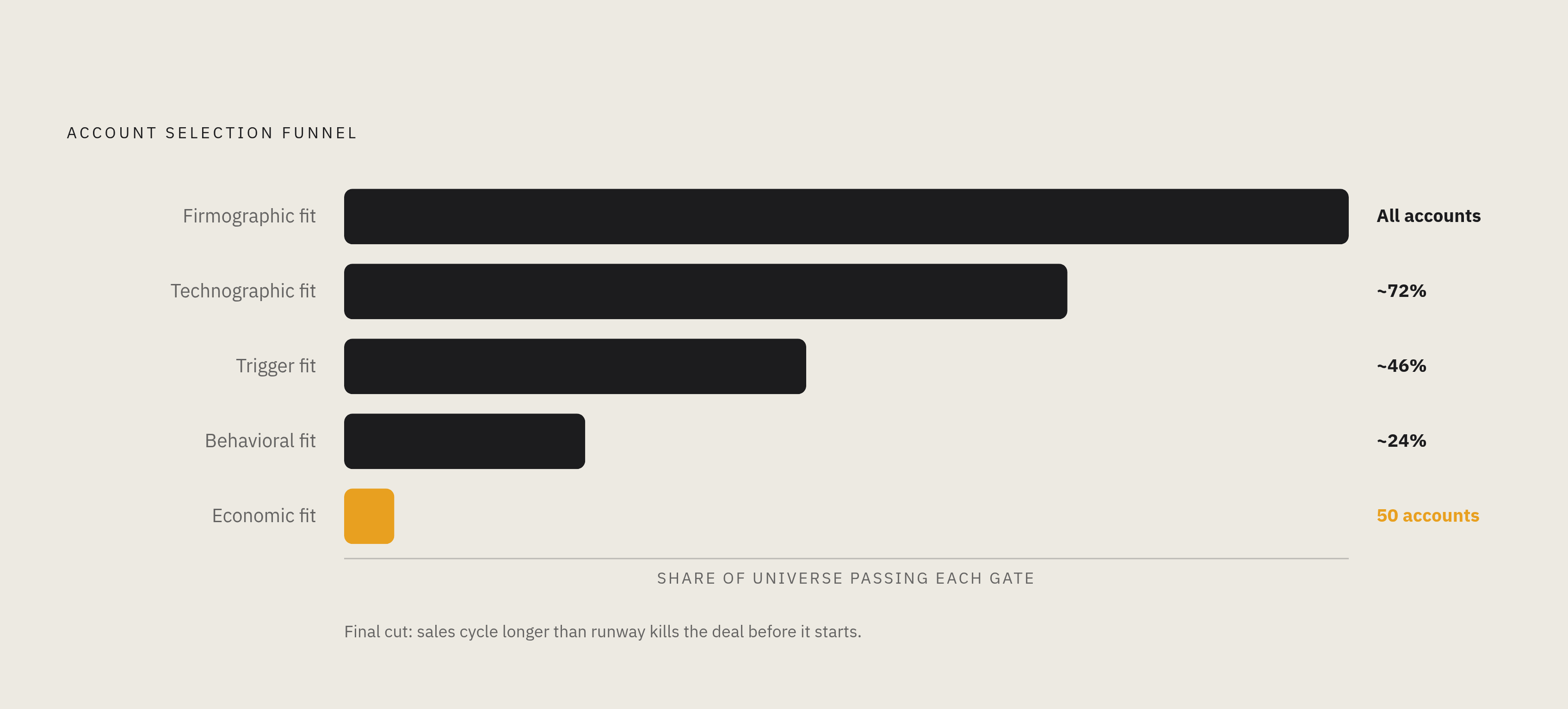
Five checks, run in order, each one narrowing the field:
Firmographic fit. Does the account match the industry, size, geography, and maturity of your best current customers? This is the gate, not the answer. Passing it gets you in the room, nothing more.
Technographic fit. Does the account's current stack play well with your product, or create an obvious displacement opportunity? Tools like LinkedIn Sales Navigator and purpose-built GTM research platforms can help surface this for fast-growing SaaS targets. Look for stack compatibility, legacy software your product clearly replaces, and the absence of an entrenched competitor already sitting in that seat.
Trigger fit. Is there a recent event cracking a buying window open right now? A funding round means fresh budget and a mandate to build. A new VP or C-suite hire often means vendor relationships are getting reset from scratch. Expansion into a new market, or new regulatory pressure your product directly addresses, both count too.
Behavioral fit. Has the account shown intent already? A like, comment, or share on founder content is a documented signal, not a vanity metric. Website visits, content downloads, event attendance, any trackable touch with the brand counts. So do peer referrals and dark-social mentions that surface through self-reported attribution on demo forms.
Economic fit. Does the account actually have the budget and the maturity to buy? Revenue band, headcount, and funding stage are rough proxies. Just as important: is the buyer reachable, or locked behind procurement bureaucracy you can't navigate at this stage? And does the likely sales cycle fit your runway? An account that takes 18 months to close is a bad bet if you've got 12 months of cash left. That's not pessimism, that's arithmetic.
Just as important as the ICP is naming its opposite. Write down explicitly which accounts do not belong on the list. Large enterprise accounts with opaque, multi-quarter procurement. Heavily regulated verticals your product isn't certified for. Geographies where you can't support a customer if something breaks. Defining the anti-ICP is what keeps aspiration from sneaking back onto the list disguised as ambition.
Why the accounts that matter already need to know you before outreach begins
Here's the number that should reorder every GTM plan built this year: 94% of B2B buyers build a shortlist before they ever contact a vendor, and per 6sense 2025 and Corporate Visions research, whoever's visible to that buyer on day one wins the deal roughly 80% of the time. Being first is a necessity. It's most of the game, decided before your first cold email even lands.
And the window keeps shrinking. Per that same 2025 report, buyers now reach out to sellers at 61% of the journey, down from 69% in prior years. The invisible research phase, the part that happens entirely outside your CRM, is getting longer every cycle. Gartner's research puts it even more starkly: buyers complete roughly 70% of a B2B decision before contacting any vendor at all. By the time someone books a demo, the shortlist is basically locked.
AI research tools are compressing that window further. A G2 survey from March 2026 found 71% of B2B software buyers used AI chatbots for their research, and those buyers were 2.3 times more likely to finalize a shortlist before ever reaching out to a vendor.
Layer the committee problem on top. B2B buying committees averaged 11 stakeholders in 2024, and every additional stakeholder drops purchase probability by 10 percentage points. Walk into a high-stakeholder account cold, with zero prior visibility, and you're not behind, you're structurally disadvantaged before the first call gets scheduled.
There's a compounding risk buried in here too: research from Emblaze in 2024 found an average 54.5% misalignment between how sellers and buyers describe the core problem being solved. When that alignment does happen, win rates jump 38%. Which means the fix isn't a better pitch deck, it's visible, problem-focused content out in the world before outreach starts, so the buyer already agrees with your framing of the problem by the time you show up.
The practical takeaway: account selection and founder visibility aren't two separate projects. The 50 accounts on your list are also the 50 audiences you need to be visible to before message one goes out.
How dark social shapes which accounts already trust you, and how to use it for list-building
Dark social is the sharing that never shows up on a dashboard. Private Slack channels, forwarded emails, WhatsApp groups, peer communities where people actually talk shop with colleagues they trust. Research suggests a large majority of content sharing happens in these private channels. Which means any strategy measured purely on public metrics, likes, shares, comment counts, is systematically blind to most of the influence actually shaping a deal.
And buyers trust it more, not less, for being invisible. A substantial share of B2B buyers cite peer recommendations from private, dark-social channels as their most trusted research source, ranking above analyst reports and above anything a vendor publishes directly.
Picture the mechanism: someone on a buying committee sees your LinkedIn post, screenshots it, drops it in their team's internal Slack with a "this is basically our problem" comment attached. That moment never touches a dashboard. No tracking parameter, no pixel, nothing. But it just moved your company onto a shortlist, and you'll have no idea it happened unless you go looking.
So go looking. A few habits surface it:
- Add a real attribution question to every demo form: "How did you hear about us?" and "Who referred you?"
- Ask the same thing again in onboarding surveys and early discovery calls
- Watch for patterns in the answers: "a peer shared your post in our Slack," "I heard you on a podcast." These answers tell you which communities and which content formats are quietly doing the work
- Use those patterns to identify which accounts are already circling inside your orbit, and move them up the list
Dark social is a channel that already exists, waiting to be tapped. It's evidence of trust that already exists, sitting there waiting to be read, if you bother building the attribution habit early enough to catch it.
How founder LinkedIn presence turns a static account list into a warm pipeline
Personal LinkedIn profiles generate 561% more reach than company pages posting similar content. The platform is built to work this way rather than through a hack. A founder posting under their own name will outperform the company account by structural design, not by trying harder.
Trust follows the same pattern. LinkedIn users are three times more likely to trust content from an individual than from a brand account. That gap is the entire reason founder-led visibility beats brand-led outreach for the fifty accounts on your list. There are roughly 65 million decision-makers on the platform, and something like four in five members influence business decisions in some capacity. The accounts on a pre-Series A target list are, statistically, already sitting in that room.
An analysis of 200 B2B SaaS companies that scaled from $0 to $5M ARR in Q1 2026 found 78% had founders actively posting on LinkedIn, and per Teract.ai research, the average founder-led company pulled in 20 to 30 qualified enterprise leads a month from LinkedIn alone. Not from ads. From posts.
The loop that makes this work runs like this: post content aimed squarely at the pain points of the fifty target accounts. Treat every like, comment, save, and profile visit as a real intent signal, because that's exactly what it is. Then follow up referencing the specific post someone engaged with. That's not cold outreach dressed up as warm, it's actually warm, because the person already told you what they cared about by engaging with it. One example from the research: a founder running this loop saw reply rates climb from single digits into the high twenties. Same content, same outbound motion, just connected properly instead of run as two separate efforts.
There's a newer wrinkle worth flagging too. Consistent posting on the same topics trains AI models to associate a founder's name with a company and a specific area of expertise, which matters given that 71% of B2B technology buyers used generative AI tools during their evaluation process. Show up consistently enough, and the AI itself starts recommending you.
None of this pays off in a week. Recognition and trust on LinkedIn compound, so give the system a genuine 90 days before judging whether it's actually moving the account list from cold to warm.
The thought leadership content that earns the right accounts before they raise their hand
Per the 2025 Edelman-LinkedIn B2B Thought Leadership Impact Report, 55% of hidden decision-makers, the ones who almost never engage with vendors directly, still use thought leadership to size up a company before anything else happens. And 95% say strong thought leadership makes them more open to being contacted by sales or marketing at all. The content does the warming up so the outreach doesn't have to start from zero.
The same report found B2B decision-makers consistently weight thought leadership heavily when judging what a company can actually do. That's the bar the content has to clear, not "sounds professional," but "sounds like it knows what it's talking about."
And tone matters more than most founders assume. 65% of buyers prefer something more human and less polished, the actual voice of the person writing it rather than corporate copy run through a style guide. Which is good news for founders who don't have a content team and just have opinions.
A few things worth building into the content itself:
- Write to the problem, not the product. Problem-focused sellers are 30% more effective than solution-focused ones, per Emblaze's 2024 research, yet only 13% of sellers actually take that approach. That gap is wide open.
- Be specific and be opinionated. 86% of decision-makers, per the same Edelman-LinkedIn report, prefer content that challenges their assumptions over content that just confirms what they already believe.
- Use real, owned numbers. Proprietary benchmarks from actual experience, not generic advice repackaged. AI models and human readers both prioritize the specific over the generalized.
Format matters too, and the data here is fairly concrete. Native document carousels lead every other format at a 7.00% average engagement rate, up 14% year over year, according to Socialinsider's 2026 benchmark report. Video is climbing fast as well, up 36% year over year in consumption, and video posts get shared roughly 20 times more often than other formats. On cadence, Findings suggest that 3 to 4 substantive posts a week beat daily light posting, and for smaller audiences specifically, 2 to 3 substantial posts weekly outperformed posting something thin every single day. Less, done properly, beats more, done on autopilot.