Why Your ICP Is Not the Same as Your LinkedIn Target Audience
Confusing who to target with what to say on LinkedIn quietly kills most founder content strategy.

Your ICP tells you which companies to chase. It says nothing about which humans to talk to once you're on LinkedIn, and that gap is where most founder content quietly dies. Confuse the two and you end up writing posts that describe a market segment to an audience made entirely of individual people who scroll, click, and move on in about two seconds.
An ICP is a company profile. It covers firmographics (industry, headcount, revenue, growth stage), technographics, buying triggers, and how operationally messy a business is before your product becomes worth the switching cost. What it deliberately leaves out is anything about a human: no anxieties, no communication style, no hint of what makes someone stop scrolling at 9:47pm on a Wednesday.
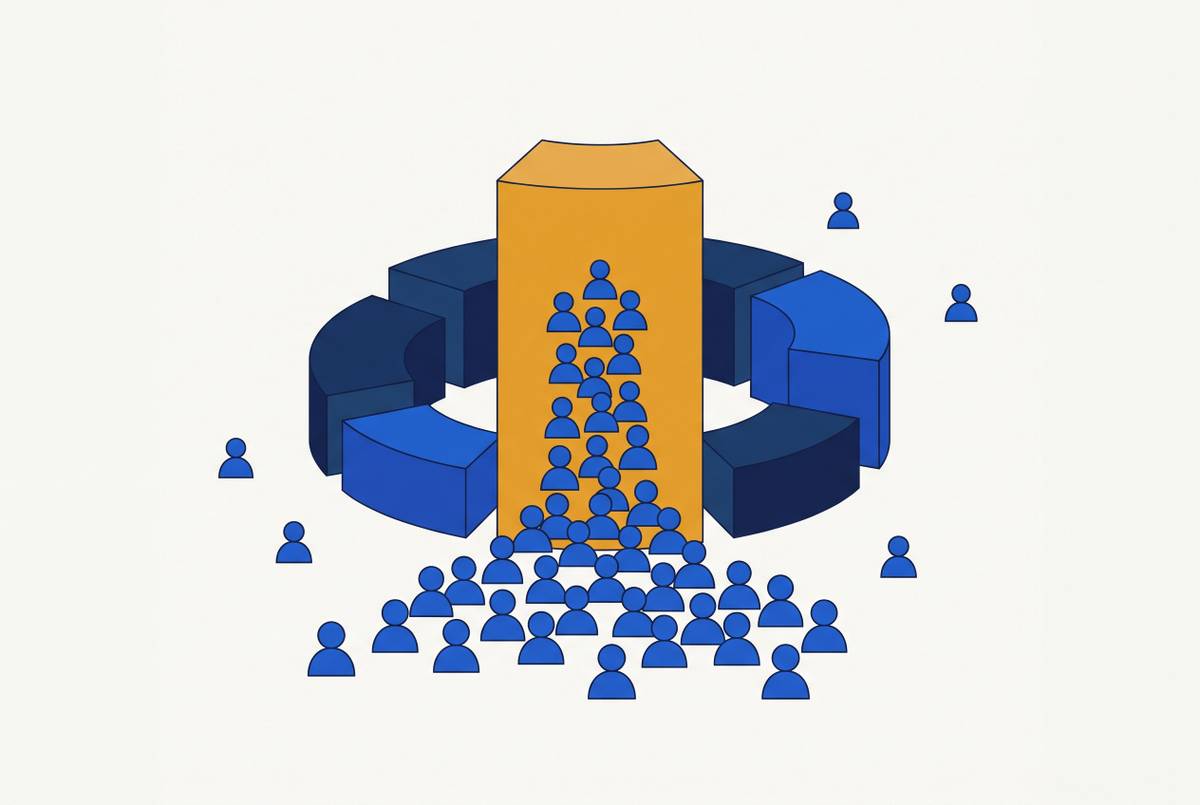
Think of it as three separate layers, each answering a different question. Target audience is the whole ocean you're fishing in. ICP narrows that down to the specific ponds worth your bait, say, SaaS companies with 100 to 500 employees, several product lines, five-plus integrated tools, and a RevOps function that actually owns decisions. Buyer persona is the individual fish, like a Director of Operations drowning in cross-functional workflows who's been asked to automate three processes by next quarter and has no idea where to start.
Factors.ai's ICP marketing guide puts it about as cleanly as it can be put: target audience determines reach, ICP determines focus, buyer persona determines resonance. Three different jobs. Three different tools. Knowing which companies to pursue tells you exactly nothing about what to say, to whom, or how to say it on a platform where accounts don't scroll, but people very much do.
The specific failure mode that collapses LinkedIn strategy
Here's the classic mistake, and it's a sneaky one because the first half is done correctly. A team nails the ICP at the account level, gets specific about firmographics, feels good about the work. Then they write LinkedIn content as if they're speaking directly to that account, a legal entity that, last anyone checked, does not have a LinkedIn profile and does not scroll a feed on its lunch break.
There's a companion failure that shows up just as often: nailing the individual but missing the organization. You find the perfect job title, the perfect seniority level, the perfect vocabulary, and you aim it at a startup that can't afford your product or an enterprise that doesn't have the problem you solve. Right person, wrong company. It's like being an excellent matchmaker who keeps setting people up in the wrong city.
The paid-targeting version of this mistake is baked into the platform itself. LinkedIn's native targeting operates at the individual-profile level, meaning job title, seniority, function, not at the account level where your actual ICP criteria live. Titles that sound close enough sneak through and let the wrong users into your funnel, which quietly inflates cost and muddies every metric downstream. Directive Consulting has reported that when practitioners manually cross-check LinkedIn account lists against real ICP criteria, they catch and remove close to half the accounts for not fitting the profile at all. That's roughly half of potential ad spend eliminated before a single impression runs.
The organic content version of the same failure is less measurable but just as costly. A post written "for the ICP," meaning for the company archetype rather than a person, has no voice and no tension. It reads like a capability statement stapled to a stock photo. Nobody argues with it, nobody nods along either. It's technically accurate about the market and completely inert as a piece of writing: seen, scrolled past, forgotten by the time the next post loads.
Who is actually in your LinkedIn audience, and what job each group is doing
LinkedIn audiences aren't one crowd, they're at least three, and each one behaves differently enough that treating them the same is like running a single ad for coffee, decaf, and motor oil because they're all technically liquids.
Buyers inside ICP accounts are the economic decision-makers, champions, and blockers at companies you actually want to close. Mostly, they lurk. They self-educate quietly and almost never comment in public where their boss or a competitor might see. The Edelman-LinkedIn B2B Thought Leadership Impact Report found that 55% of these hidden decision-makers, the ones who rarely engage with vendors directly, still use thought leadership content to vet companies before ever picking up the phone.
Fans and amplifiers are peers, adjacent practitioners, fellow founders, and curious onlookers who aren't buyers at all but who like, comment, and share. They're the ones who carry a post past its original audience and into feeds you'd never reach on your own.
Latent buyers sit somewhere in between: people at ICP-adjacent companies, or people who haven't officially stepped into a buying role yet but will in six months. They're not ready today. They're forming an opinion of you for later.
Jason Patterson of Jewel Content Marketing Agency frames the tension well: focus only on customers and "you are creating a funnel that's all bottom," with no wider reach to get found by more customers in the first place. Buyers tend to stay quiet while amplifiers drive visible activity. Without fans, there's no reach. Without reach, the lurking buyers never see the post that would've mattered to them. A single post can't fully serve all three groups at once, which is exactly why content needs to be judged as a portfolio over weeks, not graded post by post like a pop quiz.
Translating a company-level ICP into the individual roles that actually appear in the feed

Translation here doesn't mean inventing a fictional persona with a name and a stock photo just to feel thorough. It means figuring out which real job titles and functional concerns actually sit inside your ICP accounts, then writing to those people specifically.
The ICP already hands over most of the raw material. Industry and growth stage narrow down which business pressures are actively live right now. Revenue range and headcount hint at org structure and who really owns the decision. Tech stack and integrations point to which roles are hands-on operational stakeholders. Buying triggers show which role feels the pain first, and usually loudest.
From there, map the roles that actually show up in a deal, including the economic buyer who signs off, the champion (often a mid-senior operator building the internal case brick by brick), the technical evaluator kicking the tires, and the blocker in legal, finance, or IT who can kill a deal with one quiet email nobody else sees. Each carries a different mental state and a different vocabulary, and each has a completely different reason to stop scrolling. A CFO at a 200-person SaaS company does not respond to the same hook as the RevOps Director sitting two floors down at that same company.
The same product feature even lands differently depending on who's reading it. Per Leadfeeder's ICP guide, cost savings is the frame that works for a CFO, while feature-based pain-point resolution is the frame that works for the end user actually clicking around in the tool every day. Same feature, two entirely different pitches.
For each major ICP segment, map at least two or three distinct roles and write out the specific concern, the specific vocabulary, and the specific objection each one brings to the feed. That's the whole exercise. It's not persona creation as a branding ritual, it's the prerequisite for writing a post that makes one particular person feel understood instead of generically addressed.
Why founders specifically carry this translation responsibility, and why it works when they do it
The platform data on this isn't subtle. Per LaGrowthMachine's 2026 strategy guide, personal LinkedIn profiles generate eight times the engagement of company pages. Eight times isn't a rounding error, it's a different category of outcome.
The mechanism behind that gap is trust. Buyers don't buy from companies first, they buy into leadership, and as skepticism toward traditional advertising keeps climbing, buyers increasingly vet a company by studying the person running it. Research consistently shows that a substantial majority of B2B buyers say a founder's thought leadership content directly shapes their purchase decision. The Edelman-LinkedIn 2025 research adds texture worth sitting with: 86% of buyers prefer ideas that challenge their assumptions over content that just confirms what they already believe, and 65% prefer a tone that's more human and less formal. Both traits come naturally to a founder typing out a real opinion. Neither comes naturally to a company page, which is structurally built to sound like a company page.
Founders are also the only people who can perform the ICP-to-individual translation with any real authenticity, because they built the product against one specific problem, for specific people, inside a specific context. No ghostwriter and no marketing team can borrow that lived specificity without the founder's direct input somewhere in the process.
Lara Acosta's launch of her startup Kleo is worth sitting with as a case in point. She launched with two or three LinkedIn posts, no ad budget, no elaborate launch sequence, and reached $60,000 in monthly recurring revenue by the second month. The audience she'd built over two years recognized the exact problem the product solved on sight, because her content had been speaking to those specific people the entire time, not to a market segment.
The algorithm rewards this instinct too. Through 2025 and into 2026, LinkedIn has leaned harder into dwell time, meaningful comments, topic consistency across three to five recurring themes, and network relevance. All four of those favor founders who post specifically and consistently over founders who post broadly and sporadically, which is really just the platform mechanically rewarding what good writing was already supposed to do.
Building a content portfolio that serves buyers, fans, and latent buyers at the same time
One post can't do three jobs well. So the fix isn't a better post, it's a mix, planned across weeks with each piece pulling its own weight for a specific audience.
Content for fans and amplifiers tends to be broader: industry observations, contrarian takes, behind-the-scenes moments, opinion pieces that give someone a reason to hit share because it makes them look sharp for reposting it. These are the posts that extend reach into ICP accounts that have never heard of the founder before.
Content that resonates with lurking buyers works differently. It's specific and problem-centric, naming the exact pain an ICP company feels and speaking in the vocabulary of whichever role feels it first. These rarely go viral. They generate the quiet DM instead, or the inbound inquiry that shows up three weeks later referencing a post nobody commented on.
Content that converts latent buyers leans on case studies framed around outcomes rather than features, sequenced educational posts that build an argument across several installments, and posts that stake out where the founder thinks the category is headed next.
Format matters here too. Carousels carry the highest engagement rate among 2026 benchmarks, at 6.60%, and work well for laying out an educational framework step by step. Video drives the most sharing and reads as the highest-trust format for showing actual personality. LinkedIn Live, per Snov.io's research, produces 24x more reactions than standard posts.
Sequencing compounds all of this. Content Marketing Institute's 2025 research found that thematically linked content published in a logical progression pulls in 62% more cumulative engagement than the same content posted randomly. One Brixon client in B2B SaaS ran a four-part sequence on a single topic and saw overall reach jump 340%, generating 27 qualified leads, compared to just 4 leads from the same content published without any sequencing. Same material, different order, wildly different result.
As a rough mix: most posts should educate and build authority. A smaller share should stake out a clear point of view or challenge a category assumption. A minority should be direct evidence, case studies, results, or anything overtly promotional. Cadence matters as much as mix, and the founders seeing the strongest results tend to post several times a week with substantive content, not daily surface-level takes that read like they were written in the elevator.

What changes when you plan content from the person first, not the account first
Planning from the person first changes the very first line of the post. "Here's a challenge mid-market SaaS companies face" becomes something closer to "here's what a RevOps Director is actually thinking at 11am on a Tuesday when the CRO asks why pipeline is thin." One is a company archetype. The other is a specific mental state, and only one of those makes a real person feel caught mid-thought.
It changes which metrics actually matter, too. Reach from fans tells you the content is traveling. Inbound messages and meaningful comment threads from the right roles tell you the content is landing where it counts. Both matter, and they're measuring two entirely different things, so treating them as interchangeable is how teams end up celebrating vanity numbers while the pipeline stays flat.
The business case for getting this right isn't a branding argument, it's closer to pre-sales infrastructure. The Edelman-LinkedIn 2025 data found that 95% of hidden decision-makers say strong thought leadership makes them more receptive to being contacted by sales or marketing later on. Content that reaches and resonates with the right individuals doesn't just build a brand, it changes the temperature of every outreach email that follows it.
The same logic carries over to paid targeting. For direct-response campaigns aimed at ICP accounts, tighter, more curated audience sizes tend to hold the highest ICP match rates, and the organic work of correctly mapping individuals to ICP accounts feeds directly into which targeting parameters to include and which to exclude before spending a dollar.
LinkedIn's platform shifts through 2025 and 2026 have leaned toward rewarding this same instinct: distribution for substantial, industry-relevant content has grown even as reach for viral-but-empty posts has thinned out. Before drafting anything, name the ICP account type the post is meant to serve. Then name the specific role inside that account you're writing for. Then name the one thing that person is actually worried about this week. The post writes itself from there, and it stops sounding like it was written for everyone, which is really another way of saying it stops sounding like it was written for no one at all.