How B2B SaaS Investors Read a Founder's LinkedIn Before the First Call
Investors scan your LinkedIn profile before the first call to test your market conviction.

SaaS multiples fell from 15-20x revenue at the 2021 peak to roughly 7x in 2024, and VC holding periods stretched to 7.2 years, up from 5.5 in 2019, per PitchBook. Do the math on that and it gets uncomfortable fast: investors are stuck with the founders they back for the better part of a decade, at half the price they used to pay. LinkedIn has quietly become the background check that happens before the background check, and founders still treating it like an online business card are already losing deals they'll never know they lost.
How investor due diligence actually reaches a founder's LinkedIn profile
Diligence doesn't start with a term sheet. It starts the moment an investor reads an intro email, and the casual questions that follow are already pattern-matching for something specific.
DocSend found that 78% of investors check a founder's thought leadership before the first meeting happens. LinkedIn is where that check gets done, because it's the one place a founder's thinking sits out in public, dated and time-stamped, hard to fake after the fact.
Every serious VC evaluation eventually comes back to the team, and that scrutiny happens earlier than most founders assume. A deck lands, or a warm intro comes through, and before a call even gets scheduled, the investor has already typed a name into a search bar.
What shows up in the first 90 seconds decides whether that eventual call feels like an obligation or an opportunity. In that window, LinkedIn works as a live feed of domain knowledge, communication style, and conviction, all visible before anyone says hello.
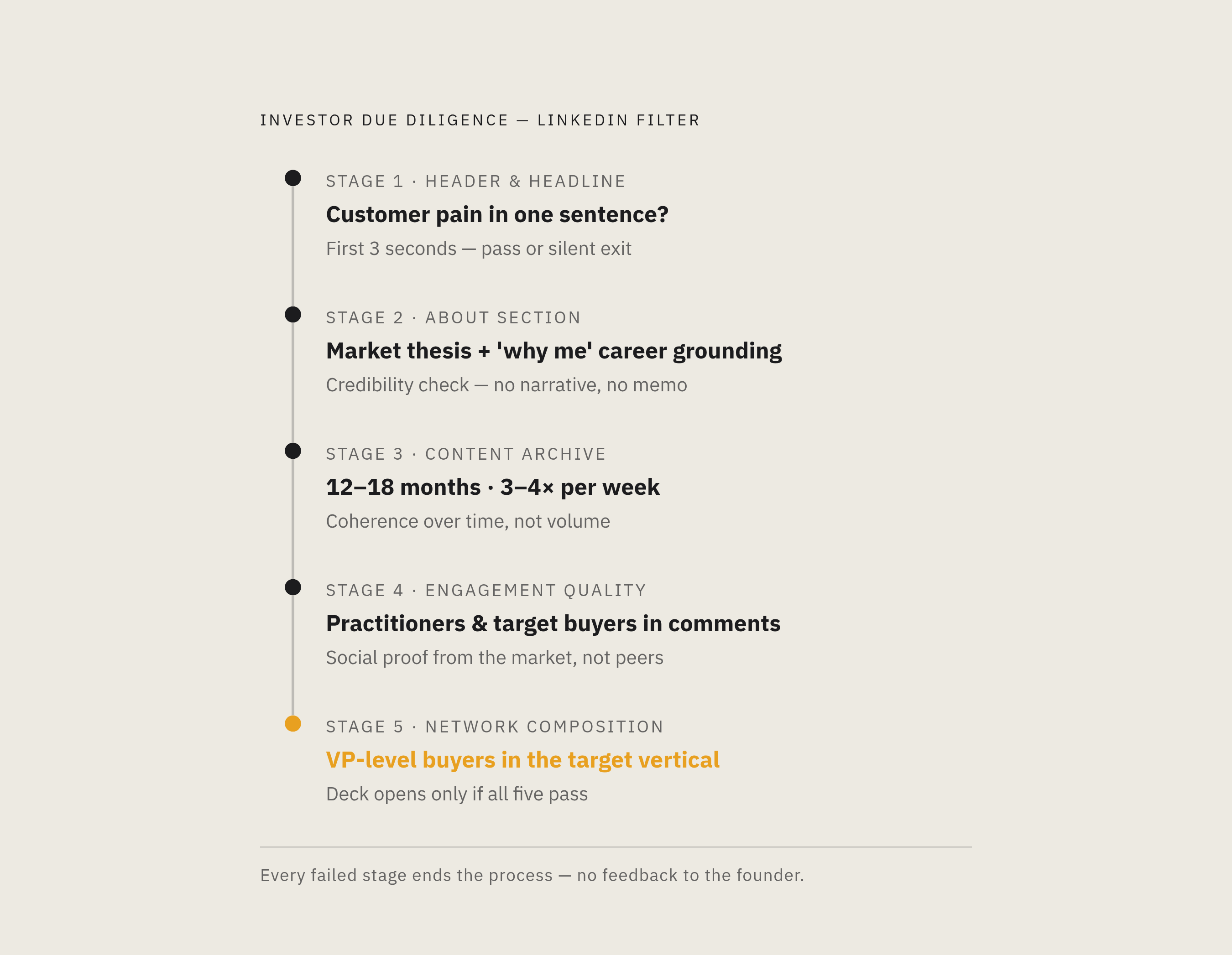
The profile as a first filter: what investors read in the header and About section
The header is the first pass, and it's brutally quick. Investors check whether a founder can state the problem they solve in one sentence, without leaning on a job title or company name to carry the weight.
The best headlines lead with the customer's pain, not the product's feature list. That single choice tells an investor the founder knows who they're building for, which works as a cheap, hard-to-fake stand-in for market fit.
The About section is where the real test happens. Can this person explain, in plain words, why they're the one to fix this problem, with no deck-speak and no borrowed jargon? Investors are pattern-matching for a specific thesis about why the market is broken, a background connected to the problem by cause rather than coincidence, and language that sounds like a person instead of a pitch.
A thin About section reads exactly like a thin deck. Here's what most founders get wrong: they assume investors will call it out. Investors just move on instead, quietly, with less interest than they walked in with. Weak thought leadership doesn't get flagged; it gets forgotten, which is worse.
Topic consistency in the content archive as a proxy for domain conviction
The content archive is a track record, whether the founder meant it to be one or not. How long has this person been publicly thinking about the problem, and has that thinking sharpened over time, or just repeated itself in different fonts?
Staying narrow convinces a human reader that someone actually lives in this problem space, instead of cramming for it right before a raise.
Investors scan for specifics: how much of the archive touches the real problem versus how much is noise, whether posts from a year ago line up with the current pitch, whether the content takes a position or just says something safe enough to forget by lunch. Coherence over time reads as credibility. A sudden pivot in tone reads as a tell.
Founders posting three to four times a week with real depth see strong engagement returns, per 2026 benchmark data. And investors can always tell when the archive started right before the raise, because six weeks of posts does not read the same as two years. A sudden sprint of activity before a fundraise looks exactly like what it is: homework finished the night before the test.
Engagement quality as early evidence of market pull
Who shows up in the comments matters more than how many people do, full stop. A comment from a VP of Operations at a logistics company, on a founder's post about warehouse workflows, is worth more to an investor than a hundred likes from other founders cheering each other on. That single comment is a data point no pitch deck can manufacture on command.
The Edelman–LinkedIn B2B Thought Leadership Impact Report 2025 found 95% of hidden decision-makers say strong thought leadership makes them more open to being pitched, and 42% went as far as inviting a company to bid after engaging with content they found genuinely useful. An investor reading an active comment section is watching that exact behavior happen for free, before anyone's written a check.
Low-quality engagement has its own tells, and they're easy to spot once someone points them out: only other founders in the comments, nobody who actually buys the product, plus rows of "Great post!" with nothing underneath. A big follower count sitting next to almost no real conversation usually means the numbers were bought or the content never had a point to begin with.
Here's the wrinkle most founders miss: personal profiles generate roughly five times the engagement of company pages running similar content. If an investor notices the company page outperforming the founder, that's not a neutral fact. It means the founder handed their voice to someone else, a strange move given that voice is supposed to be the one asset nobody can duplicate.
Network composition and what it reveals about go-to-market reality
Investors can see exactly who follows a founder and who follows back, and a network stacked with the right buyer persona is evidence that distribution isn't hypothetical. It's already happening, or being built with intent, instead of hoped for on a slide.
One analysis of B2B SaaS companies that grew from zero to meaningful ARR found 78% had founders actively posting on LinkedIn, with the average founder-led company pulling in 20 to 30 qualified enterprise leads a month from the platform alone. Investors read a founder's network the way a scout reads a farm system: proof the pipeline exists somewhere other than a projection column.
For founders selling above a significant contract value, or targeting buyers at VP level and up, that buyer needs a real conversation before committing, and LinkedIn is usually where it starts. So the makeup of a founder's network becomes a stand-in for the entire go-to-market thesis, whether the founder intended that or not.
What investors actually look for: connections that include practitioners and department heads in the target vertical, not just a rolodex of fellow founders and VCs patting each other on the back, plus visible back-and-forth with known voices in the category. Early customers or pilot users showing up in the comments before any official metrics get shared is basically the ghost of product-market fit, haunting the page months before anyone calls it that.
A network built entirely from other founders and investors, with zero sign of an actual buyer anywhere in it, tells its own story. The distribution plan hasn't been tested anywhere except in a slide, and investors have seen that ghost before too.
The narrative coherence test: does the LinkedIn story match the pitch deck?
By the time an investor opens the actual deck, they've already read the profile, scrolled the archive, and clocked who's commenting. A narrative has already formed in their head, and the deck either confirms it or breaks it wide open.
The check is simple to describe and brutal in practice. Does the problem the founder obsesses over in public match the problem the deck claims to solve? Does the go-to-market story on the slide match the audience the founder's actually been building on LinkedIn? A deck that promises an enterprise sales motion, sitting next to a LinkedIn full of product-led-growth content, tells an investor one of two things. Either the strategy is genuinely fuzzy, or the deck was built to flatter what investors want to hear rather than describe what's actually happening on the ground. Pick whichever explanation sounds worse; investors usually assume both.
That mismatch does more damage than founders expect, because it suggests the whole story was assembled for the raise rather than lived before it.
Call it narrative capital: the credibility built through months, sometimes years, of consistent public thinking. No slide deck generates that on demand. Founders who invest in consistent narrative development before a raise tend to enter conversations with more credibility already established. Research also found 53% of B2B decision-makers say strong thought leadership makes brand recognition matter less, which is the exact mechanism at work here. An early-stage founder without brand equity can build something that substitutes for it: a public record of being right, repeatedly, about the market they're now asking someone to fund.
Underneath all of it, the investor isn't just checking the story once. They're checking whether this person can keep telling it credibly, to customers, to the press, and to the next round of investors three years from now.
What a LinkedIn profile optimized for investor diligence actually looks like
Strip it down and two layers do the work: the profile itself, and the content sitting on top of it.
On the profile side, the headline states the problem and who has it, with the title serving as supporting detail rather than the whole pitch. The banner reinforces the category the founder wants to own, logo playing a supporting role rather than a decorative one. The About section reads like a thesis on the market, with a "why me" grounded in real career history instead of ambition-flavored filler. The Featured section holds two or three pieces that actually prove depth: a long post that pulled real practitioner engagement, a press mention, a framework the market has picked up and used somewhere outside the founder's own posts.
On the content side, cadence matters as much as substance: three to four posts a week, built around three to five themes that don't wander. Consistency here reads as conviction, maintained deliberately rather than farmed out to an assistant's calendar. The mix matters too, market observations with an actual point of view, sharp descriptions of customer pain, and the occasional disagreement with where the category is headed, because specific and opinionated beats safe and forgettable every single time. The founder also needs to show up in their own comments, replying to the practitioners who bother to respond, since the thread underneath a post is content too, and investors read it.
Timing is the one detail nobody can fake, no matter how good the writing is. An archive built over twelve to eighteen months before a raise reads as real. One assembled in the two months before reads as tactical, and it lands exactly that way, because investors have seen the pattern and they clock it fast. Every post, in the end, is a compounding data point sitting there waiting to be found: a public transcript of how this founder has been thinking about the market, long before anyone asked them to pitch it.
Why the founders who treat LinkedIn as a fundraising instrument before they need to raise win the most
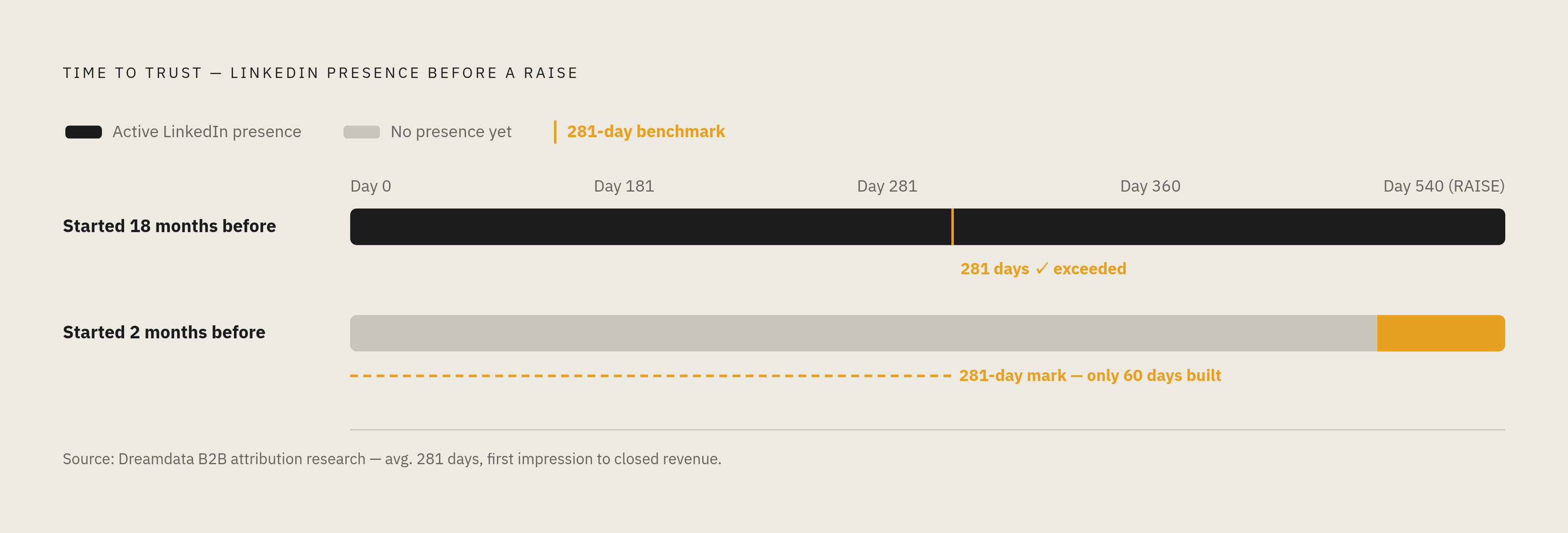
Dreamdata puts the average time from a first LinkedIn impression to closed B2B revenue at 281 days. That same clock runs on the investor side too, quietly, long before a formal process starts. Founders who wait until they need money to start posting are trying to compress 281 days into three weeks, and it shows the way cramming always shows.
An investor who's been following a founder's content for months walks into the first call already halfway convinced, and that compresses diligence and closes rounds faster, because half the conviction-building already happened in a feed instead of a conference room. Edelman-LinkedIn's numbers back this up on the buyer side too: 95% of hidden decision-makers say thought leadership makes them more receptive to outreach, and a strong majority trust it more than traditional product materials. Founders who've been quietly present in an investor's feed for a year are cashing in on that exact psychology before they've sent a single deck.
There's a layer to this that never shows up in any dashboard, and it might be the most important one. Plenty of an investor's exposure to a founder happens in forwarded posts, private Slack threads, and side conversations between partners, none of which registers in LinkedIn analytics anywhere. Founders posting consistently build influence they can't measure directly, and it surfaces later as warm intros and interest from investors who already feel like they know them before the first call happens.
The founders getting the best terms right now are rarely the ones with the sharpest slide design. They're the ones investors already trusted before the deck showed up in their inbox. Building that trust is a content decision as much as it's a fundraising decision, and the window for it is never the month before a raise; it's every month before that one.