What a 90-Day LinkedIn Content Calendar Looks Like for a SaaS Founder
LinkedIn's 2026 algorithm rewards saves over likes, reshaping how founders should post.

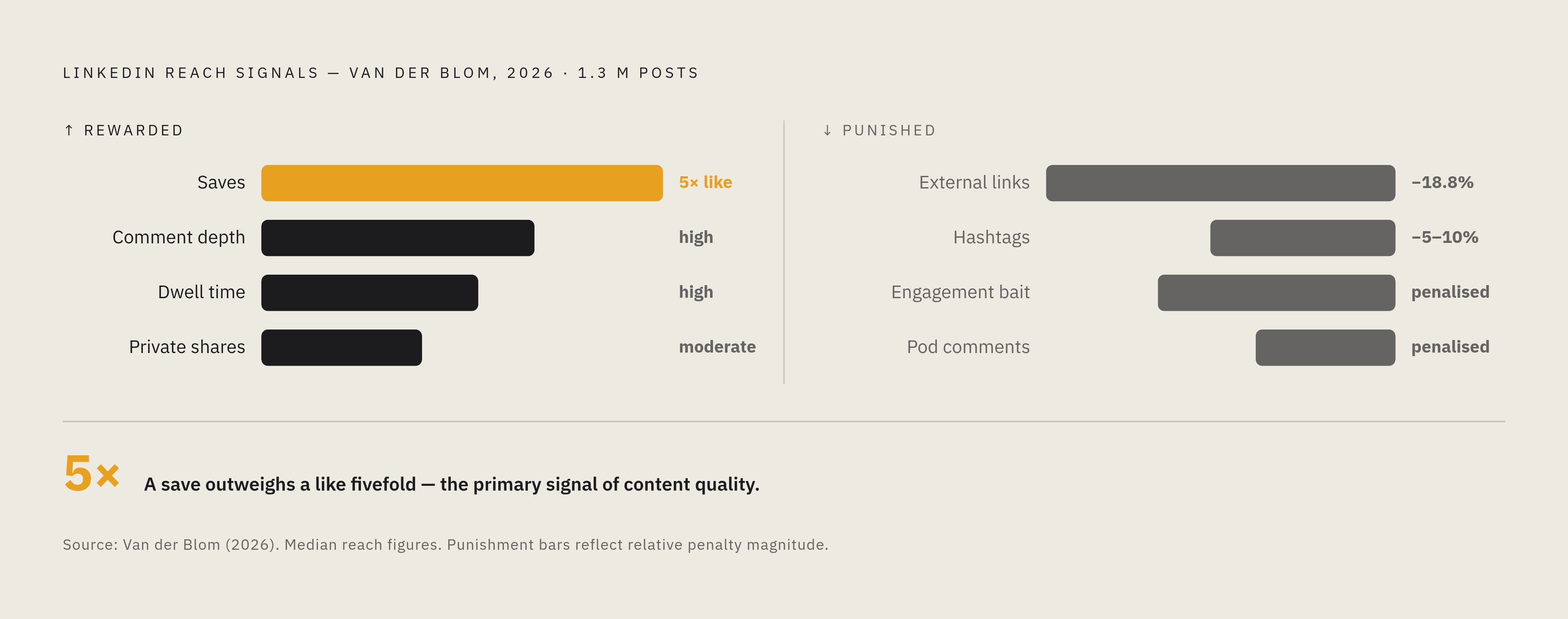
How the 2026 LinkedIn algorithm rewards content, and what it punishes
Most SaaS founders still treat LinkedIn like a broadcast channel: post something, wait for likes, feel good or bad, repeat. That model is dead. The 2026 version of the algorithm runs on an Interest Graph, not a Relationship Graph. Only about 31% of what shows up in a user's feed comes from their first-degree connections anymore. Reach isn't capped by who follows you. It's capped by whether the algorithm thinks your content is worth showing to strangers who care about the topic.
What decides that? A metric researchers have started calling the Depth Score. Dwell time, saves, comment depth, and private shares carry the weight now, not likes. Van der Blom's 2026 study of 1.3 million posts found something almost funny: a post with a handful of likes but 30 saves and 15 real comments beats a post with 500 likes and zero saves in the next distribution cycle. Saves, specifically, are roughly five times more powerful a signal than a like. So the practical question for every post isn't "will people like this," it's "will people save this for later." Those are very different pieces of content.
There's also a quieter enforcement mechanism at work: profile-to-content alignment. LinkedIn's Generative Recommenders cross-reference what you post against what your profile says you do. Say your headline is "Founder, workflow automation for logistics" and you post a rant about crypto, and the mismatch actively costs you reach. The system is checking your homework.
What gets suppressed is just as instructive as what gets rewarded:
- Engagement bait ("like if you agree," "comment YES below") gets flagged and throttled.
- Reciprocal engagement pods, where the same small group of accounts comments on each other's posts within minutes, get caught by detection that's grown sharp enough to notice the pattern.
- External links in the post body cost reach, too. Van der Blom's research found a single link in the body text drops median reach by 18.8%.
Posts without hashtags now outperform posts with hashtags by 5 to 10%. Whatever hashtag advice circulated a few years ago, forget it.
One more mechanical detail that shapes everything downstream: LinkedIn tests a new post on roughly 5 to 10% of your connections and followers first, then watches what happens in the first 60 to 90 minutes. If that early group saves it, comments on it, sits on the page reading it, the algorithm pushes it wider. If not, it dies quietly in a corner nobody sees. That early window is why timing and format choices in the calendar ahead aren't cosmetic decisions. They're the whole game.
Why the founder's personal profile is the only viable content vehicle
Company pages on LinkedIn are, for pipeline purposes, mostly decorative at this point. Employee posts reach 561% further than company page posts, and organic company page content now makes up just 1 to 2% of the LinkedIn feed, down from 7% back in 2021. Personal profiles generate roughly five times more engagement than company pages running the same content, and that gap keeps widening rather than closing.
The data on SaaS growth backs this up in a way that's hard to argue with. Of the B2B SaaS companies that grew from $0 to $5M ARR in the first quarter of 2026, 78% had founders actively posting on LinkedIn. Those founder-led companies generated, on average, 20 to 30 qualified enterprise leads a month from LinkedIn alone, according to an analysis of 200 such companies, a channel doing the job an entire outbound sales team used to do. That's not a marginal bump. That's a channel doing the job an entire outbound sales team used to do.
Consider Lara Acosta's Kleo, cited on buildmvpfast.com: she took the product to $60,000 in monthly recurring revenue by its second month, with no ad budget behind it. The mechanism wasn't a clever launch trick. It was two years of accumulated audience trust sitting on her personal profile before the product ever existed. The audience was the asset. The launch just cashed it in.
None of this means the company page is worthless. It still does real work on brand legitimacy and search presence, the kind of thing a prospect checks after they've already decided you're credible. Pipeline runs through the founder's face and words. The 90-day calendar that follows is built entirely on that premise.
There's an odd tailwind here, too. A large share of long-form LinkedIn posts today carry signs of AI generation: the same rhythm, the same hedge words, the same bullet-point wisdom that says nothing. A founder who actually writes like a person, with specific numbers and real opinions, stands out by default. Agencies and company pages can't fake that. It's a moat built entirely out of sounding like yourself.
The three-phase logic behind a 90-day calendar
A 90-day calendar isn't a content schedule. It's a sequence, and the order matters as much as the content itself. Month 1 builds topic authority. Month 2 builds proof. Month 3 turns that proof into pipeline. The sequencing is intentional, and drifting from it undermines the logic of what each phase is trying to accomplish.
The reason sequencing matters comes down to how the algorithm classifies accounts. Per PromiseClick's framework, the system needs sustained, topically consistent posting to decide you're an expert in something and start pushing your content to the right audience. Post about supply chain logistics on Monday and crypto memes on Wednesday, and the classification resets. The Interest Graph is trying to learn who to show you to, and it learns from consistency, not variety.
Think of the three months as a progression: Month 1 establishes what the founder stands for, Month 2 backs that up with evidence, and Month 3 converts the accumulated credibility into actual conversations.
The content mix across all three months follows a rough split sourced from foundera.co's framework: 40% customer wins and metrics, 25% product narrative, 20% founder narrative, with educational and market insight content rounding out the remainder. The calendar doesn't apply that mix evenly, though. Month 1 leans hard into educational and market insight content, because there's no proof to show yet. Month 3 leans into the customer-win bucket, because by then there's plenty.
Within each week, the scheduling mixes authority posts (educational, no call to action), engagement posts (questions, polls, contrarian takes), and one conversion post. The mix tilts more toward conversion posts by Month 3, but the underlying structure holds throughout.
On frequency: 3 to 5 posts a week is the sweet spot most sources converge on. Posting more than once a day backfires, because a high-performing post can keep generating engagement for 48 to 72 hours, so posting more than once a day risks splitting audience attention before the first post has run its course. Realistically, this costs a founder about 2 to 4 hours a week if batched properly, producing somewhere around 12 to 16 posts a month. Not a full-time job. More like a standing Tuesday appointment.
Month 1, Weeks 1–4: establishing topic authority before asking for anything
Month 1 has exactly one job: teach the algorithm to classify the founder correctly, and teach the audience to associate that founder with one specific problem. Per PromiseClick's framework, holding one clear position for at least 90 days builds topic authority. Wander off-topic in week two and the clock resets.
Week 1 starts before a single post goes up. Profile language needs to match what's about to get posted, since the Generative Recommenders penalize the mismatch immediately. Once that's sorted, the posting begins:
- Post 1 is an origin story, the "why I built this" narrative. It's the highest-dwell post type available for a fresh content phase, because people read origin stories the way they read the first page of a book.
- Post 2 is a specific, falsifiable take on something the ideal customer profile (ICP) believes that the founder disagrees with. Tracsio's 2026 framework calls this the "point of view" bucket, and it's designed to pull real comments from the right people, not just noise.
- Post 3 is an educational carousel, a document-format post breaking down the core problem the product solves. Document carousels lead every other format at a 7.00% average engagement rate and pull in 39% more reach than average, per a benchmark study of 1.3 million posts.
No CTAs, no demo links, no "book a call" anywhere in week one. The only goal is Depth Score signal.
Week 2 shifts toward real buyer language, pulled straight from sales call objections, support tickets, and lost-deal reasons. Tracsio's framework flags the "buyer problem" and "objection" buckets as the highest-signal raw material available to a founder.
- Post 1: a text post, roughly 1,000 to 1,300 characters, naming a specific pain point and giving an honest take on why the common fixes fail. Specificity is what earns a save.
- Post 2: a poll or question post. Polls rack up high impressions and, more usefully, reveal what the audience actually struggles with, based on the responses they generate, which feeds directly into weeks three and four.
- Post 3: a short vertical video, kept tight and captioned. Vertical video has gained significant ground while horizontal video reach dropped 18%, and strong completion rates feed the Depth Score directly.
Week 3 introduces the first real founder narrative post: "what I learned building this," framed around a decision or a reversal, not a win. Per PromiseClick's framework, story-driven posts convert simple recognition into actual trust. Pair it with a carousel breaking down a framework relevant to the ICP's problem (document carousels generate two to three times more dwell time than text or image posts, making them the strongest single format under the Depth Score model), and close the week with a genuine contrarian observation about the market, framed as an honest opinion rather than bait.
Week 4 brings the first proof-of-concept post: a real number, a metric that moved, with tight context and a clear takeaway. That combination, real metric, real context, real takeaway, consistently outperforms other post formats on average. Repeat whichever format performed best across weeks one through three, applied to a new topic, since the algorithm rewards format consistency as much as topic consistency. Close with a soft CTA, something closer to "if you're dealing with this problem, here's what's been learned" than "book a demo." At month's end, check which posts earned saves, real comments, or profile visits from ICP-fit accounts. Those topics and formats become the raw material for Month 2.
On timing: Tuesday through Thursday, 10 a.m. to 2 p.m. in the audience's time zone is the consensus peak window for B2B SaaS. Buffer's dataset of 4.8 million posts found the 3 p.m. to 8 p.m. Audience type may affect engagement more than any generic benchmark, shifting which posting window performs best. Test both during weeks one and two rather than assuming.
Month 2, Weeks 5–8: building social proof through customer evidence and build-in-public posts
By Month 2, the audience already knows what the founder stands for, and the algorithm has the account classified. Now it's time to show the product actually works, backing up whatever claims got made in Month 1 with evidence. The customer-win allocation from foundera.co's framework becomes the backbone here, so every week should carry at least one customer-evidence post.
Week 5 opens with a specific, quantified customer result. "Customer X cut onboarding from nine steps to three" is evidence. "Our customers love us" is filler nobody saves. Name the customer if allowed, since credibility multiplies with specificity; if there's an NDA in the way, anonymize by segment ("a mid-market healthcare company"), which still beats vague praise. Pair it with a video testimonial if one exists (a real person discussing real results tends to draw exceptional engagement, per foundera.co's playbook), and follow up with a "behind the numbers" text post explaining what actually drove the result. That second post turns an announcement into a lesson, which is what earns the save from a prospect quietly nursing the same problem.
Week 6 goes build-in-public: a real company number, a revenue milestone, a growth rate, a usage metric. Build-in-public content is, by most accounts, the most underused format in SaaS marketing, mostly because founders treat their own data like state secrets. Receipts are about the most credible content a founder can post. Format options include a single chart as a multi-image post, a metrics breakdown as a carousel, or a plain text post with the number sitting right in the hook. Pair it with something that didn't work, a feature that flopped, a go-to-market experiment that failed outright. Tracsio's 2026 framework calls these "experiment lesson" posts, and they build trust precisely because they're falsifiable. Nobody trusts a founder who never loses.
Week 7 turns to product narrative: a new feature or milestone, framed around what it solves for the customer rather than "excited to announce." That's the 25% product allocation from foundera.co's mix, and it does double duty, since investors want to see shipping happen and prospects want to see momentum. One post a week covers both audiences at once. Pair it with an engagement post asking the audience what they'd most want solved next, which pulls genuine comments from ICP-fit accounts and doubles as free product research.
Week 8 closes the month with founder narrative: a fundraising story, a hard hiring call, a lesson from a specific mistake. This is the 20% allocation that answers the question nobody says out loud but everybody's thinking: why work with this person. It's also the credibility groundwork that Month 3's conversion content needs to land, since buyers trust the human before they trust the software. Pair it with a second customer-win post (at five posts a week, the 40% allocation works out to two customer posts weekly) to keep the proof cadence steady. At month's end, check which customer posts pulled warm DMs or profile visits from decision-maker accounts. That list becomes the warm outreach target for Month 3.
Running dry on material is the most common failure point in Month 2, so a simple running document helps: four buckets, updated weekly, covering a customer objection that got answered, a number that moved, a decision made along with the reasoning, and something the industry believes that the founder thinks is wrong. Kept up weekly, there's usually more material by Friday than there's room to post.
Month 3, Weeks 9–12: converting accumulated attention into pipeline
Two months of posting have, by now, built something real: a following that knows the founder's point of view, and a stack of proof that the product delivers. Month 3 spends that balance. The content mix tilts further toward the 40% customer-win bucket, and the weekly 3:2:1 framework shifts its ratio slightly, adding more room for direct conversion posts without abandoning the authority and engagement content that got the account here in the first place.
The warm list built at the end of Month 2, the accounts that saved posts, left thoughtful comments, or quietly visited the founder's profile, becomes the starting point for direct outreach. This is where the inbound-versus-outbound gap actually shows up in practice: inbound-style outreach, reaching out to someone who already engaged with content, converts at a meaningfully higher rate than cold outbound ever does. The content did the qualifying work already. The DM is just a formality at that point.
Conversion posts in Month 3 still avoid the hard sell. A soft CTA buried in a genuinely useful post beats a bare "book a demo" every time, because the Depth Score still governs distribution, regardless of what month it is. Posting a case study framed as a lesson, then linking the offer at the bottom rather than the top, keeps the save-worthy structure intact while still doing the job of asking.
By week twelve, the calendar isn't really a calendar anymore. It's a habit with a track record attached to it, three months of proof that the founder said one thing consistently, backed it with evidence, and then asked for something specific. That sequence, done properly, separates a founder who merely has a LinkedIn presence from a founder whose LinkedIn presence quietly runs a chunk of the sales pipeline.